Friday, August 08, 2003

Rush, Newspeak and Fascism

[Note: Yes, it's true, I'm rerunning the final version of my essay, which is available of course also as a PDF. See the post below for more details.]

I: Projecting Fascism

Rush Limbaugh likes to call himself "the most dangerous man in America." He offers this epithet tongue in cheek on his radio program, but the truth is, he isn’t kidding.

Over the decade and more that Limbaugh has ruled America’s talk-radio landscape, it has become inescapably clear that he is, if nothing else, certainly the most dangerous demagogue in America, maybe in history.

In terms of his breadth of reach as a political propagandist, he has no real parallel in American history. The closest might be the Rev. Charles E. Coughlin, known to his radio audience of the 1920s and ‘30s as "Father Coughlin." Coughlin started out as an anti-communist firebrand, and by 1930, his weekly broadcasts reached an audience estimated at 45 million. (Limbaugh claims a weekly audience of 20 million.) He was a major supporter of Franklin Roosevelt in 1932, but turned on FDR shortly afterward and became a severe critic of the administration through most of its tenure.

Coughlin, who was attracted to the Jewish conspiracy theories promulgated by Henry Ford’s 1932 anti-Semitic tome, The International Jew, became increasingly extremist in his tone and delivery, accusing FDR of being a tool of the evil cabal that secretly ran the world. He was a significant spokesman for the "America First" movement, which advocated American non-involvement in the growing strife in Europe and Asia. And he was an inspiration for a whole generation of anti-Semites who went on to found such movements as Christian Identity and Posse Comitatus.

Limbaugh, in contrast, has always carefully eschewed conspiracy theories and anti-Semitism. Through most of the first decade of his radio career, his primary schtick has been to rail against the government and its supposed takeover of our daily lives. This anti-government propaganda has served one main purpose: To drive a wedge between middle- and lower-class workers and the one entity that has the real (if sometimes abused or neglected) capability to protect them from the ravages of wealthy class warriors and swarms of corporate wolves.

Limbaugh likes to bill himself as an "entertainer," but he is more accurately understood as a propagandist. He shows no interest in actually furthering the public debate: opposing views are rarely if ever invited onto his show, and when they are they invariably receive the kind of ham-handed mistreatment that has become common on Limbaugh’s television counterpart, Bill O’Reilly’s Fox talk show.

And there can be little doubt as to the effectiveness of Limbaugh’s propaganda: In the intervening years, it has become an object of faith, particularly in rural America where Limbaugh’s broadcasts can often be heard multiple times throughout the day, that the government is in itself evil, a corrupt entity, something to be distrusted and feared, and certainly incapable of actually solving problems.

Now that the president he supported -- George W. Bush -- is running the show, however, Limbaugh’s anti-government bent has faded quickly and quietly to the background. After all, being anti-government seems practically anti-Republican these days, considering the GOP owns all three branches of government and virtually controls the Fourth Estate as well.

Mind you, in Limbaughland, there are still "evil" people in government -- but they’re all liberals. Indeed, the demonization of all things liberal has always been a component of Limbaugh’s routine. But now it has become his focus. And it is in that shift, taking place in a context of rising extremism, that he has become openly divisive, and truly dangerous.

Limbaugh has in recent months been one of the national leaders in the right-wing campaign to characterize opposition to President Bush's questionable policies as "anti-American," a campaign that is closely associated with broader conservative attacks on the underlying ideals of multiculturalism. But Limbaugh has taken the rhetoric another step by associating liberals with Nazis and other fascist regimes.

Consider, for instance, this essay, which appeared on Limbaugh’s Web site on April 17, 2003:
Little Dick Promises Fascism If Elected

Congressman Dick Gephardt (D-MO), a Democratic presidential candidate, wants to repeal President Bush's income tax cuts under the guise of helping employers provide health insurance to workers. Yes, if employers agree to pay 60% to 65% of health care costs, Big Brother will steal some money out of those employees' paychecks and give it to the company. Dickonomics sees the government funding and controlling private businesses!

That's fascism -- a term thrown around by people who don't have the intellectual chops to defend their ideas, but Gephardt's plan has features of that discredited ideology. Merriam-Webster: "Fas•cism: A political philosophy, movement, or regime that exalts nation and often race above the individual and that stands for a centralized autocratic government headed by a dictatorial leader, severe economic and social regimentation, and forcible suppression of opposition." [Italics added.]

This is a classic case of Newspeak -- diminishing the range of thought (it's telling that Limbaugh originally filed this under "Making the Complex Understandable") by nullifying the meaning of words. Democracy, according to Limbaugh, is fascism.

In fact, even as he ironically sneers at "people who don't have the intellectual chops to defend their ideas," he resorts to the notoriously inadequate dictionary definition of fascism in order to stand the meaning of the word on its head.

Observe how Limbaugh abuses the definition he gives here by only emphasizing a couple of its aspects (centralized government and economic regimentation -- neither of which are actually applicable here, no more so than they would be to a hundred thousand other government programs) and utterly ignoring those aspects of it that clearly are not present in Gephardt's proposal (exalting nation and often race above the individual, forcible suppression of the opposition -- traits which, in fact, are often present in Limbaugh's own diatribes).

Any serious consideration of Limbaugh's accusations of incipient fascism on the part of Gephardt will recognize that at the core of his argument is the suggestion that the current American bureaucracy itself, and indeed the bulk of Western civilization, particularly in its ability to tax and redistribute income, is "fascist" -- a claim that any reasonable person can see as plainly false.

Moreover, Limbaugh's "intellectual chops" notwithstanding, the many shortcomings of the ridiculously vague Merriam-Webster definition become self-evident when contrasted with a scholarly approach, as we shall see. Utterly lacking from the definitions are the definitive aspects of fascism as described by serious political scholars: its populism, particularly its claim to represent the "true character" of the respective national identities among which it arises; and its mythic core of national rebirth -- not to mention its corporatist component, its anti-liberalism, its glorification of violence and its contempt for weakness.

There is nothing in Gephardt's plan that even remotely suggests such behavior -- it is in fact clearly far removed from genuine fascism, especially if it were to live up to Limbaugh's rather absurd claims that it would ultimately lead to a wholesale government takeover of corporations, which is in any event a communist and not a fascist behavior (fascism, as we will see, has a clear component of open corporatism).

Rather, if we were to look for these well-established earmarks of fascism, we would find them in Limbaugh's essay and numerous other of his outpourings. Limbaugh, indeed, constantly claims to be the voice of "real Americans" and regularly calls for a rebirth of the "American spirit" to be achieved by the destruction of all things liberal.

In any event, this is not the first time Limbaugh has misused the term. One of his most famous epithets is "feminazi," which juxtaposes liberal feminism with Nazism. He has referred at various times to "liberal compassion fascists," and on other occasions has explained to his national audience that Nazis in fact were "socialists." This is, of course, the kind of twisting of terminology that is the essence of Newspeak.

Limbaugh’s rhetoric, in fact, is almost a model of how Newspeak works: It renders language meaningless by positing a meaning of a word that is in fact its near or precise opposite.

Conservatives, led by Limbaugh’s blazing example, in the past decade have become masters of Newspeak, the Orwellian twisting of language that not only propagandizes but actually distorts reality. As a character in 1984 puts it:
"You believe that reality is something objective, external, existing in its own right … But I tell you, Winston, that reality is not external. Reality exists in the human mind, and nowhere else. Not in the individual mind, which can make mistakes, and in any case soon perishes; only in the mind of the Party, which is collective and immortal. Whatever the Party holds to be truth is truth. It is impossible to see reality except by looking through the eyes of the Party."

Another character explains its long-term purpose:
"Don't you see that the whole aim of Newspeak is to narrow the range of thought? In the end we shall make thoughtcrime literally impossible, because there will be no words in which to express it."

Newspeak permeates the political environment right now. The core agenda of the Bush administration, mouthed by a hundred talking heads on cable TV, is now neatly summed up by two of the core truisms of Newspeak:
"War is peace." [The purpose of the Iraq war, and the War on Terror generally, is to ensure peace and security at home, we are told.]

"Ignorance is strength." [Consider the way Bush’s fumbled syntax and express anti-intellectualism is integral to his crafted image of homespun integrity.]

Newspeak serves two functions:
-- It deflates the opposition by nullifying its defining issues, and throws the nominal logic of the public debate into disarray.

-- It provides rhetorical and ontological cover for its speakers’ own activities and agenda.

Consider, for instance, Limbaugh’s evidently groundless claims that Gephardt’s proposal calls for forcible oppression of the opposition. Contrast that with one of the more recent on-air outbursts by Limbaugh:
"Tim Robbins, who thinks he can say any thing at any time . . . I have a question: How is it that Tim Robbins is still walking free? How in the world is this guy still able to go to the National Press Club and say whatever he wants to say?"

By carefully observing the machinations of the current spate of Newspeak emanating from transmitters like Limbaugh, however, it's possible to get a clear view of the movement's underlying agenda. This is possible when the meaning of Limbaugh's obfuscations are placed in their psychological context, because they constitute a fairly clear case of projection.

Indeed, one of the lessons I've gleaned from carefully observing the behavior of the American right over the years is that the best indicator of its agenda can be found in the very things of which it accuses the left.

This is known as "projection." One of the first to observe this propensity on the right was Richard Hofstadter, whose 1964 work The Paranoid Style in American Politics remains an important contribution to the field of analyzing right-wing politics:
The enemy is clearly delineated: he is a perfect model of malice, a kind of amoral superman—sinister, ubiquitous, powerful, cruel, sensual, luxury-loving. Unlike the rest of us, the enemy is not caught in the toils of the vast mechanism of history, himself a victim of his past, his desires, his limitations. He wills, indeed he manufactures, the mechanism of history, or tries to deflect the normal course of history in an evil way. He makes crises, starts runs on banks, causes depressions, manufactures disasters, and then enjoys and profits from the misery he has produced. The paranoid’s interpretation of history is distinctly personal: decisive events are not taken as part of the stream of history, but as the consequences of someone’s will. Very often the enemy is held to possess some especially effective source of power: he controls the press; he has unlimited funds; he has a new secret for influencing the mind (brainwashing); he has a special technique for seduction (the Catholic confessional).

It is hard to resist the conclusion that this enemy is on many counts the projection of the self; both the ideal and the unacceptable aspects of the self are attributed to him. The enemy may be the cosmopolitan intellectual, but the paranoid will outdo him in the apparatus of scholarship, even of pedantry. Secret organizations set up to combat secret organizations give the same flattery. The Ku Klux Klan imitated Catholicism to the point of donning priestly vestments, developing an elaborate ritual and an equally elaborate hierarchy. The John Birch Society emulates Communist cells and quasi-secret operation through "front" groups, and preaches a ruthless prosecution of the ideological war along lines very similar to those it finds in the Communist enemy. Spokesmen of the various fundamentalist anti-Communist "crusades" openly express their admiration for the dedication and discipline the Communist cause calls forth.

Self-proclaimed anti-authoritarians such as Limbaugh thus adopt the language and style of authoritarians themselves, and engage in Newspeak-laden propaganda whose sole purpose is to appeal to persons with totalist propensities. The anti-Gephardt essay is a classic example.

Remember how during the Florida fiasco the GOP and its many talking heads regularly accused Al Gore of attempting to steal the election through court fiat? Remember how such moral paragons as Newt Gingrich, Tom DeLay, Dan Burton and Bob Livingston (not to mention John Fund and Andrew Sullivan) roared in outrage over Bill Clinton’s supposed amorality? The list could go on almost indefinitely.

When the right accuses liberals of "fascism," it almost always does so in an effort to obscure its own fascist proclivities -- and it reminds the rest of us just whose footsoldiers are in reality merrily goosestepping down the national garden path.

Next: Understanding fascism
Experiment results

I'd like to thank everyone who has contributed to my little cause by donating in exchange for the "Rush, Newspeak and Fascism" PDF. It's been an interesting experiment in Web pamphleteering.

I wound up with some 150 donations, compared to a guesstimated 4,000 downloads of the PDF. However, the broadband costs so far have not been a problem. The donations I did receive have gone toward underwriting work on my current book, Death on the Fourth of July.

I've been most impressed by the generosity of the donors. Well over half the donations were in excess of the $5 suggested. In any event, I'm humbled by the lengths to which many people went to support a journalist they probably only marginally know. I'm hoping eventually to reward your faith by producing work that makes a real difference.

I'm also extremely grateful to the many bloggers who regularly sent their readers my way in pursuit of the essay. This includes, as always, Atrios, Avedon Carol, Ginger Mayerson, Hellblazer, Kynn Bartlett, Frog n Blog, Zizka, Gil Smart, Peking Duck, Hegemoney, and of course Stonerwitch, who made the PDF for me. (Apologies to anyone I accidentally omitted -- there were many of you, and it was tough to keep track.)

I'm going to be publishing "Rush" for the next 15 days here on the blog, mostly as a way of getting the edited and revised version online in HTML. It'll be a way of keeping the blog active while I finish up the book, which is due to the publisher Sept. 1. Aaaiiieeee!!

I hope those who weren't able to download the PDF enjoy the completed version of "Rush." And of course, I'll keep the tin cup out for those who feel like tossing a nickel or two my way. Independent journalism lives.

Thursday, August 07, 2003

How Republicans empower extremists

I have argued at length in "Rush, Newspeak and Fascism" that extremists are increasingly taking up the rightward flank of mainstream conservatism. Alliances that 10 years ago might have been unthinkable between the GOP and the far right have been forming at a rapid rate in recent years.

One of the chief dangers of this, of course, is the rightward gravitational pull this exerts on the mainstream, dragging more and more conservatives into radical positions. The other, and perhaps more serious, problem is the way it enfranchises extremists, giving them real power in the political structure they might not have otherwise -- and, rather than mitigating their extremism, encouraging it.

Recent news from Washington has given us an up-close look at this phenomenon in action:
Northwest groups seek data on Rove's role in water policy

Environmental and commercial fishing groups asked the White House yesterday to explain the role President Bush's top political aide played in developing water policy in the Northwest.

The request followed the disclosure that White House political adviser Karl Rove briefed dozens of political appointees at the Interior Department a year and a half ago about diverting water in the Klamath River in Oregon to help nearby farms.

Republican leaders in the area wanted to help the farmers, a key constituency.

The Interior Department increased the water supply to drought-stricken farmland several months later despite environmentalists' complaint that diverting water from the river would kill threatened coho salmon.

What the story neglects to mention, of course, is that the policy that Rove appears to have "persuaded" (read: ordered) the Interior appointees to carry out resulted in the deaths of 33,000 salmon on the Klamath, one of the worst fish kills in the history of the Pacific Coast.

Perhaps even more significant, these same officials may well have violated the law in carrying out Rove's directives (from Oct. 27, 2002):

Federal biologist alleges law broken in Klamath fish kill

The federal biologist who led the scientific review of splitting water between farmers and fish in the Klamath Basin, site of a massive salmon kill, is seeking whistle-blower protection, claiming his team was overruled in violation of the Endangered Species Act.

In a formal disclosure to be filed Monday with the U.S. Office of Special Counsel, National Marine Fisheries Service biologist Michael S. Kelly alleges his team's recommendations were rejected twice, under "political pressure," as the U.S. Bureau of Reclamation imposed lower water levels than were scientifically justified as part of a 10-year water management plan.

Of course, the ever-timid Office of Special Counsel blew off the allegations, hiding behind the cover of the Bush administration's own report saying the cause of the fish kill couldn't be determined.

Why this isn't a scandal of at least modest proportions is beyond me. Certainly the biologist's accusations deserve a fresh hearing.

What is even more likely to fly under the radar, however, is the connection between right-wing extremists and mainstream conservatives in this case. Because the most strident voices agitating for the water policy ultimately adopted by Interior belonged to the Patriot movement and its cohorts. Indeed, it was apparent from the start that the Klamath issue was being exploited by the Patriots, and it continues to be so.

Consider, for example, this report from the Southern Poverty Law Center's Intelligence Report:

Conflict in Klamath: A battle over irrigation rights in Oregon becomes, for a time, the latest flash point for antigovernment activists

More than anything, though, the Klamath Falls protests fed the flames of far-right, antigovernment fervor. Militia activists, cursing the "U.S. Gestapo" in E-mails, volunteered to "fire the first shot at the feds." One poster on the hard-line Michigan Militia Corps Wolverine’s E-list wrote, "I know good and well that there are those of you who have access to airplanes and explosives. Common sense tells me that a nice little package dropped from the sky onto the gates that hold back the water will undoubtedly open the gates and let the water flow."

One man was arrested at the head gates for failing to appear in court to face illegal firearms charges; he claimed to be a "constitutional counselor" involved in "treason" charges brought in a pseudo-legal "common-law court" against Oregon public officials. In August, alerted by a series of Internet postings, convoys of antigovernment protesters made their way through Montana, Nevada, Idaho, Washington, California and Oregon and converged on Klamath Falls for a large "Freedom Day" protest.

Of course, as one might expect, this fish kill did little to help the handful of farmers it was meant to protect. Many of them are now anxious to trade their land back to the government. But in the meantime, the real bread-and-butter jobs in the Klamath -- the salmon fishing industry, providing some 4,000 family-wage jobs and $80 million a year to the region -- were severely trashed. Many of those businesses went belly-up along with the fish.

Of course, the Patriots and their mainstream cohorts now strenuously deny that the water plan killed the fish -- claims that, as usual, have been thoroughly debunked.

The recent revelations of involvement in this policy decision from the very upper echelons of the Bush administration, and the clear evidence that the choice was based on politics, not "sound science," are of course the most significant short-term issues related to this case.

But in the long term, Americans need to ask what the White House is doing by capitulating wholly to right-wing extremists who clearly did not represent the larger interests of working people in the Klamath Basin. And by capitulating to them, giving them real power.

Coulter vs. Moore

Carl Lewis writes in from Down Under, responding to the "Rush, Newspeak and Fascism" essay:
I live in Sydney, Australia, but of course we need to understand what the U.S. is up to like everyone else on the planet. The similarity of current U.S. regime and society to fascism always seems to come up but I had not read a decent exploration of this till now. I don't know all the historical theory which you go through, which made it hard to judge. I definitely started to worry when I saw a speech by Mr. Bush prior to the war to sailors at the USS Philippine Sea, which came off as a bit "Nuremburg Rally" style for my tastes.

No doubt you know (although it is not mentioned in the essay) that some conservatives have distanced themselves from Ann Coulter, including Andrew Sullivan, and there have been some negative comments in papers.

Anne Applebaum [in the Washington Post] writes:

As I say, it's easy to explain why this book [Coulter's Treason] is bad. What is much, much harder to explain is why so many people think this book is good, or at least why so many people are buying it.

I really wanted to know this too! Unfortunately Applebaum then wanders off the question and in the end seems to put it down to:

The real question, then, is not what makes so many people buy books by Ann Coulter, but what makes so many people lap up the Coulter-Bruce-Moore formula. Perhaps it's a longing for clarity, a reflection of the deep human need to find a straight path through the modern jungle of information. Perhaps it's laziness.


The "Coulter is the opposite of Mike Moore" meme (which Sullivan also mentions) seems to have some traction but personally I find it a bit limp in terms of explanatory power. The great thing about your essay it that it eschews this simplistic ideological interpretation and instead puts things into a framework that makes sense, and does go some way to explaining her popularity. There probably are some things to be learned from a Coulter/Moore comparison, apart from the obvious one of their preference for self-promotion over fact-checking, but I have yet to hear someone make the case.

I was asked about the Coulter/Moore comparison during the WNUR interview. It is, frankly, part of the kind of easy symmetry that conservatives love -- to wit, for every right-wing extremist, there's a left-wing one doing the same thing.

Of course, most of these analogies blithely overlook such things as volume, breadth, reach and influence of the respective extremists, not to mention the violence quotient. And in the Coulter/Moore case, there are even more significant differences.

Moore is not an extremist. He has never defended, for example, famous Communists or left-wing radicals. He has not evinced a sympathy for Ted Kaczynski, nor suggested he should have bombed the Washington Times. He has never transmitted extreme-left ideas, nor has he intimitated any sympathy for them. Coulter, conversely, is an extremist who is now attempting to rehabilitate Joe McCarthy's reputation, and who has repeatedly indicated sympathy for violent right-wing radicals.

Moreover, Moore makes errors -- about four or five a book, but sometimes serious enough to undermine his credibility. Coulter, at the same time, seems incapable of publishing a single paragraph without lying or committing an egregious (and after awhile, transparently intentional) factual error. That she enjoys any credibility whatsoever -- let alone is invited to appear on national TV with great regularity -- is evidence of the failure of nearly anyone in the media to concern themselves with such things as truthful reporting.

Michael Moore is a mainstream left-winger whose attention to factual detail is weak. Ann Coulter is a right-wing extremist who lies and commits factual errors at an astonishing rate.

Where, exactly, is the analogy in that?

Catholic extremism

Some notes from Hutton Gibson's address to the Barnes Review Holocaust-denial conference.

Gibson makes clear in this address that he believes the Catholic Church itself is the "foundation of Western civilization" and that its "destruction" is entirely for the purposes of bringing civilization under the control of unnamed "others," though it is clear he is referencing Jews. (Much of the rest of the Barnes Review conference was specifically devoted to attacking Jews.)

According to Gibson, the Catholic Church, because of Pope John XXIII (who had a "background in Freemasonry" and was "the first anti-Pope") and the "heresies" of Vatican II, has "fallen into utter depravity." All subsequent popes, he says, have in fact been "anti-Popes."

"For whose benefit?" he wonders. And then answers: "The New World Order," of course.

"Most Catholics today do not realize they have been robbed." And who has robbed them? The "international bankers" who have "subjected us to the usury which our Church formerly condemned."

Gibson adds that "our entire national monetary system is based upon a palpable fraud, and an unconstitutional one."

Echoing his previous note, he propounds: "Most Americans today do not realize they have been robbed." Again, it is those same evil "others" who have conspired to rob us, and for the same purposes.

The current Pope, he says, is "an absolute apostate heretic" who he claims does not even belong to the Church.

These beliefs do not merely fall into the category of so-called "Traditionalist Catholics" who object to Vatican II. This is extraordinary extremism, fully in line with the excommunicated Society of St. Piux X -- and in fact, is even more radical.

Is this the kind of "Catholicism" that inspired The Passion?

Wednesday, August 06, 2003

Creeping Fascist Memes Dept., Item #467

Some stories are almost too weird for comment:

Bank apologizes for citing Hitler


"Hitler's economic policies cannot be divorced from his great policies of virulent anti-Semitism, racism and genocide," Hirschhaut wrote in a letter to the bank. "There are really no circumstances under which Hitler should be held as a good model."

In the 1,500-word newsletter, Raub talks of how Hitler was the only major leader during the 1930s who successfully resuscitated his country's economy when others such as President Franklin Roosevelt could not, and "led German workers to work harder than anyone else in Europe."

"The Great Depression of the 1930's saw falling prices, staggering unemployment and shattered stock markets all over the world, and the world's leading statesmen seemed helpless to defeat it. Except for one," the newsletter reads.

"His name was Adolph Hitler. Unlike France and Britain, and unlike the United States, Germany spent most of the 1930's growing economically, not declining. If we can understand why Depression-era Germany resisted the disease, we may better understand how alarmed we should be today in the 21st century."

Raub said Hitler avoided deflation unlike other European nations and reduced unemployment.

The story neglects to mention the measures under which Hitler managed to bolster his economy -- primarily, generating a huge war machine that then devastated most of Europe.

Details, details.

[Many thanks to Skimble for the heads-up.]

Wrapped in the flag

Reader Neil Klopfenstein writes:
I've been reading through your very interesting essay on Fascism. When I came to the part where you quote the Paxton essay on fascists being "decked out in the patriotic emblems of their own countries," I was chillingly reminded of a post I read on WindsofChange.net that hinted at a lot of the signs of impending fascism about which you write.

The public display of patriotism test


Excerpt:

"Those who feel "threatened" or "oppressed" by "simple minded and vulgar" displays of real American patriotism are America haters. People who feel that way are against the very concept of America and American liberty. Most activist Democrats are in this group and they have a positively "vampire-to-garlic reaction" concerning PDP's [public displays of patriotism]."

Although this is rather striking in its attempt to co-opt popular national symbols as specifically anti-liberal, and in its implicit connotation of violence (vampire analogy), the comments below the post provide a clearer window into the minds of nascent fascists:

"One of the reasons why I display the flag is becuase I live in a very liberal area. My choice to engage in PDP's makes me feel morally superior to my neighbors who don't engage in them. I also take a sort of sadistic pleasure in displaying my flag, knowing that so many of my neighbors will be offended by it." -- 'Joe Schmoe'

Obviously, it is not love of country that motivates this man.

I don't know about anyone else, but it isn't spontaneous displays of patriotism that bother me. I'm bothered by behavior that treats war like a sport, patriotism like a pep rally, and reasonable skepticism like treason.

That isn't patriotism. It's jingoism.

And another thing: I was raised as a Boy Scout, and I had drilled into me all the rules required for respectful treatment of the flag. And I have never believed that attaching a flag to my car, except perhaps in a parade, comes close to meeting those standards.

Half of the time, when I see one of those tattered rags hanging from someone's antenna or off the back of their pickup, I want to take it down and give it a proper burial.

But then, I'd probably be accused of being unpatriotic.

Radio, radio

For anyone interested, I recently sat for a phone interview with Chuck Mertz, whose weekly radio program "This Is Hell" is heard on Chicago's WNUR-FM 89.3.

The topic: "Rush, Newspeak and Fascism."

Click here for the show's archives. I was interviewed July 5. [I couldn't get the "The middle of the show" clip to download properly; but if you download the "That day's complete broadcast" clip you can find me; I'm at about the 1:27 mark.

The simple life

Gil Smart expands on my recent post about the proliferation of fascist memes in the Bush youth corps:
A complexity complex

This reminded me of something I'd read in the Wilson Quarterly this month, a bit about former Sen. Daniel Patrick Moynihan. It spoke to Moynihan's semi-famous quote that "The biggest thing that will undo this society, it its inability to deal with complexity."

I don't think I've ever read anything more apropos to this particular moment in time.

There's more; Gil is a very, eh, smart guy, and as usual, he's on the money.

Tuesday, August 05, 2003

Sins of the fathers


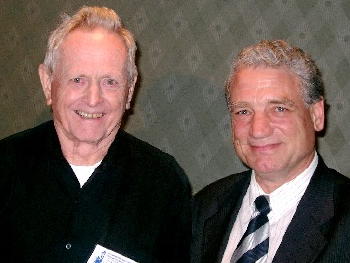
[Hutton Gibson, left, with Frederick Toben, director of the Holocaust-denial Adelaide Institute, based in Australia.]

A little more about Hutton Gibson, Mel's father ...

Turns out that Hutton was one of the featured speakers this past June at the annual conference of The Barnes Review, one of the leading Holocaust-denial publications. (Note their prominent blurb for David Duke's new book, Jewish Supremacism, as well.)

You can click here to listen to his speech, which was about "Declining influence of Roman Catholicism".

The Barnes Review, for those interested, is operated by the renowned anti-Semite Willis Carto, who used to run a conspiracist publication called The Spotlight. Carto was one of the co-founders of the similarly revisionist Institute for Historical Review, though they have feuded loudly since 1993, mostly as a matter of turf.

Besides Carto and Gibson, the conference featured such other renowned anti-Semites as Eustace Mullins, Frederick Toben and Russ Granata; and various other far-right figures, including Edgar Steele, the Aryan Nations' favorite attorney.

Toben is particularly noteworthy, because he and Gibson appear to have had a long relationship. Here is the Adelaide Institute's home page, which features large pictures of both Gibsons (including the one above).

Toben, 56, was born in Germany but left when he was 10 for Australia. He made headlines a couple of years ago for his conviction in Germany for violating that nation's anti-Nazi-propaganda laws. He served seven months of a 10-month sentence. (Here is another news account of that case.)

What does this have to do with Mel Gibson? Are sons responsible for their fathers' views?

No. But Mel Gibson, OTOH, has made plain (as in the Playboy interview I excerpted in my previous post) that Hutton Gibson was an important influence in his beliefs, and he remains so. Moreover, Mel Gibson has never at any time actually distanced himself from his father's beliefs nor repudiated them.

What he has said is this, in attacking the scholars and others who questioned the underpinnings of his forthcoming Christ-crucifixion film, The Passion:
"Neither I nor my film are anti-Semitic. Nor do I hate anyone, certainly not the Jews. They are my friends and associates, both in my work and my social life. Anti-semitism is not only contrary to my personal beliefs, it is also contrary to the core message of my movie."

But one of the core messages of the film, from all indications, is that "the Jews killed Jesus". This includes notably a panel of scholars who reviewed his shooting script and concluded that it not only clearly revives the hoary anti-Semitism of medieval Passion plays, but contrary to its defenders, it deviates from the text of the Scripture in numerous regards.

"Viewers without extensive knowledge of Catholic teaching about interpreting the New Testament will surely leave the theatre with the overriding impression that the bloodthirsty, vengeful and money-hungry Jews had an implacable hatred of Jesus," the scholars reported. They pointed to a number of scenes that are inconsistent with scriptural accounts, including one that shows Jews ordering the cross built in the temple at the direction of Jewish officials. The script, according to at least one member of the group (a leading Catholic theologian) was "one of the more anti-Semitic documents most of us have seen for a long time."

Why does this matter? Well, perhaps because these kinds of beliefs were responsible for the genocide of literally thousands of Jews in Europe and elsewhere.

Consider, for instance, the First Crusade, launched in 1096. Though the primary goal was to liberate Jerusalem from the Muslims, Jews were also a major target. As the armies passed through Europe on their way to the Holy Land, large numbers of Jews were challenged: "Christ-killers, embrace the Cross or die!" 12,000 Jews in the Rhine Valley alone were killed in the first Crusade, an event some writers have referred to as the "first Holocaust." (These attacks on European Jews en route continued for the next eight Crusades.) Meanwhile, when the armies reached Jerusalem in 1099 and broke through the city walls, they slaughtered every inhabitatant they could find, even newborns. Those Jews who survived the initial onslaught were forced into a central synagogue which was then set on fire. Some 6,000 people perished.

Ah, but it's only a movie, you say. Well, sure. The Birth of a Nation was also just a movie. But its release in 1915 inspired, a year later, the rebirth of the Ku Klux Klan and its night riders and a fresh wave of lynch-mob terror.

It's impossible to say, of course, whether The Passion could inspire a similar reaction, or would even be capable of it. The final version of the film has not yet been released, and it may be that Gibson has removed the problematic scenes and cleaned out the anti-Semitic subtexts. But judging from his defensiveness about it, and his refusal to let Jewish leaders view it, the signs are not encouraging.

Moreover, Gibson has defended the film in the context of his father's beliefs. "Whenever you take up a subject like [Christ's crucifixion] it does bring out a lot of enemies," he told Fox News Channel's Bill O'Reilly in January. "I'm a big boy. I can take care of myself, but when you start messing around with my 85-year-old father, watch out."

No one is trying to pick on an 85-year-old man. What they are concerned about, of course, is that this particular man is a vicious anti-Semite. He is also clearly a leading member of the far right. His age is no more relevant than Ayran Nations leader Richard Butler's.

What has been startlingly absent from Gibson's denials so far has been any kind of repudiation of his father's beliefs regarding the Jews and the Holocaust. Merely claiming that one is not anti-Semitic doesn't cut it -- because many, many Holocaust deniers likewise deny that they are anti-Semitic (just as many white supremacists deny that they hate blacks). They only want the truth, they claim -- when in reality, their entire purpose is to bury the truth.

If Gibson's film is so mainstream, so innocent, so purely Catholic and free of anti-Semitic taint, then why are some of its most vociferous defenders the Adelaide Institute and the neo-Nazi National Alliance?

Monday, August 04, 2003

Strange fruit


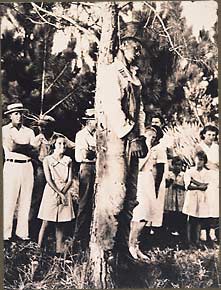
The lynching of Ruben Stacy, July 19, 1935, Fort Lauderdale, Florida, from Without Sanctuary.

Atrios and Paul Musgrave blast away at this bizarre post at The Corner, the National Review's official blog:
KEEPING THINGS IN PERSPECTIVE [Roger Clegg]

An article in The Chronicle of Higher Education this week notes, "On average, 100 African-Americans a year were lynched in the 1890s." That figure is accurate (it may actually be a little low), and it’s horrifying, but let me add two other facts. First, during this time period, the number of European-Americans lynched was about 40 per year. Second, at this rate, it would have taken 60,000 years to get to the 6 million figure that European Jewry suffered during the Third Reich. Something to keep in mind the next time you hear the American South compared to Nazi Germany.

Musgrave has researched the lynching phenomenon extensively and points out, correctly, that these kinds of comparisons are fraught with all kinds of difficulties. I probably don't have as broad a base of data as Musgrave, but I've researched the era too for my forthcoming book on hate crimes, and he is if anything too kind in assessing this nonsense:
Further, Clegg pulls a bit of a sleight-of-hand in his brief but mendacity-packed paragraph. When you put "American South" and "Nazi Germany" in the same sentence, most people would be more likely to hear "Confederate States of America" than the post-Reconstruction South. But lynchings in the modern sense--the illegal hanging often preceded by brutal torture of a black man or woman by a mob--are a post-Civil War phenomenon, part of postbellum Southern attempts to keep "Negroes" in their place. In the 1820s, as I mention in the article, lynching referred to whipping. Post-Civil War lynching was the response of a class that had lost power and was forced to violence nominally outside the law to maintain its influence. (Before the war, of course, slaveowners had legal sanction for private violence.) So what exactly is Clegg trying to say here?

In one statement, therefore, Clegg has managed to misrepresent lynchings in nearly every particular. He doesn't mention, and might not know, that by the late 1890s, more people were lynched in America than were legally executed, something that might put the "only 100" deaths a year in context.

Here's what I can tell you:

Between 1882 and 1942, according to statistics compiled by the Tuskegee Institute, there were 4,713 lynchings in the United States, of which 3,420 involved black victims. Mississippi topped the list, with 520 blacks lynched during that time period, while Georgia was a close second with 480; Texas’ 339 ranked third. And most scholars acknowledge that these numbers probably are well short of the actual total, since many lynchings (particularly in the early years of the phenomenon) were often backwoods affairs that went utterly unrecorded. In that era, it was not at all uncommon for a black man to simply disappear; sometimes his body might wash up in one of the local rivers, and sometimes not.

It is worth noting that during the years leading up to the Civil War, blacks in the South were rarely the victims of lynchings -- since they were viewed as property, it was considered an act of theft to kill someone else’s slave. There was an exception to this: Putting down slave revolts. The fear of black insurrection (and there were a handful of real slave revolts, notably Nat Turner's 1831 Virginia rebellion, in which some sixty whites were killed) was so pervasive among Southerners that any rumor that one might occur could bring swift death to the alleged conspirators, even if, as was often the case, it later turned out there were no such plans. In any event, when lynching did occur in the years before the Civil War, the victims predominantly were whites. Many of these were in the antebellum South, where lynch-mob treatment was often administered to abolitionists and other "meddlers."

If blacks' slave status largely protected them from racial violence before the Civil War, then its abolition also left them remarkably vulnerable to such assaults upon the South’s defeat. This became immediately manifest, during Reconstruction, when black freedmen were subjected to a litany of attacks at the hands of their former owners that went utterly unpunished. As documented by Philip Dray in his definitive study, At the Hands of Persons Unknown: The Lynching of Black America, these crimes turned up in hospital records and field reports from the federal Freedmen's Bureau, all of which described a variety of clubbings, scalpings, mutilations, hangings and even immolations of former slaves, all within the first year after Appomattox.

In 1866, the violence became discernibly more organized with the emergence of the Ku Klux Klan, which originated with a claque of Confederate veterans in Pulaski, Tennessee, and spread like wildfire throughout the South. Initially much of the Klan night riders’ activities were relegated to whippings, a punishment intended to remind the ex-slaves of their former status. But as the assaults on blacks increased, so did the intensity of the violence visited on them, culminating in a steady stream of Klan lynchings between 1868 and 1871 (when the Klan was officially outlawed by the Grant Administration); at least one study puts the number at 20,000 blacks killed by the Klan in that period. In the ensuing years, the violence did little to decline, and in fact worsened, despite the Klan’s official banishment.

Moreover, in addition to the night-riding type of terrorist attacks, mass spectacle lynchings soon appeared. These were ritualistic mob scenes in which prisoners or even men merely suspected of crimes were often torn from the hands of authorities (if not captured beforehand) by large crowds and treated to beatings and torture before being put to death, frequently in the most horrifying fashion possible: people were flayed alive, had their eyes gouged out with corkscrews, and had their bodies mutilated before being doused in oil and burned at the stake. Black men were sometimes forced to eat their own hacked-off genitals. No atrocity was considered too horrible to visit on a black person, and no pain too unimaginable to inflict in the killing. (When whites, by contrast, were lynched, the act almost always was restricted to simple hanging.)

The violence reached a fever pitch in the years 1890-1902, when 1,322 lynchings of blacks (out of 1,785 total lynchings) were recorded at Tuskegee, which translates into an average of over 110 lynchings a year. The trend began to decline afterward, but continued well into the 1930s, leading some historians to refer to the years 1880-1930 as the "lynching period" of American culture.

There are many postcards that recorded these lynchings, because the participants were rather proud of their involvement. This is clear from the postcards themselves, which frequently showed not merely the corpse of the victim but many of the mob members, whose visages ranged from grim to grinning. Sometimes, as in the Lige Daniels case, children were intentionally given front-row views. A lynching postcard from Florida in 1935, of a migrant worker named Rubin Stacy who had allegedly "threatened and frightened a white woman," shows a cluster of young girls gathered round the tree trunk, the oldest of them about 12, with a beatific expression as she gazes on his distorted features and limp body, a few feet away.

Indeed, lynchings seemed to be cause for outright celebration in the community. Residents would dress up to come watch the proceedings, and the crowds of spectators frequently grew into the thousands. Afterwards, memento-seekers would take home parts of the corpse or the rope with which the victim was hung. Sometimes body parts -- knuckles, or genitals, or the like -- would be preserved and put on public display as a warning to would-be black criminals.

That was the purported moral purpose of these demonstrations: Not only to utterly wipe out any black person merely accused of a crimes against whites, but to do it in a fashion intended to warn off future perpetrators. This was reflected in contemporary press accounts, which described the lynchings in almost uniformly laudatory terms, with the victim’s guilt unquestioned, and the mob identified only as "determined men." Not surprisingly, local officials (especially local police forces) not only were complicit in many cases, but they acted in concert to keep the mob leaders anonymous; thousands of coroners’ reports from lynchings merely described the victims’ deaths occurring "at the hands of persons unknown." Lynchings were broadly viewed as simply a crude, but understandable and even necessary, expression of community will. This was particularly true in the South, where blacks were viewed as symbolic of the region’s continuing economic and cultural oppression by the North. As an 1899 editorial in the Newnan, Georgia, Herald and Advertiser explained it: "It would be as easy to check the rise and fall of the ocean’s tide as to stem the wrath of Southern men when the sacredness of our firesides and the virtue of our women are ruthlessly trodden under foot."

Such sexual paranoia was central to the lynching phenomenon. In the years following black emancipation -- during which time a previously tiny class of black criminals became swelled by the ranks of impoverished former slaves -- a vast mythology arose surrounding black men’s supposed voracious lust for white women, a legend for which in truth there was scant evidence, and one that stands in stark contrast to (and perhaps has its psychological roots in) the reality of white men’s longtime sexual domination of black women, particularly during the slavery era. In any event, the omnipresence of the threat of rape of white women by black men came to be almost universally believed by American whites. Likewise, conventional wisdom held that lynchings were a natural response to this threat: "The mob stands today as the most potential bulwark between the women of the South and such a carnival of crime as would infuriate the world and precipitate the annihilation of the Negro race," warned John Temple Graves, editor of the Atlanta Constitution. Such views were common not merely in the South, but among Northerners as well. The New York Herald, for instance, lectured its readers: "[T]he difference between bad citizens who believe in lynch law, and good citizens who abhor lynch law, is largely in the fact that the good citizens live where their wives and daughters are perfectly safe."

The cries of rape, for many whites in both South and North, raised fears not merely of sexual violence but of racial mixing, known commonly as "miscegenation," which was specifically outlawed in some 30 states. White supremacy was not only commonplace, it was in fact the dominant worldview of Americans in the 19th and early 20th centuries; most Caucasians believed they represented Nature’s premier creation (having been informed this by a broad range of social scientists of the period, whose views eventually coalesced into the pseudo-science known as eugenics), and that any "dilution" of those strains represented a gross violation of the natural order. Thus it was not surprising that a number of lynching incidents actually resulted from the discovery of consensual relations between a black man and a white woman.

Underlying the stated fear of black rape, moreover, was a broad fear of economic and cultural domination of white Americans by blacks and various other "outsiders," including Jews. These fears were acute in the South, where blacks became a convenient scapegoat for the mesh of poverty that lingered in the decades following the Civil War. Lynching in fact was frequently inspired not by criminality, but by any signs of economic and social advancement by blacks who, in the view of whites, had become too "uppity."

There were, of course, other components of black suppression: segregation in the schools, disenfranchisement of the black vote, and the attendant Jim Crow laws that were common throughout the South. But lynching was the linchpin in the system, because it was in effect state-supported terrorism whose stated intent was to suppress blacks and other minorities, in no small part by eliminating non-whites as competitors for economic gain. These combined to give lynching a symbolic value as a manifestation of white supremacy. The lynch mob was not merely condoned but in fact celebrated as an expression of the white community’s will to keep African-Americans in their thrall. As a phrase voiced commonly in the South expressed it, lynching was a highly effective means of "keeping the niggers down."

Thus the numbers of deaths produced by the lynching phenomenon only hint at their impact, which broadly affected literally millions of more Americans, effectively keeping them in the thrall of terror that their white neighbors might, with the least provocation, murder them horribly.

Comparing this to the Holocaust, as Clegg did, is not entirely without merit. After all, the lynching era was replete with the same kind of hateful eliminationist rhetoric that became the earmark of Nazism (see, for example, John Temple Graves' intimations about the "annihilation" of blacks). Indeed, as Robert Paxton argues in "The Five Stage of Fascism," the Ku Klux Klan was probably the prototype of the early fascist movement -- and as I've observed previously, Hitler was an admirer of the Klan and wrote once that the Nazi agenda was modeled after the Klan's (though this appeared in the context of propaganda aimed at undermining American opposition to his actions).

However, Clegg's point is 180 degrees removed from the reality. The comparison of the lynching era to Nazism reminds us just how close America came to replicating one of history's great horrors (for that matter, more than a few historians have observed that the treatment of Native Americans in the 1800s had even more striking similarities to the genocide of Jews) -- and moreover, just how important an influence America had on the nightmare that befell Europe. This is not a comparison that would be much comfort to anyone with a conscience.

Sunday, August 03, 2003

When self-certainty becomes self-delusion

A clear picture of the Bush administration's governing style is starting to emerge from inside the halls of power, and it isn't pretty. This is from a recently retired, conservative-Republican high-level Pentagon official:

The Pentagon has some explaining to do
The result of groupthink has been extensively studied in the history of American foreign policy, and it will have a prominent role when the history of the Bush administration is written. Groupthink, in this most recent case leading to invasion and occupation of Iraq, will be found, I believe, to have caused a subversion of constitutional limits on executive power and a co-optation through deceit of a large segment of the Congress.

I am now retired. Shortly before my retirement I was allowed to return to my primary office of assignment, having served in NESA as a desk officer backfill for 10 months. The transfer was something I had sought, but my wish was granted only after I made a particular comment to my superior, in response to my reading of a February Secretary of State cable answering a long list of questions from a Middle Eastern country regarding U.S. planning for the aftermath in Iraq. The answers had been heavily crafted by the Pentagon, and to me, they were remarkably inadequate, given the late stage of the game. I suggested to my boss that if this was as good as it got, some folks on the Pentagon's E-ring may be sitting beside Saddam Hussein in the war crimes tribunals.

In other words: Bush and Co. are operating a large circle-jerk that utterly believes its own bullshit. And that is a very dangerous trait for the people who are supposed to be keeping us secure -- as well as waging a war in our name.

Or, as someone wrote recently:
"In a rarified environment like the White House, I don't think you can afford to surround yourself with people whose temperaments and views are always in synch. The meetings might run on schedule, but easy consensus can lead over time to poor decisions."

Indeed -- and as the record around the events leading up to 9/11 are examined further, the same trend becomes self-evident. Bush couldn't be bothered with international terrorism because Bill Clinton was.

Thursday, July 31, 2003

Bush and the politics of fear

Here's an important assessment of George W. Bush's public speech that ran earlier this month in the Seattle Post-Intelligencer:

Power of presidency resides in language as well as law
Take a closer look at his speeches and public utterances and his political success turns out to be no surprise. It is the predictable result of the intentional use of language to dominate others.

Bush, like many dominant personality types, uses dependency-creating language. He employs language of contempt and intimidation to shame others into submission and desperate admiration.

...

Bush is a master at inducing learned helplessness in the electorate. He uses pessimistic language that creates fear and disables people from feeling they can solve their problems. In his Sept. 20, 2001, speech to Congress on the 9/11 attacks, he chose to increase people's sense of vulnerability: "Americans should not expect one battle, but a lengthy campaign, unlike any other we have ever seen. ... I ask you to live your lives, and hug your children. I know many citizens have fears tonight. ... Be calm and resolute, even in the face of a continuing threat." (Subsequent terror alerts by the FBI, CIA and Department of Homeland Security have maintained and expanded this fear of unknown, sinister enemies.)

Contrast this rhetoric with Franklin Roosevelt's speech delivered the day after the Japanese attack on Pearl Harbor. He said: "No matter how long it may take us to overcome this premeditated invasion, the American people in their righteous might will win through to absolute victory. ... There is no blinking at the fact that our people, our territory and our interests are in grave danger. With confidence in our armed forces with the unbounding determination of our people we will gain the inevitable triumph so help us God." Roosevelt focuses on an optimistic future rather than an ongoing threat to Americans' personal survival.

...

Bush's political opponents are caught in a fantasy that they can win against him simply by proving the superiority of their ideas. However, people do not support Bush for the power of his ideas, but out of the despair and desperation in their hearts. Whenever people are in the grip of a desperate dependency, they won't respond to rational criticisms of the people they are dependent on. They will respond to plausible and forceful statements and alternatives that put the American electorate back in touch with their core optimism. Bush's opponents must combat his dark imagery with hope and restore American vigor and optimism in the coming years.

Got that, Howard Dean?

I've always appreciated Mark Crispin Miller's The Bush Dyslexicon because it makes much the same point: That Bush's supposed mangling of the language masks a fierce, nearly sociopathic contempt for others, and actually reveals a master manipulator at work. But this piece also points out the effect of this manipulation on his audience -- and, moreover, how to hoist the White House occupant upon his own petard.

[A tip o' the Hatlo Hat to Jack Davis for the heads-up.]

Passions aplenty

Patrick Giles writes thoughtfully in response to my post about Mel Gibson:
I just followed a link from Eric Alterman's site to your story on Mel Gibson and THE PASSION. I don't have the original TIMES MAGAZINE story handy, but as I recall the woman quoted with Hutton Gibson in that story was not Mel Gibson's mother, but either Hutton's second wife or a companion. I believe the story states she is a Texan.

This is correct. The ABC News story that followed, which called her his mother (and whose language I matched in my own text), was incorrect.
I also believe Gibson has made it clear his views are not synonymous with his father's. (Although that they are similar in some ways is evident from Gibson's own statements.) (Are sons responsible for their father's opinions?)

Good God, I hope not, since I'd be in serious trouble on that one myself. However, Gibson has made clear (in that Playboy interview and elsewhere) that his father has been a major influence on his thinking, which rather alters the matter of his innocence.

Specifically, Gibson eschews his father's naked anti-Semitism. But he embraces most other aspects of his belief system. This is somewhat akin to the John Birch Society's disavowal of anti-Semitism while embracing anti-Semites' conspiracy theories; instead of a secret cabal of Jewish bankers running the world, you have a secret cabal of "international" bankers (who all just happen to be Jewish) running the world. It only makes one's conspiracism slightly less vicious.
It was interesting, when the TIMES story appeared, to see that brief, general surfacing of dismay over reactionary Catholic splinter groups -- this is an issue Catholics have been worrying about for years. Their groups -- Opus Dei is the most powerful, "the Catholic masons" as a nun who taught religion in my high school used to say (others called it "the Catholic mafia") -- have a real flair for drawing the disaffected to their side, and for gaining footholds in high places. Antonin Scalia is in Opus Dei; Louis Freeh, former head of the FBI, is as well (according to published reports). I suspect a reason Robert Hanssen, the spy recently caught, managed to function undisturbed for so long is that he, too, was said to be in Opus Dei.

Anyway, there is quite a good book on this subject, called THE SMOKE OF SATAN, that is worth seeking out. If nothing else, reading about (or, even worse, meeting) the extremists in the Church gives you a newfound appreciation for the good things our current Pope has done. But that so conservative and totalitarian a Pope can be considered a flaming radical Satanist by Hutton Gibson and his fellows should tell you how frightening these people really are.

Nonetheless, there seems to be a pile-on in process about THE PASSION. Do you really think Gibson's film will get a fair shake when it does appear? Really? How? Devout Catholics are figures of derision in popular culture (in a way, say, conservative Jews aren't--but Muslims are), and this movie, which is (even if it turns out not to be anti-Semitic) going to hit some very fearful, sensitive notes in its audiences, will most likely be attacked and insulted and made fun of no matter how good or bad, incendiary or illuminating, it is. The triteness and near-hysteria of most media coverage on religious issues is mortifying; name-calling seems to be the goal. That every report on the film I've read has oozed sinisterness, for example, is ridiculous: would this be happening if Gibson were making a movie about Cesar Chavez, or Dorothy Day (to cite two other Catholic figures)?

Everything connected to the movie carries a taint. But (for example), what if Gibson is reluctant to show his film to Foxman and the ADL because he feels they have made up their minds about it already? If he showed it, for example, to other Jewish community leaders before he allowed the ADL to see it, would that be that the calculated scurrying of a Jew-hater, or a shrewd move by a man skilled in movie marketing, who knows the movie's going to be attacked by some in the public no matter what its qualities actually are? (LAST TEMPTATION OF CHRIST, a sublime film, is routinely mentioned in press reports as "offensive" when almost nobody who actually saw the film -- I should add the few who managed to see the film when it was in theaters -- found it to be so.)

For all we know, this movie could be an attempt by a Catholic to come to terms with one of the biggest tragedies of Christianity (and world history): its separating from Judaism in the first century after Christ's death and resurrection (when it became clear the majority of Jews were not going to follow their brethren into becoming members of the Jesus movement), and its turning on Judaism for thousands of years, until Pope John XXIII finally made putting a stop to Jew-hating being an option in Catholic life a priority of the Second Vatican Council. (Interestingly, reports of that Council say that then-Cardinal Karol Wotylja -- now the current pontiff -- was
one of the most forceful and insistent speakers in the Cardinals' debate on the resolution.)

We simply don't know who did what in the execution of Jesus in the same way we know that John Wilkes Booth shot President Lincoln or Napoleon was defeated at Waterloo. The Gospels are not historical reports; they were written at different times by different people for different audiences. As decades of word-of-mouth testimonies stemming from eyewitness accounts sped the new religion across the Roman empire, some stories were no doubt created, some true ones told in new ways, and others forgotten only by one or two sects. (The postwar discovery of the NagHammadi texts -- numerous alternative "gospels" filled with Jesus quotes and actions foreign to the four accepted gospels -- suggests how various accounts of Jesus were; that some of the scrolls found at NagHammadi werre used for kindling before their value was realized also demonstrates how much more has been lost.) People constantly fall into this trap, on both sides of the argument, of saying they "know" who was "responsible" for Christ's crucifixion (from Opus Dei members and such on one side to Daniel Jonah Goldhagen, who makes a fool of himself by doing the It-was-all-the-Romans'-fault line in his new book on the Vatican and the
Holocaust, on the other), when the point is not identifying who was responsible so we can be lousy to contemporary people we link to them but that this was an act of sacrifice that was the principal reason the guy was around in the first place. [Nobody ever attacks Christians for being "responsible" for Christ's death, even though His apostles and disciples deserted him when He was captured by the Romans and Judas, and the only people brave enough to stand by the guy until He was dead were a few of his women followers and (maybe) His mother and (an even bigger maybe) John.]

We still don't even know why Jesus was killed. Did that ransacking of the moneylenders in the Temple do it? (doubtful -- the Temple was a big, loud place); or was it simply that He drew an awful lot of crowds at a time when Jerusalem (a troublesome spot for the Romans at any time) was already packed with Jews in town for Passover, and He happened to enter in the manner (humbly, on a mule) and through the city entrance that the sacred scrolls had predicted the Messiah would take to enter and reclaim Jerusalem -- and this scared the temple priests and the Romans? Did the people who put Him to death want Jesus out of the way because they thought He was a troublesome political dissident, or a religious fanatic -- or maybe, really, who He said he was? (If you were running your town, how would YOU deal with a stranger who raised the dead, healed the sick, and made your neighbors not give a damn about you anymore?) At any rate, none of this should ever have had, and still shouldn't have, any impact on the people we live among today.

Whoever conspired to get Jesus arrested, convicted, not pardoned (despite custom), and crucified are long gone; to act out revenge fantasies and prejudices on people who share traits of suspects in the story (how come nobody beats up or denies equal opportunity to Romans?) is simply appalling, and inexcusable.

That this idea is starting, slowly, to sink in is becoming plain (at least in Christian societies); that we still have a long way to go before anti-Semitism is thoroughly discredited -- as is considering a person bigoted simply because he is a member of this or that religion -- is also, unfortunately, obvious. Progress in this area is fitful, and can come in unexpected ways. (My sister, who lives in North Carolina -- the only New Yorker in her little village -- says she was stunned at the locals' reaction to that first network TV telecast of SCHINDLER'S LIST some years ago: very few people had ever learned much about the Holocaust, and they were shaken to see people they had been taught to regard as all-powerful bankers and moguls and such living in poverty, rounded up like cattle and annihilated. A movie I could barely sit through without losing my temper had a powerful, salutary effect on other viewers.)

The urgent question is: how do we discuss all these issues, and cultural products related to them, without resorting to the same non-thinking, susperstition-and-prejudice bound language and actions of our forbears?

I am the last person to feel comfortable defending Gibson -- just for starters, the homophobia in BRAVEHEART and other films is disgraceful -- and some of the publicity shenanigans going on back-stairs on this film seem suspicious, but journalists and critics (and activists) should at least see the film and then offer only informed opinions based on the work at hand and not on the politics and (alleged) prejudices of its maker. Editors should take it as an opportunity to explore (rather than inflame) these still very powerful and pertinent issues. Judging by the coverage of this film so far, I suspect neither recourse will be appearing much when THE PASSION is finally released.

I think Patrick's caution about Gibson's film is well worth heeding. There's no point in criticizing a film we haven't seen yet. And I don't think my previous post did.

Obviously, there is at least a chance that the finished film will be a sincere appraisal of the crucifixion and will try to come to terms with Christianity's alienation from its Jewish origins. That would not, however, be a concern that Gibson himself has ever indicated an interest in. Rather, in interviews, he's talked about people and groups having to take "responsibility" for their actions.

Moreover, at least a few people have in fact obtained the shooting script, and their reports do not indicate that this is even remotely a subtext of The Passion. See, for instance, Paula Fredriksen's report in The New Republic from a scholar who in fact has reviewed the script, and is concerned that it may well promote an anti-Semitic worldview that condemns Jews spiritually for their role in the Crucifixion.

Again, this may not be the finished version. And it will be impossible to accurately assess the film until its release. Nonetheless, the indications prior to its release -- including particularly Gibson's semi-paranoiac defensiveness about its content -- are not encouraging.

Most of the time, debates over the religious content of films come down to a matter of personal belief anyway. And as I've said, Gibson obviously is entitled to his beliefs and his desire to make a film based on them.

However, what is clear is that the runup to the film's release is taking on increasingly political overtones, particularly considering Gibson's screening of the film for various right-wing heavyweights in the punditocracy.

Do I think The Passion will have a fair hearing? No -- but that cuts both ways. His supporters are just as unlikely to fairly consider the charges of anti-Semitism as are his critics to question them. Gibson himself has assured that it will become a political football, destined for a mosh pit in the culture wars.

I would love for a thoughtful assessment of Judaism's relationship to Christianity to proceed from Gibson's film. But when Robert Novak, Laura Ingraham and Katie O'Beirne are going to be weighing in, I despair of any likelihood of that.

Monday, July 28, 2003

The whiff of fascism

I hate to keep sounding like a broken record, but the fascist motifs trickling their way into mainstream Republican politics (which is the focus of the "Rush" essay, of course) are starting to come fast and furious -- at a much faster rate, I'm afraid, than I think most of us anticipated.

I was especially struck by Michelle Goldberg's piece in Salon:

Beautiful young shock troops for Bush

Erickson was followed by Jack Abramoff, a powerful right-wing lobbyist and former College Republican chairman, who exhorted the next generation to fight hard, lest "the ascension of evil, the bad guys, the Bolsheviks, the Democrats return."

That equation -- evil = communist = Democrats -- was nearly axiomatic at the convention. Ann Coulter's latest book, "Treason," which tarred virtually all Democrats as traitors, may have been denounced by conservative intellectuals, but its message has pervaded the party. Gene McDonald, who sold "No Muslims = No Terrorists" bumper stickers at the Conservative Political Action Conference in January, was doing a brisk trade in "Bring Back the Blacklist" T-shirts, mugs and mouse pads. Coulter herself remains wildly popular -- Parker Stephenson, chairman of Ohio College Republicans, calls her "one of my favorite conservative thinkers."

One of the essential traits of fascism, you may recall, is the widespread belief that dissent is treason, "dissent" being anything outside the official party line.
The room filled up again, though, when Warrior, an ex-WWF wrestler who has built a second career as a mascot for the right, took the stage that afternoon. Warrior -- that's his full legal name -- spoke at the Conservative Political Action conference in January, and has been one of the most requested speakers among conservative organizations ever since.

Dressed in a blue pinstriped suit, his long, dirty-blond hair pulled into a ponytail, Warrior explained why he'd left the world of wrestling. "When it became degenerate and perverted," he said, "I dismissed myself from pursuing it as a career anymore."

The speech that followed contained references to thinkers from Socrates to Tom Paine, and perhaps it would require a scholar of the classics to discern its meaning. "America was founded on that primary premise, that America would survive only as long as its people live up to their means," Warrior thundered.

"Knowledge of good and evil is the best fruit on the tree of knowledge."

The conservative movement, he declared solemnly, "needs people ready to actualize the entirety of their human potential."

One message that was clear was a hatred of nuance or ambivalence. To defeat the "pervasive degeneracy, ignorance and destruction of soul" that prevails today, he said, "you must live to judge and be ready to be judged ... extremism in defense of moral behavior is no vice." The saying "there are two sides to every story," he told his audience, "brings your loved ones closer and closer to tyranny and outright annihilation."

"Mankind survives by our leaders," he concluded. "All leaders are warriors. Mankind survives by its warriors. Our Republic will truly survive by them as well."

The notion of a nation under siege by enemies both within and without was nearly universal at the College Republican convention, and gave vehemence to its nationalism. Beneath the patriotic bombast lay two distinct currents: There was religion, that old Reaganite sense of America as the city on the hill, poised to lead the world from darkness. And there was resentment -- toward the whining of minorities, the carping of lesser countries, the life chances the students say are circumscribed by an economy made stagnant by welfare freeloaders, swarming immigration and affirmative action.

Some attendees were driven by spiritual conviction that seamlessly encompassed faith in two messiahs, Jesus and Bush. For the true believers, Bush is a man of wonder-working powers. Jason Cole, a 22-year-old senior at the University of Iowa, grew enamored of Bush when he heard his earnest, simple talk of God during the 1999 presidential campaign. Cole says he has little interest in working in politics beyond the 2004 election. "I do it," he explained simply, "because I love President Bush."

Hoo boy. It's all there -- the love of war and the war aesthetic; the identification with the charismatic leader, and the identification of that leader with a shared religious and political belief system.

Scary.

W in the Desert Quicksand

Check out this excellent new blog:

World in Conflict

It's edited by my old friend Paul deArmond (aka Warbaby), the Bellingham activist who has made a nice little career out of countering right-wing extremists in his neck of the woods with floods of information and well-organized opposition.

Check out especially this post by guest writer Danius Maximus, the pseudonym of a semi-retired political analyst:
Bush in Free Fall

The war in Iraq has proved to be only a temporary and rapidly evaporating help to Bush's political fortunes. The equation of support for war equals support for Bush has already vanished and his standing in the polls is now roughly the same as it was before 9/11. From here on out, Iraq is more likely to generate bad new for Bush than provide support for his presidency. All the same, Bush's political opponents will not benefit from passively waiting for things to get worse.

And Paul chimes in:
The Iraq war is a quagmire that will produce bad news and keep the Bush administration on the defensive indefinitely. Bush may get a bump from occasional good news--the death of Hussein's sons, or maybe, someday, the capture or death of Hussein himself. But the Administration and its supporters are staking too much on the proposition that this would turn the situation around. Indeed, reporter Robert Fisk has argued that the death of Hussein may embolden the opposition to the occupation, since disgruntled Iraqis may conclude that they have little to lose by forcing the Americans out. And make no mistake about it--Iraqis have a good deal to disgruntle them. The persistent sabotage against the power grid and the oil industry is causing relentless suffering and hampering economic recovery, and the Bush Administration has no idea how to solve the problem. There is no reason to believe that attacks on American troops will abate, whether Hussein is dead or alive. The United States clearly does not have an adequate force structure, nor does it have any significant reserves to spare to shore up a deteriorating situation. Equally problematic are administration efforts to recruit other nations to provide troops. The bad news is going to drip drip drip. There is no better in the Iraq situation--there are only varying grades of worse.

The other kind of terrorism

Here's another one that nearly slipped through the cracks ...

Boisean charged in anthrax case: Man faces felony charges for 32 alleged threats

Sandy Kevin Lamont Nanney, 38, is accused of mailing anonymous, threatening letters containing non-toxic powder. He is charged with five felony counts of threatening to use a weapon of mass destruction, and police said Friday that they expect to file 27 additional charges against him — one for each threat he allegedly sent to hospitals, businesses and government offices in Ada and Canyon counties.

The threats forced several offices and businesses to be evacuated in recent weeks and unnecessarily frightened employees, officials said.

When he was arrested and charged Thursday, Nanney admitted to sending the letters, Boise Police Lt. Mike Majors said.

Officers declined to speculate on Nanney´s motives or to disclose the written contents of the letters. “He had a message he wanted to deliver,” said Majors, who would not elaborate.

There is still no indication that this man was acting out of a particular kind of ideology, other than the fact that he wanted to send a "message." Certainly the fact that he moved to Idaho in the recent past indicates he may well be a right-wing extremist, but we don't know that yet.

What we do know is that he clearly had terroristic motives -- and indeed, he effectively terrorized important parts of the community, including hospitals.

Moreover, it is likewise clear that this is a case of "piggybacking" on the terrorism committed in October-November 2001, when an anthrax killer struck the East Coast -- which was itself a clear case of "piggybacking" on the terrorism of Sept. 11.

As I've pointed out numerous times previously, the white-supremacist movement has made it clear it intends to use such "piggyback" terrorism to further its agenda by worsening the public's fear about its security in a post-9/11 world. This kind of "lone wolf" behavior may not always be neo-Nazi- or Patriot-related, but even if it isn't, it fits in neatly with their agenda.

Friday, July 25, 2003

Rush, Newspeak and Fascism for the masses!

[I'm repeating this post -- from July 6 -- because the original post's link is bloggered, and it contains the best quick explanation of the donation for "Rush, Newspeak and Fascism," and I wanted to link to it from the text at the upper left of the blog. I've added a few words, but for regular readers, this is nothing new. Just repair work, as it were.]

Well, after 16-plus ridiculously long posts, numerous letters and a fairly tough rewriting and editing process, it's finally compiled and available in PDF:

Rush, Newspeak and Fascism: An Exegesis

This is, as regular readers well know, the extended essay that appeared here over the course of multiple posts. As promised, I've put it together into a version you can download and read on your computer or print out and read it on the bus, or share it with friends.

I'm asking for a $5 donation (button at the upper left of the home page) with each download, because my bandwidth requirements are undoubtedly going to come back and bite me on this one. Besides, I've always been loath to hand out the tin cup and ask for donations -- I prefer to have something to offer in exchange. So the donation (and donors should feel free to make it more than $5 if they like!) is also an opportunity for Orcinus readers to support independent journalism.

The completed essay is about 40,000 words and 87 pages long. It contains large chunks of new material, and as you'll see, it's been rearranged and edited significantly. I think you'll find it's both more cohesive and more coherent, a little livelier, a little more detailed. Read it onscreen or print it out and share it with your friends. E-mail it around if you like. I'm frankly more interested in having it read than in the donations; I'm mostly just hoping to cover my expenses.

I tussled with what to do with the "Rush" essay for quite awhile. It's long enough to form a short book. But frankly, I remain extremely doubtful about its chances of being published through traditional venues -- a portion of it, after all, began life as a feature for Salon (that would be those sections dealing with Clinton-hate as a venue for coalescing the extremist and mainstream right) that never ran in the magazine; and if Salon wouldn't run it, I can't imagine who would. Let's face it: The material I'm writing about here is considered very explosive, and very sensitive, by mainstream publishers, and very few of them would be willing to back these kinds of ideas.

In previous centuries, when these kinds of ideas floated about, they often found expression through alternative publishing that was distributed through other means and was nonetheless consumed by the public at large. This was mainly the pamphlet, which was the chief means of publication for many of the world's great thinkers, including Tom Paine and Baruch Spinoza.

So I'm following their example with 21st-century means. Think of the 'Rush' essay as a kind of Web pamphleteering -- a way to spread information and ideas without relying on traditional, staid and reluctant publishing houses, including newspapers and Webzines. I already view blogging in general as this kind of alternative medium; and the 'Rush' pamphlet is the next logical step, a way to springboard from blogs and produce something that non-computer users can read too.

Of course, any and all feedback is always appreciated. Later this month, I'm going to start serializing the revamped 'Rush' essay so that it is available in an online version as well.

Finally, a big shout-out and THANKS to Paula at Stonerwitch for her hours of fine work, helping me put the essay together into the PDF form.

Wednesday, July 23, 2003

The forgotten terrorist

Hey, what happened to that anthrax guy anyway?

You know, the one who killed a handful of people and terrorized the nation for the better part of two months?

Yeah, that one. The one the FBI can't seem to nail down.

The case that was a clear case of attempting to piggyback off the terror wrought by the events of Sept. 11. The case no one in the media ever talks about.

At least Dan Thomasson is paying attention:
Another botched investigation?

What is of grave concern here is the vulnerability of Americans to this kind of continued anonymous assault by madmen who seem able to escape detection by the nation's most celebrated law enforcement agency.

Richard Jewell was the wrong guy and when the right one was identified it took forever to catch him.

The Unabomber ultimately was caught by his own brother whose efforts to inform the bureau of his suspicions were summarily dismissed until he hired a lawyer to "drop the dime," as informing is known in street parlance.

All of us would feel more secure if the bureau and the other agencies working on this case were more effective.

It is legitimate to ask how long it takes for the attorney general or the current director of the bureau to consider that an investigation of a particular individual may have run its course.

It is also legitimate to ask when the press will give this case the attention it deserves, if for no other reason than its deep and disturbing implications regarding the proliferation of biological weapons.

Ichiro, Ichiro

Another sign of Ichiro Suzuki's utter coolness:

Why No. 51? I'd originally heard that he wore the number 51 (he wore it in Japan as well) after the Yankees' Bernie Williams, who wears the same number. But Suzuki later told an interviewer (during the 2001 ALCS) it was not true. Later the story cropped up that he kept it in Japan because the number in Japanese sounds similar to his name. But the P-I set us all straight the other day:
The truth is far simpler. Ichiro tells John Hickey, Mariners beat writer for the P-I, that he was a low draft pick and that he was simply handed a uniform bearing #51 in recognition of his lowly status at the start of his career. When Ichiro began to demonstrate his prodigious talents, he was offered a more prestigious number (#7) but declined. He has stayed with #51 ever since.

Integrity is a rare commodity nowadays, especially among the famous.

Creeping fascism

I was on a remote island much of last week and am just now catching up. Certainly worth mentioning was this piece:

A Kind of Fascism Is Replacing Our Democracy
Like previous forms of totalitarianism, the Bush administration boasts a reckless unilateralism that believes the United States can demand unquestioning support, on terms it dictates; ignores treaties and violates international law at will; invades other countries without provocation; and incarcerates persons indefinitely without charging them with a crime or allowing access to counsel.

The drive toward total power can take different forms, as Mussolini's Italy, Hitler's Germany and Stalin's Soviet Union suggest.

The American system is evolving its own form: "inverted totalitarianism." This has no official doctrine of racism or extermination camps but, as described above, it displays similar contempt for restraints.

While the author, Sheldon S. Wolin -- a Princeton professor emeritus -- reaches his conclusions through different avenues, I was gratified that they were essentially the same as those I explored in "Rush, Newspeak and Fascism" -- namely, that fascism remains alive and well and is threatening to re-emerge in strange new American clothing.

[Many thanks to Joel S. for forwarding this.]

Tuesday, July 22, 2003

Mad Max and the Jews

There's a storm brewing in the culture wars, all of it building around Mel Gibson's forthcoming "Passion Play" film, which is bearing all the earmarks of reviving that old tradition's hoary anti-Semitism as well, blaming "the Jews" for Christ's crucifixion.

It's hard to tell exactly what the content will be -- other than the gruesome and graphic depictions of crucifixion -- but it's clear that Gibson is building political chits among the punditry well in advance. See, for instance, today's Lloyd Grove column:

Mel Gibson's Washington Power Play
Yesterday's secret screening at the Motion Picture Association of America included columnists Peggy Noonan, Cal Thomas and Kate O'Beirne; conservative essayist Michael Novak; President Bush's abortive nominee for labor secretary, Linda Chavez; staff director Mark Rodgers of the Senate Republican conference chaired by Sen. Rick Santorum (R-Pa.); former Republican House member Mark Siljander of Michigan; and White House staffer David Kuo, deputy director of the Office of Faith-Based and Community Initiatives.

"I find this sad," said ADL National Director Abraham Foxman, who hasn't been permitted to see the movie. "Here's a man who appeals to the mass audience, but he feels he has to surround himself with a cordon sanitaire of people who back him theologically and maybe ideologically and will stand up and be supportive when the time comes. My request still stands: I would like to see the movie, and if it turns out I was wrong, I'll be the first to say so."

Were it anybody else, the concern might be misplaced. But Gibson -- who has displayed a talent for starring in revenge melodramas over the years, ranging from the first Mad Max to Ransom, Payback, Braveheart and The Patriot -- has made a series of public pronouncements that have been troubling. Some of them are a reflection of Gibson's extremist father, Hutton Gibson.

The issue came into focus this spring when Christopher Noxon of the New York Times wrote a piece titled, "Is the Pope Catholic . . . Enough?" that featured bizarre and outrageous remarks from Gibson, his father and his mother. There was a brief flurry of stories about it that quickly dropped from the radar, notably this ABC report:

Gibson Family Under Fire for Anti-Semitism

Of particular note was the bizarre conspiracy-mongering of Hutton Gibson, accompanied by a full dose of Holocaust denial:
The actor's father, Hutton Gibson, told The New York Times he flatly rejected that the terrorist group led by Usama bin Laden had any role in the attacks on the World Trade Center and the Pentagon Sept. 11.

"Anybody can put out a passenger list," the elder Gibson told The Times.

"So what happened? They were crashed by remote control."

He and the actor's mother, Joye Gibson, also told The Times that the Holocaust was a fabrication manufactured to hide an arrangement between Adolf Hitler and "financiers" to move Jews out of Germany to the Middle East to fight Arabs.

"Go and ask an undertaker or the guy who operates the crematorium what it takes to get rid of a dead body," Hutton Gibson told The Times. "It takes one liter of petrol and 20 minutes. Now six million?"

Said Joye Gibson: "That weren't even that many Jews in all of Europe."

And then there were Gibson's plans for the movie:
The comments from the Gibson family come just after the actor built a church in near Malibu that caters to a revisionist version of Catholocism. According to The Times, the church has a congregation of 70, including the star of such films as "Braveheart" and "Conspiracy Theory."

Mel Gibson, a devout Catholic, is directing and co-wrote an upcoming movie "The Passion," rooted in a theological movement known as Catholic traditionalism that seeks to return the faith to its pre-1962 period, before the Pope issued what is known as Vatican II, a series of proclamations that did away with the notion that Jews were responsible for the crucifixion of Jesus.

Bill Berkowitz addressed the underlying issues further at Working for Change:

Does Mel Gibson have a Jewish problem?

Gibson's theology, writes Christopher Noxon in the New York Times, "is a strain of Catholicism rooted in the dictates of a 16th-century papal council and nurtured by a splinter group of conspiracy-minded Catholics, mystics, monarchists and disaffected conservatives -- including a seminary dropout and rabble-rousing theologist who also happens to be Mel Gibson's father."

In the 1992 El Pais interview, Gibson said that "For 1,950 years [the church] does one thing and then in the 60s, all of a sudden they turn everything inside out and begin to do strange things that go against the rules.

"Everything that had been heresy is no longer heresy, according to the [new] rules. We [Catholics] are being cheated. ... The church has stopped being critical. It has relaxed. I don't believe them, and I have no intention of following their trends. It's the church that has abandoned me, not me who has abandoned it," he said.

Frederick Clarkson, the veteran right-wing researcher and author of "Eternal Hostility: The Struggle Between Theocracy and Democracy" (Common Courage Press) told WorkingForChange in an e-mail that "Traditionalist Catholics describes those who insist on practicing the Latin mass and other features of the church prior to the reforms of Vatican II. Some Traditionalists operate within the Church; others belong to a faction, the Society of Saint Pius X that has been excommunicated en mass for disobedience to the Pope. Its far right views include conspiracy theories that the Catholic Church is controlled by liberals as a result of an ancient conspiracy of Freemasons."

According to thelatinmass.com, a web site that aims "to foster devotion to the Tridentine Latin Mass and traditional forms of Roman Catholic piety, and to propagate the orthodox Faith of the Church," Gibson "attends the Tridentine Mass exclusively."

Also worth noting, but not available online, is a piece by Allan Brown in the Sunday Times of London from May 5, 2002, titled "Braveheart and the Nazis," which included this:
Euan Hague, an academic who has investigated the development of Celtic supremacist ideas in the United States, describes the perception of "a pure white culture where the men are strong and the women dance. For most American followers, Highland games mean having a beer and a laugh with 10,000 other people. But, for some, they can be a way to assert their whiteness".

That the KKK was founded by two emigres from Paisley is embarrassingly well-documented, a matter of historical record dating back to the 1860s.

Far more recent, however, is the passion of the other parties for Celtic racial mysticism; traceable almost entirely, believes historian Tom Devine, to the rise of "Braveheartism" in the mid-1990s, which overnight made William Wallace the new kid on the neo-Nazi block.

As their battles contracted to squabbles over the need for secession from larger states or economic protectionism in the face of rampant immigration, Wallace and his efforts were recast in the extremist mind as a kind of medieval Neighbourhood Watch scheme.

A particular fan was William Pierce, the "Farm Belt Fuhrer" and head of the National Alliance in America, whose novel of white supremacism, The Turner Diaries, was published under the pseudonym (or nom de guerre) of Andrew Macdonald in tribute to his Scots ancestry. He considered Braveheart a hymn to the need for personal sacrifice in the name of one's cause.

"That, I think, is one of the strongest things in our people and is something we need to call on and recognise, and for more people to be willing to do whatever is necessary, as William Wallace was," Pierce said.

In Italy, meanwhile, Umberto Bossi was heading the fascist Northern League in its attempt to secede from the southern half of the country. By displaying a Braveheart poster on his office wall he was equating the struggle of Wallace with his own against Roman dominance. These days, the newly-respectable Bossi serves in Berlusconi's government and his fondness for nebulous ideas of racial integrity has given way to a more naked aggression against all forms of economic immigration.

"Bossi has no real international outlook and no real passion for Scottish politics," says Joe Farrell of Strathclyde University. "He capitalised on something that was in the air at a certain time. The downside is that the follow-up is so tainted with racism."

Finally, there's the interview Gibson gave in Playboy, July 1995 (Vol. 42 ; No. 7 ; Pg. 51). Some excerpts:
PLAYBOY: What does he [Hutton Gibson] have to do with the Alliance for Catholic Tradition, which one magazine called "an extreme conservative Catholic splinter group"?

GIBSON: He started it. Some people say it's extreme, but it emphasizes what the institution was and where it's going. Everything he was taught to believe was taken from him in the Sixties with this renewal Vatican Council. The whole institution became unrecognizable to him, so he writes about it.

.........

PLAYBOY: Do you believe in Darwin's theory of evolution or that God created man in his image?

GIBSON: The latter.

PLAYBOY: So you can't accept that we descended from monkeys and apes?

GIBSON: No, I think it's bullshit. If it isn't, why are they still around? How come apes aren't people yet? It's a nice theory, but I can't swallow it. There's a big credibility gap. The carbon dating thing that tells you how long something's been around, how accurate is that, really? I've got one of Darwin's books at home and some of that stuff is pretty damn funny. Some of his stuff is true, like that the giraffe has a long neck so it can reach the leaves. But I just don't think you can swallow the whole piece.

PLAYBOY: We take it that you're not particularly broad-minded when it comes to issues such as celibacy, abortion, birth control --

GIBSON: People always focus on stuff like that. Those aren't issues. Those are unquestionable. You don't even argue those points.

PLAYBOY: You don't?

GIBSON: No.

PLAYBOY: What about allowing women to be priests?

GIBSON: No.

PLAYBOY: Why not?

GIBSON: I'll get kicked around for saying it, but men and women are just different. They're not equal. The same way that you and I are not equal.

PLAYBOY: That's true. You have more money.

GIBSON: You might be more intelligent, or you might have a bigger dick. Whatever it is, nobody's equal. And men and women are not equal. I have tremendous respect for women. I love them. I don't know why they want to step down. Women in my family are the center of things. An good things emanate from them. The guys usually mess up.

PLAYBOY: That's quite a generalization.

GIBSON: Women are just different. Their sensibilities are different.

PLAYBOY: Any examples?

GIBSON: I had a female business partner once. Didn't work.

PLAYBOY: Why not?

GIBSON: She was a cunt.

PLAYBOY: And the feminists dare to put you down!

GIBSON: Feminists don't like me, and I don't like them. I don't get their point. I don't know why feminists have it out for me, but that's their problem, not mine.

.................

PLAYBOY: How do you feel about Bill Clinton?

GIBSON: He's a low-level opportunist. Somebody's telling him what to do.

PLAYBOY: Who?

GIBSON: The guy who's in charge isn't going to be the front man, ever. If I were going to be calling the shots I wouldn't make an appearance. Would you? You'd end up losing your head. It happens all the time. All those monarchs. Ifhe's the leader, he's getting shafted. What's keeping him in there? Why would you stay for that kind of abuse? Except that he has to stay for some reason. He was meant to be the president 30 years ago, if you ask me.

PLAYBOY: He was just 18 then.

GIBSON: Somebody knew then that he would be president now.

PLAYBOY: You really believe that?

GIBSON: I really believe that. He was a Rhodes scholar, right? Just like Bob Hawke. Do you know what a Rhodes scholar is? Cecil Rhodes established the Rhodes scholarship for those young men and women who want to strive for a new world order. Have you heard that before? George Bush? CIA? Really, it's Marxism, but it just doesn't want to call itself that. Karl had the right idea, but he was too forward about saying what it was. Get power but don't admit to it. Do it by stealth. There's a whole trend of Rhodes scholars who will be politicians around the world.

PLAYBOY: This certainly sounds like a paranoid sense of world history. You must be quite an assassination buff.

GIBSON: Oh, fuck. A lot of those guys pulled a boner. There's something to do with the Federal Reserve that Lincoln did, Kennedy did and Reagan tried. I can't remember what it was, my dad told me about it. Everyone who did this particular thing that would have fixed the economy got undone. Anyway, I'll end up dead if I keep talking shit.

Gibson, of course, is entitled to his beliefs, as is any extremist. But it is troubling when they are given such a powerful forum as the national distribution the film no doubt will receive.

And it is even more troubling when they are given the imprimatur of high-profile mainstream conservatives. It is another clear sign of the increasing tolerance for radicalism among the ranks of conservatives.

Monday, July 21, 2003

Bush Doctrine über alles

It is becoming increasingly apparent that the Bush administration abused and misused intelligence for political purposes in selling the nation a bill of goods on the invasion of Iraq. Many of Bush's critics, however, are making the mistake of misjudging Bush's motives for going to war with Iraq.

Bush misled the nation not merely because he hoped to use the war for political fodder in the 2002 and 2004 elections, though that certainly figured into the equation. Neither was it merely because Iraq is such a significant source of oil, though that too probably was an added incentive.

No, this war was above all about ideology.

Specifically, it was about establishing once and for all the Bush Doctrine, otherwise known as "The National Security Strategy of the United States of America." Even a cursory read reveals that its emphasis on pre-emptive actions against threatening nations, all in the name of spreading "democracy," is a major departure. A more careful read reveals that the nation, under Bush's guidance, has taken the leap from semi-realistic self-promotion to outright self-delusion in its basic view of international relations.

If you want to understand the wellsprings of this ideology, look no farther than the neo-conservative Project for a New American Century, which not only endorsed it -- it obviously was its chief architect and promoter, the font of wisdom for such folk as Donald Rumsfeld.

Particularly chilling is the PNAC description of the Bush Doctrine:
Promoting liberal democratic principles. "No nation is exempt" from the "non-negotiable demands" of liberty, law and justice. Because the United States has a "greater objective" -- a greater purpose -- in the world, Bush sees in the war not just danger but an opportunity to spread American political principles, especially into the Muslim world.

(And let's not forget the chance to spread American religious principles as well.)

The reality, of course, as Jonathan Raban recently pointed out, is that western-style democracy may be meaningless or even destructive in the context of Muslim culture. Bush's presumption that democracy is a panacea for every nation is backed only by blind faith and ideological blinkers.

And then there's this:
The Bush Doctrine is also notable for what it is not. It is not Clintonian multilateralism; the president did not appeal to the United Nations, profess faith in arms control, or raise hopes for any “peace process.” Nor is it the balance-of-power realism favored by his father. It is, rather, a reassertion that lasting peace and security is to be won and preserved by asserting both U.S. military strength and American political principles.

Nor is it, for that matter, any of the multilateral approaches to foreign policy that have characterized the American approach since World War II. PNAC's arrogant unilateralism actually is, as Todd Gitlin has pointed out, a radical restructuring of American foreign policy, and possibly forever transforming our place in the world -- and not necessarily for the better.

A terrific resource on this point is PNAC.info: Exposing the Project for the New American Century (who I'm adding to my blogroll).

Remember: This crowd had a plan in place for attacking Iraq the day Bush was elected (see especially the Philly Daily News' excellent report, Invading Iraq not a new idea for Bush clique: 4 years before 9/11, plan was set). It set that plan into motion on Sept. 12, 2001.

And there was no way the radical ideologues who now control American foreign policy were ever going to let it get derailed. Intelligence to the contrary be damned.

This is not as obviously crass a motivation as, say, trying to swing an election with a war, or helping out the president's oil-industry pals. But it is in many ways much more deeply troubling.