Thursday, January 04, 2007

Return to Manzanar

-- Sara Robinson

NPS photo

Manazar looked almost exactly like this photo last Wednesday when I drove by it: cold, clear, with the snowy eastern escarpment of the Sierra rising up behind it in the winter light. The California Highway Patrol had cleared the road of commercial traffic between Olancha and Independence after two Crystal Geyser trailer trucks on their way to the bottling plant had blown over in the 60-mile-per-hour winds thrashing the southern end of the valley, so there were just a few cars straggling along the empty highway. The kids in the back seat were still talking about the trucks as we approached Independence, northbound toward home and a brief visit with my dad's side of the family.

"Look to the right, kids. There's usually a herd of tule elk grazing in that field out there. The lake is Haiwee Reservoir -- haiwee is the Northern Paiute word for small bird, and a popular name for Paiute girls. The water's going into the aqueduct, headed for LA."

They nodded and looked. Being perhaps more sensible than us, the elk had taken note of the wind and cold and made themselves scarce. I gave up on them, and returned my eyes to the highway. It was then that I noticed a new landmark ahead on the left -- one I'd never seen in nearly half a century of driving this familiar stretch of US 395.

NPS photo

Against the clouds, there was a tower. The shape was familiar: I'd seen it in photographs all my life, at least since the first Saturday I took my shiny new driver's license and my mom's car, drove down to the county's rare book library in Independence, and asked to check out the Manzanar High School yearbooks -- one of which featured this stark black-and-white image on its cover. It was a guard tower made of fresh pine boards, maybe 30 feet high, imposing and unmistakeable at the edge of the road. Nearby, a new sign (a perfect copy of the 1942 original, right down to its oddly Nazi-looking font) marked the Manzanar Relocation Center, National Parks Service. As we approached the tower, I saw a dozen cars parked in a new, paved parking lot. After sixty years of decay and denial, Manzanar is returning to life.

NPS photo

I used to visit Manzanar a lot in my twenties, when I lived in LA and made this trip home half a dozen times a year. Back in the 70s and 80s, there wasn't much to see. The stone pagoda-shaped gatehouse was abandoned and falling to ruin. The big auditorium -- the only remaining building of consequence -- was being used by the county as a heavy equipment storage barn. Other than that, the only evidence from the road that this had once been a makeshift city of 10,000 incarcerated people were the trees.

Those who remember Manzanar back in the day often like to talk about the gardens. Dropped into the stark high-desert xeriscape, fending off 120-degree summers and zero-degree winters in board-and-tar-paper huts, faced with a severe lack of water and winds like the ones we were braving today, you’d think that landscaping would be about the last thing the inhabitants would think to attempt.

But "Manzanar" means "apple orchard" in Spanish. After the local Paiutes had been marched off to Fort Tejon in the early 1900s (the first crime committed by the federal government on this land, but far from the last), it had been the name of an apple farming community that had been founded there in 1910. Those farms were forcibly run out of business in the 1920s when -- with federal collusion -- the Los Angeles Department of Water and Power (LADWP) diverted the valley's water to the city. (If you want the details, rent Chinatown.).

So the site came dotted with mature apple trees, which formed the basis of much more extensive gardens. Many of the internees were nurserymen and farmers, who whiled away the next three and a half years planting trees and flowers, building hardscape, and turning some of Manzanar's sandy, windy avenues into gracious outdoor parks.

The huts are long gone, removed by the government along with the barbed wire fences, the guard towers, and all other evidence of the crime immediately after the war. But for decades afterward, even whizzing by the site at highway speeds, you could see that in that particular square mile of sage and rabbit brush, there were trees -- and they all stood in straight lines, marking the interstices between the barracks where the streets of Manzanar had once been. And if you stopped for half an hour, and took the time to tromp through the brush (watching carefully for rattlesnakes and horny toads, as Owens Valley kids learn young to do), the desert landscape would reveal more treasures.

One day, I found a large round concrete planter, which had once probably held a spreading tree with flowers and rock arrangements underneath. (Manzanar is built on an alluvial outflow where, at the end of the last Ice Age, a dying glacier dropped the load of salt-and-pepper granite boulders it had carried down through the centuries from the Sierra crest. The smooth, round ice-washed stones are a landscaping and construction staple all over the valley.) This work, unlike most anything else at the site, was signed and dated: "Built by Wada and crew, June 19, 1942." ("Wada," it turns out, was Bunyamon Wada,whose family still lives in San Diego.)


photo by Ligaya & George Wada

Not far away stood the stone foundation and hearth of the superintendent's house. Once in a while, the sand underfoot gives way to a square of concrete; or a small circle of stones marks where a campfire once burned or a tree once grew. Off to one side is the cemetery, the final resting place of fifteen souls who didn't live long enough to see the gates open and their families return home. (One hundred and fifty Manzanar residents died during the internment -- including two killed in a riot -- but all except for these 15 chose to be cremated.)


photo by Tory Amorello

For five decades between 1945 and 1995, these little remnants in the gravel are all that remained of Manzanar. Nobody in America wanted to remember what had happened here. Even in my own family, my stepfather -- who was 13 the summer his Japanese neighbors abandoned their homes in East LA's Boyle Heights, took up temporary quarters in the horse stalls at the nearby Santa Anita racetrack, and were ultimately transported here -- can still faithfully recite the rationalizations. There were spies among them. There were Japanese subs in Long Beach harbor. It was for their own good -- and most of them, knowing this, went voluntarily. And besides, life in the camps wasn't that bad: a lot of them drove their own cars up to Independence, and they could leave the camp and drive into town to buy groceries any time they pleased.

This misinformation has, unfortunately, persisted through the years; and some of it is still an article of faith among Owens Valley's working classes. Many of the locals in Lone Pine and Independence worked in or for the camps; many of the old families, impoverished since the DWP ran them off their farms, were all too grateful for the jobs. The shame of their complicity breeds an ambivalence that feeds the silence, though occasionally it breaks through: The drug store in Lone Pine, which boasts the largest newsstand in town, still carries Lillian Baker's revisionist accounts of what happened at Manzanar right alongside the geology maps and the field guides to local flora and fauna. Anyone looking for an accurate history will not find it there.

The internees themselves didn't seem eager to break that long silence, either. When it was over, they went home -- some angry and defeated, some simply determined to get on with rebuilding their lives. Their children and grandchildren, a few of whom I went to college with, learned early not to ask too much about those years: in most families, it was something Mom and Dad resolutely refused to discuss. (Jeanne Wakatsuki described this attitude as shikata ga nai -- "It must be done," or in American English: Suck it up, and get on with your life.) Manzanar, under the administrative aegis of the LADWP, began to vanish into the dust of the valley floor; and for the next 25 years, the internment itself simply faded from the national memory, lingering on as a paragraph in an eighth-grade textbook, and a two-minute lecture on civil rights in a high school civics class.

That began to change in the early 70s, when Jeanne Wakatsuki Houston -- one of my stepfather's Boyle Heights neighbors before the war -- chronicled her childhood in the camp in her book, Farewell to Manzanar. In 1976, it was turned into a TV mini-series, which was hailed as the Japanese-Americans' version of Roots (which had also been aired that year). The book and TV series broke the silence at last. In most families, it was the internees' grandchildren who started asking the questions, doing the research, and making trips out to Manzanar, Tule Lake, Poston, and other relocation sites across the west. Ansel Adams' and Dorothea Lange's photographs of the camp were pulled out of the vaults, and put on exhibit; I remember going to the first public showing of of camp photographer Toyo Miyatake's work in San Francisco in the late 80s. Starting in 1969, vanloads of young Japanese-Americans started pulling up in front of that dilapidated pagoda gatehouse on annual pilgrimages, trying to imagine the place as their elders had known it. Political pressure to right the wrongs mounted: in 1988, President Ronald Reagan signed a reparations bill that gave $20,000 and a signed presidential apology letter to every internee, or his or her survivors and heirs.

The effort to create a physical monument to the Japanese internment took far longer. Of the ten camps scattered throughout the west, Manzanar was the most logical candidate: there were restorable structures left on the site (which was generally not true elsewhere); and at four hours from LA and Las Vegas, five from San Diego, and seven from San Francisco, it was far and away easiest site for would-be visitors to get to. The State of California kicked off the process in 1972 by naming Manzanar a state historical landmark. The Department of the Interior added National Landmark designation in 1985. Somewhere in the years that followed, the county stopped parking its road equipment in the auditorium, a broad parking lot was graded, and the pagoda gatehouse got cleaned up. In 1992, on the fiftieth anniversary of Executive Order 9066 (which ordered the internment), Congress named it a National Historic Site. The restored entrance sign went up not long after the site's remaining 813 acres were turned over the National Park Service in 1997.

After that, the changes started coming faster; the Manzanar I saw last week is now a completely different place. The auditorium has been completely restored, and turned into a museum and research center. The front fence has been rebuilt, along with the new tower -- a faithful reproduction of one of the eight that originally surrounded the camp. In the next couple years, plans call for a re-created barracks -- and park, with ponds and gardens, like the ones that the internees built in their efforts to make hell seem more like paradise.

Manzanar, which was was vanishing both from both the landscape and our common memory during my childhood, is evolving into a major asset for the tourist economy of the southern Owens Valley -- and the heart of a wide-ranging new conversation about equality, justice, and freedom in America. These days, the annual pilgrimage draws thousands to the Manzanar cemetery on the last Saturday in April every year, where internees, their children and grandchildren, and friends and locals all turn out for a day of remembrance and education. Many hundreds camp out over the weekend, in order to experience the harsh landscape first-hand. (Though late April, with its blooming wildflowers and mild weather, is usually a spectacular time of year for a visit.) The dead are honored in Christian and Buddhist ceremonies; and internees gather in the great auditorium they built to tell the tales one more time -- this time in front of cameras, so they will not be forgotten. Local schoolchildren no longer get lies or silence, but rather frequent field trips. The county museum in Independence is expanding its own collections, and hosts regular internment-related events aimed at locals and visitors alike.

My little valley, lauded by no less worthies as John Muir and Ansel Adams as one of the most beautiful spots in America, is dotted with the wreckage of a century of government and corporate malfeasance: a handful of Native Americans shoved onto postage-stamp reservations, the epic story of farms seized and water stolen so a few families could get rich and LA could sprawl, unabated mining pollution, sundown towns and meth labs -- and the guilty memories of the region's main contribution to the war. Manzanar is the first monument to this last wrong; it is holy ground now, not just to the ancestors of those who were interned there, but also to all Americans who care about what happens when we allow fear to undermine our commitment to our best principles and ideals.

It's appalling that, even as we are busily re-creating this famous concentration camp into a place of national memory and healing, we are also busily constructing yet more camps under yet more wretched conditions -- thus dooming our own grandchildren to someday build monuments of memory to our own failures, in order to disinherit themselves of our shame. Anyone who thinks interning illegal immigrants in faraway places is a good idea should be brought to Manzanar, preferably in the baking heat of summer or the fierce winds of winter, and made to stand in the shadow of that tower. It is not a place we can, or should, continue to pass by.

Manzanar Relocation Center is located on US Highway 395, six miles south of Independence, CA. A wide variety of information on the camp -- including its history, current facilities and programs, and trip planning assistance -- is on the excellent Manzanar National Historic Site website.

Wednesday, January 03, 2007

Euphemisms


[Photo of Manzanar Relocation Center by Dorothea Lange, 1943.]

The elderly gentleman had a stack of file folders full of clippings he had obviously brought with him, and he thumbed through these on the table where he had taken a seat, waiting for my talk.

His clippings caught my eye, as did the man himself. The talk I was giving was to promote my most recent book, Strawberry Days: How Internment Destroyed a Japanese American Community, at the historic old Panama Hotel in Seattle's International District (this was in July of 2005). Most of the other patrons that evening were Japanese Americans; a number of them were elderly Nisei who had been interned at "relocation centers" during World War II, and some of these were people I had interviewed in the process of writing the book.

This man, however, was an elderly Caucasian, and it was apparent shortly after finishing my brief talk, when I opened up the floor to questions, that he was there to defend the internment as justifiable. He was obviously familiar with the arguments offered by such historical revisionists as Lillian Baker, David Bowman, and Michelle Malkin, and proceeded to attack the book's thesis.

I was somewhat prepared for this, and gladly answered his questions with what I think were accurate and succinct responses that refuted his underlying assumptions (like most revisionists, he continually ignored the distinction between American citizens and Japanese nationals). I could see that the rest of the audience was growing agitated by his persistent willingness to assume their guilt as potential traitors, the same assumption that resulted in their incarceration.

He finally stepped in it, however, when he attacked my consistent use of the term "concentration camps" to describe the so-called ten "relocation centers" that held some 120,000 internees. (There has been some ongoing discussion of exactly what terminology to use to describe the Japanese American "internment"; currently, most historians favor using "internment camps" to describe the military camps that held a number of "enemy aliens" swept up in Justice Department arrests shortly after the outbreak of war, while the "relocation centers" -- a bureaucratic euphemism concocted by architects of the evacuation -- are more accurately described either in terms of the incarceration they represented, either as "prison camps" or "concentration camps.")

"You shouldn't call them concentration camps," he said. "We weren't starving people to death or murdering them in gas chambers. Calling them that makes people think that's what went on there."

Well, I responded, what you're describing is properly called a death camp. "Concentration camp" was a term created, during the Boer War, to describe the mass prison camps the British erected to incarcerate Boer families. It has been used consistently afterward to describe these kinds of arrangements, including by both Franklin Roosevelt and Attorney General Biddle, in official documents, to describe the Japanese American camps.

It was at this point, however, that several of the elderly internees in the audience nearly came out of their seats; they were shaking with anger.

"If that wasn't a concentration camp, I'd sure like to know what the hell it was," said one of them, a Nisei man. "I was there. I saw the armed guards in the watchtowers, the barbed wire."

"That barbed wire was just a line in the sagebrush," the skeptic retorted. "You could have walked over it at any time."

"Yes, and we'd have been shot the moment we tried," said the Nisei. "You have no idea what we had to endure. You weren't there."

Other audience members jumped in, demanding to know how he could distort the reality of the camp experience of their own memories, especially as he tried to depict the camps essentially as vacation camps with golfing and nice schools. I let them argue for awhile -- it was more of a verbal dogpile, actually -- and then finally stepped in verbally and moved on to other questions and questioners. My elderly interlocutor, looking nonplussed, packed up his clippings and left.

The whole incident underscored for me the way we let invented terminologies disguise and distort the reality of the things we do. It's an easy way of softening it -- because we just don't like looking that reality in the face.

We slaughter thousands of innocent Iraqi citizens in the process of dislodging their dictator, and call it "collateral damage." We stand by as thousands more are slaughtered in the name of ancient hatreds, in places like Rwanda and Darfur, and we name it "ethnic cleansing."

We've done it throughout history. We stole land from the native Americans and murdered them relentlessly, and called it "Manifest Destiny." We lynched thousands of African Americans under the rubric of an imagined threat of rape and called it "defending white womanhood," while driving out thousands more from our communities and calling it "defending our way of life."

And we put 120,000 people behind barbed wire under armed guard and called it a "relocation center." Nowadays, we have a new name for it: the "family detention center" or, better still, the utterly neutral "residential center."

Last week, Pachacutec at Firedoglake raised a few eyebrows by referring to the privately operated "detention centers" where Immigration and Cusgtoms Enforcement has been incarcerating thousands of illegal immigrants, including their citizen children, as "concentration camps." Some of his commenters particularly objected, like my elderly inquisitor, to using a term that they, at least, associated primarily with Nazis and the Holocaust.

But as Pach noted in follow-up (with an assist from Lambert at Correntewire), "concentration camp" is a perfectly applicable term here, for largely the same reasons I gave at the talk. Considering the information that is starting to come to light from at least the largest of these centers, there are reasons to believe that conditions at these privately run "detention centers" are even worse than those at the Japanese American camps.

And Digby's keen eye, as always, observes that there's a disturbing trend emerging here -- namely, that thousands of people, including citizens, are being spirited away to these centers, and so far life within them has a real totalitarian quality to it. (Meanwhile, Latina Lista has been leading the way in reporting on this.)

The chief reports involve the largest of the family detention centers: the T. Don Hutto Residential Center in Taylor, Texas, which is operated by Corrections Corporation of America. A piece in the Austin Statesman reported on concerns raised by local activists:
On Thursday, members of Texans United for Families, a coalition of community, civil rights and immigrant rights groups, sought to highlight that difference. Starting with a press conference at the state Capitol, then embarking on a 35-mile walk to the Taylor jail, they charged that detaining families and children under what they described as poor conditions is immoral and violates human rights.

"Housing families in for-profit prisons not only calls to question our moral values and our respect for human rights, but it is also a waste of taxpayer money," said Luissana Santibanez, a 25-year-old University of Texas student and an organizer with Grassroots Leadership, which works to stop the expansion of the private prison industry.

The Taylor jail began holding immigrant families this summer under a contract with the federal Immigration and Customs Enforcement agency. It is owned and operated by Corrections Corporation of America. Williamson County receives $1 per day for each inmate held there. A spokesman for the company referred questions to Immigration and Customs Enforcement's San Antonio office.

... Organizers of Thursday's press conference and walk said the Taylor jail houses about 400 people, including about 200 children who are held with their parents. They said children receive one hour of education -- English instruction -- and one hour of recreation per day, usually indoors.

It should be noted that, at the Japanese American relocation centers, the War Relocation Authority provided full schooling facilities for children in the camps. Recreation was also readily available, usually in the form of baseball, which in the summertime was played almost endlessly.
Frances Valdez, an attorney with the Immigration Clinic at the University of Texas School of Law who has visited clients at the facility, said detainees have reported receiving substandard medical care and becoming ill from food served at the jail.

"A lot of children are losing weight. People suffer from severe headaches," Valdez said. "I think there's a lot of psychological issues going on. Most of these people are asylum seekers, so they've already suffered severe trauma in their country." She said immigrants are not given psychological treatment.

Valdez said children wear jail uniforms when they are big enough to fit in them, and all wear name tags. "Even a baby client had a name tag," she said. For instruction, children are divided into groups, 12 and under and 13 and above.

In the DailyKos diary by on this matter, a commenter provided the text of an e-mail from flamenco guitarist Teye, who has become involved in raising the appropriate concern over these facilities, which he describes thus:
I have been to the Hutto Residential Center in Taylor Texas and can testify that it does not look like their publicity picture. The publicity picture looks almost nice: the lobby of an East European hotel maybe? The reality looks like an updated version of a concentration camp, replete with razor wire, double fence with gravel covered death zone between them. It looks like a place where you would stick grave criminals, not children.

Teye also passed along a letter from Dallas attorney John Wheat Gibson, who is representing a number of clients inside the walls at the Hutto "residential center", writing to the Austin reporter who covered the Hutto story:
Dear Mr. Castillo:

Whoever told you the people imprisoned in Taylor, Texas entered the country illegally lied to you. I have seven clients now imprisoned since November 3 at the T. Don Hutto prison, and every one of them entered the U.S. legally with a visa issued by the United States government.

Furthermore, there is no reason for the imprisonment of these children except as victims of a Michael Chertoff publicity stunt. In midnight raids on November 3 the Department of Homeland Stupidity took these children, who were enrolled in school, from their homes, with their parents and imprisoned them.

The sole purpose of the raids, political propaganda, was apparent from a DHS press release which characterized the victims as "fugitives" and "criminals." In fact, none of the families I know of were either fugitives or criminals. The two families I represent had conscientiously kept the DHS informed of their current residential addresses.

The purpose of the publicity stunt was to make the ignorant Fox-News brainwashed masses believe that 1) the Muslims among us are our enemies but 2) the DHS is protecting us, and therefore 3) we should not mind shredding the Constitution.

In fact, there was no legitimate reason for the raids at all. The two families I represent had been ordered deported, but had never received the customary notice to report for deportation. If they had, they would have worked out through their attorneys arrangements with the government for the children to finish the school year and then to depart at their own expense.

Now, this is a letter from a defense attorney and its accuracy may be a matter of interpretation. But it seems evident, not merely from this case but a number of similar anecdotes -- including the arrests of a number of legal immigrants -- that many of the current wave of immigration detentions are occurring under circumstances that are questionable at best. These include several instances of clear-cut racial profiling.

On top of the horrendous conditions and the inappropriate arrests, it's becoming clear that not only is the system failing to work as it should, there is a real lack of accountability, in no small part due to the fact that the government is handing off this work to private corporations, who are simply not accountable to the public. A Statesman editorial observes:
The facilities also are living testimony to a broken system for adjudicating immigration cases. There are 215 federal immigration judges serving in 53 immigration courts across the country. Last year, they handled more than 350,000 specific matters, including 270,000 individual cases.

The backlog is so strained that U.S. Attorney General Alberto Gonzalez, the grandson of Mexican immigrants, noted: "The department and the federal courts are straining under the weight of an immigration litigation system that is broken. Under the current system, criminal aliens generally receive more opportunities for judicial review of their removal orders than noncriminal aliens."

In short, illegal immigrants who commit crimes get speedier legal attention than these children, who have done nothing wrong other than follow their parents.

... Hard information on the program and the private prison is difficult to come by. The company running the prison refers questions to the immigration office, and the immigration office has had little to say about the situation.

The lack of accountability begins with the Department of Homeland Security, which appears to consider itself immune from such picayune nuisances as both public inquiry and even the courts. A Denver Post story reveals that ICE agents ignored a court order in transporting some of its detainees to Texas:
About 75 people detained during a raid at a Greeley meatpacking plant last week are returning to Colorado after federal agents transported them against a judge's order to a Texas immigration jail, according to the union representing the plant's workers.

U.S. District Court Judge John Kane signed an order Wednesday that prohibited federal agents from sending detainees in the raid out of state.

"If a federal judge ordered me to do something, I would do it," said Dave Minshall, a spokesman for the United Food and Commercial Workers Local 7. "I have no idea why ICE felt they were exempt from this order."

Also, the union filed suit charging that some of those taken in the raid were illegally detained, jailed and interrogated.

Most of the detainees returning to Colorado are immigrants from countries other than Mexico, such as El Salvador and Guatemala, Minshall said.

It's clear that Homeland Security is gearing up for more detentions, though the matter of having enough manpower to arrest illegal immigrants and transfer them to detention facilities is already starting to stress DHS officials, who are currently preparing a hiring spree to deal with the workload. The push to increase detentions has even resulted in a mini-scandal at DHS, with bureaucrats caught making an illegal funds transfer from ICE to Customs and Border Protection for the work of transporting detainees. And a new facility in Raymondville, Texas, opened this summer, designed to hold eventually some 2,000 illegal immigrants.

However, in the past year, reports Jonathan Marino at Government Executive, arrests have actually been flat, which could rule out the need for those Halliburton detention centers reportedly waiting in the wings:
Immigration enforcement officials indicated Monday they might not need to implement a contingency contract to create additional jail beds because immigration-related arrests dropped during fiscal 2006.

As of March, Customs and Border Patrol arrests stood at a five-year high. But following President Bush's call for beefed-up border security in May, apprehensions dropped. Immigration officials speculated that increased enforcement efforts may have led to a decline in attempted border crossings.

Overall, arrests were down 8 percent from fiscal 2005 to fiscal 2006, from about 1.2 million to 1.1 million. The 2006 figure represents a three-year low.

Julie Myers, the head of U.S. Immigration and Customs Enforcement, told reporters after a press conference Monday that as long as arrests continue to decline, the agency will not need to create more spaces in detention centers.

Still, Myers said space is limited and the agency needs to be "making sure we're using it as efficiently as possible." Currently, Halliburton subsidiary KBR has a contingency contract to build detention centers that -- if implemented -- would be worth $385 million.

It's also worth noting what Marino reports regarding the nature of that KBR contract, which supports my contention that much of the initial paranoia regarding these camps was largely unwarranted:
In an e-mail message to Government Executive, ICE Press Secretary Dean Boyd said the KBR contract "has absolutely nothing to do with immigrant detentions on the Southwest border. It is a contingency contract that has existed for years, pre-dates ICE altogether, and is only designed as a contingency for mass-migration emergencies such as a potential mass-migration from Cuba or Haiti to South Florida. There have never been any plans to activate the contingency contract to handle the routine flow of migrants across the Southwest border." Boyd said the agency is continuing to seek out additional detention space through contracts with state and local correctional institutions and the creation of new detention facilities.

This latter effort, however, is so far obtaining mixed results, mainly because state and local facilities are already bulging. In Minnesota, for example, Ramsey County officials have already decided not to take any more immigration detainees. The same response is cropping up elsewhere as well.

The KBR contract, in reality, represents a bigger problem: the expansion of mass detention facilities, including those like Hutto designed to house families, is an ominous development in a country where authoritarianism, fed by fearfulness, is increasingly rearing its head -- especially when, as in these cases, there are profits involved for corporations like Halliburton or CCA. It's not the kind of America, I think, any of us wants to see again -- an America where, in a fit of pique, we deprived thousands of their rights and treated them like animals.

As I noted earlier:
The problem, though, is that these kinds of facilities are so open to abuse -- that is, they're quite readily converted to other purposes, as some immigrant advocates observe later in the [New York Times] piece:

Advocates for immigrants said they feared that the new contract was another indication that the government planned to expand the detention of illegal immigrants, including those seeking asylum.

"It's pretty obvious that the intent of the government is to detain more and more people and to expedite their removal," said Cheryl Little, executive director of the Florida Immigrant Advocacy Center in Miami.


Nor is that the only potential area of abuse. These facilities also have a history of being used to deprive citizens of their civil liberties, embodied in the World War II internment camps. Some of the camps' most vociferous progressive critics point this out as well:

For those who follow covert government operations abroad and at home, the contract evoked ominous memories of Oliver North's controversial Rex-84 "readiness exercise" in 1984. This called for the Federal Emergency Management Agency (FEMA) to round up and detain 400,000 imaginary "refugees," in the context of "uncontrolled population movements" over the Mexican border into the United States. North's activities raised civil liberties concerns in both Congress and the Justice Department. The concerns persist.

"Almost certainly this is preparation for a roundup after the next 9/11 for Mid-Easterners, Muslims and possibly dissenters," says Daniel Ellsberg, a former military analyst who in 1971 released the Pentagon Papers, the U.S. military's account of its activities in Vietnam. "They've already done this on a smaller scale, with the 'special registration' detentions of immigrant men from Muslim countries, and with Guantanamo."


Considering these latter points, Ellsberg's fears are at least not groundless, and may prove prophetic.

So it seems almost inevitable that we will be seeing more of these mass detention centers, particularly as Bush's announced plan to arrest more illegal immigrants takes full effect. The almost certain byproduct will be that we will see more and more of them designed to accommodate whole families, including citizen children, and the record so far indicates that the conditions will once again be those of a concentration camp.

The law of unintended consequences is arising here. In their determination to arrest illegal immigrants, the government -- acting, in the end, at the behest of nativist agitators -- is potentially putting itself in the business of splitting up families, since many of these illegal immigrants are the parents of citizen children. So to avoid that outcome, the only solution available is to incarcerate those children alongside their parents. The end result: concentration camps -- euphemistically designated "family detention centers" as part of an effort to "secure our borders."

It's not as though our history has not warned us. This was the same predicament the government found itself in back in 1942, as it was contemplating the evacuation of potential "enemy aliens" from the Pacific Coast -- namely, the resident population of Japanese immigrants and Japanese Americans. The first-generation Issei immigrants -- who had been barred by law from naturalizing -- were the only class they could actually designate "enemy aliens" and evacuate with some impunity. But most of these Issei had Nisei children and even Sansei grandchildren -- all of whom were American citizens -- living in their care, and evacuating them would leave these families without providers.

Page Smith, in Democracy On Trial: The Japanese American Evacuation and Relocation in World War II, describes the debate among the various persons involved in the decision [pp. 112-113]:
There was an air verging on desperation that hung over the numerous discussions of what was to be done. Various alternatives to "mass evacuation" were debated endlessly. James Rowe [Attorney General Francis Biddle's assistant], and Edward Ennis, head of the Justice Department's Alien Enemy Control Division, suggested that the Kibei [American citizen Nisei who had been educated in Japan] be expatriated to Japan on the grounds that having been educated in Japan and having, in most instances, that troublesome dual citizenship, it was reasonable to assume that most of them were loyal to the Emperor. But the principal obstacle to such a far-reaching and expensive plan was constitutional rather than practical. They were, after all, U.S. citizens and there would doubtlessly be unsurmountable legal problems in any plan for expatriation. To ship some nine thousand Nisei back to Japan under wartime conditions would present staggering logistical problems. [Lt. Col. Karl] Bendetsen and [Provost Marshal General Allen] Gullion [the chief co-architects of the internment] and discussed the notion of repatriating the Issei, who numbered some forty thousand, but that seemed even more impractical. An alternative that was debated by Bendetsen and Gullion (and doubtlessly many others) was simply evacuating the Issei. But that would mean, inevitably breaking up families. Where were the Issei to go in any event?

In the end, the government settled on what seemed the simplest approach: mass evacuation of all persons of Japanese descent, citizen or otherwise. Of the 70,000 or so Nisei who were incarcerated, some 40,000 of them were minor children.

It's important to understand that the internment of Japanese Americans was not the result of a nefarious design by racist schemers within the government, but was the natural outcome of a belief bereft of either humanity or truth -- that is, that all Japanese Americans were potential traitors -- and fueled by a heedless hysteria, working its way through the bureaucracy. The government more fell into the internment episode of World War II than it was driven there.

We're in the process of falling into the same mistake -- regardless of whatever euphemisms we devise to disguise it.


[Cross-posted at Firedoglake.]

Tuesday, January 02, 2007

Eliminationism in America: V

[Continuing a ten-part series.]

Parts I, II, III and IV.

Part V: 'Nits Make Lice'


For much of their early history on the American continent, white Europeans saw the Enemy as being Wilderness: the implacable, alien, deadly swamp whose subjugation it was their mission to impose.

The European conception of wilderness which white immigrants brought to the Americas was complex and shaded, but it was ultimately rooted, as I discussed in Part II, in a worldview that placed Europe and Christian civilization at the center of the world, the source of civilization and light. The wilderness was the embodiment of sinfulness and evil -- and so were its inhabitants. And their elimination was an essential component of the conquest.

This was true not merely of the human inhabitants, but its animals as well. Threatening creatures -- cougars, bears and wolves especially -- were hunted to near-extinction. Even wild food sources such as salmon were wantonly harvested and their habitat destroyed, especially as dams were erected on every river on the Eastern Seaboard they inhabited. Stocks were not only depleted but intentionally wasted.

Lt. Campbell Hardy, an officer of the Royal Artillery in New Brunswick, observed the mentality in action in Nova Scotia in 1837, where once-plentiful salmon stocks were already plummeting:
"The spirit of wanton extermination is rife; and it has been well remarked, it really seems as though the man would be loudly applauded who was discovered to have killed the last salmon."

Perhaps even more symbolic was the fate of the grizzly bear, which at one time ruled both the Plains and the mountain ranges of the open West. But between 1850 and 1920, grizzlies were systematically and ruthlessly exterminated everywhere humans came into contact with them, effectively eliminated from 95 percent of their traditional range.

The same was true of the native peoples who dwelt in this wilderness. It was common for colonists to view the wilderness as capable of overwhelming civilized men, even from within, turning them into "savages" and "wild men," while the people who had lived there for centuries were commonly viewed as no less than vile beasts themselves.

This was not uniformly the case, of course. There were white Europeans who believed fully in the Indians' humanity. Some of them even defended them as cultural equals, though not many. Even among the natives' defenders, it was not uncommon, while acknowledging that they were intelligent humans with souls, to still consider them savages whose redeemability was an open question.

One of these, as it happened, was the most renowned Indian fighter, a Civil War hero named George Armstrong Custer, who in his bestselling 1872 book, My Life on the Plains, described as "erroneous" the view "which regards the Indian as a creature possessing the human form but divested of all other attributes of humanity," but also observed:
We see him as he is, and, so far as all knowledge goes, as he ever has been, a savage in every sense of the word ... one whose cruel and ferocious nature far exceeds that of any wild beast of the desert.

Nonetheless, the prevailing view was that as "savages" they were indistinguishable from beasts. This is reflected in the 1850 Census, which found that there were 19,553,068 white people living in the United States, along with a "free colored population" of 434,495 and 3,204,313 slaves. It also observed that "the Mestizo is the issue of the Indian and the Negro, and has all the disabilities of the mulatto." But nowhere was there an accounting of the native American in that Census, nor in any succeeding Census until 1890, which found that there were 325,464 Indians remaining in the United States and its territories. Until then they hadn't counted. Ten years later, there were only 266,760.

So the actual population numbers of the Indian population in 1850 are guesses at best, though the guesses run to as high as a million and a half people. What we do know is that in that year, fully a generation after the Indian Removal Act, well over half of the land that would eventually constitute the lower 48 states was considered Indian Territory, the vast wilderness officially designated the "permanent Indian frontier." Within 30 years, it was all but gone.

You can see this clearly in the following graphic, taken from The Native Americans:


Whatever sympathy some humanitarian whites may have had for the natives, they were utterly ineffectual in stopping the wave of murderous bigotry that swept away all their good intentions along with the Indians themselves, fueled by the prevailing view of Indians that equated them with the beasts they encountered in this wilderness.

These encounters increased, of course, because the "permanent Indian frontier" turned out to be a very flexible concept indeed. As the Americans' thirst for land and for gold grew, so did the borders of the frontier shift ever westward, consumed by treaties that often were mere ruses for outright land theft. A promise made to an Indian was innately nonbinding. The murder of an Indian was considered, if not a non-event, cause for celebration; but any retaliatory murder of whites provoked indiscriminate slaughter and justified the genocide of entire peoples.

Missionaries were often the forerunners of this push westward, establishing trails and outposts that became way stations and provided a kind of social foundation for the pioneer travelers. Most of them were well-meaning humanitarians, but like Custer, they had little to the lowest regard for native culture, and indeed were intent on overthrowing it in the process of Christianizing them. Their view of the value of their charges' souls often depended on their willingness to submit to the missionaries' personal dictates.

These included characters like Henry Spalding, missionary to the Nez Perces who eventually took to whipping and beating his converts. His friends, Marcus and Narcissa Whitman, were similarly high-handed, and their clumsy mishandling of relations with the local Cayuses resulted in the notorious Whitman Massacre of 1847, committed by a small band of angry Cayuses who blamed the Whitmans for the smallpox epidemic that had ravaged their tribe.

That in turn, as Alvin Josephy detailed in his landmark text The Nez Perce and the Opening of the Northwest, provoked a wildly disproportionate response from the newly arriving whites who now claimed these lands as their territory. The Cayuses were stripped utterly of all their lands and dispossessed; and in ensuing years, the remaining Northwest tribes systematically stripped of their lands as well, most often through intentionally provoked wars and resulting treaties that were themselves later intentionally broken.

Fresh on the missionaries' heels were waves of settlers, many of them in search of free land, others trying to strike it rich by finding gold. The Oregon Trail and California Trail were especially popular after the discovery of gold in California in 1848.

Fairly typical of the settlers' views were those voiced by Robert A. Anderson, a California rancher who lived in northern California in the 1860s. Like most of them, he equated the "savages" with the wild beasts they also encountered. Theodora Kroeber describes him in her account of the Yana people in Ishi: In Two Worlds:
He matched wits and physical prowess with Indians and grizzlies alike; both, in his opinion, "infested" the region and should be cleared out. He and Good, Anderson says, used to argue at length about how the clearing out was to be done. Good was for leaving the women and children alone; Anderson believed that immolation was the only effective way to be rid of Indians, and grizzlies too, no doubt.

Anderson, together with his longtime companion Hiram Good, organized a systematic program of extermination of the Yanas from their traditional lands in 1863-65. Some bands of the Yana, finding their traditional food sources being wiped out by invading settlers, had attacked whites in force in 1862, and had been committing lesser depredations, including the murders of several ranchers and their wives and children.

The ranchers in response, led by Anderson and Good, who had become expert trackers, embarked on a program of complete extermination, built on a paid bounty for Yana scalps that were then obtained by self-proclaimed "guards" who were essentially local riffraff hired to hunt down and kill any Yana they could find. Kroeber describes this campaign in some detail in Ishi [pp. 74-77]:
[I]t was the murder of two women, Mrs. Dirsch and Mrs. Allen August, 1864, somewhere in the vicinity of Millville and Balls Ferry, which triggered the unwontedly concentrated and bloody activity of Anderson and Good's men among the Yana.

In a space of less than five months, between August and December, 1864, three quarters of the remaining task of extermination of the Yana was accomplished. To this end two fully armed companies of guards combined the ridges, streams, and meadowlands from Deer Creek in the south to Montgomery Creek in the north. One of Waterman's informants recalled the year 1866, but this date was from oral memory fifty years later. The 1864 date has the confirmation of Jeremiah Curtin whose account is detailed and circumstantial as far as it goes, and was gathered and written down only twenty years after the events it describes ...

Curtin's account has to do with those Central and Northern Yana who were by then on a wide and exposed front vis a vis white settlers, and who, whether willingly and freely or not were in fact working for white ranchers and drawing pay for their work. Many of them lived on the ranches where they worked, sometimes in the ranch house itself as domestics, or in near-by bunk houses if they were field workers or were the old people occasionally attached affectionally and familially to younger workers.

Curtin estimated from the figures given him that in January, 1864, there some three thousand of these Yana, counting the women, the old, and the children, and that by the end of the same year their massacre was complete except for the remnants of families or bands, or for single individuals. ...

Curtin's account of the massacres agrees with Waterman's composite story obtained between 1911 and 1914 from old timers ... In both, the murder of the same two women is alleged as the inciting cause; both mention the organization of a second company of guards; Waterman notes that the organization meeting was again held at Pentz's ranch; both say that no effort was made to fix guilt for the murders, and that extermination was the objective. Curtin tells more about the guards below the leader level. They were, he says, a miscellany of the foot-loose, the semicriminal, the hangers-on of saloons and bunk houses. Anyone who wanted to come along was taken, so that among the ragtag of both companies drunkenness, looting, and violence for the sake of violence obtained and were tolerated. His account emphasizes the wantonness of the killings and the opposition of most of the ranchers to it.

The guards stole and sometimes literally tore children and half-grown girls from the arms of their white friends or employers, murdering them in view of anyone who was present except when enough men were at home and heavily enough armed to beat them off. "We must kill them big and little," one of the guards is quoted as saying, "nits will be lice." Curtin recounts some unpleasantly specific details of these encounters. They are of this sort: three Yana men were murdered out of hand while at work in a hay field belonging to a rancher who regularly employed them but who was not at home at the time. His pregnant wife could do nothing to save the Indians, but when the guards came to the house to get their wives the rancher's wife threw herself in front of the three women. The opposition even at its most rash hesitated to get three further victims at the cost of manhandling a white woman. Later, the rancher and his wife managed somehow to secrete the three women in a place of safety; how they did it or where they took them they never told.

... Sadism entered into the violence also. There was one young Yana woman, unusually popular with the white people who knew and employed her, who was dragged by force out of the white man's home where she lived. Her old aunt and uncle who were there with her were also taken, and the three of them pumped full of bullet holes on the spot. Curtin's informant had counted eleven bullet holes in the breast of the young woman. The man who killed her, and who was well "likkered up," was not satisfied. "I don't think that little squaw is dead yet," he is reported as saying. To make sure, he smashed in her skull with his revolver.

The record piles up -- an Indian woman and her baby killed here, three women at another place, twenty Yana of both sexes in the settlement of Cottonwood, and three hundred who were attending an autumn harvest festival at the head of Oak Run. Curtin's informants estimated the number of surviving Yana of pure and mixed blood to be about fifty persons by the time the avenging parties were through with their work in December.

The extermination continued unabated until the last surviving bands were tracked down and massacred. The culmination, as Kroeber details (pp. 84-85], occurred late in 1864:
Neither Robert Anderson, Hiram Good, nor any other of the guards participated in the final mass massacre of Yahi. A party of four vaqueros, J.J. Bogart, Scott Williams, and Norman Kingsley, were camped at Wild Horse Corral engaged in a roundup of cattle from the Yana hills. One morning toward the end of the roundup they came on a trail of blood. Guessing that it was a wounded steer, they followed the blood trail which led them in the direction of upper Mill Creek. They found a broken arrow and, a little beyond, the remains of the carcass of a steer. The hunters who had killed the steer had been too pressed to skin it in their usual fashion, and had instead hurriedly hacked off chunks of meat, as much as they could carry, and thrown the rest into the brush to be retrieved no doubt if there was opportunity later.

Having found this much, the vaqueros went back to their own camp, but the next day, with dogs this time, they picked up the trail again and followed it into Mill Creek and upstream to a large cave. In this remote and seemingly safe spot were gathered more than thirty Yahi including young children and babies, well supplied with food, even to fresh and dried meat. They were helpless against the four armed men who forthwith killed them all. Norman Kingsley, as he explained afterwards, changed guns during the slaughter, exchanging his .56-caliber Spencer rifle for a .38 caliber Smith and Wesson revolver, because the rifle "tore them up so bad," particularly the babies.

This pattern repeated itself almost endlessly. Rather than even endure contact with "savages" they fully expected to turn against them and murder them, the settlers moving westward in the end always chose to act preemptively and slaughter Indians as they found them. This was particularly the case wherever gold entered into the picture.

And always, this spasm of eliminationist violence was preceded by eliminationist rhetoric. Before there was action, there was talk. And the talk not only rationalized the violence that proceeded, but actually had the function of creating permission for it.

The same year the Yana were exterminated, settlers in Colorado, where gold had been discovered in 1858, embarked on a similar program. In this case, the tribes against whom they were arrayed, particularly the Cheyenne and Sioux, were considerably larger and more warlike than the Yana. Thus the conflicts with whites were even more inevitable, and again, the pattern repeated: depredations by whites provoked violent, often murderous retaliation from Indians, which in turn sparked wanton slaughter of any Indian in the vicinity.

The Rocky Mountain News in Denver led the campaign to wipe out local Indians, editorializing in March 1863: "They are a dissolute, vagabondish, brutal, and ungrateful race, and ought to be wiped from the face of the earth." After a series of skirmishes and killings, the News, in August 1864 proclaimed that August 1864 settlers and troops must "go for them, their lodges, squaws and all."

Enter John Chivington, a Methodist minister and self-proclaimed Indian hater, who helped Colorado Gov. John Evans organize a "volunteer militia" constituted once again of "concerned citizens" whose characters were formed more by saloons than by churches. As Dee Brown notes in Bury My Heart at Wounded Knee, Chivington made a public speech in Denver while organizing this militia in which he "advocated the killing and scalping of all Indians, even infants: 'Nits make lice!' he declared."

With his volunteer army in place, Chivington set out "on the warpath," as he put it, ordering his men: "Kill all the Indians you come across." When Indians attempted to negotiate, he was implacable, saying that he was not instructed to make peace, but only war.

When Cheyenne chief Black Kettle's peaceful band (which included some Arapahoes) traveled through Colorado en route to their new reservation in Oklahoma, they reported to Army officials at Fort Lyon, intent on avoiding conflict. Encamped at a site along a stream called Sand Creek, Black Kettle himself traveled to the fort in mid-November in hopes of securing their safe passage. The fort's new commander, Major Scott J. Anthony, met with Black Kettle in what appeared to be a friendly exchange.

As Brown describes it, "Several officers who were present at the meeting between Black Kettle and Anthony testified afterward that Anthony assured the Cheyennes that if they returned to their camp at Sand Creek they would be under the protection of Fort Lyon."

Whether Anthony was aware of Chivington's intentions or not -- and the evidence suggests he was -- his assurance had the effect of making Black Kettle's band sitting ducks. So certain were they of their security that they did not even set out watchmen to guard the camp at night.

Geoffrey Ward, writing in The West, describes what happened next:
Chivington and some 700 volunteers arrived at Fort Lyon on November 26, 1864, eager for a fight before their hundred-day term of enlistment ran out. Some officers protested that to attack the peaceable encampment would betray the army's pledge of safety. "Damn any man that sympathized with Indians," Chivington said. "I have come to kill Indians and believe it right and honorable to use any means under God's heaven ..."

At dawn on November 29, 1864, Chivington and seven hundred men, many of them full of whiskey they had swallowed to keep them warm during the icy all-night ride, reached the edge of Black Kettle's sleeping camp. "Kill and scalp all," Chivington told his men, "big and little; nits make lice." His men needed little encouragement.

One of William Bent's sons, Robert, was riding with them, commandeered against his will to show the way to the Cheyenne camp. Three of Bent's other children -- Charles, Julia, and George -- were staying in it. George Bent watched the soldiers come:
From down the creek a large body of troops was advancing at a rapid trot ... more soldiers could be seen making for the Indian pony herds to the south of the camp; in the camps themselves all was confusion and noise -- men, women, and children rushing out of the lodges partly dressed; women and children screaming at the sight of the troops; men running back into the lodges for their arms ... Black Kettle had a large American flag tied to the end of a long lodgepole and was standing in front of his lodge, holding the pole, with the flag fluttering in the gray light of the winter dawn ...

All the time Black Kettle kept calling out not to be frightened; that the camp was under protection and there was no danger.

Robert Bent was watching it too:
I saw the American flag waving and heard Black Kettle tell the Indians to stand around the flag, and they were huddled -- men, women, and children. This was when we were within fifty yards of the Indians. I also saw a white flag raised. These flags were in so conspicuous a position that they must have been seen ... I think there were six hundred Indians in all ... [T]he rest of the men were away from camp hunting ...

The volunteers began firing into the lodges. Warriors did all they could to defend their families. "I never saw more bravery displayed by any set of people on the face of the earth than by these Indians," a regular soldier recalled. "They would charge on the whole company singly, detemined to kill someone before being killed themselves ... We, of course, took no prisoners."

"After the firing," Robert Bent remembered,
the warriors put the squaws and children together, and surrounded them to protect them. I saw five squaws under a bank for shelter. When the troops came up to them they ran out and showed their persons to let the soldiers know they were squaws and begged for mercy, but the soldiers shot them all. I saw one squaw lying on the bank whose leg had been broken by a shell; a soldier came up to her with a drawn saber; she raised her arm to protect herself, when he struck, breaking her arm; she rolled over and raised her other arm, when he struck, breaking it, and then he left her without killing her. There seemed to be indisriminate slaughter of men, women and children. There were some thirty or forty squaws collected in a hole for protection; they sent out a little girl about six years old with a white flag on a stick; she had not proceeded a few steps when she was shot and killed. All the squaws in that hole were killed. ...

"In going over the battleground the next day," a regular army lieutenant testified later,
I did not see a body of a man, women, or child but was scalped, and in many instances their bodies were mutilated in the most horrible manner. ... I heard one man say that he had cut out a woman's private parts and had them for exhibition on a stick; I heard another say that he had cut the fingers off an Indian to get the rings on his hand; according to the best of my knowledge and belief these atrocities that were committed were with the knowledge of J.M. Chivington, and I do not know of his taking any measures to prevent them; I heard of one instance of a child a few months old being thrown in a feedbox of a wagon, and after being carried some distance left on the ground to perish; I also heard numerous instances in which white men had cut out the private parts of females and stretched them over the saddle-bows and wore them over their hats while riding in ranks.

Chivington and his men returned to Denver in triumph, claiming to have killed five hundred warriors -- instead of ninety-eight women and children and a handful of mostly old men. The Rocky Mountain News pronounced it a "brilliant feat of arms." "All did nobly," Chivington said, and one evening during intermission at the Denver opera house, one hundred Cheyenne scalps were put on display while the orchestra played patriotic airs and the audience stood to applaud the men who had taken them.

As word of these atrocities got out, there was a perhaps predictable outcry from white Americans with some vestige of human decency; but their outrage, as always, had no effect. The killers were downright gleeful about their "victory." David E. Stannard, in American Holocaust: The Conquest of the New World, notes that the Rocky Mountain News declared that "Cheyenne scalps are getting as thick here now as toads in Egypt. Everybody has got one and is anxious to get another to send east."

Still, there was an outcry in Congress, and a Senate report eventually declared Chivington's "battle" what it really was: "a foul and dastardly massacre which would have disgraced the veriest savage among those who were the victims of his cruelty." As Stannard notes [p. 134]:
One of them, a senator who visited the site of the massacre and "picked up the skulls of infants whose milk-teeth had not yet been shed," later reported that the concerned men of Congress had decided to confront Colorado's governor and Colonel Chivington openly on the matter, and so assembled their committee and the invited general public in the Denver Opera House. During the course of discussion and debate, someone raised a question: Would it be best, henceforward, to try to "civilize" the Indians or simply to exterminate them? Whereupon, the senator wrote in a letter to a friend, "there suddenly arose such a shout as is never heard unless upon some battlefield -- a shout almost loud enough to raise the roof of the opera house -- 'EXTERMINATE THEM! EXTERMINATE THEM!' "

The committee, apparently, was impressed. Nothing was ever done to Chivington, who took his fame and exploits on the road as an after-dinner speaker. After all, as President Theodore Roosevelt said later, the Sand Creek massacre was "as righteous and beneficial a deed as ever took place on the frontier."

Trusting the word of such men was obviously a foolhardy proposition, but the Indians had little choice if they chose not to fight. As Black Kettle had found, making peace and trusting the word of white men was a mistake with broadly fatal consequences.

Incredibly, Black Kettle managed to survive the Sand Creek massacre, and his wife managed to survive nine gunshot wounds. But four years later, in 1868, they did not manage to survive their encounter with General Custer.

It was Custer's first venture out West, serving under General Phil Sheridan, who was leading a campaign to battle Cheyenne depredations in Kansas. Some of the warriors had come from Black Kettle's band. After orders were made for all non-hostile Indians to move to a designated area along the Washita River, Black Kettle moved his camp there, hoping to be designated a friendly band.

Anxious to avoid a repeat of Sand Creek, the chief had traveled to Fort Cobb to seek the protection of the army under the command of Gen. William B. Hazen; Hazen, according to Brown, "assured Black Kettle that if his delegation would return to their villages and keep their young men there, they would not be attacked."

Black Kettle returned to his camp on the evening of November 26. The next morning, Custer's troops attacked, in what came to be known as the Battle of the Washita.

James Welch, in Killing Custer [p. 62], describes the massacre that ensued:
The "battle" in the village was short, barely fifteen minutes. The soldiers drove the people from their lodges basefoot and half naked, shooting them in the open. Many of the warriors managed to reach the treees, where they began to return fire; a few of them escaped, but after a couple of hours, the firing ceased and 103 Cheyennes lay dead in the snow and mud. Custer reported that they were fighting men, but others said that ninety-two of them were women, children, and old people. Black Kettle, the sixty-seven-year-old leader of the band, and his wife, Medicine Woman Later, who had survived nine gunshot wounds at the Massacre of Sand Creek four years before, had been shot in the back as they attempted to cross the Lodge Pole or Washita River. Their bodies, trampled and covered with mud, were found in the shallow water by the survivors.

In Montana, 200 Piegans were massacred in a similar manner in 1870 in the so-called "Battle of Marias River," in which soldiers once again descended upon an unsuspecting camp comprising mostly women and children, the warriors once again away at the hunting grounds, and fired upon them mercilessly.

The massacre was widely reviled in the eastern press (the Chicago Tribune called it "the most disgraceful butchery in the annals of our dealings with the Indians") while the local press widely celebrated it for its "salutary effect on the other tribes."

This effect included an eagerness on the part of most Indians to attempt to make peace, often in the form of abject surrender. But this only invited more contempt from whites, which was often voiced as a wish to simply exterminate.

After the Washita massacre, as Brown describes [p. 166], many of the warring tribes completely submitted to Sheridan. His response became famous:
Yellow Bear of the Arapahos also agreed to bring his people to Fort Cobb. A few days later, Tosawi brought in the first band of Comanches to surrender. When he was presented to Sheridan, Tosawi's eyes brightened. He spoke his own name and added two words of broken English. "Tosawi, good Indian," he said.

It was then that General Sheridan uttered the immortal words: "The only good Indians I ever saw were dead." Lieutenant Charles Nordstrom, who was present, remembered the words and passed them on, until in time they were honed into an American aphorism: The only good Indian is a dead Indian.

This implacable racial hatred, combined with their dim view of the Indians' intelligence and skill at battle, led to further tragedies for both sides. George Armstrong Custer, who returned to Indian wars in 1874 after gold was discovered in the Black Hills of the Dakotas, also happened to believe -- given his experience in such "battles" as the Washita massacre -- that Indians could not withstand a charging cavalry and would retreat under such an attack every time. So it was with such hubris that, in 1876, he charged the largest encampment in the history of the Plains Indians -- over a thousand Indians -- with a force of about 600 men, including his own detachment of about 200, in what was to be the most famous of all the Indian battles, the Little Bighorn. Custer and his men were entirely wiped out.

But the defeat only further inflamed the whites, who over the course of the next year tracked down and defeated or captured nearly all of the Indians who had been involved in the battle, including the chiefs Sitting Bull and Crazy Horse.

However, trying to accommodate the whites, as Black Kettle and many others had found, was no guarantee of safety. Even the most famous peacekeeper among the Indian chiefs, Chief Joseph of the Nez Perce, whose tribe had aided Lewis and Clark and who had a long history of cooperation with whites, found himself on the wrong end of settlers' ambitions. In 1877, they found themselves at war with the U.S. Army, and Joseph led his band of some 800 Nez Perce on a remarkable retreat that nearly succeeded before they were caught just short of the Canadian border.

The last of the Indian wars, the Sheepeater War of 1879, was scarcely even a skirmish, and arose under the sketchiest of circumstances. Having seen the profits that came to the Oregon towns of Lagrande and Baker City for having hosted the Army's campaign in the Nez Perce war, a number of ambitious merchants in the newly opened Yankee Fork mining district in central Idaho decided an Indian war might help them prosper as well. So when a group of Chinese miners -- whose presence was widely hated by whites anyway -- were found massacred, it was initially blamed on the Sheepeaters (though it was later established the killings were by whites, not Indians), which became a pretext for calling in the Cavalry. The ensuing chase over the rugged mountains of the Middle Fork of the Salmon River proved so exhausting that the Army nearly gave up before it finally located a ragtag band of Indians they then took prisoner. The commanders declared victory and packed for home.

The coup de grace, as it were, was finally delivered some 11 years later. The mounting misery of the scattered remnants of tribes produced among them a last, dying spate of messianic movements that produced some hope of redemption for their people and their heritage. One of the most prominent of these, involving the ritual of the Ghost Dance, spread widely among the Siouxan peoples of the Pine Ridge Reservation in South Dakota.

But reservation officials feared the movement could become grounds for a last-gasp Indian uprising, and they undertook to suppress it with arrests. The resulting discord culminated in the assassination of Sitting Bull, who had taken up residence at Pine Ridge. Soon, the reservation faced outright unrest, and so the soldiers were called in.

There have been many detailed accounts of what happened then, perhaps none as eloquent as Brown's account in Bury My Heart at Wounded Knee. Peter Nabokov's account in The Native Americans [pp. 365-366] is succinct:
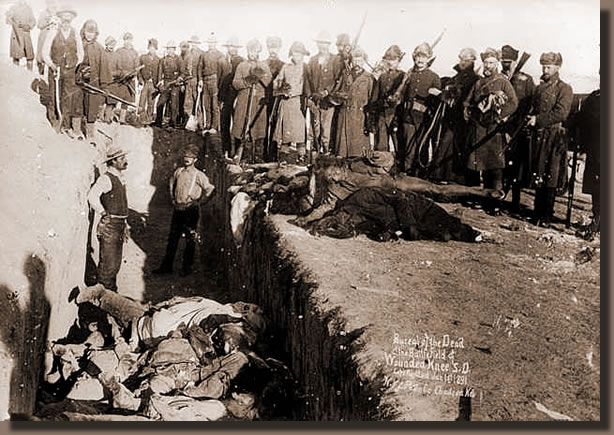
Along Wounded Knee Creek on the Pine Ridge Reservation, Seventh Cavalry Troops, having rounded up a band of Hunkpapa Sioux suspected of potential trouble (fully two-thirds of them were women and children), herded the Indians for the night into a tight group surrounded by five hundred soldiers, their normal armament reinforced with four Hotchkiss guns. In the morning, the Sioux men were culled out, lined up, and disarmed. Someone is said to have discharged a weapon. Immediately, the Hotchkiss guns opened fire, and most of the men were killed in the first five minutes.

The Hotchkiss guns, carefully trained on the milling, terrified people, continued to fire. Some Indians fought back with whatever they had, stones or sticks or bare hands (leaving twenty-nine soldiers dead), while others tried to flee. Within an hour some two hundred Indians were dead or dying. A few women got as far as three miles away before being caught and killed. The rest, about one hundred souls, fled and later froze to death in the hills.

Afterwards, the American Indians were reduced to virtual nonentities. Their children were forcibly shipped off to >boarding schools whose main purpose was to eradicate any vestige of their "savage" heritage and completely "civilize" them; most of these schools eventually descended into horror, and their larger effect only left behind generations of damaged Indians who had been stripped of their heritage.

Even those who had managed to find ways to thrive, such as the Osages -- whose oil rights from their treaty lands in Oklahoma led to tremendous economic riches in the 20th century -- had their wealth taken from them. Beginning in the early '20s, a handful of scheming whites successfully undertook to steal land rights away from the Osages by murdering them. The scheme, which became known as the Osage Reign of Terror, typically involved white men marrying women who held the rights, and then surreptitiously having them killed and their murders officially covered up.

At every step of this systematic extermination, whites justified their brutality with eliminationist rhetoric that referred always to the savagery of the Indians, who indeed were not hesitant to shed blood and to do so in brutal fashion that, as it often was with whites, was intended to send a message. The entire history of the Indians' dealings with American settlers fit this pattern.

Yet even the most avid of the eliminationists among them often recognized that the original fault nearly always lay with the invading whites. Kroeber notes that Robert A. Anderson, who led the extermination of the Yana, nonetheless observed retrospectively in his memoirs the following:
It is but just that I should mention the circumstances which raised the hand of the Mill Creeks against the whites. As in almost every similar instance in American History, the first act of injustice, the first spilling of blood, must be laid at the white man's door.

Such reflection, however, rarely led to the perpetrators to wonder if their murderousness had been anything more than an unpleasant necessity -- because, regardless of the fault, in their view the Indians were nonetheless savage beasts for whom the only means of "civilization" was elimination.

At the turn of the century, the Indians were no longer a threat to white Americans, and so the eliminationist rhetoric was gradually replaced with romantic "noble savage" mythology that made them seem distant and harmless, which in fact they were. By then, anyway, they had found a new "threat" and a fresh object for elimination: black people.

Next: Strange Fruit

Sunday, December 31, 2006

Far-right lying liars

Seems that Peter Brimelow and his gang of nativists at VDare are trying to raise funds by smearing Eric Muller:
Earlier this year, I was on a radio show, "Brad and Britt in the Morning," with Brad Krantz and Britt Whitmire, WZTK-FM in Burlington, North Carolina. We were supposed to talk for forty minutes including questions. But instead, after a few minutes, Brad Krantz abruptly terminated the interview without explanation.

I was puzzled, because talk radio is usually supportive of patriotic immigration reform and always hungry for controversy. But I didn't put two and two together until the publicist who had arranged the interview told me what had happened. While I was on air, Krantz had received a call from a "friend" who was a law professor at the University of North Carolina. This "friend" had told him that VDare was a "hate" site. And Krantz had run away.

Naturally, we called and wrote Krantz, asking him for an opportunity to defend ourselves. But he never responded.

As Muller notes, however, this account is demonstrably false from start to finish: Krantz never cut Brimelow off and interviewed him at length. Muller did not contact Krantz by phone but by e-mail, and did so after the interview aired:
One morning back in June, I was listening to the Brad and Britt show on WZTK-FM out of Greensboro, NC, when they had Brimelow as a guest. They did not cut him off, or end the interview abruptly. He was on for what I remember as a long segment, during which he spoke without interruption (and without significant challenge) for much of the time.

After hearing the interview, I contacted Brad Krantz, one of the show's hosts, to ask whether he knew much about Brimelow's VDare site and some of its writers. Here's the text of the email that I sent him:

Brad,

Read this stuff, and check out some of the linked material.

http://en.wikipedia.org/wiki/Steve_Sailer

http://en.wikipedia.org/wiki/Peter_Brimelow: "Brimelow is a paleoconservative and maintains that America's culture and way of life is threatened by unrestricted immigration from Latin America and the Third World . "

It's all about maintaining white culture.

There's *lots* more if you dig.

--Eric

Nothing about VDare.com being a "hate site." No coded or conspiratorial transmissions from my supposed controllers at the Southern Poverty Law Center. Just links to Wikipedia entries, with an encouragement to Brad that he click through to VDare.com -- whose FAQ, incidentally, boasts that the site publishes the work of "white nationalists."

Muller wrote to Brimelow and asked for a correction and retraction. Instead, VDare decided to compound the problem by posting a piece by Patrick Cleburne characterizing Muller's response thus:
In a characteristically disingenuous, misrepresentation-festooned posting, the Is That Legal? blog has admitted what Peter Brimelow suspected: that it was the intervention of the blog's proprietor Eric Muller of UNC Law School that caused Brad Krantz of Burlington N.C's WZTK-FM to cut short a planned interview and call-in session last June...

... Muller advances one main reason for this act of repression: he quotes several writers posted on VDARE.COM . That is it. Apparently the fact that he disagrees with them is enough to give him the right to repress their publisher.

... In any case, Muller's own site is highly judeo-centric and much pre-occuped with scoring debating points against the founding culture. But, of course, different rules apply to Professor Muller and his friends.

As Muller points out in his update, this characterization of his post is 180 degrees removed from what he actually wrote. Once again, he's asked for a retraction.

I'm trusting, of course, that Muller is not holding his breath. After all, he need only consider the character of the people in question. (I've posted on VDare quite often here.)

There are, after all, many sound reasons that VDare was designated a "hate group" by the Southern Poverty Law Center:
[Brimelow, in his book Alien Nation] described the role of race as "elemental, absolute, fundamental." He said that white Americans should demand that U.S. immigration quotas be changed to allow in mostly whites. He argued that spending tax dollars on anything related to multiculturalism was "subversive." He called foreign immigrants "weird aliens with dubious habits."

He worried repeatedly that his son, with his "blue eyes" and "blond hair," would grow up in an America in which whites had lost the majority.

At one point, he wrote that if one enters an Immigration and Naturalization Service waiting room, just like entering the New York subways, "you find yourself in an underworld that is not just teeming but also almost entirely colored."

Even earlier, in 1993, Brimelow, who is himself an immigrant from England, lauded a book by Jared Taylor, who now oversees the racist American Renaissance magazine.

In his review, he said that racism is "undetectable" in opinion polls and "does not seem" to affect blacks' economic status. He said tax money spent to help blacks and the poor "has done little good and much ill." And he said that "policemen of all races are, if anything, more lenient with criminals of a different race."

Even more than Brimelow himself, you have to appreciate the kind of garbage that passes for discourse on VDare's pages:
Fast forward to 2003. Once a relatively mainstream anti-immigration page, VDARE has now become a meeting place for many on the radical right.
One essay complains about how the government encourages "the garbage of Africa" to come to the United States. The same writer says once the "Mexican invasion" engulfs the country, "high teenage birthrates, poverty, ignorance and disease will be what remains."

Another says that Hispanics have a "significantly higher level of social pathology than American whites. ... In other words, some immigrants are better than others." Yet another complains that a Jewish immigrant rights group is helping "African Muslim refugees" come to America.

Brimelow's site carries archives of columns from men like Sam Francis, who is the editor of the newspaper of the white supremacist Council of Conservative Citizens, a group whose Web page recently described blacks as "a retrograde species of humanity."

Here's another outtake from Francis, also from the pages of VDare:
The reason blacks and whites do not enjoy similar outcomes despite similar treatment by society is that the black and white populations are not equivalent. ... Our government has permitted a huge influx of non-white immigrants who threaten to reduce whites to a minority by the middle of this century. In their bones, whites know this will not be a good thing. They know that an increasingly Third-World America will slip into Third-World habits of corruption, poverty, and violence.

People on the far right are so far removed from reality, really, that the truth long ago became indistinguishable to them. They long ago abandoned truthfulness in the defense of their bigoted racial beliefs. We certainly shouldn't expect it now.

Friday, December 29, 2006

The stupids

I normally try not to pay too much attention to the idiocy that passes for commentary from the Mouth Breathing sector of the right blogosphere, but this post from the execrable Ace of Spades was just too stupid to pass up.

Note how it begins:
There's an idiot named David Nieuwert who writes an ultralefty blog called Orcinus. He's absolutely convinced this country is about to be taken over by the white power skinhead movement, and he churns out crappy books and crappier blogposts endeavoring to prove this.

Ace's entire post is essentially dedicated to proving what an idiot I am, and he can't even get my name spelled right.

And of course, there's no link to this blog. That no doubt saves his readership from actually checking into what I've written, where they might actually discover that I've never written anything remotely like the charge that "this country is about to be taken over by the white power skinhead movement."

As he mentions, I have a bit of a history with Ace; we used to spar over at Slate's forum, The Fray, and later at a subscriber-based forum called The Mote. He goes on with a recollection of an argument we had (I actually think this one was at The Mote) regarding hate crimes.

You see, Ace -- who is an attorney of some kind, but not a criminal attorney -- wanted to challenge my assertions about the nature of criminal law vis a vis hate crimes (I think we were discussing the distinction between intent and motive). Ace decided that, because I was not an attorney, I had no expertise whatsoever in the subject and should not be discussing it. I pointed out to him that I had been a cops-and-courts reporter for three years and had covered a number of federal trials in subsequent years. I am not a lawyer, that's certain, and would never claim to have any kind of serious legal expertise beyond that experience -- though obviously that experience gave me a considerably broader working knowledge than your average Joe. And I was fairly certain I knew a hell of a lot more about criminal proceedings than a pencil-pushing corporate attorney whose only time in a criminal courtroom involved dealing with his own DWIs. (Or something like that.)

In other words, the conversation -- and what I actually said -- bore only the barest similarity to Ace's description. The "Nieuwert" he describes is, of course, a gigantic moron, the kind of journalist that nimrods like Ace prefer to believe is similarly responsible for reporting that things are not going well in Iraq. It's so much easier to score points when your opponent is that big fat straw man.

But guys like Ace would have nothing to write if they didn't have straw men to build and then knock over. Guess it keeps them busy.

Thursday, December 28, 2006

Mad Max vs. the Mayans redux


"The Jews are coming! Run for your lives!"

I have to admit that I laughed when I saw the recent Saturday Night Live "recut" of the trailer for Mel Gibson's Apocalypto. But it was kind of a guilty laugh.

After all, bringing up the bizarre anti-Semitism that resurfaced in Gibson's arrest earlier this year for driving while intoxicated seems like a little bit of a cheap shot. The film, like any ostensible work of art, deserves to be judged on its own merits (or lack thereof, as is the case here), regardless of the auteur's personal foibles. This is why I only referenced it obliquely in my own review.

Then, however, longtime reader Beth pointed out in my comments an MTV interview with Gibson by Kurt Loder, which contained the following nuggets:
Loder: Do you think the Mayan culture was even more violent than you've depicted it in "Apocalypto"?

Gibson: Absolutely. Some of the stuff they did was unspeakable. You could not put it on film. I really did go light. There are accounts of when the conquistadors first arrived in the Aztec empire and saw something like 20,000 human sacrifices in four days. They must have had four or five temples going at the same time. All these hearts being ripped out -- it was a kind of culture of death. Human sacrifice wasn't as prevalent in the Mayan civilization as in the Aztec. But with conquest and the melding of cultures, it became more commonly practiced further south.

Ahem. You'll notice, of course, that Loder asked Gibson about Mayan culture, and Gibson responded with a disquisition -- laden with nonsense -- about the Aztecs. Yet the Mayans were quite distinct from the Aztecs (or Mexica), particuarly in that while they also practiced human sacrifice, it was neither of the scale nor of the same nature as their northern neighbors.

Note what the historical record actually says about the Aztecs:
No first-hand, eyewitness accounts by Europeans of actual human sacrifice are known, although there exist some first-hand eyewitness accounts of the remains of alleged human sacrifices.

It's also important to understand the context of these sacrifices, which occurred as part of the war engaged in by the Mesoamerican nations. There was relatively little actual bloodshed -- or at least death -- on their battlefields. That's because, as the Wikipedia entry above notes, the primary -- if not sole -- source of sacrificial victims was not poor schlubs rousted out of the jungle (there was no jungle of note near the Aztecs) but "had to be captive warriors who were from a Nahuatl culture":
Because the objective of Aztec warfare was to capture victims for human sacrifice, Aztec battle tactics were designed primarily to injure the enemy rather than kill him. The flower wars were designed to intimidate subject states, thus discouraging "real armed insurrection," and the capture of victims for human sacrifice was an exercise in prestige for the individual Aztec warrior.

The same was true, it must be noted, of Mayan warfare and its associated human sacrifices, which largely involved warriors from rival Mayan cities. Mayan bloodletting rituals also featured a significant component utterly lacking from Gibson's depiction: most of the time, the people whose blood was being shed were the kings and high priests themselves. (It was, in fact, a horrifying scene; the bloodletter would pierce various appendages -- tongues, hands, feet, penises -- and run ropes through the openings to assist the flow of blood down the temple steps.) Yet it also signified an aspect of their culture that belies the core of Gibson's thesis: sacrifice on the part of their leaders was understood as essential for the good of all.

It should also be noted that Mayan rituals did not, as far as we know, even remotely resemble Gibson's depiction. Most scholars of Mayan culture say that these rituals were extremely solemn affairs undertaken with great care, including ceremonial participation by the audience, not the bloodthirsty gibbering by an audience of savages to which Gibson treats us. It's difficult not to contemplate the difference and conclude that Gibson's intent is to depict Mayan culture in the worst, most inhuman, most bestial light possible.

But Gibson really reveals the eliminationist mindset of the film when he describes his view of the film's ending:
Loder: At the end of "Apocalypto," the first Spanish explorers arrive in the Mayan empire, and they're carrying a large cross. I know you're Catholic: What do you think was the effect of Christianity on these pagan cultures?

Gibson: Well, there were only a few hundred conquistadors, and their weaponry wasn't that far superior. The Mayans could pierce their armor -- these cleavers that they had could cut a side of beef in half. So how did the conquistadors take power? I think that the majority of the populace was really discontented with what was going on. They didn't dig it. Twenty-thousand people being bumped off? It was like, who's next? And they began to rebel. I think the conquistadors led more of a revolution with the help of the people.

Pardon the interruption, but this is pure, unadulterated bullshit.

The real collapse of the so-called Classic Mayan culture occurred in about the ninth and tenth centuries, well before contact with the Spanish. And that collapse, as far as anyone can tell, was only partially related to depredation from its continued warring (and concomitant human sacrifice). Far more likely causes involved environmental disasters and their effects (including famine) -- but then, portraying that, once again, might have conflicted with Gibson's thesis.

Even then, Mayan city-building cultures continued to flourish in the Yucatan and Guatemala in the ensuing centuries, and were still fully in business when the Spaniards began arriving in the early 16th century; modern Yucatan cities like Merida, Izamal, and Valladolid were in fact built on top of active Mayan cities, complete with temples (which were largely torn down by the Spanish).

More to the point, the Mayans did not collapse shortly after contact with the Spanish. In fact, they successfully repelled them for nearly 150 years; the last Mayan city, the Peten city of Tayasal, did not fall until 1697. There was no assistance in the conquest by a disgruntled Mayan citizenry; rather, the unquestionably decisive factor was the onslaught of disease -- consecutive and overlapping pandemics of smallpox, bubonic plague, swine flu, tuberculosis, which also had lethal side effects such as starvation -- that killed an estimated 70 to 80 percent of the existing Mayan population. Combine that with the murderousness of the conquistadors and the death sentence that was slavery in the Spanish mines, and the result was inevitable: 95 out of every 100 Mayans died over those 150 years.

It seems that, perhaps, Gibson is again confusing Mayans with Aztecs: the Mexicana indeed fell relatively quickly, and the Spaniards were in fact assisted by rival warring tribes (not disgruntled citizens; rather, these were rival tribes who also probably practiced human sacrifice). But once again, the decisive factor in the eventual fall of Tenochtitlan was not the internal corruption of the Aztecs but disease -- specifically, an epidemic of smallpox that ravaged the city and the Aztecan resistance.

The most significant aspect of these remarks is that they make clear Gibson's view that the arrival of the Catholic Spaniards was something that benefited the Mayan people, despite the reality that it actually wrought the deaths of most of them. You may recall my assertion, in both the review and the associated piece on eliminationism, that Gibson intended to portray the arrival of the Spanish as a net good for the Mayan people, because Mayan civilization itself had become irredeemably corrupt, and the Spaniards in effect were "rescuers." This assertion drew considerable debate in the ensuing thread, with Gibson's defenders denying he intended any such thing. I think it's clear from this quote that he did.

In any event, Gibson delivers the real coup de grace in the next several breaths:
But many of these conquistadors were pretty wild guys -- you weren't getting the cream of the crop from Spain, okay? They considered the people to be animals, without souls. And so indiscriminate killing was also part of what they did. And they actually recorded that it was the Franciscans baptizing these people that saved them from being killed -- the conquistadors wouldn't kill them because they figured they must have a soul. I think that Christianity gets a bum rap a lot of the time in the history books. But you've got to consider who's writing them.

Well, simply as a factual matter, it must be said that the actual record regarding the Conquistadores' willingness to refrain from inhuman behavior for those natives who converted to the faith was decidedly mixed; there certainly is no shortage of evidence that Spanish soldiers and colonial officials just as often sneered at the submission of the natives and killed them anyway. Moreover, they often manipulated the efforts of the conversos to their own murderous ends. An illustrative (and certainly not untypical) example comes from colonial Mexico, when Spanish governors were no less murderous than the Conquistadors, as in this case from the mid-19th century (described in The Native Americans):
To open up new land for ranching and to stop raids on existing rancheros, Mexicans waged a murderous undeclared war against the interior Indians of California. In 1837 an expedition led by Jose Maria Amador invited both "wild Indians and their Christian companions" to a feast. They then surrounded them, separating out the Christians. On the return march at "every half mile or mile we put six of them on their knees to say prayers, making them understand that they were about to die. Each one was shot with four arrows, two in front and two in back. Those who refused to die immediately were killed with spears." Having dispatched a hundred Christian Indians, they turned to the non-Christians. Amador and a companion each took a bottle of water and "baptized all the Indians and afterwards they were shot inthe back. At the first volley 70 fell dead. I doubled the charge for the 30 who remained and they all fell dead."

OK, so it's a Hollywood movie and expecting factual accuracy from its director is a lost cause.

But why, exactly, should we "consider who's writing them"?

It's an enigmatic remark, of course. Coming from anyone else, we might dismiss it as a generic swipe at historians as ivory-tower academics with a hostility to people of faith.

But this is the same guy who not only ranted to police about how Jews control everything, he's implied the same thing in interviews that also revealed a darkly conspiratorial side, with a decided dose of anti-Semitism. This is the man who has never repudiated his father's incontestable anti-Semitism -- and has in fact consistently defended him.

"Who's writing them"? Why, the Jews, of course.

This may help explain why Apocalypto has attracted such a fervent audience in the far-right extremist crowd. Conspiracy-monger Alex Jones, in typically understated fashion, found it "the most powerful film of all time." Meanwhile, over at the white-supremacist National Vanguard forum, [warning: links to hate site] you can find reviews of the film along these lines:
The 20 minute scene of the Mayan city, unparalleled in moviedom, is the end result of jewish culture in it's ultimate manifestation ie pure primitive beast and his savage bodily urges. And if that doesn't terrify you, I don't know what could. The solution is a global tapir hunt. You are Jaguar Paw, white man! That Mayan temple is your fate and those ecstatic brown hordes longing for your tumbling noggin will be your last experience as the kike reaches in to rip your heart out. This is the message of Apocalypto.

All in all, I'd have to say SNL actually had it just about right. So much for feeling guilty.