Thursday, July 21, 2005

Reviews from here and there

My new book, Strawberry Days: How Internment Destroyed a Japanese American Community, just got its highest-profile review in a paper I've harshly criticized on many occasions in the past: the (ulp!) Washington Times.

Nonetheless, Tom Carter's piece is not just a strong review, but a good read in its own right. Carter, you see, grew up in Bellevue:
Growing up in the 1950s in a suburb of Atlanta "coloreds only" and "whites only" signs on water fountains and public toilets were fairly common. It never occurred to me that white people might have similar feelings toward "Orientals" until we moved to Bellevue, Wash., a suburb of Seattle in 1962. I remember my parents bewilderment at the openly hostile neighborhood reaction when a Japanese family tried to buy a house in our Mockingbird Hill development.

Riding our bicycles on Bellevue streets, walking to school, swimming in nearby Lake Sammamish, Bellevue was a white and middle-class. We knew nothing of the history, that Bellevue was a small farming suburb hewn from the wilderness, stumps removed, fields made workable and then planted by Japanese immigrants in the early 1900s. And after Dec. 7, 1941, the Japanese attack on Pearl Harbor, it was one of many West Coast cities depopulated of Japanese by government order, a forced evacuation that sent hundreds of Bellevue Japanese to internment camps -- ultimately clearing the way for white suburbia.

Be sure to read it all.

And, while I'm at it, it's worth noting that the reviews for the book at the Amazon link were invaded earlier this week by the execrable "Bob," a onetime regular commenter here who not only liked to argue (a la Michelle Malkin) that the internment of Japanese Americans was justifiable but necessary, but eventually, he developed a habit of posting personal smears about local Nikkei, which earned him a deletion and a ban. Then he went away.

Eric Muller recently posted some information about "Bob", who is evidently closely associated with a Bainbridge Island figure named James Olsen (if he isn't in fact Olsen himself). Olsen and his wife, Mary Dombrowski, have been badgering the Bainbridge school district about its history curriculum regarding the internment, a campaign that has, unsurprisingly, earned Malkin's endorsement.

Unfortunately, Amazon deleted Bob's review of my book. I say "unfortunately" not because I endorse Bob's views, of course, but because I do believe in the free exchange of ideas. It's useful to have Bob's explanation of why the internment was justifiable out there in black and white so that anyone can see exactly how thin and, ultimately, groundless -- not to mention profoundly amoral -- their argument really is.

As it happened, I preserved a copy of his review, and so I'll reproduce it here:
Absolute Garbage! Neiwert's a race-baiting flake!, July 14, 2005

Reviewer: Bob - See all my reviews

It is well-documented that the evacuation was motivated, not by racism, but by information obtained by the U.S. from pre-war decoded Japanese diplomatic messages "MAGIC" and other intelligence revealed the existence of espionage and the potential for sabotage involving then-unidentified resident Japanese aliens and Japanese-Americans living within the West Coast Japanese community.

You can read about MAGIC and it's subseqently being ignored by the reparations commission here.

[...]

The actual declassified MAGIC intercepts are here.

http://www.athenapressinc.com/smithsonian/Appendix3.html

The U.S. Congress immediately passed legislation providing enforcement provisions for FDR's Executive Order, unanimously in both the House and Senate, provided under Article 1, Section 9 of the United States Constitution.

Only persons of Japanese ancestry (alien and citizen) residing in the West Coast military zones were affected by the evacuation order. Those living elsewhere were not affected at all.

It is not true that Japanese-Americans were "interned. Only Japanese nationals (enemy aliens) arrested and given individual hearings were interned. Such persons were held for deportation in Department of Justice camps. Those evacuated were not interned. They were first given an opportunity to voluntarily move to areas outside the military zones. Those unable or unwilling to do so were sent to Relocation Centers operated by the War Relocation Authority.

At the time, the JACL (Japanese American Citizens League) officially supported the government's evacuation order and urged all enemy alien Japanese and Japanese Americans to cooperate and assist the government in their own self interest.

It is misleading and in error to state that those affected by the evacuation orders were all "Japanese-Americans."

Approximately two-thirds of the ADULTS among those evacuated were Japanese nationals--enemy aliens. The vast majority of evacuated Japanese-Americans (U.S. citizens) were children at the time. Their average age was only 15 years. In addition, over 90% of Japanese-Americans over age 17 were also citizens of Japan (dual citizens)under Japanese law. Thousands had been educated in Japan. Some having returned to the U.S. holding reserve rank in the Japanese armed forces.

During the war, more than 33,000 evacuees voluntarily left the relocation centers to accept outside employment. An additional 4,300 left to attend colleges.

In a questionaire, over 26% of Japanese-Americans of military age at the time said they would refuse to swear an unqualified oath of allegiance to the United States.

According to War Relocation Authority records, 13,000 applications renouncing their U.S. citizenship and requesting expatriation to Japan were filed by or on behalf of Japanese-Americans during World War II. Over 5,000 had been processed by the end of the war.

After loyalty screening, eighteen thousand Japanese nationals and Japanese-Americans were segregated at a special center for disloyals at Tule Lake California where regular military "Banzai" drills in support of Emperor Hirohito were held.

The Supreme Court of the United States upheld the Consitutionality of the evacuation/relocation in Korematsu v. U.S., 1944 term. In summing up for the 6-3 majority, Justice Black wrote:

"There was evidence of disloyalty on the part of some, the military authorities considered that the need for action was great, and time was short. We cannot -- by availing ourselves of the calm perspective of hindsight -- now say that at the time these actions were unjustified."

That decision has never been reversed and stands to this day.

It should be noted that the relocation centers had many amenities. Accredited schools, their own newspapers, stores, churches, hospitals, all sorts of sports and recreational facilities. They also had the highest percapita wartime birth rates for any U.S.community.

More history for you to consider regarding the Commission on Wartime Relocation and Internment of Civilians:

Consider that of the nine commission members, six were biased in favor of reparations. Ishmail Gromoff and William Marutani, relocatees themselves, sat in judgment of their own cases. Arthur Goldberg and Joan Bernstein made sympathetic, pro-reparation statements publicly before hearings even began. Arthur Fleming had worked closely with the JACL (he was a keynote speaker at its Portland convention in the '70s). Robert Drinan was a co-sponsor of the bill establishing the commission.

Consider that notices of when and where hearings were to be held were not made known to the general, non-Japanese public.

Consider that witnesses who gave testimony were not sworn to tell the truth.

Consider that witnesses who were pro-reparation were carefully coached in their testimony in "mock hearings" beforehand.

Consider that witnesses against reparation were harassed and drowned out by foot-stomping Japanese claques, that the commission members themselves ridiculed and badgered these same witnesses.

Consider that not one historian was asked to testify before the commission, that intelligence reports and position papers contrary to reparations were deliberately ignored.

Consider that as a result of the above, the United States Department of Justice objected strongly to the findings of the commission.

Lastly while we've all been educated on the doctrines associated with the rise of Nazism, I would be curious to know if courses are provided teaching the history of the doctrines of Japanese militarism, a belief system similar and equally as insidious as Nazism?

Any clasess on the kokutai? Hakko Ichiu? Any reading of Kokutai no Hongi? Shimin to Michi? The role of Nichiren Buddhism and Japanese "Language Schools" in teaching these doctines of Japanese racial superiorty to ethnic Japanese colonies throughout the word prior to Pearl Harbor?

Those of you learning this history at your public schools and universities should understand you are being taught an extemely biased and partial version of what really happened and why. I would urge you to go beyond the politically correct version of this history as propagated by the Japanese-American reparations movement.

I understand that publishing Bob's remarks helps him circulate those views. But I also believe that seeing them in print helps people understand how these folks think -- and a careful examination reveals their utter bankruptcy.

Ironically, nearly every one of the points Bob raises is in fact addressed and specifically refuted in the text of Strawberry Days, including the very real role of racism in the drama; the actual significance of the MAGIC encrypts; the demographic makeup of the internees; the military signup debate; what was really taught in those Japanese schools; and the significance of the Supreme Court rulings and the fact that Korematsu has never been overturned. (I don't discuss the behavior of some audience members at the Wartime Relocation Commission hearings, but then, it doesn't strike me as particularly significant. Strange, though, how "Bob" isn't equally outraged by the treatment that was afforded anyone who dared speak out against the evacuation at the Tolan Committee hearings in the spring of 1942.) Oh, and incidentally: I have no connection to any "Japanese American reparations movement."

So, how odd is it to post a review of a book whose text specifically refutes everything in your review?

Well, that doesn't matter to people like "Bob" and James Olsen and Michelle Malkin. They are True Believers, and no evidence -- not even a mountain of it -- will move them to admit that they are wrong. (Not that "Bob" will have bothered to actually read the book.) Nor, it seems, do they possess enough self-awareness to recognize just how morally repugnant the upshot of their argument (to wit: those Japanese really were untrustworthy and deserved to be locked up en masse) really is.

The rest of us can judge for ourselves.

Wednesday, July 20, 2005

The elimination game

Probably the most striking scene in Patrice O'Neill's excellent P.O.V. documentary currently airing on PBS, "The Fire Next Time," involves my friend Brenda Kitterman teaching her two teenage daughters how to use a handgun.

The girls were more or less forced to learn because Elizabeth, the elder of the two, began speaking out against right-wing hate groups at her Kalispell, Montana, school in emulation of her mom, and was subsequently threatened and had her tires slashed. Their family was subjected to a barrage of threatening phone calls and late-night visitations from strange men in their yard, one of them shouting at the mother to come out. The elder daughter was being followed home from her job every night.

It was part of a campaign of right-wing intimidation of conservationists and "liberals" in Montana's Flathead Valley, a phenomenon I've described in some detail previously. The Kittermans were hardly alone in facing this kind of harassment, but they experienced an especially intense version of it.

So we see Brenda, who is an ex-cop and more than familiar with firearms, teaching her daughters how to hold the gun, aim properly, and squeeze off a shot at a silhouette target. Trisha, the younger of the two, is uncertain whether she can actually pull the trigger on another person, so they sit down to talk about it, and Brenda advises her not to carry a gun until she's sure she can use it. Trisha nods, and agrees, then tucks her face into her arms and silently begins to cry.

This was one of the more vivid sequences in the film's depiction of the dynamic that hits any community when hateful eliminationist rhetoric takes root. Just as striking for me, in a low-key way, was how it demonstrated the chilling and intimidating effect that such thuggishness can have on ordinary people. As the film's advance text explains:
Nothing was more telling -- and is more disquieting in "The Fire Next Time" -- than the community's reaction to discovery of Project 7, its cache of guns and its hit list. The targets, after all, were not distant officials or outsider bureaucrats. They were everyone's longtime neighbors, including popular Police Chief Frank Garner and Sheriff Jim Dupont. And while many citizens, like Brenda Kitterman and newly elected Mayor Pam Kennedy, felt immediately moved to rally in protest, there was a degree of denial about the potential danger. Those accused of being terrorists were also neighbors, who had carved out a place for their views in public meetings and on the radio. For elected officials like Pam Kennedy and Gary Hall, the daily blast of on-air attacks turns public life into a risky proposition, given the real threat from Project 7. The result was also a spreading fear as people began to weigh the costs of speaking out.

I thought this was particularly embodied in an interview with the family of Mike Raiman, a Flathead Valley conservationist who took a leading role in standing up to the hateful talk that emanated from the likes of local right-wing radio talk-show host John Stokes.

Raiman is a grandfather, and both of his sons are in their early 30s with families of their own, though they work with him and have supported him throughout his ordeal -- in some cases, coming in for abuse themselves. But the elder of the two sons, you can tell, is weary of it all and wary too: he has a family to think about, and their safety is paramount to him. He doesn't know how much longer he can keep it up. You can't really blame him.

That's how eliminationist hate works, regardless of its target: Its aim is to threaten and intimidate not merely the immediate target, but anyone who might think of speaking out on their behalf. This cuts the target off from the community support it might normally enjoy and leaves them feeling even more isolated.

What, really, is eliminationism?

It's a fairly self-explanatory term: it describes a kind of politics and culture that shuns dialogue and the democratic exchange of ideas for the pursuit of outright elimination of the opposing side, either through complete suppression, exile and ejection, or extermination.

I first encountered it in Daniel Goldhagen's Hitler's Willing Executioners, which is in many regards a problematic text, especially insofar as it describes prewar German society as almost uniquely predisposed to antisemitism. But Goldhagen's text correctly identifies and describes the essence of the Nazi campaign against the Jews as eliminationist in nature, something that was made undeniably manifest in the Holocaust.

But while eliminationism's most startling historical example was provided by the Nazis, it also has a long and appalling history in the annals of American democracy. It was manifest in the genocidal wars against Native Americans, when "the only good Indian was a dead Indian": in the many anti-immigrant campaigns waged by Nativists of many different stripes; in night-riding Ku Klux Klansmen, Jim Crow segregation, and the lynch mobs who murdered thousands of innocent blacks during the heyday of white supremacism; in the mass incarceration of Japanese Americans in World War II; in the continuing march of hate crimes that target various kinds of "undesirable" members of society for terrorization and exclusion; and in the lingering far-right "militias" and related hate groups who scapegoat minorities and immigrants, gays and lesbians, government officials, and liberals generally, making them the targets of both hateful rhetoric and actual violence.

Eliminationism in truth forms the really hateful, violent core of fascism, the facet that distinguishes the real item from its pseudo manifestations (though of course not all eliminationism is necessarily fascist). It glories in violence, in action over intellect, and always insists, of course, that it represents the true national identity.

Rhetorically, it takes on some distinctive shapes. It always depicts its opposition as simply beyond the pale, and in the end the embodiment of evil itself -- unfit for participation in their vision of society, and thus in need of elimination. It often depicts its designated "enemy" as vermin (especially rats and cockroaches) or diseases, and loves to incessantly suggest that its targets are themselves disease carriers. A close corollary -- but not as nakedly eliminationist -- are claims that the opponents are traitors or criminals, or gross liabilities for our national security, and thus inherently fit for elimination.

And yes, it's often voiced as crude "jokes", the humor of which, when analyzed, is inevitably predicated on a venomous hatred.

But what we also know about this rhetoric is that, as surely as night follows day, this kind of talk eventually begets action, with inevitably tragic results.

While in recent years much of this activity tends to be relegated to fringe behavior, it's disturbing to observe this trend treading out of the fringes and increasingly back into the mainstream, as it did in the Flathead Valley -- and moreover, as it is doing on a national mainstream level. It's worth remembering, of course, that there have been many instances when eliminationism was very much part of mainstream American culture, and there's no reason to believe it couldn't happen again.

I was reminded of this the other night when I was talking to the very nice-sized audience that turned out for my reading from Strawberry Days at Ravenna Third Place Books in Seattle. In the front row was an elderly Nisei woman I didn't know, but later found out was Mary Matsuda Gruenewald, who had authored her own book on the internment, Looking Like the Enemy (and an excellent book it is).

I had earlier in the evening discussed how difficult it was for white people in the spring of 1942 to stand up and publicly defend their Japanese neighbors, pointing out that the few who did were subjected to "Jap lover" epithets, sneering attacks on their motives, and in some cases threats.

Ms. Gruenewald asked an interesting question: What, she wondered, would I recommend for people today, in the current environment, should they be faced with a similar choice?

I found myself giving her an answer similar to one I've actually given many times, including during a community gathering in Kalispell the summer after the events of "The Fire Next Time" (the crew was there and filming the event, but the gathering mostly wound up on the editing floor), as well as at community discussions on hate crimes. I can't recall the exact words, but it went something like this:
I think it's important for people to understand the value of standing up and making their voices heard, regardless of the threats that may come their way. Failing to do so will make our communities less safe, places we don't want to bring our children up in anyway. And when people find the courage to stand up and be counted, they'll quickly realize that they are not alone, that others will be there to stand beside them. We're the true silent majority, and tragedies like the internment only happen because too many of us lack the courage to make our voices heard. If the internment offers us any real lessons for today, it's that we cannot repeat the same mistake.

Now, I have to admit to being amused by Rev. Mykeru's recent takedown of a right-wing intimidation artist who calls himself "Lord Spatula," who has a habit of spewing all kinds of vile eliminationist rhetoric in the direction of a number of liberals who post on the Internet, including various threats of physical harm. Mykeru called him on his bluff, arranged a halfway meeting place, and told Lord Spatula to show up for an ass-kicking. Spatula, of course, backed down.

I can't say I endorse Mykeru's tactics, as satisfying as they might be, since they come down to promising actual violence, and being prepared to carry it out. But it's well worth remembering what his little exercise clearly revealed: Bigmouthed bullies are all, at their core, pathetic cowards. When they are confronted, they run away. They may lob a few shots in retreat, but they always run away. Unless, of course, we cede the field to them.

And eliminationism, in all its myriad forms, is in the end nothing but pure bullying. The sooner we begin confronting it, the more certain we are to halt its spread.

Friday, July 15, 2005

Eliminationism from the top

The Plame affair, it seems, really has Republicans snarling, their usual response when backed into a corner.

You can tell that because now the eliminationist talk is coming from the Bush White House's own mouthpiece -- namely, Rep. Peter King, who's been selected as the House point man for defending Karl Rove.

King was on MSNBC's Joe Scarborough show the other night and, according to the MSNBC transcript, had this to say:
And Joe Wilson has no right to complain. And I think people like Tim Russert and the others, who gave this guy such a free ride and all the media, they're the ones to be shot, not Karl Rove.

I haven't seen the tape of the show, but the quote is enjoying an odd half-life on the radio, thanks to Rush Limbaugh, who alters it slightly to "ought to be shot", and then chimes in inimitably: "That's Peter King, who's right on the money."

Lovely.

Just wondering: Have any Democrats in Congress -- or Joe Wilson, for that matter -- suggested that Karl Rove be shot?

Ah, I didn't think so.

Talking 'bout internment

You know, in rereading Michelle Malkin's In Defense of Internment, I'm so relieved to reread the passage in which she adamantly insists she isn't advocating that we begin rounding up and incarcerating Muslim Americans (at least not yet). Because it certainly is odd how others on the right -- both abroad and at home -- are advocating something along those lines these days.

First, LaShawn Barber offered the following helpful discussion:
As you reply, it may be helpful to consider one or more of the following:

- Terrorist cells in America: The necessity of racial/religious profiling of Arabs/Muslims

- Muslim internment vs. rounding up suspicious Muslims only vs. status quo of doing nothing

As John Cole adroitly notes, this is just the kind of helpful and serious discussion we need right now, along with those liberal hunting licenses.

And I'm sure it's just a coincidence that the bulk of the pro-internment discussion that followed seemed strangely cribbed from Ms. Malkin's work.

Then there was this Slate report from the London press [hat tip to Paul Donnelly]:
Rupert Murdoch's Sun made the most open threat to civil liberties, making a call that will surely concern Asian communities: "Britain is crawling with suspected terrorists and those who give them succour. The Government must act without delay, round up this enemy in our midst and lock them in internment camps. Our safety must not play second fiddle to their supposed 'rights.' "

That's reminiscent of conservative Henry McLemore's Jan. 30, 1942, nationally syndicated newspaper column:
I know this is the melting pot of the world and all men are created equal and there must be no such thing as race or creed hatred, but do these things go when a country is fighting got its life? Not in my book. No country ever won a war because of courtesy and I trust and pray we won't be the first because of the lovely gracious spirit ...

I am for the immediate removal of every Japanese on the West Coast to a point deep in the interior. I don't mean a nice part of the interior, either. Herd 'em up, pack 'em off and give 'em the inside room of the badlands. Let 'em be pinched, hurt, hungry and dead up against it. ... Personally, I hate the Japanese. And that goes for all of them.

Or there was Mississippi Congressman John Rankin, on the floor of the House, on Dec. 15, 1941:
"This is a race war! The white man's civilization has come into conflict with Japanese barbarism. ... Once a Jap always a Jap. You cannot change him. You cannot make a silk purse out of a sow's ear. ... I say it is of vital importance that we get rid of every Japanese, whether in Hawaii or on the mainland. ... I'm for catching every Japanese in America, Alaska, and Hawaii now and putting them in concentration camps... Damn them! Let's get rid of them now!"

Maybe this is all fresh for me right now because I just got back from my Strawberry Days signing at the Panama Cafe in Seattle's International District. We had a large crowd, many of them elderly Nisei, including several of the folks who participated in the book as interviewees (notably Tosh Ito, Sumi and Ed Suguro, Mitsuko Hashiguchi, Kim Muromoto, and Ty Matsuoka).

There was also an elderly white gentleman who did not give me his name, but was the first to ask a question and immediately launched into questions he thought would disprove my thesis. Eventually he attacked my use of the term "concentration camps" to describe the form of incarceration used on the Japanese Americans; I explained patiently that this was precisely the correct term to describe them, since such camps existed well before World War II (they probably originated in the Boer War), and the so-called "relocation centers" actually fit the description of them to a T (not to mention that leading officials at the time, including FDR, called them "concentration camps"); what the Nazis operated, I stressed, were not merely concentration camps, but death camps, and therein lies the real difference.

He then launched into a tirade claiming life was too cushy in the American camps to call them that, which was you can imagine provoked a strong response from a number of my elderly audience members who had rather vivid memories of the barbed wire and armed guards, as well as the rows of tarpaper shacks, the general degradation and discomfort, and the acute humiliation of having been stripped of all their rights as citizens. He began arguing loudly with them, until I stopped the discussion and explained that I wasn't going to let him disrupt this gathering, the purpose of which was to discuss the book -- and I moved on to the next question.

The man picked up his papers and left, offering a nonsequitur about patriotism and the quality of my research on the way out. No one had asked him to leave -- but no one was sorry he left, either. The rest of the evening was really quite pleasant.

But the whole affair reminded me that cheap rationalizations (like those that constituted the elderly man's claims, or those that pretend that this kind of historical revisionism doesn't fuel the advancement of a more radical agenda) die hard. Don't they, Michelle?

Wednesday, July 13, 2005

More on 'Strawberry Days'

We had a nice turnout for the Strawberry Days signing at the University Book Store last night, including a surprise visit from one of my interviewees, Kiyo Yabuki.

Kiyo was a veteran of the 442nd who was wounded near Bruyeres during the famed "Lost Battalion" rescue. He grew up in Bellevue, and settled just outside of town eventually, making a living as a postman. He told us last night that one of his customers on his old route in Bellevue was Miller Freeman. For those who've read the book, you'll understand the significance.

Or, you can just read Chris Winters' nice feature on the book for the King County Journal, which is the descendant of the old Journal American, where I wrote the first iterations of this story. (I was the JA's news editor from 1991 to 1994.) Winters provides a worthwhile summary of much of the material in the book, including some regarding Freeman.

At any rate, I was honored and tickled to see Kiyo. He has a lively personality, a gleam in his eye, and a quick smile. His Purple Heart was well earned; Kiyo was hit in the back of the legs by tree shrapnel and had his ligaments severed, and spent many months recovering. One of the more notable anecdotes from the book involves him:
He was hospitalized at a military installation in Vancouver, Washington, for most of the year he spent in rehabilitation.

"One time, when I was in the hospital in Vancouver, there was a couple from Portland that used to come visit the patients at the hospital," he recalled. "I guess I made a remark about the rain coming from Portland, and it really ticked this lady off. I was just joking. Knowing that I was of Japanese ancestry, she made a remark about Japs, that, 'You're just fortunate that you're alive. A lot of our boys were killed.' I couldn't argue with her on that one. I was just too slow with any kind of comeback. Maybe it was a good thing I didn't.

"Then again, being sensitive to discrimination, it really made me kind of shrink back. Even with the uniform on, you had the feeling you were in the wrong."

Bedridden for much of his time in Vancouver, Kiyo was glad to return home when he finally was released. His older brother, Alan, was trying energetically to resurrect their home and greenhouse at Hunts Point, since both had been ruined during their stay away.

Kiyo decided one day that his Army uniform needed dry-cleaning, so he took it down to a Bellevue cleaning service to get it done.

They refused to serve him -- because he was Japanese.

Kiyo recovered well enough to become a mail carrier, which was his job until he retired in 1989. Kiyo was as spry as any 80-plus-year-old I knew until recently, when he suffered severe injuries in a fall at his home, and now lives in a care facility. But his mind, it was obvious, is as lively as ever, just like the gleam in his eye.

'The Fire Next Time'

Hope you all have a chance to check out this week's airing of the P.O.V. documentary, "The Fire Next Time," which examines a small Montana community torn apart by the hatred spewed by right-wing extremists who decided to target liberals and environmentalists.

I was involved in one of the events at which these concerns came to a head -- in fact, I was one of the keynote speakers -- and may be in the film (I haven't seen it yet). Regular readers of Orcinus will recall that I wrote at length about the matter in this piece.

I'll discuss the film more after I've seen it. The link to the P.O.V. site above will take you to a locator that will tell you when it's showing in your area. (In Seattle, it's showing Thursday at 10 p.m. on KCTS.)

Tuesday, July 12, 2005

I think they liked it

Well, reviews don't come much more glowing than David Takami's piece on Strawberry Days for the Seattle Times, calling it "superb":
Neiwert details the start of the war and its devastating aftermath for the Nikkei community, culminating in their forced removal and incarceration. The author pulls no punches: "It destroyed the livelihoods and careers of thousands of citizens, based on an unconstitutional mass presumption of guilt. It humiliated a whole population of largely loyal and patriotic citizens by identifying them with the national enemy. ... It uprooted families, destroyed their close-knit structures, and laid waste to whole communities like the one in Bellevue."

Mixing in personal stories, he includes long sections on the decisions of military and government leaders that led to the incarceration and provides numerous examples of politicians and media spouting racist hate talk.

President Roosevelt signed Executive Order 9066 in February 1942, and three months later officials posted "evacuation" orders in Nikkei neighborhoods. Because they could take only what they could carry, families had to make hasty arrangements to store or get rid of a lifetime's accumulation of property, farm equipment and personal belongings. On May 20, 1942, Bellevue's 60 Nikkei families, 300 individuals, got on a train in Kirkland, ending up in a "relocation center" in Tule Lake in northern California, the largest of 10 inland concentration camps.

The government allowed Nikkei to leave the camps and return to the West Coast in 1945. Some chose to move east; those who returned often found their homes vandalized and belongings stolen. They faced a vocal and virulent reception from the usual anti-Japanese crowd, although the support of other neighbors and the undeniable bravery and sacrifice of the all-Nisei 442nd Regimental Combat Team turned the tide of public opinion. Most Nisei (second-generation Japanese Americans) went to college and left farming for other professions.

Bellevue as they knew it was forever changed. Ninety percent of Bellevue's farmers were gone after the war, Neiwert reports, and the strawberry festival, canceled after 1941, finally resumed in 1987 but with scant acknowledgement of Japanese-American contributions.

Neiwert frets, in an afterword, about his being an outsider without the cultural sensitivity to properly approach his interview subjects. He needn't have worried. His portrayals are rich and insightful, and the quotations have the authentic ring of oral history. Although Bellevue has no significant memorial to the pioneering and (literally) groundbreaking achievements of Japanese Americans, "Strawberry Days" serves as a fitting paean to their efforts and as important historical testimony.

Takami's book on the Seattle Nikkei, Divided Destiny, was an important originating source for me (early on, I used it as something of a research guidebook). So I consider this high praise indeed.

Incidentally, we had a nice crowd of about 30 people out at Village Books last Friday in Bellingham. They asked good questions, too.

This is the busy week. Tonight is the University Bookstore appearance, and on Thursday we have the Panama Cafe event, followed by Friday's Ravenna Third Place Books show. I'll report back on anything significant.

... And for those of you wondering ... yes, I did manage to finish STP in one day Saturday. Took me till 10, but it was a good day.

Friday, July 08, 2005

Strawberry Days: First reviews

The pieces on my new book, Strawberry Days: How Internment Destroyed a Japanese American Community, are starting to roll in, and so far they've been very positive.

The highest profile so far is from the piece by Diane de la Paz in the P-I, which is actually more in the way of a profile and interview:
Do we need yet another book about the Japanese internment during World War II?

Yes, since it's "Strawberry Days" (Palgrave, 280 pages, $29.95). In this stranger-than-fiction chronicle, veteran Seattle journalist David Neiwert boils the evacuation of 117,000 down to Bellevue, and shows how neighborhood and government forces converged to empty that town of Japanese-American farmers.

In the Seattle Weekly, the estimable J. Kingston Pierce opines:
With its journalistic perspective, Strawberry Days lacks the emotional vigor of, say, Mary Matsuda Gruenewald's new internment-camp memoir, Looking Like the Enemy. Yet David A. Neiwert, once a reporter for the Bellevue Journal-American, uses extensive interviews with ex-internees and the prior printed statements of xenophobes to re-create a wartime climate of distrust, suspicion, and fear that pushed Eastside history to one of its early turning points.

... Most of the information in Strawberry Days has been presented elsewhere. But Neiwert's research into [Miller] Freeman's role in the Japanese expulsion expands our knowledge of this Eastside "founding father." That plus an epilogue in which the author eviscerates modern revisionists who would defend the internment and dispute racism as one of its causes are, by themselves, worth the price of this book.

In the meantime, Scooter at Nod to Nothing posted a warm review too. He notes something I was a little concerned about -- the essentially added-on nature of the Epilogue -- but, like Mr. Pierce, nonetheless deems it a worthy postscript:
The last chapter, "The Internment", is an attempt to contrast the internment of the Japanese in World War II with current apologists and their calls for the legality of similar actions versus other minorities, like post-9/11 American Muslims. As such, the chapter feels slightly "tacked on", but the inclusion is a valid one (and Neiwert is foremost a journalist), particularly because it resonates with Japanese Americans. There is a wonderful anecdote about a JACL employee being contacted numerous times after 9/11 by Japanese Americans having bad dreams about internment. When you read in a previous chapter that there were "claims that the Japanese internees were being fed better in the camps than were American G.I.'s" (p. 205) you get the willies and immediately begin thinking about Guantanamo and lemon chicken (excuse me for not linking to either Malkin's pages about internment or Coulter's diatribe about chicken, I find them both offensive). That's simply not a lot of forward motion since the Dies Committee (yes, it did evolve from criticizing minorities and Nazis into the persecution of communists and the New Left).

What's nice about all these responses is that they indicate the book is fairly effective in communicating the things I was trying to say.

I'm off tonight to the wilds of Bellingham for the 7 p.m. signing at Village Books.

And I'll be out much of the weekend after that. I'm riding in the Seattle to Portland bike ride, hopefully the one-day version. If anyone else is out there, my number is 210, and I'll be aboard a blue Lemond Croix de Fer with an orca on it. I've got a red and black Native "Seawolf" design jersey. Say hello if you see me.

Thursday, July 07, 2005

Far left, meet far right

One of the peculiarities of the way extremism works is that you'll often find bizarre confluences of the far right and far left, as in the cases of David Icke, Lorena Fulani and Lyndon Larouche.

A lot of people attribute this, mistakenly I think, to a kind of simplistic model in which the political spectrum becomes circular, and the far left come close to resembling the far right. That ignores an important reality: that the interests and motivations of left and right are definably distinct, even at the extremes. A better model might be a globe, in which the polar extremes do indeed resemble each other -- but nonetheless they remain a world apart. So in reality, these confluences are noteworthy just because they defy that underlying dynamic.

One of these cropped up recently in atheist circles, when the Atheist Law Center, based in Montgomery, Alabama, announced last week that it was hosting a Wednesday appearance there by the noted Holocaust denier, David Irving:
British historian David Irving, an expert on World War Two, the NAZI era and erosion of rights of a Free Press and Free Speech will speak at the Prattville Holiday Inn, Exit 179 off Interstate-65 on Wed., July 6 at 6:30 PM. Those persons wishing to attend are expected to purchase a meal from the restaurant. Call Larry Darby before 2:00 PM on Wednesday so that we may reserve a seat for you.

Irving's topic will be, "The Lipstadt Trial Five Years On: Its Methods and Achievements." This is the breathtaking inside story of Irving's British High Court action against an Atlanta professor, Deborah Lipstadt for libel in England, and how she fought back with money poured in by the usual enemies of Free Speech. Lipstadt spent 13 million dollars, paying allegedly neutral witnesses up to half a million dollars each.

Irving, who exposed the fake "Hitler Diaries" in 1983, will also speak on "The Faking of Adolf Hitler for History," a look at the numerous documents that have been faked to help provide history's present view of him.

Darby, president of the Center, urges citizens concerned about the steady erosion of liberties in the U.S. to come hear of Irving’s experiences in challenging popular history of the NAZI era and the Western world’s taboos regarding what has grown into the holocaust industry.

Media for the masses in the U.S. are self-censoring, by and large unwilling to report criticism of Judaism (the root of all theism), organized Jewry, Israel or U.S. foreign policy regarding the Jewish state. A result of this censorship of genuine issues has been the establishment in the U.S. of a void of knowledge concerning just how powerful Jewish interests, such as the American Israel Public Affairs Committee and the Jewish Institute for National Security Affairs, are in this country.

When individuals do find the courage to challenge politically correct notions involving Judaism, they are often met with knee-jerk responses of name-calling, such as "anti-Jew" or "anti-Semitic" or, in the case of Irving, "holocaust denier." Such vicious personal attacks have an effect of quashing free expression of opinion and free inquiry into a religion or faith-based practices, even when such practices have a bearing on U.S. national security.

Yes, it really is a problem that it's become difficult to raise issues regarding the activities and roles of Israel and AIPAC in American foreign policy. Especially when the people raising those issues seem immediately to resort to crude anti-Semitism and Holocaust denial to defend their positions. Because, as I've discussed at length here previously, Irving is not only a classic Holocaust denier, he's also a fairly naked anti-Semite as well.

Well, perhaps it's not surprising to see this combined with an attack on hate-crime laws:
Possibly the greatest challenge to Free Speech in the U.S. is the spread of "hate crime" legislation, where you can be punished for your thoughts or opinions, not just your bad acts.

In the United States, at least, this is simply false. Hate-crimes laws only affect acts that are already crimes.

Well, it's important to keep the activities of the Atheist Law Center in perspective, at least. The organization appears to be pretty much a one-man operation by Larry Darby. And, judging by some of the discussion generated among other atheists by Darby's announcement, nearly everyone who has read the release has immediately begun disassociating him/herself from the Center.

As well they should. People like David Irving are about the triumph of lies and superstition, both racial and religious. If atheists are the rationalists I've traditionally encountered, they'll want nothing to do with anyone who condones him.

Friday, July 01, 2005

Friday cat blogging


This is my cat, KT, shortly after we got her in November 1988. KT stood for "Kitty Trouble" -- she had a mischievous spirit, which included hiding in boxes and riding on my shoulders.

That mellowed in a few short years, of course. Other than her fondness for sharpening her claws on the plastic sheaths of my album collection, she really wasn't much trouble at all. She became a mellow, pleasant cat who was a terrific mouser and simultaneously a saint around small children, who loved to maul her. This was an important trait when we brought our own little cat mauler into the home in 2001, just when KT was getting old and little crotchety; though a little leery at first, she soon adopted my daughter as a friend and took to taking naps with her.

She also was my constant companion when I was writing. She had a knack for jumping into my lap at about the moment I needed a break and insisting on a head rub or back scratch, and otherwise lounging in the box with a blanket it in I placed atop my desk for her.

Cats can live to ripe old ages, and KT lived till she was 17. We almost lost her a year and a half ago when her kidneys started failing and she developed an internal infection, but we managed to pull her back. A couple of weeks ago, a similar infection hit again, and this time we weren't so fortunate; she gradually went into an irreversible decline and became just a little shadow of her former self. This last Monday, I took her in and held her and stroked her and talked to her while they administered the fatal shot.

I'm not sure how long I'll miss her, but I think it will be a long time. We're not getting another (my wife has become allergic to cats), and I'm not eager to do so anyway. She was my friend, and they don't replace easily. She had a sweet, gentle, and affectionate soul. And I think what tears me up the most is that I don't think I was ever adequately able to thank her for sharing it with us.

I haven't ever Friday cat blogged before (I always thought she would be annoyed by the intrusion on her privacy), and I won't again. But I hope she won't mind this little tribute, and this little way of saying: Thanks, KT.

The spectrum of hate

It's appearing likely that recent shooting death in Seattle -- a popular tennis coach gunned down by a West Seattle roadside -- was, judging by the Seattle Times report, in fact a black-on-white hate crime:
Two days before Newport High School tennis coach Mike Robb was shot to death while driving in West Seattle, the 18-year-old suspected of killing him was walking around a nearby neighborhood with a shotgun and said that he "wanted to kill a white man," an acquaintance said yesterday.

The acquaintance, Greg Triggs, also 18, said he took a box of shotgun shells from the suspect, Samson Berhe, who was with a friend who also was armed with a shotgun. Triggs said he briefly kept one of the shotguns.

Triggs said Berhe "was always talking crazy like that." He said he didn't take the threats seriously or call police.

A similar report was made last night by KIRO-7 television. It seems the teen wasn't the only one reporting that the suspect had made these threats:
Neighbors told KIRO 7 Eyewitness News the teen said he had a grudge against white people.

"He always say that he (was) gonna kill all the white people in the world," said Anna Bell Perkins. "Samson had, like, some sort of complex against Caucasian people. And he said he wanted to kill them all and told me I could watch," said another neighbor.

The P-I report has further details:
Samson Berhe twisted up his face, drooled and spoke in different voices to the two detectives questioning him about the shooting of a popular tennis coach, at one point flexing his muscles and challenging them to a fight.

In court documents filed yesterday, police say the teen called the detectives "all you haters," and, when asked to explain what he meant, punctuated his reply with an expletive: "all you ... white people!"

Berhe is now charged with first-degree murder in the death of Mike Robb, a popular Newport High School tennis coach who was shot Sunday in his car in West Seattle. Berhe was taken from King County's youth center to the adult jail yesterday, his 18th birthday.

Seattle police -- who'd dealt with the teen five times in the week before the shooting -- say he'd told neighbors he wanted to kill a white person or a police officer. One neighbor said Berhe, who is black, claimed at least a dozen times that he was "going to kill all the white people."

One of his friends -- a man whom police encountered with Berhe just hours before the shooting -- recalled Berhe stating it as an apparent mission:

"I got to shoot a cop or shoot a white person, you know, before I leave this world."

It's worth noting, of course, that none of these reports discuss this as a hate crime. That's fairly typical of the real lack of understanding among most working journalists of the nature of hate crimes.

Judging from the facts we know so far, this is an extremely disturbing case. The victim, a highly regarded Newport High tennis coach named Mike Robb, evidently pulled over on his way back from officiating an event on the other side of Puget Sound to assist the suspect, who it appears was faking automotive distress, and then hit him point blank in the head with a shotgun. It doesn't get much lower than that.

However, according to the Times report, there may have been a little more than just racial hatred at play:
Triggs' 46-year-old mother, Kelly, said Berhe was troubled. "He'd get all drugged up and say he was the Messiah," she said. "He'd say he wanted to see what it was like to kill someone."

Similarly, there's this in the P-I report:
Meanwhile, information from police and court papers show a teen with mental health problems. A week before the shooting, Berhe's mother told officers that the teen's doctor had taken him off his medication for mental illness, according to police.

These cases always become more complicated when there is a mental-illness issue involved, as there was in the Buford Furrow case. In one case in Montana, involving a mentally ill white man who walked up and gunned down a black man at rest stop in front of his family, no hate-crime charges were ever pursued; the man was simply institutionalized in the state mental hospital.

Regardless of the outcome in terms what kind of justice the perpetrator will face, this story drives home one of the real truths about hatred -- not just racial hatred, but all kinds of hatred of The Other: It is a festering toxin that infects all our lives and brings ruin to our homes.

It brings to mind another recent case involving a hate crime in an Illinois suburb:
Two men face hate crime charges in connection with the beating of two teenagers last week at the Illinois Beach State Park in suburban Zion.
Prosecutors say 29-year-old Patrick Langballe and 20-year-old Aaron Rush attacked two teenaged girls after the girls told the men they were lesbians. Officials say the men told the girls they were part of a neo-Nazi group.

Langballe is from north suburban Winnetka. He was convicted of vandalism charges after painting swastikas on a temple in Northfield back in 1997.

There's a similar report from a CBS affiliate:
Officials say one of the men made a sexual advance toward one of the girls when she told him she was a lesbian and in a relationship with the other girl.

The suspects allegedly told the girls they were Nazi skinheads and did not like homosexuals.

A fight broke out and left one girl with minor injuries.

This is, of course, only a relatively minor assault. But what's noteworthy about this is that neo-Nazis are typically understood to attack blacks and other ethnic minorities, especially Jews. That is, we tend to think of their hatred as primarily racial and ethnic hatred.

This is why, I think, so many evangelicals feel safe waging a holy war against homosexuals: that's a different kind of discrimination, they claim. It's based on moral beliefs, they argue -- as have, of course, centuries' worth of other haters, both racial and religious.

What all these stories sadly underscore is something we often forget: hate is no respecter of boundaries. It comes in all shapes and colors. Once the poison of xenophobic hatred contaminates the community well, it crosses those boundaries in ways that cannot be predicted, except for their inevitably awful outcomes.

It's always worth remembering that the chief practitioners of this kind of hatred for most of the history of this country have been white Christians. But the truth is that racial, ethnic, and religious hatred have been with us for most of the history of mankind. Hate begets hate begets hate. Who knows where it started?

All we do know is that, if we want it to stop, we need to break the cycle of hate. If we want it to end it, we have to end it now.

Thursday, June 30, 2005

Some notes on Strawberry Days

Well, things are starting to bubble up for my new book, Strawberry Days: How Internment Destroyed a Japanese American Community, released earlier this month by Palgrave Macmillan.

I'm still waiting for the first newspaper reviews to begin appearing (the Seattle Times review is scheduled for July 10). In the meantime, both Sasha at Left in SF and Richard Estes at American Leftist -- who recently interviewed me on his KDVS-FM radio show -- have published nice reviews of the book on their respective blogs.

A couple of notes on these: Sasha mentions that she wishes the book had more about the actual camp experience. It's a reasonable point; I had a great deal more material I could have used on that account. But this aspect of the story is probably the one that has been written about most extensively, including such classics of the genre as Monica Sone's Nisei Daughter and Jeanne Wakatsuki Houston's Farewell to Manzanar. For narrative purposes, I decided to provide primarily a broad overview of the camp experience, combined with a number of telling details from the experiences of my interviewees.

Richard mentions another aspect of the book:
Perhaps, Neiwert's most impressive achievement is an understated tone that allows the experiences of his Nisei interviewees to shine. In this instance, narrative style possesses an importance beyond the literary. Anyone with the most glancing familiarity with a Japanese American community is aware that a publicly low-key, modest demeanor (regardless of the actual truth in private) was considered de rigeur. Modernist and post-modernist methods of storytelling may be a creative way of producing a ground breaking biography of John Brown, sociological insight into the history of Los Angeles or a compelling oral history of the Spanish Civil War, but utilizing such techniques to describe the Japanese American community of Bellevue would have been a grave cultural error.

I wish I had in fact been this thoughtful in my approach, but the truth is that I kept the writing as spare and direct as I could for a couple of reasons: (1) I didn't want my writing to get in the way of the story that my interviewees had to tell, and I wanted it to reflect the tone of their own telling of the story; (2) that's how I strive to write generally. I'm something of a product of the Norman Maclean/Raymond Carver school of writing, and this book -- produced over many years as it was -- is probably the most polished piece I've published. No doubt my long exposure to the cultural inclinations of my subjects helped me along the way, though.

I should also mention another signing event, this one on Thursday, July 14, at the Panama Hotel Cafe in Seattle's International District, sponsored by Kinokuniya Books. I'm very excited about this one because of the historicity of the locale -- it's a very cool old building -- and the likelihood that a number of folks who were in the camps are likely to be in the audience. Many thanks to Takami Nieda at Kinokuniya for setting this one up.

Finally, I'm trying to cobble together a self-sponsored West Coast tour, and I'm proceeding with arrangements for signings in the Bay Area and San Diego. But I'd like to ask my readers for help in two other locales: Portland and Los Angeles.

The problem in Portland is that Powell's completely dominates the author-event scene there, and they've evidently decided I'm not important enough to host; when I inquired about a signing at one of their stores, they informed me they received too many requests and were declining. So, for my Portland readers who'd like to see me do a signing there, I have two requests:

-- Contact Powell's and urge them to reconsider. You can either call their main number (503-228-4651) or e-mail the person in charge of author events: michael@powells.com.

-- Failing that, I'd like some suggestions for another bookstore with enough size to host an author event. So far I haven't found one.

Finally, in Los Angeles, the number of bookstores is overwhelming. I'm wondering if any of my LA-area readers could suggest some stores to inquire with.

Thanks, and happy reading.

Wednesday, June 29, 2005

Who's weak on terror?

One of the cornerstones of the Republican attack on liberals as "weak on terrorism" -- voiced most notoriously by Karl Rove last week, but really a constant and building theme since 9/11 -- is the notion that the Bush administration has been aggressive and "resolute" in tackling this threat.

Like most Republican themes these days, it is unadulterated bullshit. It pretends that the arrogant imposition of a long-planned policy is the same as resolve, and that the careless use of military power is the same as aggressiveness. It also pretends that all of these, somehow, are an adequate substitute for real competence.

The reality is that the Bush administration has foregone a serious and effective campaign against terrorism by pursuing an unrelated military misadventure that will, in the long run, weaken our national defense -- especially against terrorist attacks.

I've made this point several times previously. The recent resurgence of the "liberals are weak on terror" theme -- inspired, no doubt, by the Bush administration's reported panic over its sinking poll numbers and the steady drumbeat of worsening news out of Iraq -- makes it even more pertinent.

Most people with real experience in combating terrorism are perfectly aware of this. They know that, before 9/11 Bush did not take terrorism seriously (and if there was any question of that, we need only reflect briefly on the remarkable record of inaction -- except, of course, for brush-clearing on the Bush ranch -- after the Aug. 6, 2001, Presidential Daily Briefing). They also know that after 9/11, he hasn't approached it seriously either. Bush has chosen instead to use "terra" as a club for advancing his political agenda while continually undermining and ignoring the difficult and intricate work that fighting terrorism in a serious fashion requires.

One of these people is former FBI agent Mike German, who specialized in cracking domestic-terrorism plots. I've posted on German's work previously. He recently sat for an interview with Amy Goodman (which should be read in its entirety) in which he said this:
I don't think that, you know, you're ever going to stop terrorism. You know, and part of the problem is, we use one word to describe very many different things, you know, whether it's the Unabomber, Ted Kaczynski, or the D.C. snipers or, you know, organized white supremacist groups and organized foreign terrorist groups. We're certainly never going to stop terrorism altogether. You know, I think we just have to try to do the best we can to prevent as many acts as we can, and it requires really a lot of proactive work. And I think one of the big problems is after 9/11, there was generated this idea that criminal law enforcement is somehow ineffective in preventing terrorist attacks.

Well, my two cases prove that you could prevent terrorist attacks. I mean, in both of my cases, we actually used criminal law enforcement techniques to prevent acts of terrorism. And unfortunately, the way the intelligence reform has gone has moved from criminal law enforcement to this intelligence model. Well, you know, basically the problem in 9/11 was the American public had no idea how dysfunctional the F.B.I. counterterrorism program had become, but now we're under this intelligence model, we actually know even less about what the government is doing to protect us from terrorism. You know, there's less accountability in the F.B.I., and I certainly know that there are problems, and I reported those problems to Congress, but so far, Congress hasn't been able to even get to the bottom of what I reported to them over a year ago.

So, there's just no oversight, and those things are really the problems. And until we fix what is internally wrong in the F.B.I., I don't think it's going to change. I think that we're still at great risk. You know, the 9/11 Commission found that the big problems were the F.B.I. had a poor ability to analyze intelligence that was coming in from the street, that they didn't share information well, and they didn't have a computerized system to share information, even among agents. And just last week, the 9/11 Commission discourse project came out and told us that -- gave us their report card, and it was that the F.B.I. still doesn't have an analytic capability, it still isn't sharing information in the intelligence community, and it still doesn't have a computer system. That's four years after 9/11.

So when attack dogs like Rush Limbaugh and Rove accuse Democrats of being "soft on terrorism" and remark: "Conservatives saw the savagery of 9/11 in the attacks and prepared for war; liberals saw the savagery of the 9/11 attacks and wanted to prepare indictments and offer therapy and understanding for our attackers," it is yet another mirror-image, Bizarro World reversal of reality.

The reality: When liberals saw the savagery of the 9/11 attack, they wanted to prepare an effective, nimble response combining military action with intelligence-gathering and law enforcement, as well as addressing the root causes of terrorism; conservatives saw the savagery of 9/11 and simply prepared to sell George W. Bush as a "war president."

Turns out they were pretty good at that. But fighting terror? These guys make Larry, Moe and Curly look like icons of competence.

Monday, June 27, 2005

The hunting of the liberals


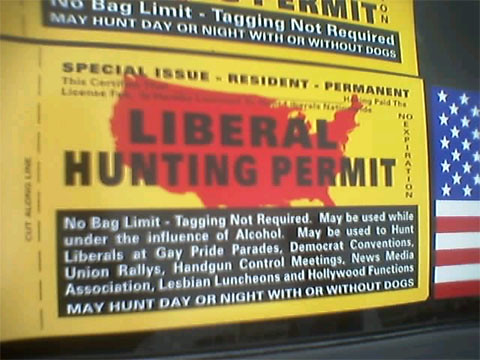
This bumper sticker was spotted by Left in SF over the weekend -- disturbingly, on an SUV parked among a crowd of cars out for a gay-pride rally.

These "permits" have been around for awhile now, mostly circulating on the fringes of the far right, but they've been increasingly making their way into broader circulation. One of the Minutemen described in Andy Isaacson's mash letter to that extremist phenomenon sported just such a sticker on his rig.

The people sporting such stickers, no doubt, will contend that it's just a joke -- as though such a fig leaf could disguise the violent attitudes and beliefs required to find it humorous. Next they'll argue that stickers saying "Hitler Needed to Finish the Job" are just meant to be funny.

This is, of course, just another permutation of the rising tide of eliminationist rhetoric directed at liberals. It's everywhere -- including now, thanks to Karl Rove, the highest echelons of the Bush administration.

I can't say I was terribly surprised by Rove's remarks, but they are well worth noting for their precise content:
"Conservatives saw the savagery of 9/11 in the attacks and prepared for war; liberals saw the savagery of the 9/11 attacks and wanted to prepare indictments and offer therapy and understanding for our attackers," Mr. Rove, the senior political adviser to President Bush, said at a fund-raiser in Midtown for the Conservative Party of New York State.

Citing calls by progressive groups to respond carefully to the attacks, Mr. Rove said to the applause of several hundred audience members, "I don't know about you, but moderation and restraint is not what I felt when I watched the twin towers crumble to the ground, a side of the Pentagon destroyed, and almost 3,000 of our fellow citizens perish in flames and rubble."

...Mr. Rove also said American armed forces overseas were in more jeopardy as a result of remarks last week by Senator Richard J. Durbin, Democrat of Illinois, who compared American mistreatment of detainees to the acts of "Nazis, Soviets in their gulags, or some mad regime - Pol Pot or others."

"Has there ever been a more revealing moment this year?" Mr. Rove asked. "Let me just put this in fairly simple terms: Al Jazeera now broadcasts the words of Senator Durbin to the Mideast, certainly putting our troops in greater danger. No more needs to be said about the motives of liberals."

Rather predictably, the right, from Michelle Malkin to Tom DeLay, has closed ranks and defended Rove's remarks as "the truth." (Malkin says Rove distilled "the fundamental difference between the left and the right's approaches to terrorism in the wake of 9/11.")

But there should be no real surprise that Rove made these remarks. They've been a long time coming. I mean, Ann Coulter published Treason: Liberal Treachery from the Cold War to the War on Terrorism two years ago. Sean Hannity's Deliver Us From Evil: Defeating Terrorism, Despotism, and Liberalism came out a year ago. Michael Savage published The Enemy Within: Saving America from the Liberal Assault on Our Schools, Faith, and Military last year too. Meanwhile, there's been a steady drumbeat on the airwaves from Rush Limbaugh and his thousand little imitators making the same charges.

This is how propaganda is supposed to work: Circulate ideas on the popular level first, perhaps disguised as "humor" or "edgy commentary," until they become part of a broadly popular "conventional wisdom." Seemingly "outrageous" ideas gradually gain broader acceptance, leveraging the populace toward the movement's agenda. Then, when these notions are enunciated at the official and most powerful levels of government, any outrage that might be voiced is easily ignored. (Indeed, Rove's remarks are notable for being the embodiment of a panoply of propaganda techniques all rolled into one.)

Of course, I've been warning about the trend toward eliminationism for some time now. Some points I made in a more recent version of this are worth repeating:
The terrorist attacks of Sept. 11, 2001, the resulting "war on terror" and subsequent invasion of Iraq all played major roles in fomenting this syndrome. At each step of the drama, liberals (increasingly defined as "anyone not in line with conservative movement dogma") in the media and elsewhere were accused of aiding and abetting the enemy, and increasingly became identified with the enemy. Manipulating a traumatized national psyche, the conservative movement throughout the drama began responding to its critics by mobilizing intimidation campaigns both from above and below, further shutting liberals off from national discourse, and doing their utmost to silence dissent, especially as its intiatives on a variety of fronts began producing grotesque disasters.

These campaigns played a decisive role in the way American journalists covered the misbegotten decision to invade Iraq, an invasion we now know was based on false pretenses. ...

What's important to understand is what the nature of these appeals -- and their self-evident success -- tells us simultaneously about the nature of the audience. Because the very nature of fundamentalist apocalypticism is profoundly dualist -- entirely contingent on a black-and-white Manichean worldview -- it is clear that the majority of at least the religious followers of the conservative movement are what is known as "totalists".

Fundamental to understanding totalitarianism is realizing that, contrary to the "brainwashing" model in which the totalitarian regime is imposed on a society from without and against their will, the reality is that nearly every totalitarian regime in history has succeeded because of the avid and willing participation of citizens eager to be its subjects.

As I've gone on to explain elsewhere, the emergence of Manichean totalism in the American electorate has become unmistakable in recent months. The open embrace of eliminationist rhetoric by the Bush administration, after years of propagandization by right-wing agitators that made this possible, raises the stakes to genuinely serious levels.

"Liberal hunting licenses" are only the ground-level expression of this rhetoric. If these sentiments were confined to a few bumper stickers by a handful of nutjobs, they might not be cause for concern. But there's a clear connection between Limbaugh's eliminationism aimed at liberals and its more explicit manifestations, just as there's a connection between Limbaugh's rhetoric and Rove's.

There are historical antecedents to this particular motif from right-wing hatemongers as well. The Klan and Aryan Nations, for instance, used to commonly circulate similar "nigger hunting license" as "jokes" (some dating back to the lynching era).

And then there were these, available in Seattle back in 1944:


And, lest we forget, it's perhaps helpful to observe what happened to the targets of these previous "hunting licenses":


We may comfort ourselves with the easy dismissal of such "jokes" as mere crude humor. But they are a signal of something much deeper, and much more dangerous.

Tuesday, June 21, 2005

Talking about hate crimes

Well, as promised, I appeared this afternoon on Michael Medved's radio show on KTTH-AM in Seattle to talk about hate crimes. We used my book Death on the Fourth of July: The Story of a Killing, a Trial, and Hate Crime in America as a jumping-off point.

I was treated courteously throughout (Medved did have to prod me at one point when I was trying not altogether successfully to come up with a succinct way to make a point) and I thought the hour was well spent. Obviously, I didn't make a convert out of Medved, but I think I managed to clear up a lot of the myths about hate crimes that permeate the discussion.

The rush of a radio talk show often sweeps away more detailed points, and there was one case of this I thought I'd explain a little more here. I mentioned, during the show, that there was a recent story in the Philly Inquirer about a significant upsurge in white-supremacist activity in New Jersey. Many of the hate crimes being perpetrated as result of this trend were anti-Semitic crimes, ranging from assaults to vandalism. But there was another component: immigrants were probably being attacked in significant numbers, but were not reporting the crimes:
Jews are hardly the only group that has felt the press of hate groups, many of which have been motivated by an influx of immigrants, experts say.

Last year, a pack of teens and young men called the East Coast Hate Crew attacked at least 10 Mexican men in Ocean County over a four-month period, investigators said. The beatings and robberies typically took place on streets late at night as the Mexicans were heading home from work.

Eight people were charged with the crimes. Officials suspected more attacks, said Christensen, the state investigator, but it was difficult to find victims because many would have been illegal immigrants.

"They were just getting beaten and walking home with their friends and not reporting this to the police," he said.

This points to one of the most significant reasons that hate crimes are underreported substantially in this country (as I said on the air, the Southern Poverty Law Center estimates that, in contrast to the 9,000 or so reported to the FBI annually, the actual figure is likely close to 40,000): a major portion of the unreported hate crimes involve attacks on immigrants. This trend has been increasing rapidly in the past year or two.

I explained some of this on pp. 168-169 of Death on the Fourth of July:
Of all the factors that cause law-enforcement officers to fail to identify and investigate bias crimes, the most significant, the DOJ study's authors found, was the gap between the victims and the police. The less trust that exists between minorities and their local law enforcement, the greater the likelihood that hate crimes will go unresolved.

The Filipino family that encountered Chris Kinison and his friends in Ocean Shores was a textbook example of how hate crimes can go unresolved this way. Many of the victims spoke poor English and had difficulty communicating with the police officers who came to their rescue; even though some of them later reported that they had wanted to pursue harassment charges against the men, the officers either failed or refused to register this. And the officers, little trained in dealing with hate crimes, clearly did not recognize that they had come upon the scene of a felony, which in most other such cases would require a careful and serious investigation and specialized handling of the victims.

By seeming eager to simply break up the potential violence and send everyone on their respective ways—and particularly by escorting the family to the town's borders—the officers communicated to the victims the message that the harassment they had endured was insignificant. This in turn feeds the distrust that any outsider (particularly a minority) in a strange town is likely to feel.

Moreover, the incident vividly illustrates that the problem of letting hate crimes go unresolved extends well beyond the mere statistical issues, and that the stakes can be very high indeed, especially for small towns. The result, as it was in Ocean Shores, was that these crimes can escalate from simple harassment to outright violence. Perpetrators, as some studies have observed, see their escape from the arm of the law almost as an invitation to step things up.

Other studies have likewise observed that the most common cause of this cascade of crime is the failure of police to proactively bridge the gap between themselves and the victims. The JRSA's Joan Weiss, in earlier research, found that the reluctance of victims to report crimes was significantly higher for hate crimes than for other crimes. The DOJ study reiterates this point: "For a multitude of reasons, hate crime victims are a population that is leery of reporting crimes—bias or otherwise—to law enforcement agencies."

Most hate-crime victims are minorities in the communities where the crimes occur. In many cases, they have poor English skills and have difficulty asking for assistance; in others, they may simply be unaware that what has happened to them is a serious crime. This is particularly true for immigrants, who may be reluctant to even contact police because of their experience with law enforcement in their homelands, where corruption and indifference to such crimes are not uncommon. Likewise, hate-crime victims may be confused about or unaware of the bias motivation involved, interpreting a threat or assault as a random act when other evidence suggests it was not. At other times, they may be reluctant to tell police about the bias aspects of the acts against them, fearing the police won't believe them or that they simply won't do anything about it anyway. And in the case of gays and lesbians, many are reluctant to report the crimes out of fear they will be forced to reveal their own identities as homosexuals; many more fear (sometimes with good reason) that they will wind up being humiliated and victimized further by police.

Likewise, many minorities in certain communities—blacks in the South or Hispanics in the Southwest, for example—have long histories of built-up distrust of law enforcement in their communities, and may simply refuse to participate in an investigation without proactive efforts on the part of police to bridge that gap. Indeed, this level of involvement was almost unanimously the chief factor reported by advocacy groups when queried by the authors of the DOJ study about what most affected hate-crime victims' decision to call or cooperate with police.

Of course, I was going to explain all that in a sentence or two. Really.

I do like blogs better than talk shows, because, you know, if I stammer behind the keyboard, I can just erase it. But thanks to Medved for the courteous and rational conversation.

[I don't think either an archive or transcript of the conversation exists, sorry to report.]

Bush World: Where science is fungible

Fresh on the heels of news storiesthat Bush administration officials tampered with government climate reports, this story in the Los Angeles Times just left me shaking my head:
Land Study on Grazing Denounced
Two retired specialists say Interior excised their warnings on the effects on wildlife and water

It describes how Bush administration officials completely reversed the scientific findings of veteran experts en route to turning public lands into open range for ranchers:
The Bush administration altered critical portions of a scientific analysis of the environmental impact of cattle grazing on public lands before announcing Thursday that it would relax regulations limiting grazing on those lands, according to scientists involved in the study.

A government biologist and a hydrologist, who both retired this year from the Bureau of Land Management, said their conclusions that the proposed new rules might adversely affect water quality and wildlife, including endangered species, were excised and replaced with language justifying less stringent regulations favored by cattle ranchers.

... The original draft of the environmental analysis warned that the new rules would have a "significant adverse impact" on wildlife, but that phrase was removed. The bureau now concludes that the grazing regulations are "beneficial to animals."

Eliminated from the final draft was another conclusion that read: "The Proposed Action will have a slow, long-term adverse impact on wildlife and biological diversity in general."

Also removed was language saying how a number of the rule changes could adversely affect endangered species.

"This is a whitewash. They took all of our science and reversed it 180 degrees," said Erick Campbell, a former BLM state biologist in Nevada and a 30-year bureau employee who retired this year. He was the author of sections of the report pertaining to the effect on wildlife and threatened and endangered species.

"They rewrote everything," Campbell said in an interview this week. "It's a crime."

You've just gotta love what those new regulations will do, too:
The new rules, published Friday by the BLM, a division of the Department of Interior, ensures ranchers expanded access to public land and requires federal land managers to conduct protracted studies before taking action to limit that access.

The rules reverse a long-standing agency policy that gave BLM experts the authority to quickly determine whether livestock grazing was inflicting damage.

The regulations also eliminate the agency's obligation to seek public input on some grazing decisions. Public comment will be allowed but not required.

OK, a quick tally: negating scientific review, forcing public lands to accommodate private industry, reducing the ability of land managers to respond to land degradation, and then cutting out public participation. Could this possibly be any worse for the public?

Well, yes, because the rules reverse some real gains made in recent years in bringing public land use -- including that by ranchers -- to sustainable levels:
In recent years, concerns about the condition of much Western grazing land has been heightened by drought, which has denuded pastures in the most arid areas, causing bureau managers to close some pastures and prompting ranchers to sell their herds.

The new rules mark a departure from grazing regulations adopted in 1995 under President Clinton and Interior Secretary Bruce Babbitt. Those regulations reflected the view of range scientists that a legacy of overgrazing in the West had degraded scarce water resources, damaged native plant communities and imperiled wildlife.

Babbitt ordered the bureau to establish standards that spelled out when public lands were open for grazing, and for the first time required range specialists to assess each pasture to ensure it held enough vegetation to support wildlife and livestock. It was the first time in about 50 years that the federal government had tried sweeping overhauls of how Western ranchers operated on public lands.

It would be like spitting into the wind, I suppose, to ask these ranchers where they think their grazing lands are going to come from when they've all been destroyed. But hey, that's someone else's long-term problem, isn't it?

It's certainly not the Bush administration's.

I come from ranching country and have written more range-management stories than I care to recall (it's not what you'd call glamor reporting). I thought I'd seen it all during the James Watt/Anne Gorsuch years, but the Bush gang really take the In Your Face Audacity prize. They're rewriting the management of public lands so that they are now no longer really belong to the public.

Just as disturbing is the consistency in the outright of abuse of scientific review for predetermined ends. At some point, you'd think people would figure out that our government is now in the hands of religious ideologues and corporate profiteers who see science as the enemy. As a nation whose superiority is built on technology that is built on science, that should trouble even conservatives.

[Via Thoughts From Kansas, which has a nice roundup of other atrocities on the endangered-species front as well.]

Monday, June 20, 2005

Radio Free Orcinus

I'm venturing into hostile territory today, at the studios of the local right-wing talk-show station KTTH-AM in Seattle, where I'll be the guest on the Michael Medved show, which is nationally syndicated. If you have Medved on a local station, you should be able to catch it.

We'll be debating hate-crime laws and whether we should have them or not. We'll discuss my book Death on the Fourth of July: The Story of a Killing, a Trial, and Hate Crime in America, which is due out in paperback next month. (More on that later.)

Medved is opposed to the concept of hate crimes, so I'll be discussing that with him. This doesn't surprise me, incidentally; he's also made clear that he thinks anti-discrimination laws are wrong-headed (and, apparently, unconstitutional) as well. The constitutionality of bias-crime laws, as it happens, is predicated in several important regards on the precedent of those rulings that upheld anti-discrimination laws.

I typically avoid right-wing talk shows, especially in situations where the host is obviously hostile. Usually such appearances are simple muggings in which the guest is set up, ambushed, incessantly interrupted, and then browbeaten in the closing segment without any chance of rebuttal. It's not a fair game, and I'm not interested in playing.

But I listen to Medved's show irregularly, and my impression is that, though I may disagree with him, he avoids that kind of ugly setup for the most part. I say "for the most part" because I know that Mark Crispin Miller, in his appearance on Medved's show last summer, had exactly the kind of experience I describe as typical for other shows.

So I'll be reporting back here with my impressions.

Incidentally, you can listen to my interview with KDVS's Richard Estes and Ron Glick by going to his program's Web site and clicking on the link. It will, however, be available only for a week. That interview was about my most recent book, Strawberry Days: How Internment Destroyed a Japanese American Community.

The real Minutemen

The media keep sending love letters to the Minutemen, this time in the form of a remarkably nearsighted Monterey Weekly piece that offered the following assessment:
Indeed, it soon seemed that the hysteria over the armed and dangerous Minutemen was much ado about nothing. Retired men and women sitting on the backs of pickup trucks in six-hour shifts, concentrated along a two-mile stretch of border fence eyeing the vacant desert, appeared more like a group on a bird watching excursion than a paramilitary force.

The author of the piece, Andy Isaacson, thus blithely ignores one of the realities about dealing with organizations like the Minutemen: when they're posing in front of the cameras, they're very careful about what they say and how they appear. It's what they're doing and saying when no one is looking that is the problem.

I had a little experience with this in my dealings with a previous permutation of the militia movement -- from which, in fact, the border "patriots" are directly derived. The Washington State Militia, for instance, held public rallies and talked before the cameras about how they were just trying to be a "neighborhood watch" out to protect their fellow citizens. Behind closed doors, as we later learned, they were building pipe bombs and talking about blowing up railroad tunnels as well as their fellow citizens. (See In God's Country for more on this.)

The Minutemen's public face works exactly the same: Have your spokesmen work hard to present a sincere and concerned image of ordinary citizens who are just "fed up," while behind closed doors they let their hair down. The core of the Minutemen comprises a corps of True Believers from the extremist right. The leaders spout talk about the "war on terror" in public, but the followers mostly (in private, of course) spout talk about their neighborhoods and homes being "invaded" by criminal brown people.

A good example of this popped up in a recent story out of Tennessee involving a formative Minuteman operation there. Tennessee, of course, has no international border; and so its Minutemen, unsurprisingly, are focused on the "invasion" of Latinos from elsewhere:
Before a meeting in Hamblen County Tuesday night, 6 News asked meeting leader Carl Whitaker if he's operating a hate group, like some people say.

"We're not a hate group. We're a concerned group. We're concerned what's happening," Whitaker says. "If people are here illegally and they want to get legal, we would be glad to try to help them follow through the process. We don't hate anybody."

He says the Tennessee Volunteer Minutemen are working to expose companies that hire illegal aliens and take jobs away from taxpaying Americans. "We've turned in five different places of employment here that are hiring illegals."

But another supporter told a different story. Off-camera, James Drinnon says there are more Mexicans than African-Americans in Hamblen County. But he didn't really say African-American. He used the "N" word.

On camera, Drinnon says, "I think they ought to get them all out. Most of them in here. That's where all the dope's coming from. Most of them's Hispanic."

That's pretty consonant with the expressions of support from the Minutemen we've seen in the comments section of this blog, isn't it?

It also resonates with a quote from another Minuteman I posted earlier:
"We understand why Gilchrist and [project co-organizer Chris] Simcox have to talk all this P.C., crap," said one. "It's all about playing to the media. That's fine. While we're here, it's their game and we'll play by their rules. Once Minuteman's over, though, we might just have to come back and do our own thing."

The Minutemen keep promising us that they're just ordinary folks. Of, course, so do Ku Klux Klan members. And there's little mistaking the real presence of exactly the same kind of "citizens" throughout this merry band, forming its real, activist core.

Daryle Jenkins of One People's Project recently found a historical reason for that: Neo-Nazis have been talking about forming precisely this kind of "citizen's border patrol" for many years now. He has the video to prove it:
Almost thirty years ago there was another group that basically our current vigilante xenophobes pattern themselves after. They weren't called the Minuteman Project then. They were the Klan Border Patrol, and it was what gave David Duke his first big break. This is an excerpt from a 1989 video titled The History of W.A.R., Pt. 1. For those who forgotten about this crew, W.A.R. stands for White Aryan Resistance, the group that Tom Metzger runs when he isn't going around California doing blues karaoke. He talks about the formation of the Klan Border Patrol back in Oct. 1977 and what it entailed.

They may hide behind masks -- whether made of white sheets or soothing PR. But we can see who they are well enough anyway.

'A chance to invade'

Everyone is taking a stab at answering the question, "Why did we invade Iraq?" See, especially, Matt Yglesias' take, which points out that one of the real outrages in the memo is the utter lack of postwar planning it depicts.

Today, Russ Baker points out in Tom Paine.com that he reported back in October, in interviews with a former Bush speechwriter, that Bush actually had envsioned invading Iraq well before 9/11:
"He was thinking about invading Iraq in 1999," said author and journalist Mickey Herskowitz. "It was on his mind. He said to me: 'One of the keys to being seen as a great leader is to be seen as a commander-in-chief.' And he said, 'My father had all this political capital built up when he drove the Iraqis out of Kuwait and he wasted it.' He said, 'If I have a chance to invade . . . .if I had that much capital, I'm not going to waste it. I'm going to get everything passed that I want to get passed and I'm going to have a successful presidency."

The mainstream press dismissed the stories and essentially ignored them. However, the Downing Street Memo only confirmed what Herskowitz was describing.

At times, I think even the talk about PNAC and the Bush Doctrine is something of a smokescreen when it comes to explaining why we invaded Iraq. It is clear, after years of observing him in action, that George W. Bush's style of leadership consists of finding data and evidence to confirm his preconceived notions. He adopted the PNAC and Iraqi National Congress folks because they were saying what he wanted to hear.

And invading Iraq was what he wanted to hear because that was his vision for his presidency from the get-go. Of course, it is a vision drenched in Oedipal rivalry and crude power-mongering, using war as a pretense for a broader political agenda.

Which is, of course, exactly what we got.