But Trump did not become the object of white nationalist affection
simply because his positions reflect their core concerns. Extremists
made him their chosen candidate and now hail him as "Emperor Trump"
because he has amplified their message on social media—and, perhaps
most importantly, has gone to great lengths to avoid distancing himself
from the racist right. With the exception of Duke, Trump has not
disavowed a single endorsement from the dozens of neo-Nazis, Klansmen,
white nationalists, and militia supporters who have backed him.
The GOP nominee, along with his family members, staffers, and
surrogates, has instead provided an unprecedented platform for the ideas
and rhetoric of far-right extremists, extending their reach. And when
challenged on it by the press, Trump has stalled, feigned ignorance, or
deflected—but has never specifically rejected any of these other
extremists or their ideas.
This stance has thrilled and emboldened hate groups far more than has
been generally understood during the 2016 race for the White House.
Moreover, Trump's tacit welcoming of these hate groups into mainstream
American politics will have long-lasting consequences, according to
these groups' own leaders, regardless of the election outcome.
In putting this piece together, Sarah Posner and I, along with Esther Kaplan and her team at the Nation Institute's Investigative Fund (Jaime Longoria, Kalen Goodluck, and Evan Malmgren) compiled a database to track all of Trump's many connections to the extremist right -- and it turned out to be massive. I was fortunate to have such gifted partners in Sarah and Esther, who were able to help shape it into what I think is a powerfully compelling narrative.
Some of the data I collected included memes from various alt-right websites and forums/chatrooms. It's some of the most vile material I've ever gathered in doing this work over many years.
Here's a collection of some of them. The most vicious ones are also near-pornographic, so I won't be posting those.
But the next time one of your Trump-loving friends complains about Hillary's comments regarding that "basket of deplorables," show them these and ask them if they consider the description wrong for these people.
Myself, I think they're even worse than that. I call them "the Execrables." And Trump has raised an army of them.
Taylor Rose likes to project a fresh-scrubbed, wholesome image to his
fellow Montanans while campaigning for a seat in the state’s House of
Representatives. It’s easy for the blonde-haired, blue-eyed and
clean-shaven 28-year-old from the rural Columbia Falls area to do,
flashing a toothy grin and ranting about the need to get the federal
government out of workers’ hair and open up the state’s timberlands to
lumber operations.
The image, combined with a pleasing message (Rose likes to label himself a “pro-labor Republican”)
and a slick campaign, have all raised the prospects that Rose might be
able to pull off an upset win over incumbent Rep. Zac Perry, a Democrat,
in the race for the House seat in District 3, which historically leans
Republican.
Taylor Rose
What many voters may not realize, however, is Taylor’s long history
of deep involvement with the white nationalist movement, and the
dangerously bigoted worldview he has promoted since his teenage years ––
a history well documented by the SPLC and the Anti-Defamation League in the years leading up to his campaign.
But Taylor has now carefully whitewashed his image with the help
of the Montana Republican Party. GOP candidates have employed Rose for
state campaigns and as a legislative aide. A number of mainstream
Republican candidates, including GOP gubernatorial candidate Greg
Gianforte, have contributed to Rose’s campaign. And one leading Montana
Republican dismissed concerns about his background, saying “the rest of
us think of him as a good conservative.”
Rachel Carroll Rivas, executive director of the Montana Human Rights
Network, said the GOP’s embrace of Rose is taking place in the broader
context of a national Republican party that has nominated Donald Trump,
whose own alliances with the radical right have radically altered the
nation’s political landscape.
"In the current climate it's hard to pick out the most concerning
things we see playing out on the ground, but Rose's candidacy makes the
list easily,” she said. “The political environment has clearly shifted
when there is mainstream party acceptance and grooming of someone with
well-documented white supremacist activity in recent years.”
Rose first came to enter the movement in 2011 when his activities on behalf of the white nationalist Youth for Western Civilization were reported by the Center for New Community. Rose, then a recent graduate of Liberty University (the college founded by religious-right leader Jerry Falwell), appeared at a YWC-sponsored “March for Freedom” in Cologne, Germany. He also met with members of Vlaams Belang,
the far-right Belgian political party, and members of German
organizations designated by authorities there as “right-wing extremist.”
Rose also authored a book in 2012 titled Return of the Right: How the Political Right Is Taking Back Western Civilization, which
argued that Western humanists are attempting to impose a “vision to
destroy the nation-state, eliminate religion, break down all defined
barriers in society (such as family) and eliminate western civilization
from the face of the earth in the attempt to institute a radical,
multicultural, New World Order agenda.” In the book, Rose argued that
this nefarious plot is failing because “the Western world is coming to
realize the complete emptiness and harm of belief systems that are at
their core, nihilistic.”
The neo-Confederate hate group the League of the South interviewed Rose about the book
when it came out. During the interview, Rose continued to warn of the
evil nature of “the Left” and predicted that a white nationalist Right
would soon rise to the fore in global politics. “You will first see the
Right-Wing act as a great power of political influence, mainly upon the
center-right, by reorienting the ideas of the center-right to reform
immigration policy and take a more hard-line anti-Socialist stance,” he
said.
Since returning to Montana, Rose has cultivated political ties with
an eye toward running for office –– mostly through the auspices of the
state’s GOP, which has made no effort to renounce or distance itself
from Rose. Indeed, in the years since Rose's radical beliefs surfaced,
the Montana GOP has warmly embraced him:
Rose worked as the Northwest Montana campaign coordinator for
then-GOP candidate Steven Daines in his 2014 U.S. Senate race, which
Daines won. Sen. Daines’ office did not respond to Hatewatch’s request
for comment or explanation.
In 2015, Rose was hired by Montana Senate Republicans
as a legislative bill title reader and as a majority aide, a staff
position that enabled Rose to network widely with party officials and
senators. According to Carroll Rivas, Rose used that position not only
to make political connections but to actively tamper with the political
process: “He was so bad and out of line that there were times in
committee that he would actually say a vote in the back of the room –
they would be voting in committee, and he would say ‘yea’ or ‘nay’ in
the back of the room.”
When asked about Rose’s candidacy during a roundtable political talk
show in June, Rep. Matthew Monforton of Bozeman, a leading House
Republican, dismissed concerns about Rose’s white nationalist
background, saying “the rest of us think of him as a good conservative.”
On his campaign Facebook page, Rose has boasted of his broad engagement with the local Republican Party, including posing for photos with local leaders at the Flathead County Fair.
Several mainstream Republican candidates have donated to Rose’s
campaign, notably GOP gubernatorial candidate Greg Gianforte, who gave a $170 donation to Rose
that was matched by his wife. Rose also received donations from
Republican Sen. Mark Blasdel of Kalispell and Rep. Greg Hertz of Polson.
Hatewatch attempted to reach a number of Montana GOP officials, including Monforton and Daines.
In addition to coverage by the SPLC, Rose’s white nationalist background has been detailed at Montana Cowgirl, Raw Story, and Wonkette. However, most Montana media coverage of his race and his candidacy (such as Rose’s profile at the Missoulian) has omitted any mention of his history of radicalism.
Rose has never renounced or apologized for his radical past, which
is extensive. Indeed, he has continued to embrace it, even appearing
last fall on a young-conservative website's podcast discussing
his candidacy with a “Montana Sovereign” banner proudly displayed
behind him – referencing his apparent involvement in the far-right sovereign citizens movement as well. In a recent interview in the Flathead Beacon, Rose denied that he was a racial supremacist and focused on defending the traditional cultural values of Western Civilization.
“I am not affiliated with white supremacist groups or leaders,” Rose
told the newspaper. “To say otherwise is slanderous. YWC was a cultural
group, not a racist group. We defined Western civilization by the
classic definition of ancient Greeks and Romans, and we were
pro-Christian. We did not say it was exclusively white. We were also
very critical of Islam, but that is an ideological issue, not a racial
issue. I can promise you that Liberty University would not have
tolerated a white power group on its campus.”
In reality, YWC was an overt white nationalist organization with multiple connections to white supremacists, though it often used code words
such as “cultural identity” and “racial chauvinists” to disguise its
racism, arguing that white people face rampant discrimination at the
hands of multiculturalism. Some of its better-known members and
associates –– Matthew Heimbach and Kyle Bristow –– have gone on to found their own white nationalist groups.
In the meantime, Rose has been busily voicing racially and ethnically
incendiary sentiments on social media over the past year. He expressed
revulsion at the prospect of a white couple giving birth to two black
babies via artificial insemination. He also bitterly complained when it
was announced that Harriet Tubman, the black woman who helped lead the
Underground Railroad during the Civil War, would replace Andrew Jackson
on the $20 bill. In one of his Facebook posts,
he compared the action to the removal of Confederate monuments around
the nation in the wake of the mass shooting at a black church in
Charleston, S.C., by a white-supremacist Confederacy admirer.
One of his commenters chimed in: “It’d be a lot quieter if they were all hanging from nooses.”
On Rose’s campaign Facebook page, he has openly indulged in Islamophobic attacks on Muslim immigrants and Syrian refugees. In one post published in March,
he wrote, “Terrorism in Europe during the Cold War was mostly conducted
by homegrown, native European Leftist terrorist groups. Now it is
committed by Islamic immigrants or the decedents of Islamic immigrants.
If we stop the importation of the jihadies, we won't have these
attacks.”
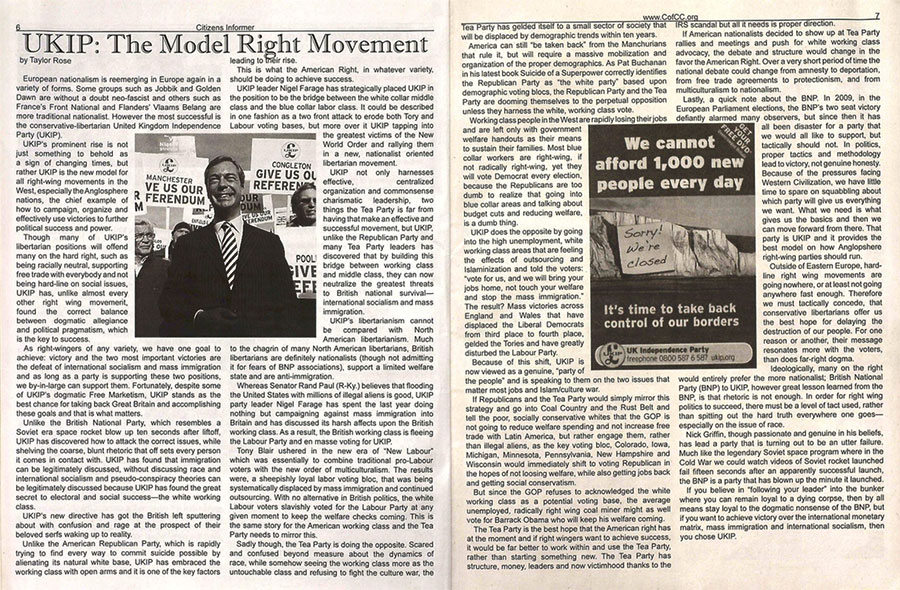
The article, which was published in the Jan.-June 2013 issue of the
paper, sings the praises of UKIP (United Kingdom Independence Party),
headed by Nigel Farage, who, according to a former classmate,
once sang a song with the lyrics "gas 'em all, gas 'em all" and liked
that his initials were the same as the neo-Nazi National Front.
Rose wrote that UKIP "provides the best model on how Anglosphere
right-wing parties should run," and then noted that "we must tactically
concede that conservative libertarians offer us the best hope for
delaying the destruction of our people." "If American nationalists, Rose
wrote, "decided to show up at Tea Party rallies and meetings and push
for white working class advocacy, the debate and structure would change
in favor of the American right” and, according to Rose, the national
debate “could change from amnesty to deportation and from
multiculturalism to nationalism.”
"UKIP: The Model Right Movement," written
by Taylor Rose and published in the Citizens Informer, the publication
of the Council of Conservative Citizens.
And while he’s running for a legislative seat, Rose nonetheless appears not to be a fan of democratic republics. He’s a member of a Facebook public group called Monarchists,
which “exists for the purpose of civil discussion between monarchists
and those interested in monarchy as the ideal form of human governance.”
Rose also conducted an interview in April
with the “Patriot” movement website NorthWest Liberty News’ weekly
podcast (though the link for that interview appears to be broken).
In an interview for a podcast with Ryan Girdusky
of the young-conservative website Red Alert Politics, Rose lightly
brushed over his radicalism and focused mostly on his status as a “young
millennial” running for office. However, behind Rose for the duration
of the interview was a banner declaring “Montana Sovereign – Don’t Tread
On Me,” clearly indicating that Rose considers himself an
antigovernment “sovereign citizen,” a movement that has been part of the Montana scene since the 1990s, in the heyday of the Montana Freemen and the Militia of Montana.
Rose’s description of his warm welcome by the Montana GOP in that
interview made for a stark contrast with the banner behind him.
ROSE: Local Republican leadership in the county, and I’ve
spoken with a lot of the Republican leadership across the state, is
very, very excited. They really have been very nice to young people
rising up. In the current Legislature, we already have several
millennials sitting in House seats across the state, and so when I
decided to throw my hat in the ring and started talking to people about
this, the leadership was very excited. They’ve been very helpful,
they’ve been very excited at the idea that there are more young people
that want to get involved, and they don’t want to get in our way.
There’s definitely – they’re not being restrictive. The old guard of the
party is being very helpful and very nice to us young people in helping
us rise up and have a voice and speak for millennials.
In his interview with the Beacon, Rose touted his broad acceptance by the local and state GOP as proof that accusations about his radicalism “don’t add up.”
“I was open about my past involvement with YWC, and I was vetted by
the Republican Party,” he told the newspaper. “I wouldn’t say that I am a
mainstream candidate, but I’m not on the fringe either. The minute you
reject multiculturalism, you become a target for the left, and that is
what’s happened
here.”
Rivas said that Rose’s embrace by the GOP represents an unfortunate
evolutionary shift in the state’s politics, in which such extremists,
always present in the background, had typically been relegated to the
fringe.
“In previous years, the Montana Republican Party distanced themselves
from candidates like Rose who had ties groups like the Klan and
National Socialist Movement,” she said. “The times have changed. The
efforts by the Alt-Right to put a nice suit on their racism may be
viewed as effective in this case. And, while Rose’s views seems aligned
with the Richard Spencers of the world, his vision isn’t so different than April Gaede’s Pioneer Little Europe.
“This is the reality of what the people of the Flathead Valley are
facing right now –– a triangulation between two white supremacists on
the national stage and a candidate for state house that just might win. I
fear to imagine what’s next.”
As he has emerged over
the past couple of years as the leading figure in Idaho’s antigovernment
movement, Brandon Curtiss has cultivated a straight-talking,
square-dealing public image with both the public and the followers of
his 3% of Idaho organization.
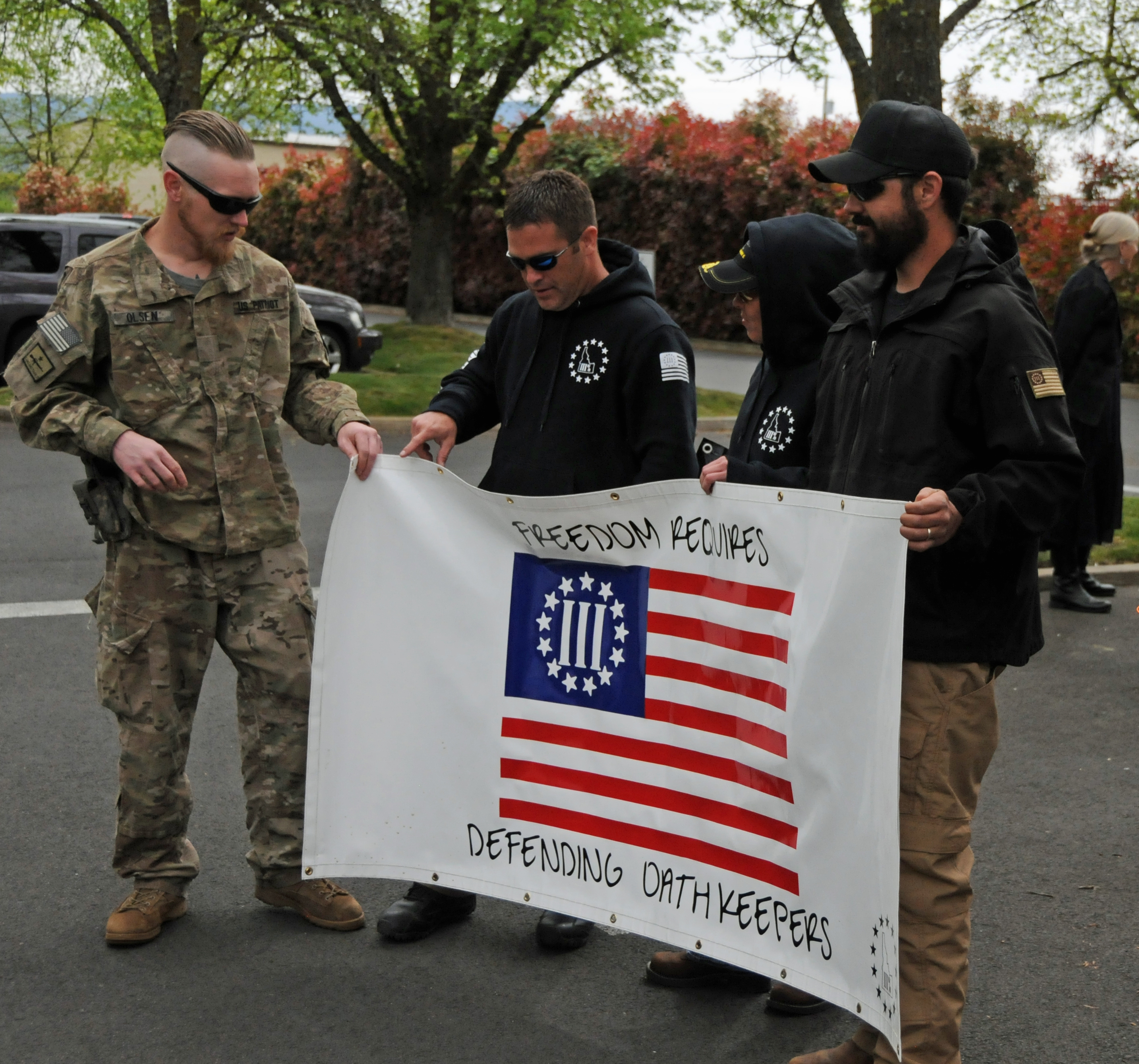
Brandon Curtiss (second from left) and
Eric 'EJ' Parker (right) in happier times, protesting the Bureau of Land
Management in Medford, Ore., in April 2015.
That image, however, collapsed like this week when a large and
prominent group of his followers – including his former vice president
and longtime cohort in the organization, Eric “EJ” Parker – announced
their resignations from 3% of Idaho. The group of 36 members were
angered over his reported misappropriation of funds raised to help the
defense of four Idahoans, notably Parker himself, by federal authorities
over their respective roles in two federal lands standoffs led by
Cliven Bundy and his two sons in Nevada and Oregon.
According to the Idaho Statesman,
some of the members were able to gain access to the PayPal website page
and bank accounts for the organization’s “Freedom Fest” concert, held
as a fund-raiser for four “political prisoners” – Parker, 32, of Hailey,
Steve Arthur Stewart, 36, of Hailey, O. Scott Drexler, 44, of Challis
and Todd Engel, 48, of Boundary County – arrested on charges
related to the Nevada standoff in April 2014 in Bunkerville, Nev. What
they discovered was a steady outflow of funds from the account for
Curtiss’ personal use, including:
“Rollin Smoke Diesel” parts for a
pickup that allow owners to customize their trucks so they belch large
amounts of black smoke, a popular fad with right-wing activists who
oppose global-warming activism.
A camping reservation.
Gas and food at a truck stop in Nevada.
A car wash.
Payment for a storage unit.
Payment for online personal-investigation services.
A Walmart purchase.
An iTunes download.
Already before the $2,475 in funds from the concert were
deposited, the account was overdrawn some $567, mostly from Curtiss’
personal use, which was immediately withdrawn. When one former member
observed this and objected to Curtiss, according to the Statesman, she
was dismissed from the organization.
“Many of us, in one way or another have worked toward, contributed
to, donated for, and sacrificed our time, hope, energy, and resources to
help these men in their hour of need,” wrote the departing members in
an official statement. “It is with heavy hearts that we, the
undersigned, do solemnly testify to you that we believe that substantial
portions of these gifts have been grievously misused within the Idaho
III% organization. We do not put forth this accusation lightly, or
without due diligence and proper deliberation ad nauseum.”
3% of Idaho issued a statement
Thursday calling the revelations a "smear campaign" and asserting that a
promised audit of the group's finances would demonstrate that funds
were not mishandled. It also claimed
that the group had raised much more money for the prisoners than what
had been raised at the concert, and that those funds had been spent on
their defense.
Curtiss, left, and Parker, center, with Sugar Pine Mine co-owner Rick Barclay, expressing their view of the mainstream press.
Curtiss has been nothing if not imaginative in building 3% of Idaho
into the state’s leading “Patriot” group, with a membership he claims
has reached over 1,000. They joined arms with antigovernment Oath
Keepers to participate in a protest and attempted armed standoff with federal authorities at the Sugar Pine Mine near Grants Pass, Ore., in the spring of 2015, and did similarly with another mine protest in Montana later that summer and fall. His “Threepers” also showed up with Oath Keepers to stand guard outside military recruiting offices in Idaho, and became heavily embroiled in the controversy in the Twin Falls area over Muslim refugee resettlement, leading a large protest against the refugees in November 2015. They then showed up to protest an even larger rally supporting the refugees later that month.
But Curtiss became an even more significant figure in January 2016 when he helped organize a protest in Burns, Ore.,
against the imminent incarceration of two local ranchers, which
afterward morphed into the armed takeover of the nearby Malheur National
Wildlife Refuge by Ammon and Ryan Bundy and their cohort of several
dozen militiamen. While his 3% group did not endorse the takeover or
participate in it directly, Curtiss later led a contingent of armed militiamen
back to Burns to briefly act as “a buffer” between the standoff
participants and federal authorities, but returned to Idaho after less
than a week.
When four of their fellow Patriots, including Parker, were arrested in federal sweeps after the Malheur standoff ended, Curtiss’ group organized a mass protest
of the arrests on the Statehouse steps in Boise, which was later
followed by concert fund-raising event in Twin Falls. Parker made a
national name for himself by being photographed aiming a sniper rifle
in the direction of the federal agents and other law enforcement
officers who were attempting to execute a federal court order directing
the Bureau of Land Management to round up Bundy’s cattle in Bunkerville,
and has been charged in connection with that.
However, clouds of concern had already begun to hover over Curtiss for his dubious business dealings. After an interview in the Oregonian raised questions about his property management and real estate business in Meridian, the Statesman uncovered
a long history of personal bankruptcies and questionable business
dealings. Curtiss, it emerged, had already filed twice for bankruptcy,
first in 2001 and then again in 2009. After returning from Burns, he
filed for bankruptcy a third time, having racked up $235,000 in debt
since 2009.
Then, earlier this month, the Statesman reported
that Curtiss had been fined $7,200 by an Ada County judge for having
failed to carry workers’ compensation insurance for his employees. The
state police, it reported, also was opening an investigation into claims
from 17 of Curtiss’ clients that he owed them money.
Curtiss, who had since moved from Meridian to Fruitland, told the
Statesman in an email that he had shut down his business. “We are in the
process of winding down and will make all efforts to fulfill any
outstanding obligations,” he wrote.
The latest financial eruption around Curtiss, however, has created a wave of disappointment among his former followers.
“What bothers everyone the most is seeing how much money was spent in
such a reckless manner, when it was supposed to go to our political
prisoners. These four families are fighting a battle against the
government and have now been betrayed,” a former member told the
Statesman.
However, at the Facebook page of Curtiss’ girlfriend, Brooke Agresta,
there was a post warning that anyone disseminating the group’s bank
information would face legal consequences, citing Idaho Code: “Anyone,
and I mean anyone, in possession of or intentionally handing out bank
statements, PayPal statements, or that has accessed any accounts of
another person or organization in relation to the Idaho 3% will be
prosecuted to the fullest extent of the law.”
There was a moment in Monday's presidential debate that has been mostly overlooked in the postmortem commentary that, in my mind, really irrevocably defined the race. Once we saw it, we couldn't unsee it.
It came about two-thirds of the way through the affair, when Trump actually suggested on national TV that the United States threaten to abrogate its solemn mutual-defense treaties in order to maybe get a better deal or blackmail money out of them:
TRUMP: Nuclear
is the single greatest threat. Just to go down the list, we defend
Japan, we defend Germany, we defend South Korea, we defend Saudi Arabia,
we defend countries. They do not pay us. But they should be paying us,
because we are providing tremendous service and we’re losing a fortune.
That’s why we’re losing — we’re losing — we lose on everything. I say,
who makes these — we lose on everything. All I said, that it’s very
possible that if they don’t pay a fair share, because this isn’t 40
years ago where we could do what we’re doing. We can’t defend Japan, a
behemoth, selling us cars by the million...
HOLT: We need to move on.
TRUMP:
Well, wait, but it’s very important. All I said was, they may have to
defend themselves or they have to help us out. We’re a country that owes
$20 trillion. They have to help us out.
When Clinton had her turn, she took a moment and looked directly into the camera and reassured those same allies Trump had just threatened:
CLINTON: Well,
let me — let me start by saying, words matter. Words matter when you
run for president. And they really matter when you are president. And I
want to reassure our allies in Japan and South Korea and elsewhere that
we have mutual defense treaties and we will honor them.
It
is essential that America’s word be good. And so I know that this
campaign has caused some questioning and worries on the part of many
leaders across the globe. I’ve talked with a number of them. But I want
to — on behalf of myself, and I think on behalf of a majority of the
American people, say that, you know, our word is good.
In that moment, we saw a real President of the United States, standing clear and strong and steady. Clinton became, in that moment, more than the globe-trotting Secretary of State she has been, and became the President she was born to be, for all of us to see.
Trump, in contrast, stood revealed as the shambling clown he has never stopped being, the bizarre existential threat to democracy that Republicans have cooked up for American voters this year. For having done so, they deserve eternal banishment from our politics.
Monday was a bad night overall for Trump. I came up with a video detailing the 12 worst moments that sent his dumpster fire of a campaign careering off into the abyss -- including his sneering assurance that avoiding paying any federal taxes "makes me smart" and his word-salad defense of the "birther" advocacy that set the foundation for his presidential run. Capped off, of course, with his bragadocious and bootylicious boast that of course he had the superior temperament to be president: "A winning temperament."
And all the rest of us saw was a loser.
Enjoy. I think you'll see a campaign going up in eternal flames here.
The veins on the man’s neck bulged. “She belongs in prison!”
he screamed at the counter-protesters at Donald Trump’s campaign rally in
Everett, Wash., as he waded in among them.
“She’s a crook! And I have every right to stand here and
speak my mind! The First Amendment is being trashed right in front of your
eyes! And you’re voting for Hillary! You people are nuts!”
It was a sentiment heard not just commonly at the rally, but
obsessively. “Hillary For Prison!” people waiting in the lines would shout at
passersby – far more often than any shouts heralding Trump himself. T-shirts
bearing that epithet were wildly popular.
Another man, holding aloft a “Hillary For Prison 2016” sign,
ran along the line of rally-goers that snaked for blocks through downtown
Everett, shouting: “This is what Donald Trump is going to do for us! He’ll put
Hillary in prison!”
Very few of them, however, seemed aware that the idea of
marching Clinton off to jail for her alleged crimes – the details of which
varied, depending on who you talked to, though most of the rally-goers seemed
affixed to the idea that she had committed some felony involving her email
accounts – originated with the conspiracist far right, particularly the
conspiracy mill operated by radio
host Alex Jones and his Infowars operation.
However, the “Hillary belongs in prison” idea long ago had
migrated to mainstream right-wing media such as Fox News, and the theme has
been specifically encouraged by Trump himself and his campaign for several
months now, producing chants such as the one heard Tuesday night in Everett’s
XFinity Arena, with about 10,000 people partaking: “Lock her up! Lock her up!
Lock her up!”
Trump himself encouraged it, offering the crowd a bizarre
mis-rendition of Clinton’s handling of her email accounts: "The only way to
learn the full depth of her public corruption is to read the 33,000 emails that
she deleted. They're gone!"
The chants of “Lock her up!” followed.
"Not only deleted, folks,” Trump then continued, “this
was after she was subpoenaed by Congress. And not only that, she bleached – which
somebody said they'd never even heard of – in a very expensive fashion, used
chemicals so that nobody will ever be able to see them. Who does this?"
[It’s not clear what kind of chemical process Trump was
referring to, since chemicals have nothing to do with email deletion; it’s
likely, as Karoli
Kuns at Crooks and Liars noted, that he was confused about how a software
program Clinton
used to wipe her hard drives called BleachBit, actually works, but there
are no chemicals involved.]
This is not particularly new for Trump. The “Lock her up!”
chants were heard first at the Republican National Convention in Cleveland in
July, and since then, the crowds at Trump rallies have seemingly become
obsessed with the idea. That and the “Hillary for Prison!” chant can be heard
with much greater regularity than anything resembling “Go Trump!”
Trump himself has actively encouraged it, at one point telling
a crowd in California: “Hillary Clinton has to go to jail. She has to go to
jail. I said that. She’s guilty as hell.”
That act in itself is viewed by many political observers to
have created a new benchmark in American politics, and not a good one. The
liberal blogger Heather “Digby” Parton described Trump’s incessant “Hillary in
jail” jokes as “normalizing
banana republic politics,” adding that “his relentless pounding by a
presidential candidate about Clinton for being some sort of criminal is really
unprecedented. We've certainly heard such things from protesters and pundits
over the years. But I've never heard a candidate say it or suggest to his
followers that he would jail his opponent if he wins.”
She’s not alone in that assessment. “It is extraordinary,”
said Larry Sabato of the University of Virginia’s Center for Politics. “I can
remember supporters of George McGovern calling Nixon and Kissinger ‘war
criminals’ – but that talk was never encouraged by McGovern. During Watergate,
‘Jail to the Chief’ became a theme on signs and T-shirts and in chants, but
again, this was not a campaign.”
The “Hillary For Prison” idea was first
generated in August
of 2015 by Jones at his Infowars program, leaping upon reports
in leading
news organizations that Clinton was facing legal
difficulties over the handling of her email accounts. Jones and his fellow
conspiracy theorists anointed themselves judge, jury, and executioners,
declaring Clinton guilty of felony criminal misconduct even before the FBI was
able to conduct its investigation.
Eventually, Jones began selling
“Hillary for Prison” T-shirts at his website, and they became a best-selling
item. He also led chants outside the Republican Convention in Cleveland – and
soon the same chant, along with “Lock her up!”, were heard inside the
convention hall.
Three different “scandals” have been
suggested by different Trump backers as ostensible causes of the Democratic
nominee’s deserved imprisonment:
nThe email
scandal that Trump himself references in his
speeches, even though it has been clear from the outset that the factual
foundations for any criminal charges were dubious
at best. The eventual FBI
investigation (after which the Justice Department cleared
her of charges) and report made it clear, as Kevin
Drum at Mother Jones observes, that Clinton may at worst
have exhibited questionable judgment, but otherwise the FBI’s report “is pretty
much an almost complete exoneration of Hillary Clinton.”
nThe so-called “Benghazi scandal,” in
which her critics blamed her, as Secretary of State, for the deaths of U.S.
personnel in Libya during a terrorist attack on a diplomatic outpost. An eventual
House investigation of the matter similarly cleared
Clinton of any wrongdoing, though it did uncover the later email
allegations.
nThe dealings of the Clinton Foundation,
which some Trump supporters, including conspiracist pundit Wayne Allyn Root,
have claimed constitute “a hanging, treasonous act.” (Root also suggested
that Clinton was blackmailing FBI Director James Comey.) Allegations about the
foundation’s work, long the target of the anti-Clinton Judicial
Watch, recently got a boost from a
credulous report by the Associated Press that itself became
the focus of considerable
criticism by other
journalists.
None of these scandals – as with all of
the many other scandals whipped up by her critics and political opponents that
have targeted the former First Lady, U.S. Senator, and Secretary of State over
the past 20 years and more – have ever effectively demonstrated that Clinton
engaged in any kind of criminal wrongdoing, especially not the kind that could
result in conviction and imprisonment.
Yet the rallygoers at Trump events have
been unequivocal in joining their candidate’s assurance that Clinton is “guilty
as hell” – of something. And the idea has spread so thoroughly that there was
even a Fourth
of July parade float in rural Iowa this summer
featuring a Hillary Clinton mock-up behind prison bars.
And sometimes the talk borders on even
uglier ends for Clinton than mere prison.
“Online, the talk from some Trump
backers is much worse than jail for Hillary Clinton,” observed Sabato. “I've
found some horrible comments in my Twitter feed to that end. I think the
candidate and some of his more extreme followers encourage each other's worst
instincts.”
The key
role played by conspiracy-mongers like Jones and
others in fueling radical and violent talk and eventually behavior in their
followers has always been well-documented,
and that is the real issue raised by Trump’s embrace of the theme.
“The kind of conspiracism pushed by Alex Jones and his ilk is
not harmless,” says Mark Potok, Senior Fellow for the Southern Poverty Law
Center. “It names specific enemies and, in effect, promotes violence against
those enemies.
“When rhetoric gets this extreme, it’s a recipe and also an
excuse for violence. The fact that a major-party nominee like Trump would
essentially endorse the furious tirades of his friend Jones is just
astounding.”
It’s a dance that Donald Trump does when the subject of the violence
and racism bubble up around his run for the presidency as the 2016
Republican nominee. Call it the Deniability Tango: Trump dances around
the problems that come with his supporters and their frequent ugliness,
which he officially disavows in certain carefully worded statements,
often accompanied by a wink and a nod.
It’s a three-step affair:
First, Trump appears to embrace
the racism and/or violent acts committed by his followers and admirers,
either by making excuses for the behavior or pretending not to know
about their racist reputations, as he demurs, hems and haws.
Second, Trump either briefly disavows the act or issues a brief
statement making an official disavowal of the person or behavior in
question that briefly mentions why such things are unacceptable.
Third, he reflexively refers to this pro forma disavowal whenever the subject is raised by the press without ever explaining or describing the motives for it.
The sincerity of these disavowals is open to question, but their
effectiveness is not: Rather than tamping down the raucous racism and
violence at Trump rallies and at white nationalist events praising
Trump, the frequency of these incidents has risen, along with the
abiding enthusiasm of neo-Nazis, white nationalists, and various
far-right extremists for the GOP nominee.
Trump’s efforts to distance himself from the far right, such as they are, in real life appear to have the opposite effect.
The clearest case of this came when white supremacist icon David Duke initially embraced Trump in February, and Trump was asked about it in an interview with CNN’s Jake Tapper. Instead of answering forthrightly, Trump fumbled:
Well, just so you understand, I don't know anything about
David Duke. OK? I don't know anything about what you're even talking
about with white supremacy or white supremacists. So, I don't know. I
don't know, did he endorse me or what's going on, because, you know, I
know nothing about David Duke. I know nothing about white supremacists.
And so you're asking me a question that I'm supposed to be talking about
people that I know nothing about.
When Tapper explained that he just wanted him to unequivocally
condemn groups like the Klan and people like Duke, Trump continued to
demur:
Well, I have to look at the group. I mean, I don't know
what group you're talking about. You wouldn't want me to condemn a group
that I know nothing about. I would have to look. If you would send me a
list of the groups, I will do research on them. And, certainly, I would
disavow if I thought there was something wrong.
The next day, with an uproar proceeding in the media, Trump quickly issued an official disavowal,
saying that he had a “bad earpiece” in his interview with Tapper and so
hadn’t understood the questions: “I’m sitting in a house in Florida,
with a very bad earpiece that they gave me, and you could hardly hear
what he was saying. But what I heard was ‘various groups.’ And I don’t
mind disavowing anybody and I disavowed David Duke. And I disavowed him
the day before at a major news conference. ... I have no problem
disavowing groups, but I’d at least like to know who they are. It would
be very unfair to disavow a group if the group shouldn’t be disavowed. I
have to know who the groups are. But I disavowed David Duke.”
The effectiveness of the disavowal became clear when Duke, several months later, announced that he was planning to run for the U.S. Senate seat
in Louisiana, inspired largely by Trump’s run. “I’m overjoyed to see
Donald Trump and most Americans embrace most of the issues I’ve
championed for years,” he said in his announcement video.
“Anyone with two brain cells to rub together can see the
denunciations [of Duke] are not sincere,” observed SPLC Senior Fellow
Mark Potok to the Huffington Post. “The sad reality is that David Duke and Donald Trump are appealing to precisely the same constituency.”
Trump has performed the same dance when it comes to racist violence
committed by his supporters. When two Boston men were arrested last fall
and charged with hate crimes for their brutal assault on a Hispanic man
– which they explained by telling officers that “Donald Trump was
right” and that “all these illegals need to be deported” – Trump
explained to reporters: “I will say, the people that are following me
are very passionate, they love this country, they want this country to
be great again, and they are very passionate.”
As the violence has spread to include his rallies, where a number of
anti-Trump protesters have been violently assaulted (and eventually, at
several rallies, where his supporters were assaulted), Trump has
similarly danced around the issue by defending the perpetrators’ motives
but then ultimately issuing a perfunctory disavowal.
I will say this. We have 25,
30,000 people -- you've seen it yourself. People come with tremendous
passion and love for the country, and when they see protest -- in some
cases -- you know, you're mentioning one case, which I haven't seen, I
heard about it, which I don't like. But when they see what's going on in
this country, they have anger that's unbelievable. They have anger.
They love this country. They don't like
seeing bad trade deals, they don't like seeing higher taxes, they don't
like seeing a loss of their jobs where our jobs have just been
devastated. And I know -- I mean, I see it. There is some anger. There's
also great love for the country. It's a beautiful thing in many
respects. But I certainly do not condone that at all, Jake.
Pressed further, Trump blamed the violence on the people showing up
to protest him. “We have some protesters who are bad dudes, they have
done bad things. They are swinging, they are really dangerous and they
get in there and they start hitting people. And we had a couple big,
strong, powerful guys doing damage to people, not only the loudness, the
loudness I don't mind. But doing serious damage. And if they've got to
be taken out, to be honest, I mean, we have to run something.”
Most of the videos showing violence against protesters at Trump events, however, reveal ordinary people behaving peacefully while carrying anti-Trump signs who are then assaulted by angry Trump protesters. And while anti-Trump protests outside Trump rallies have generally quieted down since reaching a fever pitch in early June, conditions inside the rallies for anti-Trump protesters have, if anything, worsened, as a protester at an August event in Mechanicsburg, PA, discovered when he was beaten for carrying a sign that read “Refugees Welcome.”
But Trump’s denial that he was encouraging such behavior is
particularly laughable, considering the extent to which he has openly
told participants at his rally to “beat the hell out of” protesters,
told them he’d like to “punch [a protester] in the face,” and has
described for his rally-goers the violent fate that “back in the old
days” was expected for such protesters.
Moreover, his rallies have also attracted outright white supremacists
and nationalists, neo-Nazis and “Patriot” extremists and their
likeminded supporters who have had no compunction about behaving in a
threatening manner, such as the tattooed man who screamed at Latino protesters outside a Trump rally in Phoenix.
The most noteworthy incident involving this trend occurred March 1 in Louisville, Ky.,
when a black woman was forcefully ejected from a Trump rally by a
number of people, including Matthew Heimbach, leader of the “alt right”
Traditionalist Workers Party, who was recorded shoving the woman.
Heimbach and several others now face criminal charges for their behavior.
Heimbach drew even greater national scrutiny when a California chapter of his organization held a rally in Sacramento
in July that attracted an even larger crowd of counter-protesters, with
multiple assaults and stabbings resulting from the ensuing melee.
A week later, Heimbach and his TWP followers were in Cleveland, Ohio, attending the Republican National Convention. They were there vowing to “defend” Trump from any protesters who might dare appear.
"We're essentially just going to show up and make sure that the
Donald Trump supporters are defended from the leftist thugs," TWP
spokesman Matt Parrott said.
Trump has continued to deflect any questions about the extremists drawn to his campaign.
When asked about Duke’s plans to run for the Senate and his claims to
have been inspired by Trump, the candidate quickly responded with
another disavowal: "Because last time with another person in this
position, I did it very quickly. And they said, 'He didn't do it fast
enough,' " Trump said on NBC’s Meet the Press. "Rebuked. Is that OK? Rebuked, done."
Even then, though, Trump couldn’t help qualifying the disavowal.
Asked if he would support the Democrat running against Duke, he
demurred: "I guess, depending on who the Democrat (is) -- but the answer
would be yes."
As Potok observed, it was “about the weakest and most pathetic denunciation yet.”
Officer Brandon Paudert, killed by 'sovereign citizens' in West Memphis, Ark.
In the wake of the shootings of police officers by
black-nationalist radicals in Dallas,
Texas, and Baton Rouge, La., two weeks ago, a number of right-wing pundits
and political leaders have openly blamed the Black Lives Matter movement for
the events.
“My message has been clear from day one two years ago. This
anti-cop sentiment from this hateful ideology called Black Lives Matter has
fueled this rage against the American police officer. I predicted this two
years ago,” right-wing Milwaukee County Sheriff David Clarke told
a CNN interviewer.
"I do blame people on social media with their hatred
towards police," Texas’s lieutenant governor, Dan
Patrick, said on Fox News. "I saw Jesse Jackson — I think it was on
Fox, the other night, calling police 'racists' without any facts. I do blame
former Black Lives Matter protests.”
On Bill O’Reilly’s Fox News show, Republican presidential
nominee Donald Trump blamed Black Lives Matter as a “fuse lighter” for the
killings, saying “they certainly have ignited people and you see that. You see
that all over. And I think it's a very, very serious situation and we just
can't let it happen.”
Some have even organized a counter-movement of sorts calling
itself “Blue Lives Matter,”
as a kind of retort to the black movement’s thesis that black people are
disproportionately targeted by police. Indeed, the phrase was Sheriff Clarke’s
battle cry in
his speech at the GOP convention in Cleveland on July 18, leading the crowd
to chant the phrase.
Rush Limbaugh called
BLM “a terrorist group committing hate crimes,” demanding the FBI
investigate them, and others have similarly demanded that the movement be
designated a hate group. Yet, as SPLC
President Richard Cohen has explained, BLM does not even come close to
meeting the criteria required for its consideration as a hate group – unlike the
black nationalists who actually inspired the shootings, which are in fact
designated hate groups.
Moreover, despite the efforts of right-wing media to attempt
to link BLM to attacks on police officers, there have been none yet recorded to
which any BLM member could be concretely connected, though some assaults have
seen the perpetrators use incendiary language similar to what can sometimes be
heard at BLM rallies.
All of this stands in stark contrast to media and public
response to the
single greatest threat to the lives and well-being of police officers in
the United States over the past decade and longer: the
sovereign citizens movement.
The movement, built out of a peculiar web of
white-supremacist beliefs and far-right “constitutionalist” legal theories,
first gained traction in the 1990s through such antigovernment “Patriot” groups
as the Montana Freemen and various “redemption” scams that generally left their
adherents impoverished and imprisoned. In the succeeding years, it has not gone
away – and indeed has been picking up strength in the past decade, particularly
fueled by right-wing reaction to the election of Barack Obama as president in
2008.
In the eight years since, sovereign citizens have killed nine
police officers and injured more than a dozen others in 16 separate incidents,
many of them violent responses to ordinary police actions such as issuing
traffic tickets or serving warrants. Other incidents involved plots to kidnap,
torture and murder police officers, or armed standoffs in which law-enforcement
officers were threatened.
Here is a complete list of those incidents:
June
10, 2009, Washington, D.C.: James Von Brunn, an 88-year-old sovereign citizen
who had once attempted to make a “citizen’s arrest” of the chairman of the
Federal Reserve, walks into the U.S. Holocaust Museum and opens fire, killing a
guard. Von Brunn dies while awaiting trial on murder and hate crime charges.
March
25, 2010, Sumter County, Florida: Brody James Whitaker, a sovereign citizen,
fires at two Florida state troopers when they pull him over in Sumter County,
Florida, and then flees. He’s found guilty of attempted murder and sentenced to
life in prison.
May 20, 2010, West
Memphis, Arkansas: Jerry and Joe Kane, two sovereign citizens, kill two
police officers when pulled over in West Memphis, Arkansas, then die in a
subsequent shootout with police in the parking lot of a Wal-Mart not far from
the original shootings. The Kanes, father and son, had toured the country
selling the sovereign-citizen scheme to paying audiences.
March
10, 2011, Fairbanks, Alaska: Francis Schaeffer, the leader of an Alaska
militia and self-described “sovereign citizen,” is arrested with several co-conspirators
after FBI and state agents infiltrate the militia, and accuse them of plotting
to kill government employees and accumulate weapons.They're charged with conspiracy to murder
federal officials and weapons charged, and sentenced to 26, 26, and 5 years in
prison.
December
18, 2011, Webster, Pennsylvania: Eli Franklin Myers, a self-described
sovereign citizen, shoots two officers, killing one, at a traffic stop. He dies
a day later in a gunfight with police at his Webster, Pennsylvania home.
Dec.
22, 2011, Seligman, Arizona: Shawn Rice, a sovereign citizen, engages
police in armed standoff after being indicted for variety of federal charges,
including money laundering. He’s found guilty and sentenced to 57 months in
prison.
Dec.
16, 2012, Laplace, Louisiana: Terry Smith, Brian Smith, and Kyle Joekel, sovereign
citizens with long criminal records, kill two deputies and wound two others in
a shootout. All are charged with first degree murder and await trial.
March
8, 2013, Navarre, Florida: Jeffrey Allen Wright, a sovereign citizen,
engages in an armed standoff with police in Navarre, Florida, telling
negotiators they had no authority to arrest him. Wright is killed by officers
during the standoff.
August
22, 2013, Las Vegas, Nevada: David Allen Brutsche and Devon Campbell
Newman, sovereign citizens, are arrested for plotting to abduct, torture,
murder a Las Vegas police officer. Brutsche pleaded guilty to conspiracy to
commit kidnapping, Newman pleads guilty to conspiracy to commit false
imprisonment, and both receive probation.
March
25, 2014, Middleburg Heights, Ohio: Israel Rondon, a Sovereign Citizen, shoots
at deputies serving a warrant at his home, and is shot dead in return. Rondon
had waged a five-year court battle attempting to prove the validity of his beliefs.
June
6, 2014, Cumming, Georgia: Dennis Marx, a sovereign citizen and former TSA
employee, attempts to take hostages to a Forsyth, Georgia courthouse. He shoots
and injures a sheriff's deputy before being shot and killed by police during
the assault.
June
8, 2014, Las Vegas, Nevada: Jerad and Amanda Miller, a married couple and
Patriot movement members who had spent weeks at the Cliven Bundy ranch, go on a
shooting rampage that kills three people. The rampage begins with the couple
killing two police officers in cold blood while they ate lunch in a pizza shop,
declaring to witnesses that “the revolution begins now” and draping the men’s
bodies with a Gadsden “Don’t Tread On Me” flag. They cross the street and enter
a Wal-Mart, where they kill a citizen who pulls a gun in an attempt to stop
them. They’re killed by officers during a subsequent shootout inside the
Wal-Mart.
June
17, 2014, Nevada City, California: Brent Douglas Cole, a 60-year-old
sovereign citizen originally from Idaho, engages a Bureau of Land Management
officer and a California state trooper ins gunfight when they confront him
about his illegal campsite; all three men are wounded. Cole is charged with
numerous federal and state felonies.
Aug.
12, 2014, Dallas, Texas: Dennis Lee Leguin, a man who called Dallas police
to inform them he was part of the antigovernment “sovereign citizens” movement
even as he was engaging officers in an armed standoff, was eventually arrested
after taking shots at officers and locking down an upscale North Dallas
neighborhood.
Nov.
22, 2014, Tallahassee, Florida: Curtis Wade Holley, a sovereign citizen
with rabid antigovernment views, sets fire to his home, and then opens fire on
sheriff’s deputies and firefighters when they arrive to assist. One deputy is
killed and another wounded before Holley himself is shot and killed.
Sept.
24, 2015, Mineral Wells, West Virginia:Thomas David Deegan, a heavily armed ‘Patriot,’ is charged with
threatening to commit terrorist act after planning to overthrow West Virginia’s
state government by targeting the State Capitol, State Police headquarters, the
Kanawha County Sheriff’s Department and West Virginia National Guard
facilities. Deegan is convicted of one count of making a terroristic threat and
sentenced to between 2 and 8 years in prison.
All of these acts, since they are directed at police
officers for their status as authority figures, are considered acts of domestic
terrorism by FBI and other law-enforcement experts. This is part of why the FBI
has singled out sovereign citizens for special attention as a
threat to police officers in the United States, as well as a source of domestic
terrorism.
Not all of the terrorism unleashed by sovereign citizens is
directed at police officers, however. One of the most notorious such acts
occurred on May 31,
2009, in Topeka Kansas, when a man named
Scott Roeder, who had ties to sovereign citizens and the Montana Freemen, walked
into a church and killed Dr. George Tiller, who ran an oft-targeted abortion
clinic. Roeder was later found guilty of murder and sentenced to life in
prison.
The key to understanding the threat posed by sovereign
citizens is the core of their ideology – namely, that the federal government is
an illicit entity devoted to the enslavement of all mankind, and that ordinary
people can declare themselves “sovereigns” who stand apart from such a system,
free of its obligations or its laws and capable of operating separately from
it. This means they often refuse to pay taxes (which result in warrants being
served) or their driving or license fees (which results in being pulled over by
police), and when confronted, believe they have the right to resort to deadly
force to resist arrest.
That sometimes produces scenes such as this one, which occurred
in 2015 when a police officer tried to ticket a sovereign citizen in Texas:
The situation ended harmlessly enough, as a number of such
confrontations do. But even afterward, the extremism can carry over into the
courtroom when the “sovereigns” attempt to enforce their interpretation of the
laws – such as when “liberty speaker” and “constitutionalist” guru Gavin
Seim attempted to defend one of his fellow “sovereigns” in a court
proceeding over a traffic violation in East Wenatchee, Wash.:
In recent years, however, there has been a peculiar
adaptation of the
sovereign-citizen ideology by black nationalists, who – seemingly oblivious
to its white-supremacist origins – have adopted a version of the ideology by
similarly declaring themselves free of white men’s laws and obligations.
So it is almost certainly not a coincidence that the Baton
Rouge police shooter, 29-year-old Gavin Long, who was a member of the black
separatist hate group New Black Panthers People Party, also claimed
to have been a sovereign citizen.
All of these factors have led law-enforcement experts from both
academic and official
backgrounds to conclude that by far the most lethal threat to police
officers in the United States today from radical extremists actually arises
from sovereign citizens and related far-right extremists – the vast majority of
whom, though not all, are white people.
There’s no evidence that Sheriff Clarke or any of his fellow
pundits eager to blame mainstream black activists for the murders of police
officers in recent weeks have ever spoken out against white sovereign citizens
and their ceaseless assaults on policemen and other first responders. But then
again, Clarke
himself is closely affiliated with a right-wing extremist
“constitutionalist” sheriff’s group that believes, like sovereign citizens,
that its members don’t have to obey federal laws.
That could explain the peculiar silence from Clarke, at
least, about the threat posed by sovereign citizens. It doesn’t explain the
silence from his “law and order” right-wing cohorts, however.