Friday, July 16, 2004

Forbidden reality

Apparently, it is now officially verboten by the Weltanschauungpolizei (also known as the Republican Apparat) to speak openly of reality.

The reality we're speaking of, in fact, is one that lately has gone unremarked even by liberals -- namely, the stark truth that the Republicans' theft of the presidency in the 2000 election remains the real wellspring issue of the 2004 campaign.

Without that theft -- and the widespread recognition of its nature by millions of voters, if only a handful of media pundits -- the depth and breadth of the opposition to George W. Bush would not be what it is.

Mind you, it didn't have to be this way. Bush could have recognized the need to reach out across aisles and govern from the center. He could have appointed moderates to fill his Cabinet and judiciary appointments; he could have taken a conscientious approach to the environment; he could have dealt openly with the public in formulating an energy policy; and most of all, he could have dealt with the war on terror -- and particularly the invasion of Iraq -- in a consultative, cooperative spirit that stressed traditional multilateralism.

Instead, the nation was fed a steady diet of extremist appointments, environmental pillage, arrogant secrecy, and a radical unilateralist approach to the challenges raised by the terrorist attacks of 9/11, directed from on high by a White House quick to paint their critics as unpatriotic traitors.

It was clear, in fact, that this was how Bush would rule from Day One. On Inauguration Day, he drove down Pennsylvania Avenue expecting to be greeted with hosannas -- and instead, was greeted with the largest peacetime protest of a presidential swearing-in ever. Since then, we've seen a president who clearly believes he was divinely appointed, and a governing party who believes in the birthright of wealth and power, whose continuing rule at every step reflects the unholy arrogance of the self-righteous.

And now, as reality sinks in and the fruits of that style of rule are reflected in sinking polls, they are reduced to hamhanded attempts to silence their critics -- even those on the floor of Congress. Critics such as Congresswoman Corrine Brown, a Jacksonville Democrat and an African-American, who this week was officially censured by House leadership for daring to utter the following words:
I come from Florida, where you and others participated in what I call the United States coup d'etat. We need to make sure that it doesn't happen again. Over and over again after the election when you stole the election, you came back here and said get over it. No we're not going to get over it and we want verification from the world.

Of course, the 50,996,116 people who voted for Al Gore in 2000 (or those whose votes were counted, anyway) were browbeaten from the beginning by the right-wing propaganda machine, branded as "sore losers" and told, repeatedly, to "get over it."

But how, exactly, do you "get over" the assault on democracy that the election theft represented? Certainly not by enduring three-plus years of arrogant incompetence. Moreover, any American who cherishes democratic values -- particularly the bedrock principle of having one's vote counted, because it is the essence of political enfranchisement -- would not, should not, readily shrug this off. This is not, and never should be characterized as, a minor issue.

The GOP, of course, has studiously avoided confronting this reality, and Rep. Brown's remarks were simply too much to bear. As the story goes on to explain, Tom DeLay and Co. quickly sprung into action:
Those comments drew an immediate objection from Republican members of the House. Leaders moved to strike her comments from the record. The House also censured Brown which kept her from talking on the House floor for the rest of the day.

[Via Holden at Eschaton.]

Interestingly enough, Joan Chittister of the National Catholic Reporter recently had a similar experience, this time in the field of publishing:
You will read this only here (unfortunately)

Chittister was asked to submit a piece to an unnamed publication as part of a roundtable discussion of what almost certainly was a simple, almost eighth-grade-civics-level question: "What do you think is the major issue in the upcoming November presidential election?"

As it turned out, however, the magazine was operated by a nonprofit organization, and its lawyers informed the editors that the responses produced for the piece might endanger its 501(c)3 status -- primarily because many of the pieces offered scathing assessments of the Bush administration's three-plus years of misbegotten rule.

So Chittister turned to the Reporter to publish her contribution. Here's the nub of it:
I am convinced that the unspoken -- and secretly most impelling -- issue in the election of 2004 is the election of 2000. This election, in fact, will almost certainly be seen by many, both now and in the future, as an attempt to reconfirm the image of governmental integrity in the United States, to reassert real democracy, to reauthenticate the American ballot box. John Kerry himself spoke to the lingering impact of the last election when questioned about whether, as president, he would work to overturn the election of international leaders whose policies did not agree with our own. Kerry put it this way: "As far as I know," he said, "an election is still an election. Except in Florida."

Everywhere the subject never really goes away. Everywhere the continuing dissatisfaction goes deep.

So, there is a campaign issue beyond, but basic to, any of the other ones: Will this election be decided by the people or by boxes of uncounted ballots, a State Attorney General and the Supreme Court? The real American question is: What would have been lost by taking two more weeks to recount ballots in a way that honored the foundation of the entire American system of government?

But don't be fooled. This issue is not a trivial one, coming out of pique or fostered by sore losers. On the contrary. This is the issue that determines every other issue on the agenda. Worst of all, perhaps never have there been greater issues than now, and all at one time. Until we assure ourselves that our elections are safe, nothing else in this country is safe.

Because of those ballots, lost or stolen, misused or miscounted, obstructed or not, the country found itself with one set of programs rather than another.

As a result, the issues that only a ballot can decide are this time more momentous than ever.

It's probably just as well that the Democrats on the campaign trail generally are not talking about the 2000 election at this point. But it is not a moot point -- and trying to pretend that it is ultimately is nothing less than gaslighting.
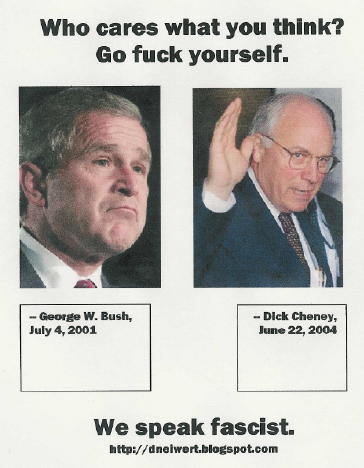
Something is wrong here

If ever one needed evidence that there is a real problem with the American press' handling of the occupation of Iraq, one need look no further than the fact that it is impossible to find anywhere in the American press -- outside of, apparently, Bloomberg News and the Washington Times (!) -- the report that Iraqi Prime Minister Iyad Allawi summarily executed six Iraqi detainees by shooting them in the head.

This is a story that has been available since early this morning. It is a a story with obviously devastating ramifications. (I'm speaking as an old wire-service ripper and news-desk hand.) And yet none of the major American news organs or wire services have picked it up.

Thanks especially to Holden for flogging the story. So far, blogs are making clear their now self-evident worth in disseminating vital information.

The Neo-Nazi landlord

Reinventing the meaning of "slumlord":
Landlord denies allegations of sinister agenda

Turns out that none other than Bill White -- one of the SPLC's "40 to Watch" -- has gotten into the business of buying up rentals in low-income neighborhoods. You tell me whether you'd want to be paying rent to this guy:
White, 27, said he's not a Nazi or a racist -- he's a "libertarian socialist" and "radical traditionalist" -- and that critics are targeting him as part of a political and personal vendetta. He said he's simply a businessman who moved to Roanoke to make a profit in the rental business by investing his money and helping raise the quality of life in neglected neighborhoods.

"I wouldn't be out here buying and fixing up houses if I had some agenda against the black community," he said. "I don't have anything against black people. The Jews, I despise. They hate me. I hate them. They can kiss my a--."

The article titled "Niggers Are Plotting Against My Shrubs" has been taken down from his site. He said a version being circulated by his critics has been altered and distorted. But he acknowledged writing the headline.

He also acknowledged declaring in the article that "the local nig-rats are already conspiring to test me" and opining that "trying to get a broad section of the black population to accept a higher standard of living is always an uphill battle. ... For centuries blacks -- particularly blacks descended from the Bantu tribes of Central Africa -- have been lying to and stealing from not only white men, but each other."

White first burst onto the scene about six years ago with his virulent anti-Clinton material (he was a big subscriber to New World Order theories) that pretty quickly devolved into anti-Semitic hatred. All along, though, he's claimed he's just a "libertarian." Right.

Thursday, July 15, 2004

The waxing of the dark tide

Of all of humanity's most primitive and destructive traits, racial and religious hatred and their attendant bigotry are probably the most difficult to eradicate. Modern society often congratulates itself on how far we've come in bringing hate to bay -- and the resulting complacency provides the fecund dark space needed for it to fester and grow anew.

People who have had direct dealings with hate groups and their adherents know this. It's one of the reasons why I expend as much energy as I do in exposing the machinations of right-wing extremists.

I have at various times been accused, unsurprisingly, of being obsessed with them, perhaps unhealthily so. My view is somewhat different, of course; it's my feeling that the haters and their activities are in reality more significant than is usually recognized, particularly by the press. The smallness of their numbers belies the breadth and depth of their reach.

In the early years of the new millennium, there was something of a collective sigh of relief in the press as it became clear that right-wing extremists were in decline, particularly after the terrorist attacks of Sept. 11. A number of media accounts focused on reports from the Southern Poverty Law Center that certain kinds of right-wing extremism -- expecially "militias" -- were in serious decline.

But the naked hatred of the far right never really dies, and it always awaits fresh opportunity, which is why it always comes and goes in cycles. For every waning of the far right and dark impulse it embodies, there is always the inevitable waxing.

What these reports described, in reality, were part of a typical "down" cycle for the far right. But those of us with more experience also understood that the remaining adherents were, if anything, typically more radicalized during such cycles, were far more likely to eventually act out, and were capable of springing back to life at any time -- with new faces and new strategies, of course, but as vicious and virulent as ever.

And in the past six months or more, it has gradually become clear that just such a resurgence is happening.

A recent report from Newhouse News Service's Chuck McCutcheoon describes the way it's happening:
Right-Wing Extremist Groups Becoming More Active After Post-9/11 Lull

Radical right-wing activity slowed after the Sept. 11, 2001 terrorist attacks, as internal disagreements erupted over the merits of the attacks and leaders of several organizations died or went to jail, several authorities said. But the groups are becoming more active -- distributing leaflets in neighborhoods, holding public rallies, starting Web sites and reaching out to like-minded activists overseas.

"We have to understand that these groups are not passe and are starting to re-emerge," David Carter, a criminal justice professor at Michigan State University, told law enforcement officials at a recent Justice Department conference in Washington.

The Southern Poverty Law Center, an Alabama civil rights watchdog that monitors the groups, counted 751 active U.S. chapters in 2003, up from 708 the year before. The number of hate-related Web sites rose from 443 in 2002 to 497 last year, the center said in a report.

Some of the activity, as the report details, is in the form of public meetings and gatherings of like-minded true believers, often organizing in fresh guises that pick up where some of the far right's decaying older groups have left off.

These include the simultaneous events by white-supremacist Christian Identity groups, as well as the gathering in western Montana of a relatively new white-supremacist sect. Even the seemingly moribund Aryan Nations is still going, though its planned Aryan parade this coming weekend is generally viewed as a kind of death rattle that is, perhaps appropriately, being mostly ignored.

Then there's the scheduled rally this weekend in Lincoln, Nebraska, of the National Socialist Movement, an event that is expected to cost local officials some $28,000 to police.

The bulk of the new activity is manifesting itself in the form of flyer distribution. Every day, it seems, brings a fresh news account from somewhere in the nation of white-supremacist fliers being left on people's doorsteps or being passed out on neighborhood streets.

In the past week alone, we've seen fliers popping up in such places as Citrus Heights, California, Vancouver, Wash., and Williamsburg, Va..

There's nothing about the flier distributions that indicate any actual increase in numbers by these groups; and it's difficult at best to tell whether they have any actual effect on recruitment. But they do indicate a real increase in activity and energy. These groups are becoming clearly more active now in their efforts to expand their appeal -- and it is equally clear that they are doing so because they believe the environment is ripe for success.

But concern about recruitment into these groups is only a small part of the picture when it comes to appreciating the effect they have on larger society. Even more worrisome is the way their hateful beliefs are spread into the mainstream, infecting not just potential recruits but ordinary people who have no desire to join a skinhead organization but for whom, for various reasons, their racial scapegoating resonates.

One of the important ways this manifests itself is in the form of hate crimes. As I explain in Death on the Fourth of July, only a small portion (roughly 8 percent) of the 9,000 or so bias crimes that are committed every year in America are committed by members of organized hate groups. Contrary to the stereotype, the average hate criminal is a young white male with little or no previous criminal record and no known association with hate groups. Typically he participates in the crime as part of a group.

Yet in the vast majority of hate crimes, the rhetoric and symbology of hate groups, such as "White power!" chants and the brandishing of Confederate flags or burning crosses, are used during their commission. This clearly suggests the extent to which these groups' influence extends well beyond their sheer numbers and have infected the public discourse.

So it is perhaps not surprising, then, that in an environment in which hate-group rhetoric is gaining increasing circulation, hate crimes appear to be surging as well. The connection, of course, can probably never be proven, but the pattern is becoming fairly clear.

In recent weeks, we have seen disturbing hate crimes being committed in various parts of the country. Last weekend in Clinton, Iowa, a young Illinois man nearly killed a white acquaintance with his vehicle -- pinning him against another car -- because he was a "race traitor" (that is, the victim had black friends). Meanwhile, three young whites in Valrico, Florida, painted a black neighbor's house with swastikas and Klan epithets.

And then there was the case of the gay Seattle man attacked by three thugs who left him with a huge gash in his back as well as various other injuries. The case so outraged the local community that a march protesting the attack was held in Seattle last week. Two of the three suspects -- who attacked the man after inquiring whether he was a "faggot" -- have been arrested.

There is a disturbing thread that runs through all these cases (as well as other recent hate crimes): All the perpetrators were young men, either teenagers or men barely out of their teens.

This, of course, fits the profile. But it also fits the trend that has developed in the past year in which young teens have also begun adopting the rhetoric, symbology and even the ideology white-supremacist groups, even though they may never join such groups. I discussed the appearance of this trend in the San Diego area previously, but the apparent adoption of racist beliefs by these young men is especially worrisome. There has always been a tendency among hate criminals in this regard, but the unapologetic defense of these beliefs has usually been relegated to a minority of cases. Now it appears to be growing.

Judging by these trends, it would not surprise me to see 2004 record a serious increase in the level of hate-crime activity for the first time since the FBI began recording statistics (in 1991). We won't know, of course, for another year and a half, when the numbers are finally released in the bureau's annual reports. In the meantime, we're left with the far more immediate problem of how to contain the appearance of this dark tide.

Why is this happening now? Americans need to begin looking in the mirror for answers. It isn't very hard to see that the current milieu is a prime environment for this to occur.
-- The country is being led by a cadre of thoughtless fearmongers who do not hesitate to wave the bloody shirt of terrorism to silence their critics and stigmatize anyone who acts "different." The harmful effects of this behavior from our leadership on the general populace is incalculable.

-- A particularly shallow brand of patriotism -- replete with jingoist sentiments, hatred of The Other, and a hollow symbolism -- has been promoted in every possible avenue, from national television broadcasts to the corner drugstore. This kind of thoughtless "Americanism" is an important feature of many hate crimes (including the one Death on the Fourth of July focuses upon) and plays a significant role in forumulating the motivations for this violence.

-- Most of all, a fog of intolerance has filtered across the national landscape over the past decade, thanks mostly to right-wing propagandists with massive popular reach: Rush Limbaugh, Michael Weiner (aka Savage), Dr. Laura, Bill O'Reilly, Ann Coulter, Sean Hannity, and the whole phalanx of their imitators. The thrust of the modern conservative movement has morphed from any sense of real conservative values into a relentless attack on the very notion of tolerance for anyone who is not part of that movement: liberals, gays and lesbians, other faiths, other colors.

Try to suggest, of course, that these trends are unhealthy, and you'll be denounced -- as unpatriotic, as paranoid, as a smear artist (projection being endemic to both the defense and attack of the American right). So the media, and the rest of us, comfort ourselves with the hollow notion that the above cases, and the many like them, are merely "isolated incidents."

We are all whistling past the graveyard.

[Thanks to Marty Heldt for the tip on the Clinton case.]

Border battles

Arizona's voters will be tested this fall on the question California voters already failed, namely, whether it will revert to bigotry instead of reason in dealing with problems associated with immigration.

As Tamar Jacoby recently observed in the Los Angeles Times, the problems certainly are real. And while government inertia reigns, standing pat should not be an option:
Ranchers on the border complain that bands of illegal migrants file across their lands, cutting fences, disturbing animals and leaving a sea of trash. Others -- liberals and conservatives alike -- feel that the Border Patrol is even more of a nuisance: the number of agents has skyrocketed, mostly to good effect, but they roam the region at will in their four-wheel drives, trampling grassland and interrogating motorists.

Healthcare providers face mounting costs. Crossing the Sonoran desert is a dangerous business; 105 migrants have died of exposure this year alone and many others end up in local hospitals. In Phoenix, immigrant smugglers warehouse their clients in filthy stash houses, then fight over them in gun battles that endanger local residents. No wonder Arizonans are clamoring for a solution -- any solution.

So now we get the "Protect Arizona Now" initiative touted by the fine bigots at Federation for American Immigration Reform and their hate-group cohorts at VDare, which not only would deny state services to illegal immigrants, it would prosecute any state employee who failed to report illegals applying for services.

Fortunately, Arizona's Republicans have learned their lesson from the California debacle -- where Latino support for the GOP vanished after the party supported the anti-immigrant Proposition 187 -- and are staying away from the PAN initiative like the festering carbuncle it is. And even though the initiative seems to enjoy broad support, there likely is time to bring reason to bear on the electorate.

It will all depend on how smart PAN's opponents are. As Jacoby observes:
California's Proposition 187 debacle holds several lessons for PAN's opponents. The biggest mistake then was the failure to create a broad-based, bipartisan coalition to denounce what could easily have been characterized as an extremist measure. Instead, it was the opposition that appeared extremist: all Mexican flags and protest rallies. Arizonans needn't repeat that blunder. After all, the business community, the political establishment, unions, immigrant advocates, Latino leaders and the state's active religious left all share reservations about the measure.

It will be crucial, in the end, for Republicans to step up to the plate on this measure and help knock it down. Otherwise, all that talk about attracting Latino voters will fit the rest of the "compassionate conservative" profile as we've seen it so far -- all talk and no hat.
 
UPDATE: Jeff Smith of the Tucson Citizen has more.

Friday, July 09, 2004

What! Another break?

I've been working on a longer post, but my clock has run out. I'm out of town for a family reunion for the next several days. Look for some fresh material next Wednesday or so.

In the meantime, let me recommend everyone check out a post my friend Rob Salkowitz at Emphasis Added wrote last week titled "Defining Dissent Down," which neatly sums up a number of thoughts I think many of us have had in recent weeks. Rob's an excellent writer with keen insight, so be sure to check out the rest of his site too.

Tuesday, July 06, 2004

The psychological combat field

It's one thing to realize you've been had. But even more important, perhaps, is to realize why it's happened.

The natural reaction that most people have to the discovery that the shots of the statue of Saddam coming down in Baghdad as Americans took control were not, in fact, a spontaneous demonstration, but were part of a carefully staged event for the TV cameras, is one of simple disgust -- to remark, as Atrios did the other day, that the incident reveals what suckers the Bush administration has played the public for.

Even more disturbing, however, is to read the L.A. Times report carefully and observe that this project was specifically a product of the Pentagon's "psychological combat" program:
The Army's internal study of the war in Iraq criticizes some efforts by its own psychological operations units, but one spur-of-the-moment effort last year produced the most memorable image of the invasion.

As the Iraqi regime was collapsing on April 9, 2003, Marines converged on Firdos Square in central Baghdad, site of an enormous statue of Saddam Hussein. It was a Marine colonel -- not joyous Iraqi civilians, as was widely assumed from the TV images -- who decided to topple the statue, the Army report said. And it was a quick-thinking Army psychological operations team that made it appear to be a spontaneous Iraqi undertaking.

Psychological operations -- or "PsyOps," as they are known in lingo -- are the subject of a multitude of conspiracy theories, in no small part because they are in fact cloaked in so much official secrecy. Much of the accusatory material that circulates about the programs is bogus, but there are serious scholars who have examined it and remain useful sources of what we do know about them. (A reasonably factual collection of documents can be found at The Information Warfare Site, while this Wikipedia page can give you a quick rundown on what's known.)

One of these scholars is Christopher Simpson, the American University professor who has written extensively on the subject, notably in Science of Coercion: Communication Research and Psychological Warfare 1945-1960 (an excerpt of which you can read here).

One of the important points that Simpson raises is that the combat field for psychological warfare is not merely the physical field of combat, but the home front as well. In an interview with Simpson, he discussed this point a little further:
From its inception psychological warfare has been the mating of violence on the one hand and what people would call today propaganda or mass communication on the other hand. Another thing that's interesting about psychological warfare, from its inception it has also targeted the people of the United States, the common preconception is that for better or for worse this is something we do to them. The reality is that from the government's standpoint, from the standpoint of those who are paying the bills for its development the targets always involve not only foreign audiences but domestic audiences as well.

We have in fact known from even before the outset that the war against Iraq would prominently feature psychological warfare. Most people have assumed that this warfare would be directed against the enemy and the subject citizens. They have not stopped to consider that, by definition, it would also be directed toward the American public as well.

This reality raises a serious concern about the fragility of democracy during wartime. Because under the aegis of a seemingly eternal war, the American government has clearly been involving the public in its psychological combat, and has hijacked the nation's press in the process. The entire meaning of the Iraq war -- and by extension, the "war on terrorism" -- is inextricably bound up in the psychological manipulation of the voting public through a relentless barrage of propaganda.

This is why the both the runup to the war and its subsequent mishandling have been so replete with highly symbolic media events -- many of them played repeatedly on nightly newscasts -- that have proven so hollow at their core, from the declarations of imminent threat from Iraq's supposed weapons of mass destruction, to phony images of Saddam's statue being torn down, to flyboy antics aboard airline carriers, to meaningless "handovers" of power. It also explains why certain important and humanizing symbols of wartime -- civilian casualties, the returning flag-draped coffins -- have been so notably absent from our views of the war.

The role of the media in this manipulation cannot be understated. The abdication of the media's role as an independent watchdog and its whole subsumation as a propaganda organ bodes ill for any democracy, because a well-informed public is vital to its functioning.

But the fact that the military establishment, in the context of the "war on terror," clearly views the American public as the subject of a psychological combat operation should give us all pause regarding the ability of democracy to withstand this kind of assault.

In the end, I think there is enough innate resistance to this kind of propagandization in a free society to win out. But the November election will be a crucial test of whether or not this is true.

The good fight

There's some good reading to be had over at Working for Change, where Bill Berkowitz interviews my friend Daniel Levitas, author of The Terrorist Next Door: The Militia Movement and the Radical Right, on one of my favorite subjects, the failure to confront domestic terrorism. [It's a two-parter: Part I and Part 2.]

Some excerpts [from Part 1]:
BB: What about the people who didn't quit the movement?

DL: They have become even more radicalized, more hard core. After all, they believe that the Clinton administration bombed the Murrah building on purpose -- and set up Timothy McVeigh and Terry Nichols as patsies in order to persecute the "Patriot" movement. This is the same crowd that believes that the planes used on 9/11 were remote-controlled by the Israeli Mossad and the CIA. They used the tragedy at Waco to bolster their argument. "Look," they said, "If Bill Clinton and Janet Reno could kill all those innocent Branch Davidians down in Waco, what makes you think they weren't behind the Oklahoma City bombing?" This all fit in rather nicely with fanatical gun culture and extreme religious beliefs of the radical right. After all, the Davidians were wanted on gun charges and had unconventional religious beliefs. So, for those white supremacists that worship fully automatic weapons and believe that Jews are the children of Satan, it wasn't all that difficult to convince them that the government was out to murder them, as well.

[From Part 2]
BB: Given all that you've said, what is the state of the far right movement today?

DL: Thankfully, much of the movement is in pretty serious disarray, due to a combination of factors, but that doesn't mean the potential for violence is all that significantly diminished. If anything, the arrests in Tyler, Texas in April 2002 show that even small numbers of right wing activists can build up a terrifying arsenal. The death of William Pierce, in July 2002, left a big leadership vacuum, both in his group and in the movement. Smaller, but equally militant groups like the World Church of the Creator, based in Illinois, have been hit hard by recent arrests. In the case of the WCOTC, its leader, Matthew Hale, is currently in federal prison facing charges that he attempted to solicit the murder of a federal judge. Even though membership in the Klan and other hate groups is down, the people that have remained in the movement are more hard-core. But there is another, more dangerous problem that is affecting the political mainstream.

BB: What is that?

DL: What concerns me most is the rising level of prejudice and bigotry in American society, and these attitudes have penetrated well beyond the confines of the far right. More specifically, we're experiencing rising anti-Semitism, skyrocketing anti-Arab and anti-Muslim bigotry, heightened hostility toward foreigners and immigrants and persistently high levels of racism. In short, these trends don't bode well for the fabric of a democracy ostensibly devoted to protecting civil rights and liberties. Of course it is easy to point to the bombers and shooters of the radical right and identify them as the problem. And they certainly pose a threat and a challenge. In the end, however, their actions basically require a law enforcement response, and there is not a whole lot that everyday citizens can do to counteract the hard core criminality of domestic right-wing terrorists.

And while you're at it, be sure to check out the conclusion of Tacitus' exchange with VDare columnist Steve Sailer, one of the so-called "racial realists" of the Jared Taylor school. Tacitus acquitted himself marvelously; people like Sailer are real tar babies, incapable of comprehending that their core arguments have been demolished, and responding by piling phony "fact" upon phony "fact." Considering Sailer's background as a promoter of pseudo-science, he handled the situation just right.

I don't give enough credit to serious conservatives who make real efforts to repudiate the racist element of the right. Tacitus deserves a round of applause.

Sunday, July 04, 2004

The Whale Sells Out

.

You can buy your own Orcinus T-shirts here, with a special election-year message like the one above on the back. A mere $19.99, with proceeds going toward my fall research projects (some travel involved), which I'll be sharing here.

I may expand the repertoire later. This is all for fun.

Saturday, July 03, 2004

Change the channel

Just so that festering core of Clinton-haters won't feel altogether left out -- what with the release of Bill Clinton's My Life and Michael Moore's Fahrenheit 9/11 -- the fine folks at ABC News decided to remind its audience just what the corrupt press corps thought was really important back in the 1990s:
'It Started With Me': Paula Jones Reacts to Clinton Memoir; Talks About 'Vast Right-Wing Conspiracy'

Y'know, with the benefit of hindsight, you'd think ABC could've discussed something that really mattered during Clinton's tenure -- e.g., the war on terrorism or the economy. But that might have entailed interviewing people who had, say, lost their jobs in the ensuing four years. In the minds of our so-called liberal media, the only Clinton legacy worth discussing is a fiasco that actually stands as an enduring testament to their own manifest failures.

But then, what should we have expected? The senior producer was none other than Chris Vlasto.

And it is outta here!

From David Letterman:
Top Ten George W. Bush Complaints About Fahrenheit 9/11

10. That actor who played the President was totally unconvincing

9. It oversimplified the way I stole the election

8. Too many of them fancy college-boy words

7. If Michael Moore had waited a few months, he could have included the part where I get him deported

6. Didn't have one of them hilarious monkeys who smoke cigarettes and gives people the finger

5. Of all Michael Moore's accusations, only 97% are true

4. Not sure -- I passed out after a piece of popcorn lodged in my windpipe

3. Where the hell was Spider-Man?

2. Couldn't hear most of the movie over Cheney's foul mouth

1. I thought this was supposed to be about Dodgeball

[Via James Benjamin.]

Friday, July 02, 2004

Input, please

Paul Lukasiak, who compiled that recent outstanding analysis of Bush's military records, "Deserter: The Story of George W. Bush After He Quit the Air National Guard", is about to release the second part of his work, titled "Discharge? or Desertion? How the Bush Files Show that Bush Deliberately Ignored His Legal Obligations to America's National Security". He's asking for readers to critique the work before he officially "releases" it.

If you're interested, write to him at awol@glcq.com. He'll send you a URL for the latest installment.

I'm particularly eager to read the portion of his work that Paul described in a post at Table Talk:
the "Deserter" article is just a fraction of what I've been able to come up with by comparing the records themselves to the laws and policies of that era.

right now, I'm working on the documents concerning Bush's actual discharge. Those documents make it clear that Bush's INTENTION was to blow off his Military Service Obligation.

The really fun part of all of this is that the White House doesn't realize how much information is in the payroll records that were released...

if they knew, they would never have released them.

At the bottom of each page, there are all these lines of incomprehensible "data"....as it turns out, those lines are the data that was entered INTO the payroll system.....and THAT information makes it clear that Bush engaged in pre-meditated fraud.

[Update: I see Paul has posted the working draft URL. You can get a sneak peek at it here.]

Big Brother Trucker

Time magazine has a disturbing report on the "Highway Watch" program designed to put 400,000 truckers and the like on the lookout for terrorists:
Highway Watch, which will receive an additional $22 million next year, preserves the part of TIPS concerned with monitoring behavior in public space. The Department of Homeland Security has also launched Port Watch, River Watch and Transit Watch. Then there are the familiar Neighborhood Watch groups, many of which have expanded their missions to include homeland security. In New York City, government outsourcing of surveillance has even trickled down to doormen and building superintendents, thousands of whom are being trained to watch out for strange trucks parked near buildings and tenants who move in without furniture.

After the session in Little Rock, two newly initiated Highway Watch members sat down for the catered barbecue lunch. The truckers, who haul hazardous material across 48 states, explained how easy it is to spot "Islamics" on the road: just look for their turbans. Quite a few of them are truck drivers, says William Westfall of Van Buren, Ark. "I'll be honest. They know they're not welcome at truck stops. There's still a lot of animosity toward Islamics." Eddie Dean of Fort Smith, Ark., also has little doubt about his ability to identify Muslims: "You can tell where they're from. You can hear their accents. They're not real clean people."

Um, yes, Ann Coulter would agree on the cleanliness thing. Except there are also a few other teeny little problems:

-- "Islamic" terrorists planning an attack are extremely unlikely to make themselves stand out or otherwise draw attention to announce their presence by wearing something like a turban.

-- In much of the country, as the story goes on to explain, many of those turban-wearing truck drivers are Sikhs, not Muslims.

-- Tim McVeigh did not wear a turban.

This whole passage makes clear that the purpose of the program is not to do anything serious about terrorism: It's to enable these truck drivers in harassing "non-American" minorities.

In the end, it is not significantly different than government law-enforcement actions that encouraged citizens to "crack down" on their neighboring Japanese Americans on the Pacific Coast during World War II.

The story explains further:
That kind of prejudice is hard to undo, but it's a shame Beatty's slide show did not mention that in the U.S., it's almost always Sikhs who wear turbans, not Muslims. Last year a Sikh truck driver who was wearing a turban was shot twice while standing near his tractor trailer in Phoenix, Ariz. He survived the attack, which police are investigating as a hate crime.

Worst of all is the reality that Highway Watch's program is amateurish -- a kind of secret-decoder-ring approach to security at best, and an official sanction of vigilantism at worst.
The Highway Watch website boasts that the program is open to "an elite core [sic] of truck drivers" who must have clean driving and employment records. In fact, their records are not vetted by the American Trucking Associations. At the Little Rock event, some came in off the street without preregistering. However, the organization is highly security conscious about other parts of its operations. It refuses to disclose the exact location of its hotline call center or the number of operators working there. "It could be infiltrated," says Dawn Apple, Highway Watch's director of training and recruitment.

What's clear is that Highway Watch is a morale booster for drivers. "I don't want to sound too hokey, but truck drivers are a very patriotic bunch," says Mike Russell, a spokesman for the organization. "It made sense for us to take advantage of what we do every day -- which is, basically, patrol major highways through a windshield."

Somehow, I'm less than comforted.

Here, BTW, is the Highway ISAC Web site.

[Via BoingBoing and Tom Paine.]

Thursday, July 01, 2004

It's out


My second book, Death on the Fourth of July: The Story of a Killing, a Trial, and Hate Crime in America, is now officially available on bookstands today.

You can, of course, order it through Amazon or some other online seller, or through your bookstore. If it's not on the shelves, ask for it at the desk and they should be able to order it easily.

[Here is the publisher's page for the book.]

A little background, for those interested ...

As you can see from clicking on any of the above links, the book on its surface is about an unusual homicide case that happened in Ocean Shores, Washington, four years ago. Three young Asian men were confronted late at night by a group of young white men shouting racist slogans and epithets, the ringleader of whom eventually assaulted them. But one of the young men fought back, and the young white instigator -- a kid named Chris Kinison -- wound up being stabbed to death.

I became involved in the story in the months that followed because of what the case revealed about the nature of hate crimes. As far as anyone could tell, neither Chris Kinison nor his friends had any organizational or other connection to skinhead or hate groups -- though in the process of assaulting not just the three Asians but a series of other minorities in town throughout the weekend, Kinison and his friends had affected the look, the rhetoric and even the symbology of white supremacists, in the form of a large Confederate flag.

This reflects one of the realities that butts up against the many myths about hate crimes, namely, that only a small percentage of such crimes are committed by real "skinheads" or white supremacists. The average hate criminal is a young white man with no previous criminal record and no organizational "hate group" ties or history. And yet in the vast majority of these crimes, "hate group" rhetoric and symbols are used.

It suggests, for one thing, how broad-reaching the influence of white-supremacist belief systems actually can be, well beyond the rather sparse numbers that "hate groups" enjoy. It also tells us a great deal about the reach of the terroristic impulse that underlies bias crimes.

So I contacted my editors at Salon.com and asked if they wanted me to cover the trial of the young Asian man, Minh Duc Hong, charged with manslaughter in Kinison's death. They gave me the green light, and I spent two weeks in Aberdeen and Montesano covering it. I was a little shocked to discover, when I entered the courtroom, that I actually was acquainted with Hong already ... but you can read about that in the book.

In any event, the story I turned in to Salon was 10,000 words, a ridiculous length, so it never ran there. Worse yet, I knew there was more to the story, whose surface I'd only begun to scratch. So I decided to make a book out of it.

Here's hoping you all enjoy it. Even if you disagree with my conclusions, I think you'll find it an interesting, informative and worthwhile read.

[You'll note that the subtitle on the photo above doesn't match the book's actual subtitle. I'm working to correct that soon.]

Tuesday, June 29, 2004

AWOL: The final analysis

My old Table Talk cohort Paul Lukasiak -- whose research skills are top-notch, and whose judgment I've learned to implicitly trust -- has examined all the officially released documents relating to George W. Bush's service records and has just released the following report:
Deserter: The Story of George W. Bush After He Quit the Air National Guard

Paul's piece most carefully examines the records that appear in Bush's records after he was transferred to the Air Personnel Reserve Center once he had failed to maintain his flight status:
SUMMARY

An examination of the Bush military files within the context of US Statutory Law, Department of Defense regulations, and Air Force policies and procedures of that era lead to a single conclusion: George W. Bush was considered a deserter by the United States Air Force.

After Bush quit TXANG, he still had nine months of his six-year military commitment left to serve. As a result, Bush became a member of the Air Force Reserves and was transferred to the authority of the Air Reserve Personnel Center (ARPC) in Denver, Colorado. Because this was supposed to be a temporary assignment, ARPC had to review Bush's records to determine where he should ultimately be assigned. That examination would have led to three conclusions: That Bush had "failed to satisfactorily participate" as defined by United States law and Air Force policy, that TXANG could not account for Bush’s actions for an entire year, and that Bush's medical records were not up to date. Regardless of what actions ARPC contemplated when reviewing Bush's records, all options required that Bush be certified as physically fit to serve, or as unfit to serve. ARPC thus had to order Bush to get a physical examination, for which Bush did not show up. ARPC then designated Bush as AWOL and a "non-locatee" (i.e. a deserter) who had failed to satisfactorily participate in TXANG, and certified him for immediate induction through his local draft board. Once the Houston draft board got wind of the situation, strings were pulled; and documents were generated which directly contradict Air Force policy, and which were inconsistent with the rest of the records released by the White House.

Lukasiak also agrees with earlier reports that Bush's records were tampered with:
It is also clear that the Bush records were tampered with to hide this fact. Many documents were thrown out that should have been kept, and there is indisputable evidence that at least one key documents has been altered.

The documentary evidence also strongly suggests that when news of Bush's situation reached Texas, strings were pulled that resulted in Bush being "rehabilitated" in a manner completely inconsistent with Air Force policy.

The paper trail is incomplete, and in some cases ambiguous. But "clerical error" is not sufficient to explain the anomalies, because the level of "coincidence" required for a "clerical error" explanation is well beyond any rational possibility.

Paul has done yeoman's work on this. It appears Michael Moore's shot from the hip may have been on target after all. And it makes clear, irrevocably, that Bush's military record should be a scandal not merely for what it contains (or rather, doesn't) but because of the extent to which it has been tampered with and lied about in the past eight years or so.

[For handy reference, here is a post that contains links to most of my AWOL posts. Here and here are the most recent posts.]

Monday, June 28, 2004

Liberals: The root of all evil

Yo, Tucker, come check out the lovely sentiments coming from another "mainstream" right-winger, Doug Giles, who, after selecting an especially fetid slice of Ann Coulter, offers the following:
It's hard for salt of the earth, hard working, hard playing pro-American types to wrap their minds around why their liberal neighbors hate the U.S. so much. But liberals do, and it's a staple of their worldview's diet. They reflexively root for that which will undo our great land.

As far as the liberals are concerned, the battle is joined ... the war is on. We must recognize the primal nature of the contest, the fundamental loathing the left has for virtually everything that conservatives cherish.

Concerned citizens of our amazing country need to be aware of the fear and loathing of the liberals and meet them head on at the polls, through the media and in the public square.

Please talk to us again about civility in about, oh, another decade or so, Doug. You too, Tucker.

[Via World O' Crap.]

Wow

Just realized that over the weekend, while I was away, I reached my one millionth visitor.

On previous big-number watermarks, I've paused to pontificate about the meaning of it all.

This time, I'll keep it simple:

Thanks, everyone.

And here's to the next million.

Nadering nabobs

Look, every time I post something pointing out that not only is Ralph Nader a right-wing tool, he continues to confirm it beyond any serious deniability, his defenders come out of the woodwork and whine that I'm demonizing or somehow attacking the man personally ("Nader-bashing").

So let's be clear: I'm not saying that Nader is a bad man. All I'm saying is that any serious progressive should question his credentials as someone representing their vote.

Nader was never my man. His record on civil rights, labor and immigration policy was enough to convince me Al Gore was a better vote. I also was mature enough to understand that democracy is an imperfect thing, and voting forces us sometimes to make imperfect choices that in the end must be pragmatic. A progressive voter in 2004 should be asking (as they should have in 2000), "Do I want to be playing offense for the next four years, or defense?"

But I have many friends who were Nader voters in 2000, and I understand their choices. This year, as it happens, all of them are voting for Kerry. Which leaves me wondering about the diehards who continue to lend his candidacy any credence.

Obviously, the pragmatic need is both crystal-clear and great now not to vote for Nader. If the past four years haven't convinced progressive purists just how disastrous Republican rule can be, they haven't been paying attention.

But even clearer now is what I only suspected in 2000, which is that Nader is a right-wing tool. I'm not saying that to demonize the man, but simply as a strategic reality. He's a stalking horse for progressive votes whose most ardent silent supporters are Bushevik conservatives, and his continuing flirtations with rightist elements underscores this fact in a poignant way -- because they call into serious question Nader's progressive credentials.

A recent report by Max Blumenthal for American Prospect lays it out:
Nader's Dubious Raiders: Ralph's Arizona ballot tactics are worse than this week's Democratic lawsuit alleges. Some petitions piggybacked on a reactionary anti-immigrant initiative -- and others were paid for by a former executive director of the state GOP.

The story explains it in detail:
In its effort to get on the ballot in the key battleground state of Arizona, the Prospect has learned, the Nader campaign hired a petition company that is also gathering signatures for a draconian anti-immigrant initiative pushed by right-wing elements in the state. The initiative, called Protect Arizona Now (PAN), would restrict access to public services by undocumented immigrants.

In addition, according to several sources, the Nader campaign was assisted in its petition drive by an unlikely figure: the ultra-conservative former executive director of the Arizona Republican Party, Nathan Sproul. Sources say Sproul -- who is also spearheading an initiative to block public funding from political campaigns in the state -- made payments to the petition contractors working on his public-funding initiative to gather signatures for Nader as well.

Moreover, according to several sources, the signature-gathering drive for PAN is mostly funded by the Federation for American Immigration Reform (FAIR), a Washington-based anti-immigrant group that has spent tens of millions in the last two decades to roll back the rights of both legal and illegal immigrants living in the United States.

The Arizona ballot drive was never the grassroots effort that Nader characterizes his campaign as. In trying to garner the 14,694 signatures necessary to get on the Arizona ballot, the Nader campaign first unsuccessfully solicited a Republican consulting firm to handle its ballot-qualification bid. This spring, as droves of professional petitioners descended on Arizona like traveling carnival folk to gather signatures for PAN -- and to collect the $2–4 that a petitioner is awarded for each signature delivered -- they also presented signatories with the Nader petition, according to several sources. This petition piggybacking helped Nader get more than the amount of signatures he needed to qualify for the ballot -- most of them from Republicans. In fact, according to a volunteer for the Arizona Democratic Party who has reviewed Nader's signatures, of the more than 21,000 signatures Nader garnered, a whopping 65 percent percent came from Republicans, compared to 18 percent from Democrats.

I'm sure I'll still be flooded with heated denials from his diehard supporters. But at some point, you'd think they'd have to stop sniffing the kool-aid and understand that George Bush and Karl Rove and Rush Limbaugh are all counting on their "purity".

UPDATE: Joe Conason has a report on a similar situation in Oregon, where Bush-Cheney operatives worked behind the scenes to get Nader on the ballot.

Tedster update

Following up on my speculation that Ted Olson's sudden departure as Solicitor General may have been related to the Abu Ghraib mess, Salon had an item the other day indicating it wasn't Abu Ghraib, but today's ruling on "enemy combatants" -- in which the Bush administration largely received a slap upside the head -- that induced Olson to step aside.
The Washington Post reports that Olson was "known inside the Justice Department to be unhappy that he was not informed about controversial memos authored by the Office of Legal Counsel on the use of harsh interrogation methods on detainees overseas." The head of that office, Jack L. Goldsmith III, announced his resignation last week.

By announcing his own departure Thursday, Olson may be hoping to head off suggestions that he resigned as a result of unfavorable Supreme Court rulings related to the torture issue. The Supreme Court will likely issue its decisions next week in cases involving "enemy combatants" Jose Padilla and Yaser Hamdi and the detainees being held at Guantanamo Bay. Justice Department lawyers are braced for what Newsweek calls a "crushing defeat" in those cases, so much so that they're scrambling to find alternative theories for keeping Padilla in prison.

Olson seemed to acknowledge, albeit obliquely, that he was getting out ahead of the storm. He told the Post he wanted to announce his resignation before the court issues its final decisions of the term because it's "going to be a big deal next week."

The item goes on to note that while the Tedster's inimitable style simply can't be replaced, Paul Clement is likely to be Olson's successor. Bet that catches Eric Muller's attention.

[Thanks to R. Prichard at Table Talk for the Salon pointer.]

Thursday, June 24, 2004

Back soon

I'm off for a weekend away again.

In the meantime, be sure to check out my friend John McKay's excellent work at archy regarding the holes in the Saudis' story about how Abdul Aziz al-Muqrin was apprehended. [Scroll down; permalinks appear busted.]