Wednesday, January 16, 2008

Jonah and the Klan


-- by Dave

I'd like the public to remember someone left out of Jonah Goldberg's book about American fascism, Liberal Fascism. Someone who might have something to say on the subject, were he still alive.

His name was Leo Frank. You may have heard of him. Evidently, either Jonah has either never heard of him, or has forgotten all about him, or perhaps would just like everyone else to forget all about him. Leo, you see, inspired the formation of the Anti-Defamation League, though not through any action of his own.

From the Wikipedia entry:
Leo Max Frank (April 17, 1884 – August 17, 1915) was an American Jew. His lynching by a mob of prominent citizens in Marietta, Georgia, in 1915 demonstrated anti-Semitism in the United States and led to the founding of the Anti-Defamation League.

Frank, the manager of a pencil factory in Atlanta, Georgia, was convicted on the basis of circumstantial and direct evidence of murdering an employee, 13-year-old Mary Phagan. The case is widely regarded as a miscarriage of justice. The trial was sensationalized by the media. The Georgia politician and publisher Tom Watson used the case to build personal political power and support for a revival of the Ku Klux Klan.

Shortly after Frank's conviction, new evidence emerged that cast doubt on his guilt. After the governor commuted his death sentence to life imprisonment, Frank was kidnapped from prison by a group of prominent citizens calling itself "The Knights of Mary Phagan", and lynched. The mob is reported to have included the son of a senator, a former governor, lawyers, and a prosecutor.

As the entry (which is quite accurate) goes on to explain, the Frank lynching played a key role in the founding of the Ku Klux Klan:
Southerners who believed Frank was guilty saw similarities between the Frank trial and The Birth of a Nation. Watson used sentiments aroused by sensational coverage of the Frank trial to build up power. Some members of the lynching mob decided to create a new Ku Klux Klan. The new Klan was inaugurated in 1915 at a mountaintop meeting, led by William J. Simmons, and attended by aging members of the original Klan, along with members of the Knights of Mary Phagan.

I want people to remember Leo Frank, and how his lynching inspired the birth of not just the ADL but more particularly the Klan, because Liberal Fascism contains probably the worst whitewashing of the Ku Klux Klan I have read, outside of overt Klan apologists, in my thirty years or so of writing about them and studying them. Here it is, on pp. 259-260:
Perhaps an even better indication of how little modern popular conceptions jibe with the historical reality during this period is the Ku Klux Klan. For decades the Klan has stood as the most obvious candidate for an American brand of fascism. That makes quite a bit of sense. The right-wing label, on the other hand, isn't nearly as clean a fit. The Klan of the Progressive Era was not the same Klan that arose after the Civil War. Rather, it was collection of loosely independent organization spread across the United States. What united them, besides their name and absurd getups, was that they were all inspired by the film The Birth of a Nation. They were, in fact, a "creepy fan subculture" of the film. Founded the week of the film's release in 1915, the second Klan was certainly racist, but not much more than the society in general. Of course, this is less a defense of the Klan than an indictment of the society that produced.

For years the conventional view among scholars and laymen alike was that the Klan was rural and fundamentalist. The truth is that it was often quite cosmopolitan and modern, thriving in cities like New York and Chicago. In many communities, the Klan focused on the reform of local government and maintaining social values. It was often the principal extralegal enforcer of Prohibition, the consummate progressive "reform." "these Klansmen," writes Jesse Walker in an illuminating survey of the latest scholarship, "were more likely to flog you for bootlegging or breaking your marriage vows than for being black or Jewish."

...Moreover, if the Klan was less racist than we've been led to believe, academia was staggeringly more so. ...

This is, of course, outrageous. Nothing that Goldberg presents as "evidence" actually suggests that "the Klan was less racist" -- rather, it only demonstrates that the Klan, a profoundly racist organization, was more than merely a collection of rural rubes; it was, in fact, a complicated phenomenon. And while popular conceptions of the Klan such as Goldberg cites may have distorted that reality, there have never been any illusions about that on the part of historians.

Nor has there been any illusion about where the Klan resides on the American political spectrum: it is an established figure of the far right, and it is so for many reasons besides its racism.

The Klan, of course, was much, much more than merely a "creepy fan subculture" for a film. It used the film for its symbology -- its costumes and cross-burnings were taken from the film, not from the old Klan -- but the heart of its meaning and purpose could be found in the lynching of Leo Frank.

Because the Klan, as Robert O. Paxton explains in his 2004 book The Anatomy of Fascism, was probably the first real manifestation of fascism as an organization, not just in America but anywhere:
... [I]t is further back in American history that one comes upon the earliest phenomenon that seems functionally related to fascism: the Ku Klux Klan. Just after the Civil War, some Confederate officers, fearing the vote given to African Americans by the Radical Reconstructionists in 1867, set up a militia to restore an overturned social order. The Klan constituted an alternate civic authority, parallel to the legal state, which, in its founders' eyes, no longer defended their community's legitimate interests. In its adoption of a uniform (white robe and hood), as well as its techniques of intimidation and its conviction that violence was justified in the cause of the group's destiny, the first version of the Klan in the defeated American South was a remarkable preview of the way fascist movements were to function in interwar Europe.

Moreover, as Paxton explains, the Klan was fascist not just in its function and the political space it occupied, but in being the embodiment of its ideology, namely:
Although one can deduce from fascist language implicit Social Darwinist assumptions about human nature, the need for community and authority in human society, and the destiny of nations in history, fascism does not base its claims to validity upon their truth. Fascists despise thought and reason, abandon intellectual positions casually, and cast aside many intellectual fellow-travellers. They subordinate thought and reason not to Faith, as did the traditional Right, but to the promptings of the blood and the historic destiny of the group. Their only moral yardstick is the prowess of the race, of the nation, of the community. They claim legitimacy by no universal standard except a Darwinian triumph of the strongest community.

Elsewhere, Paxton explains:
Fascism may be defined as a form of political behavior marked by obsessive preoccupation with community decline, humiliation, or victimhood and by compensatory cults of unity, energy, and purity, in which a mass-based party of committed nationalist militants, working in uneasy but effective collaboration with traditional elites, abandons democratic liberties and pursues with redemptive violence and without ethical or legal constraints goals of internal cleansing and external expansion.

David Chalmers, in his Hooded Americanism: The History of the Ku Klux Klan, also is unequivocal in placing the Klan firmly on the right of the political spectrum:
Throughout its history, the Klan has been a conservative, not revolutionary, organization. As a vigilante, it has sought to uphold "law and order," white dominance, and traditional morality. To do this it has threatened, flogged, mutilated, and on occasion, murdered. The main purpose of the Klansmen, Kligrapps, Kludds, and Night Hawks, Cyclopses, Titans, Dragons, and Wizards assembled in their Dens, Klaverns, and Klonvokations, rallying in rented cow pastures, and marching in solemn procession through city streets, has been to defend and restore what they conceived as traditional social values. The Klan has bascially been a revitalization movement.

This happens to confirm the identification of the Klan with American fascism if we follow Roger Griffin's definition of fascism as "a palingenetic and populist form of ultranationalism" (palingenesis referring to a core myth of phoenix-like national rebirth).

The Klan was about much more than mere racism, which was more an expression of its larger mission -- enforcing, through violence, threats, and intimidation, "traditional values" and what it called "100 percent Americanism." It was essentially populist, certainly, but there was no mistaking it for anything "progressive." The latter, in fact, was its sworn enemy.

Chalmers describes (pp. 32-33) how Col. William J. Simmons, the man most responsible for the revival of the Klan in the 1915-20 period, and the leader of that group that burned a cross atop Stone Mountain in honor of the Frank lynch mob, shifted the Klan's focus from merely attacking blacks to a very broad menu of targets:
Upon being introduced to an audience of Georgia Klansmen, Colonel Simmons silently took a Colt automatic from his pocket and placed it on the table in front of him. Then he took a revolver from another pocket and put it on the table too. Then he unbuckled a cartridge belt and draped it in a crescent shape between the two weapons. Next, without having uttered a word, he drew out a bowie knife and plunged it in the center of the things on the table. "Now let the Niggers, Catholics, Jews, and all the others who disdain my imperial wizardry, come on," he said. The Jews, Mrs. Tyler told newspapermen during a shopping trip in New York, were upset because they know that the Klan "teaches the wisdom of spending American money with American men." To be for the white race, she continued, means to be against all others. Clarke suggested sterilizing the Negro. Simmons explained that the Japanese were but a superior colored race. Never in the history of the world, the Klan believed, had a "mongrel civilization" survived. The major theme, however, was the rich vein of anti-Catholicism, which the Klan was to mine avidly during the 1920s, and it was this more than anything else which made the Klan.

To the Negro, Jew, Oriental, Roman Catholic, and alien, were added dope, bootlegging, graft, night clubs and road houses, violation of the Sabbath, unfair business dealings, sex, marital "goings-on," and scandalous behavior, as the proper concern of the one-hundred-percent American. The Klan organizer was told to find out what was worrying a community and to offer the Klan as a solution.

Simmons' conception of the Klan as a special secret service bustling about spying on radicalism and questionable patriotism and generally reliving its wartime grandeur, was translated into a more enduring system of societal vigilance. The Klan was brought to Muncie, Indiana, by leading businessmen to cope with a corrupt Democratic city government. It entered Tulsa, Oklahoma, and Herrin County, Illinois, to put down bootlegging. When a newly formed Klan chapter would write to Atlanta for suggestions as to what to do first, the response was almost unvaryingly to "clean up the town," an injunction which usually came to rest it emphasis on the enforcement of the small-town version of the Ten Commandments.

Philip Dray, in his history of the "lynching era," At the Hands of Persons Unknown, describes this opportunism on the part of the Klan as well:
Marketed like any other business or lodge association, the Klan was eventually franchised in twenty-seven states and varied its purpose to confront a wide palette of enemies. To a town inundated with unemployed blacks, one historian has pointed out, it was the Klan of the Griffith film; if bootleggers ran amok, the Klan was an auxiliary police outfit; in the face of labor activism, Klan members became corporate thugs and enforcers; where immigrants threatened to overwhelm a city, the Klan stood ready to publicize 100 percent Americanism. As the organization served as a kind of enforcement group for godly values, many clergymen became Klan members of boosters. Jesus Christ himself, it was said, would have been a Klansman.

A history of the Klan by the SPLC explains that the "community values" agenda in short order became a justification for all kinds of violence:
The message was clear--the new Klan was going to mean business. And that soon meant expanding its list of enemies to include Asians, immigrants, bootleggers, dope, graft, night clubs and road houses, violation of the Sabbath, sex, pre- and extra-marital escapades and scandalous behavior. The Klan, with its new mission of social vigilance, soon had organizers scouring the nation, probing for the communities' fears and then exploiting them to the hilt.

And the tactic was an overnight raging success. By the late summer of 1921 nearly 100,000 people had enrolled in the invisible empire, and at ten dollars a head (tax-free since the Klan was a "benevolent" society), the profits were impressive. While Simmons made speeches and tinkered with ritual, Clarke busied himself with expanding the treasury, launching Klan publishing and manufacturing firms and investing in real estate. The future looked very good.

...And its violence was clearly revealed. Under Evans a wave of repression punctuated by lynchings, shootings and whippings swept over the nation in the early and mid-1920's and many communities were firmly in the grasp of the Klan's terror. The victims were usually blacks, Jews, Catholics, Mexicans and various immigrants, but sometimes they were white, Protestant, and female. Klansmen attacked people they considered "immoral" or "traitors" to the white race.

In Alabama, for example, a divorcee with two children was flogged for the crime of remarrying, and then given a jar of Vaseline for her wounds. In Georgia a woman was given 60 lashes for a vague charge of "immorality and failure to go to church." And when her 15-year-old son ran to her rescue, he received the same treatment. In both cases the leaders of the Klansmen responsible turned out to be ministers.

But such instances were not confined to the South--in Oklahoma Klansmen applied the lash to girls caught riding in automobiles with young men, and the Klan in the San Joaquin Valley in California were know to flog and torture women.

In a period when many women were fighting for the vote, for a place in the job market, and for personal and cultural freedom, the Klan claimed to stand for "pure womanhood" and frequently attacked women who sought independence.

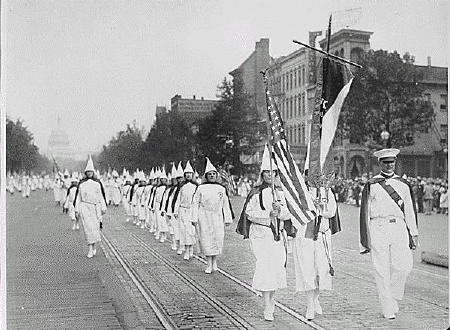
Although politicians became increasingly uncomfortable with Klan allies as a result of the turmoil, the success of the Klan candidates across the nation in 1924 buoyed Evans' spirits. His notoriety peaked with a parade of 40,000 Klansmen down Washington's Pennsylvania Avenue to the Washington Monument in August 1925. Evans boasted of having helped re-elect Coolidge, of having secured passage of strict anti-immigration laws and of having checked the ambitions of Catholics and others intent on "perverting" the nation. All in all, the Klan was riding high in the saddle.


As we recently noted, the Klan briefly became a real political force: a nationwide organization with chapters in all 48 states that briefly became a political powerhouse in a number of states, including Oregon, Indiana, Tennessee, Oklahoma, and Maine, where the Klan played a critical role in the 1924 election of Owen Brewster to the governorship. That same year, the Klan made waves at the Democratic Convention when the Klan-backed candidate, William Gibbs McAdoo of Georgia, declined to denounce them. Al Smith of New York managed to block his nomination, largely on these grounds, and West Virginia's John Davis emerged as the compromise selection. He lost to Calvin Coolidge.

As Chalmers records:
In 1922, the Klan helped elect governors in Georgia, Alabama, California, and Oregon, and came close to knocking Missouri's Jim Reed out of the U.S. Senate. It was reported that perhaps as many as seventy-five members of the lower house had received help from Klan votes. An undetermined, and unguessable, number of congressmen, veterans, and newcomers, had actually joined the hooded order, and E.Y. Clarke was asking the local chapters to suggest likely candidates for the future. The next year, the Klan continued to expand, with its greatest strength developing in the upper Mississippi Valley and in the Great Lakes kingdom of D.C. Stephenson.

All this time, the Klan's propensity for violence became its very byword. In Tulsa, where the Klan was such a prominent and active presence that it kept a public "whipping field" at which it publicly humiliated various miscreants, the violence evenutally erupted into the massive Tulsa Race Riot of 1921, where the resulting death toll of African Americans is estimated to have been between 300 and 3,000.


[More photos from the riot here.]

Klan violence clearly was not relegated strictly to the South, but its was particularly intense there, especially the use of cross burnings to threaten and intimidate blacks. This became especially the case in the 1930s and '40s, when the Klan rose to attempt to stem the oncoming tide of the Civil Rights movement; and in the early 1950s, the Brown v. Board of Education ruling ordering the desegregation of Southern schools actually produced a second revival of the Klan, all of it focused on the "traditional values" of white supremacy and its fruits: Jim Crow, segregation, lynching.


There were thousands of these lynchings. They are the human victims, like Leo Frank, of the Klan who Jonah Goldberg so casually and carelessly airbrushes out of the pages of his history of American fascism.

And it is not as if the Klan has gone away since. In the ensuing years, it has remained the implacable enemy not merely of civil rights for blacks, but for any minority, including gays and lesbians. Its activities have remained associated with violence of various kinds, including a broad gamut of hate crimes committed against every kind of non-white, or non-Christian, or for that matter non-conservative.

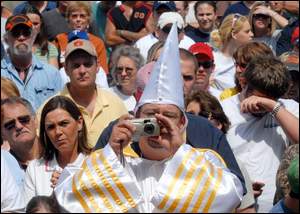
In the recent past, it has revived its nativist roots by becoming vociferously active in the immigration debate, openly sponsoring anti-immigrant rallies at which the Klan robes have come out:


Somewhat predictably, immigration has become a major point of recruitment for the Klan and other white supremacists. And just as predictably, a sharp spike of bias crimes against Latinos has followed in their wake.

This is of a piece with Goldberg's treatment of fascism generally: just as he has managed to trivialize a genuinely destructive and monstrous ideology such as fascism, so does he whitewash and minimize the horrendously poisonous history of real American fascists like the Ku Klux Klan. Indeed, it seems as if Goldberg is almost poised to declare the Klan "liberal" or yet another "progressive" offspring; but surely even that must give a pseudo-thinker like Goldberg pause. If the Klan is just another "phenomenon of the Left," then the word no longer has any meaning.

Jonah Goldberg doesn't just want us to forget about Leo Frank; he wants us to ignore the Klan's real presence, and its many victims, even today, as well as its long-running poisoning of the body politic. Because that would kind of, you know, undermine his thesis that the real American fascists are those dirty liberals. And you know what? The Klan would probably agree with him.

Who Goes Nazi?


-- by Sara

In 1939, Time magazine named Dorothy Thompson the second most influential woman in America after Eleanor Roosevelt. The first American journalist expelled from Nazi Germany -- and still then the wife of Sinclair Lewis -- she was one of the country's leading voices against fascism. She'd seen it up close in Europe, and was furiously outspoken about its creeping influence in America.

In the August 1941 issue of Harper's, Thompson wrote a short piece, based on her long European experience, outlining which Americans at any given dinner party might be expected to "go Nazi." It's still in Harper's archives, and it's as insightful and prescient now as it was on the eve of America's entry into World War II:
It is an interesting and somewhat macabre parlor game to play at a large gathering of one’s acquaintances: to speculate who in a showdown would go Nazi. By now, I think I know. I have gone through the experience many times–in Germany, in Austria, and in France. I have come to know the types: the born Nazis, the Nazis whom democracy itself has created, the certain-to-be fellow-travelers. And I also know those who never, under any conceivable circumstances, would become Nazis.

It is preposterous to think that they are divided by any racial characteristics. Germans may be more susceptible to Nazism than most people, but I doubt it. Jews are barred out, but it is an arbitrary ruling. I know lots of Jews who are born Nazis and many others who would heil Hitler tomorrow morning if given a chance. There are Jews who have repudiated their own ancestors in order to become “Honorary Aryans and Nazis”; there are full-blooded Jews who have enthusiastically entered Hitler’s secret service. Nazism has nothing to do with race and nationality. It appeals to a certain type of mind.

It is also, to an immense extent, the disease of a generation–the generation which was either young or unborn at the end of the last war. This is as true of Englishmen, Frenchmen, and Americans as of Germans. It is the disease of the so-called “lost generation.”

Sometimes I think there are direct biological factors at work–a type of education, feeding, and physical training which has produced a new kind of human being with an imbalance in his nature. He has been fed vitamins and filled with energies that are beyond the capacity of his intellect to discipline. He has been treated to forms of education which have released him from inhibitions. His body is vigorous. His mind is childish. His soul has been almost completely neglected....

.... Kind, good, happy, gentlemanly, secure people never go Nazi. They may be the gentle philosopher whose name is in the Blue Book, or Bill from City College to whom democracy gave a chance to design airplanes–you’ll never make Nazis out of them. But the frustrated and humiliated intellectual, the rich and scared speculator, the spoiled son, the labor tyrant, the fellow who has achieved success by smelling out the wind of success–they would all go Nazi in a crisis.

Believe me, nice people don’t go Nazi. Their race, color, creed, or social condition is not the criterion. It is something in them.

Those who haven’t anything in them to tell them what they like and what they don’t-whether it is breeding, or happiness, or wisdom, or a code, however old-fashioned or however modern, go Nazi. It’s an amusing game. Try it at the next big party you go to.
The whole thing is an easy but rewarding read -- an perceptive look at the way class, power, motivation, and character intertwine in the individual political choices we make in the face of authoritarian power. Thompson watched people sort themselves on one side or another of an invisible line that, in Europe, had already hardened into a battle front. From the distance of 67 years, she reports to us what she saw, how they got there, and who among us will be most likely to take us there again.

The clearing view of Ron Paul


-- by Dave

Well, we've been saying all along that Ron Paul's presidential campaign -- which is charged up enough with very public xenophobia as it is -- is attracting white supremacists and other extremists in large droves because, largely, that's who Ron Paul is.

Clearly, more people are coming to realize this, thanks in no small part to Jamie Kirchick's superb reporting in The New Republic last week on Paul's long history of publishing newletters riddled with racism, homophobia, and conspiracy-mongering. Kirchick has a follow-up this week with even more newsletters, and as he observes at the TNR blog:
At this point, it seems that the only people still defending Ron Paul are the openly bigoted or the comically credulous. For the former, the revelation that Paul had (at best, negligent at worst, complicit) involvement in the publishing of and profiting from paranoid and bigoted newsletters for over two decades neatly confirms the reasons why they had chosen to support the Texas Congressman presidential campaign in the first place. For the latter, no amount of evidence will ever convince them that “Dr. No” is anything less than some saintly, “Mr. Smith Goes to Washington” caricature.

Now comes the revelation that one of Paul's organizers in Michigan -- a man he's seen posing with in the photo below, located on the michigan4ronpaul.com site -- is also a notorious neo-Nazi and Klan organizer in that neck of the woods.

Phenry at DailyKos (who has been doing a bang-up job tracking Paul all along) has the details:
As voters in Michigan go to the polls to vote in today's primary, volunteer coordinators for the Republican and Democratic presidential candidates are working hard across the state. One of these is Randy Gray, a 29-year-old resident of Midland, Michigan whom the Ron Paul 2008 Michigan Campaign Web site lists as the Midland County coordinator for the Ron Paul campaign. Gray's campaign profile page, a cached version of which can be seen here, doesn't go into much detail; there's a picture of Gray with the candidate, along with Gray's statement that "I support Ron Paul because he is in the fight for freedom." The page contains no mention of one of Gray's other roles: organizer with the Knight's Party faction of the Ku Klux Klan.

Modest Mouse goes on to detail this:
Randy Gray is referenced in our Far Right in West Michigan Database due to a speech he delivered at the fiftieth anniversary of the Knight's Party faction of the Ku Klux Klan.... Since 2005, Gray has filed the paperwork necessary to air the program "This is the Klan" on Midland Community Television. The program, hosted by Thomas Robb and Rachel Pendergraft, is a thirty minute program designed primarily for viewing on the Internet....

Gray has attended various racist events with and without the Ku Klux Klan in recent years as well. He is quoted in a May 2004 article in the Tennessean in which the Ku Klux Klan planned a rally against a "Gay Day" event at the "Dollywood" theme park.... Gray was twice (1, 2) kicked out of city council meetings for protesting the city's permitting process in relation to a Klan protest against the Martin Luther King holiday.

There's also a video of Gray speaking at that white-power rally in Tennessee:


Transcript:
... [S]o many of these savages, according to our statistics, they're murdering our people, on a daily basis, and there's nobody in our legal system that would dare say, "Bring back the rope! Bring back the electric chair!" Instead, they take our tax dollars and they feed these animals at the cost of our race!

Yes, ladies and gentlemen, you have been lied to about diversity and multiculturalism. The immigration crisis that's being pushed upon us by the race traitors of Washington, D.C. -- they don't care about our people, they're too concerned about the homosexual rights! They're too worred about protecting the rights of the Highlander communist school in New Market, Tennessee, that pushes this immigration, this race problem in our nation today -- comes right out of the communist school. It was closed down originally in 1960 by the state of Tennessee, but they are in New Market, Tennessee, and we were up there yesterday taking photo pictures.

One of the interesting aspects of Kirchick's follow-up is that it makes clear how much Paul's newsletters were relying on the work of the "academic" white supremacist Jared Taylor of American Renaissance,, something we had pointed out earlier in relation to the newsletters.

Even more revealing, perhaps, is the reportage from Julian Sanchez and David Weigel of Reason regarding the chief authorship of the newsletters. as was hinted at earlier, it was none other than Lew Rockwell:
[I]n interviews with Reason, a half-dozen longtime libertarian activists—including some still close to Paul—all named the same man as Paul's chief ghostwriter: Ludwig von Mises Institute founder Llewellyn Rockwell, Jr.

Financial records from 1985 and 2001 show that Rockwell, Paul's congressional chief of staff from 1978 to 1982, was a vice president of Ron Paul & Associates, the corporation that published the Ron Paul Political Report and the Ron Paul Survival Report. The company was dissolved in 2001. During the period when the most incendiary items appeared—roughly 1989 to 1994—Rockwell and the prominent libertarian theorist Murray Rothbard championed an open strategy of exploiting racial and class resentment to build a coalition with populist "paleoconservatives," producing a flurry of articles and manifestos whose racially charged talking points and vocabulary mirrored the controversial Paul newsletters recently unearthed by The New Republic. To this day Rockwell remains a friend and advisor to Paul—accompanying him to major media appearances; promoting his candidacy on the LewRockwell.com blog; publishing his books; and peddling an array of the avuncular Texas congressman's recent writings and audio recordings.

Rockwell has denied responsibility for the newsletters' contents to The New Republic's Jamie Kirchick. Rockwell twice declined to discuss the matter with reason, maintaining this week that he had "nothing to say." He has characterized discussion of the newsletters as "hysterical smears aimed at political enemies" of The New Republic. Paul himself called the controversy "old news" and "ancient history" when we reached him last week, and he has not responded to further request for comment.

But a source close to the Paul presidential campaign told reason that Rockwell authored much of the content of the Political Report and Survival Report. "If Rockwell had any honor he'd come out and I say, ‘I wrote this stuff,'" said the source, who asked not to be named because Paul remains friendly with Rockwell and is reluctant to assign responsibility for the letters. "He should have done it 10 years ago."

Rockwell was publicly named as Paul's ghostwriter as far back as a 1988 issue of the now-defunct movement monthly American Libertarian. "This was based on my understanding at the time that Lew would write things that appeared in Ron's various newsletters," former AL editor Mike Holmes told reason. "Neither Ron nor Lew ever told me that, but other people close to them such as Murray Rothbard suggested that Lew was involved, and it was a common belief in libertarian circles."

And they also uncover the point that this was not a penny-ante operation:
The publishing operation was lucrative. A tax document from June 1993—wrapping up the year in which the Political Report had published the "welfare checks" comment on the L.A. riots—reported an annual income of $940,000 for Ron Paul & Associates, listing four employees in Texas (Paul's family and Rockwell) and seven more employees around the country. If Paul didn't know who was writing his newsletters, he knew they were a crucial source of income and a successful tool for building his fundraising base for a political comeback.

As Kirchick observes:
To believe that Ron Paul had no knowledge of what was being written in his own name, in his own office, for 20 years -- and that he didn't even read his own monthly publication -- not only “stretches credulity to the breaking point,” it actually requires believing bald-faced lies.

Moreover, the whole picture is now emerging into public view of Ron Paul, not just regarding his integrity and honesty on these matters, but of what his politics really are.

He has successfully sold himself to many people -- including many thoughtful, smart people who believe in his decency -- as a libertarian.

But what he really always has been is a far-right Bircherite who has successfully adapted the language of libertarianism to fit an extremist agenda -- which is why he has so many neo-Nazis hanging out in his woodshed.

And now people can see that clearly -- if they can find it within themselves to shed their emotional attachments.

Tuesday, January 15, 2008

The Jonah note of the day

-- by Dave

Well, while we twiddle our thumbs waiting to see if Jonah Goldberg even acknowledges, let alone responds to, my lengthy response to his counter -- what was that Jonah was saying about how he can't find any liberals to properly engage him in reasoned discourse? -- I thought I'd continue to share a few notes and pointers about just how misbegotten Goldberg's text really is.

One of the major ways that Liberal Fascism connects modern liberals to 1930s fascists is by the various "socialist" economic and cultural programs sponsored by the Nazi regime, particularly its program for universal education. The current embrace of such programs by liberals, Goldberg argues, makes clear their descendancy from Hitler's ideology.

Using this logic, one could make precisely the same case for modern conservatives. "Privatization" has been a major conservative watchword since at least the Reagan era. Yet, as it turns out, the Nazis similarly pursued such a program as well.

Germà Bel of the University of Barcelona explored this in considerable detail in her thesis, "Against the Mainstream: Nazi Privatization in 1930s Germany" [PDF file]. Its abstract covers the relevant points:
The Great Depression spurred State ownership in Western capitalist countries. Germany was no exception; the last governments of the Weimar Republic took over firms in diverse sectors. Later, the Nazi regime transferred public ownership and public services to the private sector. In doing so, they went against the mainstream trends in the Western capitalist countries, none of which systematically reprivatized firms during the 1930s. Privatization in Nazi Germany was also unique in transferring to private hands the delivery of public services previously provided by government. The firms and the services transferred to private ownership belonged to diverse sectors. Privatization was part of an intentional policy with multiple objectives and was not ideologically driven. As in many recent privatizations, particularly within the European Union, strong financial restrictions were a central motivation. In addition, privatization was used as a political tool to enhance support for the government and for the Nazi Party.

So, applying the Goldberg Standard, we can clearly deduce that the modern conservative movement -- including the Bush administration and the Republican Congress of 2000-2006 -- is also an ideological descendant of the Nazis.

I guess we're all just Nazis on this bus, eh, Jonah?

UPDATE:

Jonah writes:
Pretty much all the leftwing blog stuff I've seen is too vile to pick through the trash in search of a good argument. Some conservative friends have some thoughtful and constructive critiques (Yuval Levin's going to write some of them up to get a conversation going). I would like to see such a critique, but the leftwingers don't seem interested in providing it, invested as they are in the character-assassination gambit.

Evidently, a “good argument” is now “any argument I anticipated beforehand and have some notes about in my index-card file.” Any argument outside those Jonah is already prepared to answer is, by definition, a “bad argument”.

See? The Goldberg Principle in action!

Cleaning up the litter

-- by Dave

So the San Diego Minutemen have decided to shine up their civic image by adopting a highway for cleanup:
SAN DIEGO -- The Knights of Columbus have adopted a highway. So have the Japanese American Citizens League, biker groups, Indian casinos and the International House of Pancakes.

Now add the San Diego Minutemen.

Caltrans has granted an Adopt-A-Highway stretch of Interstate 5 to the ardent foes of illegal immigration -- and not just any stretch. The two miles of freeway the Minutemen will be charged with beautifying include the U.S. Border Patrol Checkpoint near San Clemente.

"How great is that," Jeff Schwilk, the group's founder, told his members in an e-mail.

Critics disagreed, saying the California Department of Transportation ignored its own rule that bars groups that advocate violence or discrimination from participating in the program.

"The Adopt-A-Highway program was designed to allow organizations to show pride in the state of California . . . and it is unfortunate that the Minutemen, whose approach . . . includes advocating violence, have been allowed by Caltrans into the program," said Tina Malka, associate director of the San Diego branch of the Anti-Defamation League.

Schwilk denied Friday that his group advocates violence and said no member has ever been arrested for immigrant-related violence.

Actually, at least one San Diego Minuteman (he may not have been a member of Schwilk's specific organization, which is in fact an offshoot group) was in fact arrested and charged after he got violent with day laborers.

This is the same group that tries to intimidate day laborers every weekend of the year:
On Saturday mornings, when they travel to the sleepy suburban gas stations where immigrant day laborers go to find work, they create scenes that would play well in a show called "Nativists Gone Wild." They call immigrants "wetbacks" and "Julios." They pull out Mace and threaten passing motorists who disagree with them. Calling those who hire day laborers "slavemasters," they've been known to slap flashing amber police lights on their SUVs and chase the would-be employers down. When they're not busy physically intimidating migrants, they take to the airwaves and the Internet to accuse them, without a shred of evidence, of running child prostitution rings and practicing "voodoo Santeria rituals."

And let's not forget that sometime members of this group like to make fantasy videos about shooting border crossers in the dead of night with night scopes.

But what the hell. If they want to try cleaning up roads, they should feel free to do so. But Caltrans officials had better be prepared: these adoptions by right-wing vigilante groups don't always work out so well. As we noted when Klan and neo-Nazi groups did likewise elsewhere, there were certain unforeseen consequences:
It's worth noting that court rulings in question only outlaw the banning of a group from these programs based on the content of its beliefs. What it doesn't prohibit is limiting participation based on a group's actual ability to perform the cleanup, as well as the likelihood of its participation becoming an attractive nuisance. Both of these avenues are available to Oregon officials.

Both of these issues, as it happens, have arisen in previous cases where the Klan or other extremist groups sought to participate in roadside-cleanup programs. The first was in the mid-1990s in Arkansas, an experiment that ended badly when the Klan failed to ever perform the promised cleanups.

They perhaps had a good reason not to: the stretch of road that they claimed attracted an unusual amount of garbage. It was as though, for some reason, everyone in the county who had noxious waste (ranging from loads of soiled disposable diapers to animal carcasses) to toss from their pickups chose that stretch of road to do it. Guess they wanted to be sure the Klan had plenty of busy work. But it became something of a public health hazard.

Likewise, in Missouri, the Ku Klux Klan's participation in the Adopt-a-Highway program sharply plummeted shortly after they were admitted. It didn't help, of course, that Missouri renamed the highway after Rosa Parks. Nor did it help that, once again, the road attracted inordinate amounts of garbage.

The signs in Marion County, Oregon, incidentally, only lasted a week.

Sunday, January 13, 2008

It's fundraising week!

We're getting near the end, so if you can, please donate.

A little about why we raise funds.

And a little about why we do what we do.

[This post will remain atop the blog this week. See below for fresh content.]

The methodology of Liberal Fascism


-- by Dave

Well, while I've largely given up on actually having a good-faith dialogue with Jonah Goldberg regarding my review of his book Liberal Fascism and his response to it, I've decided to at least continue with my detailed counter -- not in the hopes that it will produce anything in the way of genuine dialogue, but because Goldberg's book in many ways presents a "teachable moment" -- an opportunity to clear up and debunk misconceptions about the nature of fascism, and along the way, one hopes, actually enhance the public understanding of it.

So let's take a look at Goldberg's response, even though, as I've noted, it utterly neglects to address the review's central point (namely, that the continuing presence of real American fascists residing well on the right side of the nation's political aisle, both contemporaneously with those Europeans who he sees as fascism's only significant manifestation, and contemporarily in our current society, clearly disproves his claim that fascism, particularly in America, is "a phenomenon of the Left"). Because the response itself helps make clear that the shoddiness of Goldberg's methodology permeates and contaminates his entire enterprise.

(Incidentally, for a hilarious but incisive takedown of the response, check out Gavin's post at Sadly, No! Also, see Tom Hilton's e-mail exchange with Goldberg for a picture of why it's proving so worthless to even attempt to engage him in an honest discourse -- it's like conversing with the Queen of Hearts.)

Goldberg's unwillingness or inability to honestly engage the discussion is a product of something that manifests itself in his response: In the process of preparing this book, he evidently tried to imagine what the critical responses might be -- and prepared accordingly. So when someone offers a critique that doesn't fall within any of the potential lines of attack for which he has prepared, he simply refuses to even recognize its existence and dismisses it out of hand -- as he did in tossing off my insistence he address my central argument with a strawman-style mischaracterization of what that point actually was.

But as we'll see, the entirety of even the prepared lines of defense he's concocted is a farrago of falsehoods, presumptions, distortions, and straw men piled one atop the other (including an entire line of argumentation built upon responding to an argument I don't even make). His entire methodology, moreover, is essentially a thesis that's gone searching for supporting evidence -- the opposite of anything resembling a serious historical inquiry.

Goldberg is much offended, of course, that I've compared his work to David Irving's in this regard, saying "he tries ever so slightly to tag me as a member of the David Irving Holocaust-denier camp." But that, of course, isn't what I'm saying at all: Rather, my point is that he employs the same historical methodology as Holocaust deniers, which is rather a different thing. I once made a similar point about Michelle Malkin's methodology in her book In Defense of Internment -- and predictably, as Jonah did, she simply tossed it off as a "smear" rather than answer the point.

But I make this comparison measuredly -- not as a tossoff way of smearing Goldberg, but to make a serious point. It's coming not from someone who likes to call conservatives fascists willy-nilly, but as someone who's listened to Irving speak, read his books, and is intimately familiar not only with his arguments and claims but with his methodology.

Let me restate what the methodology constitutes, just so we're clear:
[I]t selects a narrow band of often unrepresentative facts, distorts their meaning, and simultaneously elides and ignores whole mountains of contravening evidence and broader context.

Most of all, it tries to represent this narrow band of facts, distortions, and falsehoods as representing the whole of the picture, when in fact the mass of the greater historical context paints if not a wholly different picture then at least a measurably more complex one.

This methodology is manifest not just in his book but in his response. For example:
Then there’s the omnipresent canard that I must be wrong because of fascism’s “overwhelming anti-liberalism.” Neiwert is again displaying either his ignorance or his dishonesty. It is absolutely true that a great many academic definitions — Ernst Nolte’s “fascist negations” for example — cite fascism’s anti-liberalism. And it is true that Mussolini and Hitler spoke of their disdain for liberalism many times, and there are many quotes to that effect. But guess what? These two European statesmen were speaking in — wait for it! — a European context where liberalism generally means limited government: classical or “Manchester” liberalism. They were most emphatically not talking about progressivism or socialism, which are the correct label for American liberalism and/or the American left (as I demonstrate at length in my book).

As he does consistently throughout the book, Goldberg here defines his terms -- in this case, "classical liberalism" -- in a very selective way that is clearly designed to enhance his premise, but in fact does not represent either a complete or really even an accurate decription of the term in question. (Some wags are now referring to this as "the Goldberg principle": "You can prove any thesis to be true if you make up your own definitions of words.")

"Classical liberalism" indeed involved limited government and, more importantly, laissez-faire economics, the things that most make it an important antecedent of modern conservatism. But it also involved, just as significantly, the primacy of the rule of law and democratic institutions, the advancement of civil liberties and civil rights, and freedom from restraint -- things all very much part of the basic strains of modern liberalism, which in turn largely is descended from social liberalism, itself an offshoot of classical liberalism.

This is an important point, because in reality modern conservatism and modern liberalism have much more in common with each other, in terms of philosophical foundations, than either do with any forms of fascism, or for that matter communism. The latter are both totalitarian, but fully distinct species of that phenomenon. (More on this point later.) The former, in contrast, are both fundamentally democratic, built on a foundation of philosophical humanism that is their shared heritage.

Indeed, this common ground is the basis for what Rick Perlstein calls "the American consensus": the great power-sharing agreement between mainstream conservatives and modern liberals that has held sway in the United States since the FDR era, and is now threatening to break down in large part because of an increasingly hostile conservative movement that openly states its intention to end that agreement -- and acts accordingly. This is a large part of why Goldberg's book is such a noxious contribution to the public discourse, because it's clearly intended to drive a wedge farther into that consensus by casting liberals as not just antiliberal, but indeed the embodiment of everything we've come to think of in the postwar era as the truly demonic.

Let's also stipulate that when historians -- and not just the actors themselves -- describe fascism as "antiliberal," their meaning extends well beyond mere classical liberalism to include "the Left" generally, which would include not just European communists and socialists, but the democratic socialists and social liberals generally associated with modern American liberalism. They do so not just because the actors themselves engaged in frequent tirades against "the Left" generally as often as they disparaged "liberalism," but because, as we shall explore in more detail shortly, their actions clearly demonstrated their vehement, indeed violent, opposition to the principles of all these factions.

Yet Goldberg is so intent on his thesis that he openly discards the historical consensus that fascism was indeed a phenomenon of the right and not of the left:
Yes, it’s true. Many historians call Nazism a right-wing enterprise. One of the arguments of my book is to demonstrate that these historians are wrong to do so. If that enrages the trade guild controlling most of academia, them’s the breaks. But simply saying that people say my view is wrong doesn’t make it wrong. I marshal hundreds of pages of evidence to back up my points. Neiwert thumbs through the indexes of a few books to make his. Moreover, I am hardly alone in this point of view. Friedrich Hayek, Paul Johnson, Richard Pipes, Milton Friedman, Erik von Kuehnelt-Leddihn, John Lukacs, Joshua Muravchik, A. James Gregor, Michael Ledeen, Ayn Rand, and — as I show in my book — countless contemporary observers of classical fascism agree with my view in whole or in part.

As Gavin observes: "Well, he’s got us there. He does have the support of a large number of 'observers of classical fascism', all of whom happen to be right-wing ideologues, libertarians, and doctrinaire conservatives."

Perhaps more to the point, only two of these people (Johnson and Lukacs) are historians: Hayek was an economist, Pipes is a neo-conservative activist, Friedman is an economist, von Kuehnelt-Leddihn is an "aristocrat intellectual," Muravchik is an AEI "scholar", Gregor is a political scientist, Rand was an economist and author of monumentally bad fiction.

The reality is that, within the realm of academic historians, no one would seriously contemplate posing as even a master's thesis the notion that fascism was a "phenomenon of the left." No one. And the reasons for that, as we shall see, have far more to do with the weight of historical evidence than any silly, unprovable, and groundless claim that this historical consensus is purely the product of a "trade guild" mentality. Jonah's defense here, frankly, is reminiscent of the global-warming deniers who insist that the scientific consensus on the relation of human activity to the phenomenon is in fact far from established. But then, according to Goldberg, global-warming activists are just another form of "liberal fascists."

To emphasize this point, I've compiled an appendix (posted just below) comprised of various scholarly attempts to define fascism, and it tries to reflect the range of contemporary thought on the matter. If you survey these definitions and descriptions, you'll see that, in toto, there are very few traits described therein that even remotely fit the description of being left-wing generally, and certainly not "liberal" or "progressive" in either their contemporary or classical senses. In contrast, a large number of them are clearly traits we associate with the right generally -- particularly the militarism, the nationalism, the cults of masculinity and violence.

These descriptions, however, are only the end products of these historians' thorough examination of the evidence surrounding fascism. They are built, as we shall see, on the bedrock of historical fact, and the evidence regarding fascism's right-wing orientation is mountainous indeed.

I'd also like to call special attention to Goldberg's citation of Michael Ledeen (who also has a blurb on the book's jacket), because I think it reflects the dishonest way he represents even his alleged fellow travelers. Ledeen, in fact, has something of a history as a philo-fascist. His 1972 book, Universal Fascism, in fact was in the way of an encomium to primal first-stage fascism, or what he calls "fascism-movement," as distinct from "fascism-regime," which evidently is where it all went wrong. Ledeen specifically argues -- as does his intellectual mentor, Italian historian Renzo de Felice -- that "Italian fascism was both right-wing and revolutionary." In its movement stage, according to Ledeen, it was actually a thing of beauty and great promise. (Of course, by 2003, when Ledeen began touting the threat of "Islamofascism," his perspective on this presumably had changed.)

Indeed, we might well take note of the history of Jonah's publication, National Review, regarding its own record of philo-fascism, including its open adoration of Francisco Franco and its running attacks on the trial of Adolph Eichmann. By Goldberg's measure, this should stand as evidence that not just National Review but conservatives themselves are fascist.

Of course, that's a nonsensical standard that obliviates the larger context of conservatism generally. But Goldberg is content to proceed in exactly that fashion when it comes to liberalism. Goldberg has mounds of quotes from ostensible left-wing figures voicing their admiration for fascism and fascists -- most of them from before 1930 -- and for him, this is insurmountable proof of fascism's left-wing orientation.

Similarly, he is downright credulous when it comes to quoting fascists about their relationship to socialism:
Again, as I try to show in my book, the reason we call fascism and National Socialism “right wing” is because these were forms of “right-wing socialism,” or, as both the Marxist theoretician Karl Radek and Leon Trotsky argued, “middle class socialism.” And while the academic literature is on my side of the argument that the Nazis appealed to the lower classes just as much as the Communists did (if not more so), I have no problem conceding that the nature of Nazi socialism was in some significant respects different from Soviet socialism. So call it right-wing socialism if you like. But don’t saw off the right-wing part and then bludgeon American conservatives with it.

The point here is that these were all different kinds of socialism. And in the Anglo-American tradition, socialism is a phenomenon of the Left. Period. And many, many more historians who would no doubt take issue with my book — Michael Mann and the Germans Götz Aly and Wolfgang Schivelbusch come to mind — nonetheless have written at length about the fundamental and indisputable antipathy the National Socialists had for capitalism.

The mistake -- almost certainly an intentional one -- that Goldberg makes here is in placing as much weight as he does, not just here but throughout his "hundreds of pages of evidence," on the words of fascist ideologues, and particularly on their words in the formative first stage.

The problem with doing so is twofold: not only were fascists prodigious liars and deceivers, they also were highly mutative and opportunistic. Because fascism is more in the way of a pathology than an ideology -- a pathology centered around the crude acquisition of power -- it would adopt and discard ideologies and ideas with great alacrity, depending on its needs in forming alliances and gaining access to the levers of state power. As Franz Neumann put it:
National Socialism ideology is constantly shifting. It has certain magical beliefs -- leadership adoration, the supremacy of the master race -- but it is not laid down in a series of categorical and dogmatic pronouncements.

Thus, to genuinely understand historical fascism, it's far more important to look at their actions as well as their words.

This is the approach in fact taken by Robert O. Paxton in his book The Anatomy of Fascism, which I'm going to rely on here for a bit because Paxton's methodology not only is sound -- built out of a lifetime's study of the broader historical context involved -- and his scholarship fairly representative of the historical consensus about fascism, he clearly lays out the flaws in a thesis like Goldberg's. This book was written in 2004, and Goldberg even cites, but it's clear that he ignores Paxton's warnings about the very methodological flaws that he insists indulging. Actually, he doesn't merely ignore them -- he dismisses them outright, but as we shall see, on wholly inadequate grounds.

Right at the outset in his introduction, Paxton makes clear that Goldberg's thesis is deeply flawed:
Another supposed essential character of fascism is its anticapitalist, antibourgeois animus. Early fascist movements flaunted their contempt for bourgeois values and for those who wanted only "to earn money, money, filthy money." They attacked "international finance capitalism" almost as loudly as they attacked socialists. They even promised to expropriate department-store owners in favor of patriotic artisans, and large landowners in favor of peasants.

Whenever fascist parties acquired power, however, they did nothing to carry out these anticapitalist threats. By contrast, they enforced with the utmost violence and thoroughness their threats against socialism. Street fights over turf with young communists were among their most powerful propaganda images. Once in power, fascist regimes banned strikes, dissolved independent labor unions, lowered wage earners' purchasing power, and showered money on armaments industries, to the immense satisfaction of employers.

As he goes on to explore, the seeming internal contradictions of fascist rhetoric in opposition to fascist action has created much of the ongoing academic debate over its nature:
Faced with these conflicts between words and actions concerning capitalism, scholars have drawn opposite conclusions. Some, taking the words literally, consider fascism a form of radical anticapitalism. Others, and not only Marxists, take the diametrically opposite position that fascists came to the aid of capitalism in trouble, and propped up by emergency means the existing system of property distribution and social hierarchy.

This book takes the position that what the fascists did tells us at least as much as what they said. What they said cannot be ignored, of course, for it helps explain their appeal. Even at its most radical, however, fascists' anticapitalist rhetoric was selective. While they denounced speculative international finance (along with all other forms of internationalism, cosmopolitanism, or globalization -- capitalist as well as socialist), they respected the property of national producers, who were to form the social base of the reinvigorated nation. When they denounced the bourgeoisie, it was for being too flabby and individualistic to make a nation strong, not for robbing workers of the value they added. What they criticized in capitalism was not its exploitation but its materialism, its indifference to the nation, its inability to stir souls. More deeply, fascists rejected the notion that economic forces are the prime movers of history. For fascists, the dysfunctional capitalism of the interwar period did not need fundamental reordering; its ills could be cured simply by applying sufficient political will to the creation of full employment and productivity. Once in power, fascist regimes confiscated property only from political opponents, foreigners, or Jews. None altered the social hierarchy, except to catapult a few adventurers into high places. At most, they replaced market forces with state economic management, but, in the trough of the Great Depression, most businessmen initially approved of that. If fascism was "revolutionary," it was so in a special sense, far removed from the word's meaning as usually understood from 1789 to 1917, as a profound overturning of the social order and the redistribution of social, political, and economic power.

Paxton also explains why the reliance on fascists' early rhetorical appeals is methodologically flawed (p. 53):
Looking mainly at early fascism starts us down several false trails. It puts intellectuals at the center of an enterprise whose major decisions were made by power-seeking men of action. The intellectual fellow travelers had diminishing influence in the rooting and regime stages of the fascist cycle, although certain ideas reasserted themselves in the radicalization stage ... Further, concentrating on origins puts misleading emphasis on early fascism's antibourgeois rhetoric and its critique of capitalism. It privileges the "poetic movement" of Jose Antonio Primo de Rivera that would impose "hard and just sacrifices ... on many of our own class," and "reach the humble as well as the powerful with its benefits," and the "great red fascism of our youth," as Robert Brasillach remembered it with fond nostalgia shortly before his execution for treason in Paris in February 1945.

As for the "hatred of capitalism" that they actually practiced:
It turned out in practice that fascists' anticapitalism was highly selective. Even at their most radical, the socialism that the fascists wanted was a "national socialism": one that denied only foreign or enemy property rights (including that of internal enemies). They cherished national producers. Above all, it was by offering an effective remedy against socialist revolution that fascism turned out in practice to find a space. If Mussolini retained some lingering hopes in 1919 of founding an alternative socialism rather than an antisocialism, he was soon disabused of those notions by observing what worked and what didn't work in Italian politics. His dismal electoral results with a Left-nationalist program in Milan in November 1919 surely hammered that lesson home.

The pragmatic choices of Mussolini and Hitler were driven by their urge for success and power. Not all fascist leaders had such ambitions. Some of them preferred to keep their movements "pure," even at the cost of remaining marginal.

Paxton makes abundantly clear that the political space the fascists, in obtaining power, chose to occupy was clearly on the right. Goldberg, in contrast, insists that "fascism, properly understood, is not a phenomenon of the right at all" because, he explains, fascism and communism "are closely related, historical competitors for the same constituents, seeking to dominate and control the same social space." He claims throughout the book and elsewhere that fascists didn't seek out their political space on the right -- rather, they were doing so on the left.

He actually addresses Paxton's characterization with what can most kindly be characterized as a lame rebuttal (p. 47):
In November the newly named explicitly left-wing Fascists ran a slate of candidates in the national elections. They got trounced at the hands of the Socialists. Most historians claim this is what taught Mussolini to move to the "right." Robert O. Paxton writes that Mussolini realized "there was no space in Italian politics for a party that was both nationalist and Left."

This, I think, distorts the picture. Mussolini did not move fascism from left to right; he moved it from socialist to populist.

Yet if Goldberg had actually bothered to read Paxton's account of how the move occurred -- or for that matter, any other historical account of these events -- he would know that the ideological shift by Mussolini had not even the remotest thing to do with populism. Rather, it all occurred in the defense of wealthy landowners and the established economic and cultural powers, and it entailed a wave of murderous violence against socialists, leftists, and any form of progressive.

From Paxton, pp. 60-64:
Above all Mussolini bested D'Annunzio by serving economic and social interests as well as nationalist sentiment. He made his Blackshirts available for action against socialists as well as against the South Slavs of Fiume and Trieste. War veterans had hated the socialists since 1915 for their "antinational" stance during the war. Big planters in the Po Valley, Tuscany, Apulia, and other regions of large estates hated and feared the socialists for their success at the end of the war in organizing the bracianti, or landless laborers, to press for higher wages and better working conditions. Squadrismo was the conjunction of these two hatreds.

Following their victory in the first postwar election (November 1919) the Italian socialists had used their new power in local government to establish de facto control over the agricultural wage-labor market. In the Po Valley in 1920, every farmer who needed workmen for planting or harvesting had to visit the socialist Labor Exchange. The Labor Exchanges made the most of their new leverage. They forced the farmers to hire workers year-round rather than only seasonally, and with better wages and working conditions. The farmers were financially squeezed. They had invested considerable sums in transforming Po Valley marshlands in cultivable farms; their cash crops earned little money in the difficult conditions of the Italian postwar economy. The socialist unions also undermined the farmers' personal status as masters of their domains.

Frightened and humiliated, the Po Valley landowners looked frantically for help. They did not find it in the Italian state. Local officials were either socialists themselves, or little inclined to do battle with them. Prime Minister Giolitti, a true practitioner of laissez-faire liberalism, declined to use national forces to break strikes. The big farmers felt abandoned by the Italian liberal state.

In the absence of help from the public authorities, the large landowners of the Po Valley turned to the Blackshirts for protection. Glad for an excuse to attack their old pacifist enemies, fascist squadristi invaded the city hall in Bologna, where socialist officials had hung up a red banner, on November 21, 1920. Six were killed. From there, the movement quickly spread through the rich agricultural country in the lower Po River delta. Black-shirted squadristi mounted nightly expeditions to sack and burn Labor Exchanges and local socialist offices, and beat and intimidate socialist organizers. Their favorite forms of humiliation were administering uncontainable doses of castor oil and shaving off half of a proud Latin moustache. In the first six months of 1921, the squads destroyed 17 newspapers and printing works, 59 Peoples' Houses (socialist headquarters), 119 Chambers of Labor (socialist employment offices), 107 cooperatives, 83 Peasants' Leagues, 151 socialist clubs, and 151 cultural organizations. Between January 1 and April 7, 1921, 102 people were killed: 25 fascists, 41 socialists, 20 police, and 16 others.

... Long after his regime had settled into routine, Mussolini still liked to refer to the "Fascist revolution." But he meant a revolution against socialism and flabby liberalism, a new way of uniting and motivating Italians, and a new kind of governmental authority capable of subordinating private liberties to the needs of the national community and of organizing mass assent while leaving property intact. The major point is that the Fascist movement was reshaped in the process of growing into the available space. The antisocialism already present in the initial movement became central, and many antibourgeois idealists left or were pushed out. The radical anticapitalist idealism of early Fascism was watered down, and we must not let its conspicuous presence in early texts confuse us about what Fascism later became in action.

Paxton, p. 83:
The Italian Fascist Party, having discovered that in its first identity as a Left-nationalist movement the space it coveted was already occupied by the Left, underwent the necessary transformations to become a local power in the Po Valley. The Nazi Party broadened its appeal after 1928 to court farmers desperate over going broke and losing their farms. Both Mussolini and Hitler could perceive the space available, and were willing to trim their movements to fit.

The space was partly symbolic. The Nazi Party early shaped its identity by staking a claim to the street and fought with communist gangs for control of working-class neighborhoods of Berlin. At issue was not merely a few meters of urban "turf." The Nazis sought to portray themselves as the most vigorous and effective force against the communists -- and, at the same time, to portray the liberal state as incapable of preserving public security. The communists, at the same time, were showing that the Social Democrats were unequipped to deal with an incipient revolutionary situation that needed a fighting vanguard. Polarization was in the interest of both.

Fascist violence was neither random nor indiscriminate. It carried a well-calculated set of coded messages: that communist violence was rising, that the democratic state was responding to it ineptly, and that only the fascists were tough enough to save the nation from antinational terrorists. An essential step in the fascist march to acceptance and power was to persuade law-and-order conservatives and members of the middle class to tolerate fascist violence as a harsh necessity in the face of Left provocation. It helped, of course, that many ordinary citizens never feared fascist violence against themselves, because they were reassured that it was reserved for national enemies and "terrorists" who deserved it.

The path to power for both Italian Fascists and German Nazis was essentially the same: They presented themselves as "revolutionary socialists" in their initial appeals but, finding the political space for such a movement already well occupied on the left by socialists and communists, shifted their appeals and their alliances to the right and center, particularly with business capitalists who financed them, sponsored their activities, and essentially contracted with them to engage in systematic violence against the Left. For the Nazis, Fritz Thyssen, head of the nation's largest steel producer, was only the most prominent example of business capitalists who funneled money to the Nazis both as they rose to power and once they gained it.

To characterize this shift as "populist" simply flies in the face of historical fact. And yet Goldberg insists on this, largely by making a nakedly false assertion about the nature of populism itself:
An unwieldy phenomenon, populism had never been known as a conservative or right-wing orientation before, and it is only because so many were determined to label fascism right-wing that populism under Mussolini was redefined as such.

Well, as I explained in the review, populism in fact is a historically complex and broad phenomenon that has encompassed both right- and left-wing political spheres, and every point in between. Some of the previously observed right-wing expressions of populism in America included Bacon's Rebellion, the Know-Nothing nativists, and the Ku Klux Klan.

Indeed, as we have already discussed here in some detail, Goldberg is quick to dismiss the Klan as a clownish "creepy fan subculture" and dismisses the notion that they were fascist in an offhand manner -- relying, once again, on an anecdotal factoid as his "proof."

It's clear throughout the book that Goldberg believes liberals identify groups like the Klan as fascist simply because they are racist. Perhaps that's true for some liberals, but it's certainly not true in my case, nor for those historians who have affirmed that they were indeed not just genuine fascists, but perhaps the first real immanation of fascism. As I've explained, the Klan is definably fascist because it wholly fits the definition of fascism, of which its racism is only one expression. Indeed, its racism is really only a symptom of the deeper impulses to which it appeals.

And so not only does he make the same point again in his response, but he also proceeds to put an argument in my mouth that I never make:
This point about race that Neiwert brings up is an important one — and one that I anticipate and discuss in my book. Because he believes that racism is inherently right-wing, the fact that the Nazis were racists means they had to be right-wingers. I concede, and talk at length, about the fact that the Nazis were racists. But racism, I’m sorry to say, is not definitively right-wing in my book (literally and figuratively).

If you'll read the review, you'll not only see that I make only a glancing reference to racism -- and I certainly never argue either that racism is inherently right-wing, or that this is what makes the Nazis right-wing. As we've seen above, what makes the Nazis definably right-wing is the actual manifestation of their agenda in action -- particularly its destruction of democratic institutions and norms; its violent attacks on left-wing organizing of any kind, including the banning of labor unions; and its open embrace of capitalism as the engine for their war machines once they obtained power.

Goldberg is quite right that racism itself is not inherently right-wing, particularly not for the period in question. I've actually explored this point in some detail on several occasions here, as well as in my book Strawberry Days -- pointing out that much of the early labor organizing on the West Coast between 1870 and 1920 was actually predicated on naked anti-Asian prejudice. Likewise, anyone who knows the history of labor unions at all is familiar with the racial animus stirred up by the use of black strikebreakers by various captains of industry.

Nonetheless, it is accurate to say that modern liberalism -- the liberalism that Goldberg seeks to smear by associating it with fascism -- does have as one of its current major traits an abiding opposition to racism. This is the legacy of liberals' long-running support for the Civil Rights movement and the legislative advancement of minority rights, its open embrace of multiculturalism -- for which it is regularly and often scorned and maligned by conservatives.

Indeed, for conservatives like Jonah, this embrace of the multicultural itself is evidence of racism -- because it's all about boxing everyone into their racial identity, you see, and not the notion that all racial identities deserve to be equally empowered. And so liberal efforts to overcome the effects of decades of racism are themselves racist, you see. (The Queen of Hearts is talking again.) This reasoning (if that's what you call it) is what gives Goldberg the chutzpah to emit this howler:
In America, conservatives argue for colorblindness; the Left does not.

Actually, conservatives only seem to argue for colorblindness when it comes to efforts to overcome racism's legacy, like affirmative-action and racial-sensitivity programs. In the meantime, there's all kinds of color-awareness being promoted by conservatives nowadays: Patrick Buchanan and Bill O'Reilly are only two of the more prominent voices from the movement to argue vehemently about the need to save "white culture" and who worry about America being swamped by a brown tide. They're also kept company by figures like Jared Taylor and Peter Brimelow, not to mention the execrable Steve Sailer and the late Sam Francis, all of whom Goldberg may not consider conservatives (or maybe he'd just like to redefine them as "populists") but who do in fact operate at will within the conservative movement broadly. There's also Michelle Malkin, who has written an entire book advocating the use of ethnic-profiling measures to enhance national security -- by defending the mass incarceration of a single ethnic group during World War II as a shining example of such measures.

We can see that obviating this reality is the entire purpose of Goldberg's enterprise. He has repeatedly stated that what inspired him to write it was getting tired of hearing conservatives bearing smeared as fascists.

His retort in the text is of a piece with his methodology in general:
Liberals are the ones who've insisted that conservatism has connections with fascism. They are the ones who claim free-market economics are fascist and that therefore their own economic theories should be seen as the more virtuous, even though the truth is almost entirely the reverse.

Who, exactly, claims that "free-market economics are fascist"? Hillary Clinton? Barack Obama? Keith Olbermann? Atrios? Please, Jonah, name some names. Because this is just a classic strawman argument.

He closes his response to me in largely the same vein:
and that brings us to the close of his review which is really just a recitation of the same usual talking-points about how if you scratch an American conservative you find a Nazi underneath.

Of course, I've never made this claim (and particularly not in this review). Indeed, this is a gross mischaracterization of what I did write, which was the central thesis of the review, and bears repeating:
What goes missing from Goldberg's account of fascism is that, while he describes nearly every kind of liberal enterprise or ideology as representing American fascism, he wipes from the pages of history the fact that there have been fascists operating within the nation's culture for the better part of the past century. Robert O. Paxton, in his book The Anatomy of Fascism, identifies the Ku Klux Klan as the first genuine fascist organization, a suggestion that Goldberg airily dismisses with the dumb explanation that the Klan of the 1920s disliked Mussolini and his adherents because they were Italian (somewhat true for a time but irrelevant in terms of their ideological affinities, which were substantial enough that by the 1930s, historians have noted, there were frequent operative associations between Klan leaders and European fascists).

Beyond the Klan, completely missing from the pages of Goldberg's book is any mention of the Silver Shirts, the American Nazi Party, the Posse Comitatus, the Aryan Nations, or the National Alliance -- all of them openly fascist organizations, many of them involved in some of the nation's most horrific historical events. (The Oklahoma City bombing, for instance, was the product of a blueprint drawn up by the National Alliance's William Pierce.) Goldberg sees fit to declare people like Wilson, FDR, LBJ, and Hillary Clinton "American fascists," but he makes no mention of William Dudley Pelley, Gerald L.K. Smith, George Lincoln Rockwell, William Potter Gale, Richard Butler, or David Duke -- all of them bona fide fascists: the real thing.

This is a telling omission, because the continuing existence of these groups makes clear what an absurd and nakedly self-serving thing Goldberg's alternate version of reality is. Why dream up fascists on the left when the reality is that real American fascists have been lurking in the right's closet for lo these many years? Well, maybe because it's a handy way of getting everyone to forget that fact.

I have in fact written at length about the crosscurrents between American proto-fascists and mainstream movement conservatives, and have done so by insisting rigorously on people making the distinction between them. But at the same time, it's important to understand that the rise in ideological traffic between the far right and the mainstream actually means that the constellation of traits that constitute the fascist pathology gain traction, and the demon itself starts to take shape.

This is why so many people outside the conservative movement look at its True Believers and see budding little fascists. If Jonah Goldberg is concerned about people mistaking conservatives for fascists, he'd do far more good calling on conservatives to stand back and take a look at where they're heading ideologically.

If conservatives like Jonah don't want to be mistaken for fascists, they won't embrace the racial politics of people like Buchanan or Brimelow or Malkin. They won't let a far-right extremist like Ron Paul, whose campaign is riddled with white supremacists, even into the Republican Party, let alone play a significant role in the GOP presidential campaign, and they won't embrace vigilante organizations like the Minutemen. Maybe they won't write books that manage to trivialize an utterly monstrous and destructive right-wing ideology, pretending that entities like the Klan really aren't right-wing in the process. But conservatives like Jonah have done all these things.

Most of all, perhaps, they could eschew the eliminationist rhetoric that has not only deeply infected the conservative discourse but has poisoned the larger public discourse as well. After all, as Robert Paxton observes:
The legitimation of violence against a demonized internal enemy brings us close to the heart of fascism.

Books like Dinesh d'Souza's The Enemy at Home: The Cultural Left and Its Responsibility for 9/11, Ann Coulter's Treason: Liberal Treachery from the Cold War to the War on Terrorism, Sean Hannity's Deliver Us From Evil: Defeating Terrorism, Despotism and Liberalism, and Michael Savage's The Enemy Within: Saving America from the Liberal Assault on Our Schools, Faith, and Military all were about promoting the idea that liberals are America's internal enemy.

And it's clear we can add Liberal Fascism to that list. What's almost pathetically amusing about this is that we're talking about a book whose stated purpose is to make conservatives look less like fascists. And of course, its end result is very much the opposite.

An appendix on fascism

-- by Dave

Below are some attempts to define fascism from various scholars and observers over the years.

George Orwell, in The Lion and the Unicorn (1941):
But what then is Fascism?

Fascism, at any rate the German version, is a form of capitalism that borrows from Socialism just such features as will make it efficient for war purposes. Internally, Germany has a good deal in common with a Socialist state. Ownership has never been abolished, there are still capitalists and workers, and — this is the important point, and the real reason why rich men all over the world tend to sympathise with Fascism — generally speaking the same people are capitalists and the same people workers as before the Nazi revolution. But at the same time the State, which is simply the Nazi Party, is in control of everything. It controls investment, raw materials, rates of interest, working hours, wages. The factory owner still owns his factory, but he is for practical purposes reduced to the status of a manager. Everyone is in effect a State employee, though the salaries vary very greatly. The mere efficiency of such a system, the elimination of waste and obstruction, is obvious. In seven years it has built up the most powerful war machine the world has ever seen.

But the idea underlying Fascism is irreconcilably different from that which underlies Socialism. Socialism aims, ultimately, at a world-state of free and equal human beings. It takes the equality of human rights for granted. Nazism assumes just the opposite. The driving force behind the Nazi movement is the belief in human inequality, the superiority of Germans to all other races, the right of Germany to rule the world. Outside the German Reich it does not recognise any obligations. Eminent Nazi professors have “proved” over and over again that only nordic man is fully human, have even mooted the idea that non-nordic peoples (such as ourselves) can interbreed with gorillas! Therefore, while a species of war-Socialism exists within the German state, its attitude towards conquered nations is frankly that of an exploiter. The function of the Czechs, Poles, French, etc is simply to produce such goods as Germany may need, and get in return just as little as will keep them from open rebellion. If we are conquered, our job will probably be to manufacture weapons for Hitler’s forthcoming wars with Russia and America. The Nazis aim, in effect, at setting up a kind of caste system, with four main castes corresponding rather closely to those of the Hindu religion. At the top comes the Nazi party, second come the mass of the German people, third come the conquered European populations. Fourth and last are to come the coloured peoples, the “semi-apes” as Hitler calls them, who are to be reduced quite openly to slavery.

Stanley Payne, in Fascism: Comparison and Definition (1980):
A. The Fascist Negations:
-- Antiliberalism
-- Anticommunism
-- Anticonservatism (though with the understanding that fascist groups were willing to undertake temporary alliances with groups from any other sector, most commonly with the right)

B. Ideology and Goals:
-- Creation of a new nationalist authoritarian state based not merely on traditional principles or models
-- Organization of some new kind of regulated, multiclass, integrated national economic structure, whether called national corporatist, national socialist, or national syndicalist
-- The goal of empire or a radical change in the nation’s relationship with other powers
-- Specific espousal of an idealist, voluntarist creed, normally involving the attempt to realize a new form of modern, self-determined, secular culture

C. Style and Organization:
-- Emphasis on esthetic structure of meetings, symbols, and political choreography, stressing romantic and mystical aspects
-- Attempted mass mobilization with militarization of political relationships and style and with the goal of a mass party militia
-- Positive evaluation and use of, or willingness to use, violence
-- Extreme stress on the masculine principle and male dominance, while espousing the organic view of society
-- Exaltation of youth above other phases of life, emphasizing the conflict of generations, at least in effecting the initial political transformation
-- Specific tendency toward an authoritarian, charismatic, personal style of command, whether or not the command is to some degree initially elective

Robert O. Paxton, The Anatomy of Fascism, p. 218:
Fascism may be defined as a form of political behavior marked by obsessive preoccupation with community decline, humiliation, or victimhood and by compensatory cults of unity, energy, and purity, in which a mass-based party of committed nationalist militants, working in uneasy but effective collaboration with traditional elites, abandons democratic liberties and pursues with redemptive violence and without ethical or legal constraints goals of internal cleansing and external expansion.

Paxton's nine "mobilizing passions" of fascism:
-- a sense of overwhelming crisis beyond the reach of any traditional solutions;

-- the primacy of the group, toward which one has duties superior to every right, whether universal or individual, and the subordination of the individual to it;

-- the belief that one's group is a victim, a sentiment which justifies any action, without legal or moral limits, against the group's enemies, both internal and external;

-- dread of the group's decline under the corrosive effect of individualistic liberalism, class conflict, and alien influences;

-- the need for closer integration of a purer community, by consent if possible, or by exclusionary violence if necessary;

-- the need for authority by natural leaders (always male), culminating in a national chief who alone is capable of incarnating the group's destiny;

-- the superiority of the leader's instincts over abstract and universal reason;

-- the beauty of violence and the efficacy of will, when they are devoted to the group's success;

-- the right of the chosen people to dominate others without restraint from any kind of human or divine law, right being decided by the sole criterion of the group's prowess in a Darwinian struggle.


Roger Griffin:
Fascism: modern political ideology that seeks to regenerate the social, economic, and cultural life of a country by basing it on a heightened sense of national belonging or ethnic identity. Fascism rejects liberal ideas such as freedom and individual rights, and often presses for the destruction of elections, legislatures, and other elements of democracy. Despite the idealistic goals of fascism, attempts to build fascist societies have led to wars and persecutions that caused millions of deaths. As a result, fascism is strongly associated with right-wing fanaticism, racism, totalitarianism, and violence.

Umberto Eco:
1. The first feature of Ur-Fascism is the cult of tradition.

Traditionalism is of course much older than fascism. Not only was it typical of counterrevolutionary Catholic thought after the French revolution, but is was born in the late Hellenistic era, as a reaction to classical Greek rationalism. In the Mediterranean basin, people of different religions (most of the faiths indulgently accepted by the Roman pantheon) started dreaming of a revelation received at the dawn of human history. This revelation, according to the traditionalist mystique, had remained for a long time concealed under the veil of forgotten languages -- in Egyptian hieroglyphs, in the Celtic runes, in the scrolls of the little-known religions of Asia.

This new culture had to be syncretistic. Syncretism is not only, as the dictionary says, "the combination of different forms of belief or practice;" such a combination must tolerate contradictions. Each of the original messages contains a sliver of wisdom, and although they seem to say different or incompatible things, they all are nevertheless alluding, allegorically, to the same primeval truth.

As a consequence, there can be no advancement of learning. Truth already has been spelled out once and for all, and we can only keep interpreting its obscure message.

If you browse in the shelves that, in American bookstores, are labeled New Age, you can find there even Saint Augustine, who, as far as I know, was not a fascist. But combining Saint Augustine and Stonehenge -- that is a symptom of Ur-Fascism.

2. Traditionalism implies the rejection of modernism.

Both Fascists and Nazis worshipped technology, while traditionalist thinkers usually reject it as a negation of traditional spiritual values. However, even though Nazism was proud of its industrial achievements, its praise of modernism was only the surface of an ideology based upon blood and earth (Blut und Boden). The rejection of the modern world was disguised as a rebuttal of the capitalistic way of life. The Enlightenment, the Age of Reason, is seen as the beginning of modern depravity. In this sense Ur-Fascism can be defined as irrationalism.

3. Irrationalism also depends on the cult of action for action's sake.

Action being beautiful in itself, it must be taken before, or without, reflection. Thinking is a form of emasculation. Therefore culture is suspect insofar as it is identified with critical attitudes. Distrust of the intellectual world has always been a symptom of Ur-Fascism, from Hermann Goering's fondness for a phrase from a Hanns Johst play ("When I hear the word 'culture' I reach for my gun") to the frequent use of such expressions as "degenerate intellectuals," "eggheads," "effete snobs," and "universities are nests of reds." The official Fascist intellectuals were mainly engaged in attacking modern culture and the liberal intelligentsia for having betrayed traditional values.

4. The critical spirit makes distinctions, and to distinguish is a sign of modernism.

In modern culture the scientific community praises disagreement as a way to improve knowledge. For Ur-Fascism, disagreement is treason.

5. Besides, disagreement is a sign of diversity.

Ur-Fascism grows up and seeks consensus by exploiting and exacerbating the natural fear of difference. The first appeal of a fascist or prematurely fascist movement is an appeal against the intruders. Thus Ur-Fascism is racist by definition.

6. Ur-Fascism derives from individual or social frustration.

That is why one of the most typical features of the historical fascism was the appeal to a frustrated middle class, a class suffering from an economic crisis or feelings of political humiliation, and frightened by the pressure of lower social groups. In our time, when the old "proletarians" are becoming petty bourgeois (and the lumpen are largely excluded from the political scene), the fascism of tomorrow will find its audience in this new majority.

7. To people who feel deprived of a clear social identity, Ur-Fascism says that their only privilege is the most common one, to be born in the same country.

This is the origin of nationalism. Besides, the only ones who can provide an identity to the nation are its enemies. Thus at the root of the Ur-Fascist psychology there is the obsession with a plot, possibly an international one. The followers must feel besieged. The easiest way to solve the plot is the appeal to xenophobia. But the plot must also come from the inside: Jews are usually the best target because they have the advantage of being at the same time inside and outside. In the United States, a prominent instance of the plot obsession is to be found in Pat Robertson's The New World Order, but, as we have recently seen, there are many others.

8. The followers must feel humiliated by the ostentatious wealth and force of their enemies.

When I was a boy I was taught to think of Englishmen as the five-meal people. They ate more frequently than the poor but sober Italians. Jews are rich and help each other through a secret web of mutual assistance. However, the followers of Ur-Fascism must also be convinced that they can overwhelm the enemies. Thus, by a continuous shifting of rhetorical focus, the enemies are at the same time too strong and too weak. Fascist governments are condemned to lose wars because they are constitutionally incapable of objectively evaluating the force of the enemy.

9. For Ur-Fascism there is no struggle for life but, rather, life is lived for struggle.

Thus pacifism is trafficking with the enemy. It is bad because life is permanent warfare. This, however, brings about an Armageddon complex. Since enemies have to be defeated, there must be a final battle, after which the movement will have control of the world. But such "final solutions" implies a further era of peace, a Golden Age, which contradicts the principle of permanent war. No fascist leader has ever succeeded in solving this predicament.

10. Elitism is a typical aspect of any reactionary ideology, insofar as it is fundamentally aristocratic, and aristocratic and militaristic elitism cruelly implies contempt for the weak.

Ur-Fascism can only advocate a popular elitism. Every citizen belongs to the best people in the world, the members or the party are the best among the citizens, every citizen can (or ought to) become a member of the party. But there cannot be patricians without plebeians. In fact, the Leader, knowing that his power was not delegated to him democratically but was conquered by force, also knows that his force is based upon the weakness of the masses; they are so weak as to need and deserve a ruler.

11. In such a perspective everybody is educated to become a hero.

In every mythology the hero is an exceptional being, but in Ur-Fascist ideology heroism is the norm. This cult of heroism is strictly linked with the cult of death. It is not by chance that a motto of the Spanish Falangists was Viva la Muerte ("Long Live Death!"). In nonfascist societies, the lay public is told that death is unpleasant but must be faced with dignity; believers are told that it is the painful way to reach a supernatural happiness. By contrast, the Ur-Fascist hero craves heroic death, advertised as the best reward for a heroic life. The Ur-Fascist hero is impatient to die. In his impatience, he more frequently sends other people to death.

12. Since both permanent war and heroism are difficult games to play, the Ur-Fascist transfers his will to power to sexual matters.

This is the origin of machismo (which implies both disdain for women and intolerance and condemnation of nonstandard sexual habits, from chastity to homosexuality). Since even sex is a difficult game to play, the Ur-Fascist hero tends to play with weapons -- doing so becomes an ersatz phallic exercise.

13. Ur-Fascism is based upon a selective populism, a qualitative populism, one might say.

In a democracy, the citizens have individual rights, but the citizens in their entirety have a political impact only from a quantitative point of view -- one follows the decisions of the majority. For Ur-Fascism, however, individuals as individuals have no rights, and the People is conceived as a quality, a monolithic entity expressing the Common Will. Since no large quantity of human beings can have a common will, the Leader pretends to be their interpreter. Having lost their power of delegation, citizens do not act; they are only called on to play the role of the People. Thus the People is only a theatrical fiction. There is in our future a TV or Internet populism, in which the emotional response of a selected group of citizens can be presented and accepted as the Voice of the People.

Because of its qualitative populism, Ur-Fascism must be against "rotten" parliamentary governments. Wherever a politician casts doubt on the legitimacy of a parliament because it no longer represents the Voice of the People, we can smell Ur-Fascism.

14. Ur-Fascism speaks Newspeak.

Newspeak was invented by Orwell, in Nineteen Eighty-Four, as the official language of what he called Ingsoc, English Socialism. But elements of Ur-Fascism are common to different forms of dictatorship. All the Nazi or Fascist schoolbooks made use of an impoverished vocabulary, and an elementary syntax, in order to limit the instruments for complex and critical reasoning. But we must be ready to identify other kinds of Newspeak, even if they take the apparently innocent form of a popular talk show.

Jonah: Note this last one especially.