Monday, December 25, 2006

Eliminationism in America: IV

[Continuing a ten-part series.]

Parts I, II, and III

Part IV: 'People Die Very Much'


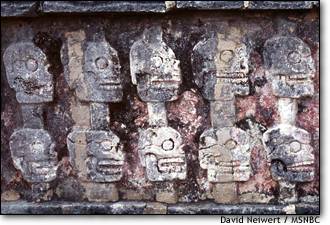
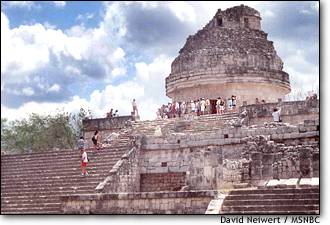
Although life in Mesoamerica was not exactly idyllic, given its warring and rituals that included human sacrifice, it is clear that most of the pre-contact Amerindians were relatively healthy societies. This same good health, however, was precisely what made them so vulnerable to conquest.

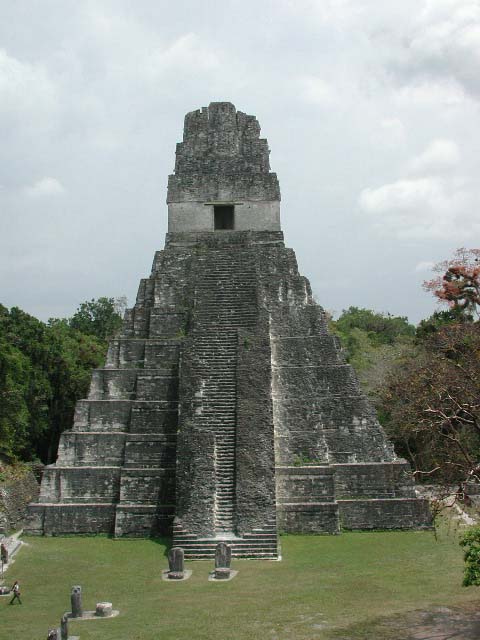
Though disease almost certainly was present in Mesoamerica, there is no evidence in the surviving records (which admittedly are scant) that plagues or "contact epidemics" were ever common in these societies -- although there are some hints that such an epidemic played a role in the still-mysterious abandonment of the Mayan city of Tikal in the 9th century. There, scientists speculate, an epidemic may have driven the surviving Mayans back to a milpa-based existence built around small villages in which such diseases could have been more readily contained. Still, within generations, even these Mayans were back to building large cities in newer regions.

Europe, in stark contrast, had been convulsed with devastating plagues and epidemics for centuries -- cholera, the bubonic plague, smallpox, tuberculosis all had ravaged the populations of Europe for ages, and by the 16th century were common facets of life. The extant surviving populations had built up some immunity to these diseases, but never wholly so. And so even as ships were departing for the New World, Europe itself was being ravaged by fresh outbreaks of smallpox and bubonic plague, which in some locales (40,000 died in Lisbon alone) produced mortality rates as high as 60 percent.

But these rates paled in comparison to the effect these plagues had as they spread to the New World. As David E. Stannard explains in American Holocaust: The Conquest of the New World [p. 93], an illustrative case involves the plagues' arrival in Brazil in 1563 aboard a ship anchored off the coast:
The resulting carnage beggared all description. The plague was first. It seemed as though everyonewas infected. At least everyone who was a native. As is common when a contagion invades a people with no previous exposure to it, the first generation of symptoms are like nothing anyone, even anyone with long experience with the infection, has ever seen: "The disease began with serious pains inside the intestines," wrote Simao de Vasconcellos, "which made the liver and the lungs rot. It then turned into pox that were so rotten and poisonous that the flesh fell off them in pieces full of evil-smelling beasties." Thousands died in a matter of days, at least 30,000 within three months. Then, among the plague's survivors, the smallpox was discovered. Wrote Leonardo do Vale:

When this tribulation was past and they wanted to raised their heads a little, another illness engulfed them, far worse than the other. This was a form of smallpox or pox so loathsome and evil-smelling that none could stand the great stench that emerged from them. For this reason many died untended, consumed by the workms that grew in the wounds of the pox and were engendered in their bodies in such abundance and of such great size that they caused horror and shock to anyone who saw them.


As had been the case in the Caribbean and Mexico and Central America and Peru before, the secondary consequences of the epidemic were as bad or worse than the monstrous diseases themselves. With no one healthy enough to prepare food or to draw water or even to comfort the others, multitudes starved to death, died of dehydration, or of outright despair, even before the affliction could run its deadly course. Children were the worst afflicted. "In the end," recalled Valle, "the thing grew so bad that there was no one to make graves and some were burried in dunghills and around the huts, but so badly that the pigs routed them up."

This pattern repeated itself endlessly throughout the New World as the plagues, particularly smallpox, spread widely, first through Mexico, Central America, and South America, then through the rest of North America. Many times the epidemics raged ahead of actual contact with Europeans; English explorers along the Atlantic Coast described coming upon villages wiped out by disease, with skeletons so thick on the ground they crunched under the white men's feet.

As Jared Diamond explained it in a 1992 piece for Discover titled "The Arrow of Disease":
When we in the United States think of the most populous New World societies existing in 1492, societies existing in 1492, only the Aztecs and Incas come to mind. We forget that North America also supported populous Indian societies in the Mississippi Valley. Sadly, these societies too would disappear. But in the case conquistadores contributed nothing directly to the societies' destruction; the conquistadores' germs, spreading in advance, did everything. When De Soto marched through the Southeast in 1540, he came across Indian towns abandoned two years previously because nearly all the inhabitants had died in epidemics. However, he was still able to see some of the densely populated towns lining the lower Mississippi. By a century and a half later, though, when French settlers returned to the lower Mississippi, almost all those towns had vanished. Their relics are the great mound sites of the Mississippi valley. Only recently have we come to realize that the mound-building societies were largely intact when Columbus arrived, and that they collapsed between 1492 and the systematic European exploration of the Mississippi.

When I was a child in school, we were taught that North America had originally been occupied by about one million Indians. That low number helped justify the white conquest of what could then be viewed as an almost empty continent. However, archeological excavations and descriptions left by the first European explorers on our coasts now suggests an initial number of around 20 million. In the century or two following Columbus's arrival in the New World, the Indian population is estimated to have declined by about 95 percent.

The main killers were European germs, to which the Indians had never been exposed and against which they therefore had neither immunologic nor genetic resistance. Smallpox, measles, influenza, and typhus competed for top rank among the killers. As if those were not enough, pertussis, plague, tuberculosis, diphtheria, mumps, malaria, and yellow fever came close behind.

In countless cases Europeans were actually there to witness the decimation that occurred when the germs arrived. For example, in 1837 the mandan Indian tribe, with one of the most elaborate cultures in the Great Plains, contracted smallpox thanks to a steamboat traveling up the Missouri River form St. Louis. The population of one Mandan village crashed from 2,000 to less than 40 within a few weeks.

The one-sided exchange of lethal germs between the Old and New Worlds is among the most striking and consequence-laden facts of recent history. Whereas over a dozen major infectious diseases of Old World origins became established in the New World, not a single major killer reached Europe from the Americas. The sole possible exception is syphilis, whose origin still remains controversial.

Stannard describes [pp. 108-109] this spread into the northern Americas, and particularly the explosive effect of smallpox as it struck the native people, literally rotting the flesh off their bodies and turning them into barely walking corpses:
As usual, earlier visits by Europeans already had spread among the Indians a host of deadly plagues. The Patuxet peoples, for example, were effectively exterminated by some of these diseases, while other tribes disappeared before they were even seen by any white men. Others were more fortunate, suffering death rates of 50 and 60 percent -- a good deal greater than the proportion of Europeans killed by the Black Death pandemic of the fourteenth century, but still far short of total liquidation. These were rates, however, for any given single epidemic, and in New England's sixteenth and seventeenth centuries few epidemics traveled by themselves. The extant descriptions of what life and death were like at times like these are rare, but the accounts we do have of the viral and bacteriological assaults are sobering indeed, reminiscent of the earlier Spanish and Portugese accounts from Mesoamerica and Brazil. Wrote Plymouth Colony's Governor William Bradford, for instance, of a smallpox epidemic from which huge numbers of Indians "died most miserably":

For want of bed and linen and other helps they fall into a lamentable condition as they lie on their hard mats, the pox breaking and mattering and running one into another, their skin cleaving by reason thereof to the mats they lie on. When they turn them, a whole side will flay off at oncec as it were, and they will be all of a gore blood, most fearful to behold. And then being very sore, what with cold and other distempers, they die like rotten sheep. The condition of this people was so lamentable and they fell down so generally of this disease as they were in the end not able to help one another, no not to make a fire nor to fetch a little water to drink, nor any to bury the dead. But would strive as long as they could, and when they could procure not other means to make fire, they would burn the wooden trays and dishes they ate their meat in, and their very bows and arrows. And some would crawl out on all fours to get a little water, and sometimes die by the way and be able to get in again.


While "very few" of the Indians escaped this scourge, including "the chief sachem ... and almost all his friends and kindred," Bradford reported, "by the marvelous goodness and providence of God, not one of the English was so much as sick or in the least measure tainted with this disease." Time and again Old World epidemics such as this coursed through the veins of the native peoples of the North Atlantic coast, even before the arrival of the first great waves of British settlers, leaving in their wake so many dead that they could not be buried, so many piles of skeletal remains that one early colonist referred to hte land as "a new found Golgotha." But it was a Golgotha the Puritans delighted in discovering, not only because the diseases they brought with them from England left the Puritans themselves virtually unaffected, but because the destruction of the Indians by these plagues was considered an unambiguous sign of divine approval for the colonial endeavor. ...

God, however, was not enough. At some point the settlers would have to take things into their own hands. For, terribly destructive though the Old World diseases were, some Indians remained alive. The danger posed by these straggling few natives was greatly exaggerated by the English (as it remains exaggerated in most history textbooks today), not only because their numbers had been so drastically reduced, but because their attitudes toward the colonists and their very means of warfare were so comparatively benign.

... [T]he native people of this region (as elsewhere) combined in their everyday lives a sense of individual autonomy and communal generosity that the earliest Europeans commented on continuously. This was a great cultural strength, so long as the people they were dealing with shared those values and accepted the array of culturally correct reciprocal responses to them. However, just as their isolation from Old World diseases made the Indians an exceptionally healthy people as long as they were not contacted by disease-bearing outsiders, once Europeans invaded their lands with nothing but disdain for the native regime of mutual respect and reciprocity, the end result was doomed to spell disaster.

In some cases, the English deliberately spread the smallpox. E. R. G. Robertson, in Rotting Face: Smallpox and the American Indian,, writes:
With the surrender of New France to Great Britain, command of the English North American military forces fell to Lord Jeffrey Amherst. An arrogant aristocrat who despised all Indians, Amherst withheld gunpowder and lead from France's former native allies, stating that England's enemies ought to be punished, not rewarded. When informed that the tribes depended on their muskets for taking game and would starve without ammunition, he remained unswayed, callously informing his aides that they should seed the complaining bands with smallpox so as to lend starvation a speedy hand. [More on Amherst can be found here.]

... In the spring of 1763, during the Indian uprising led by Ottawa Chief Pontiac, a party of Delawares ringed British owned Fort Pitt (now Pittsburgh, Pennsylvania), calling for its surrender. Captain Simeon Ecuyer, a Swiss mercenary and the fort's senior officer, saved the garrison by giving the Delawares a gift—two blankets and a handkerchief. The Indians readily accepted the offering, but still demanded that Ecuyer vacate the stockade. They had no inkling that the blankets and kerchief were more deadly than a platoon of English sharpshooters. Ecuyer had ordered the presents deliberately infected with smallpox spores at the post hospital. By mid July, the Delawares were dying as though they had been raked by a grape cannonade. Fort Pitt remained firmly in English hands.

The same year, British General Sir Jeffrey Amherst urged Colonel Henry Bouquet to figure some way of infecting France's Indian allies with smallpox. On July 13, the colonel wrote that he would attempt seeding some blankets with Variola, then send them to the warring tribes. Recognizing the risk of such a tactic, Bouquet expressed the hope that he would not catch the sickness himself. Whether the plan was ever carried out is unknown.

The English callousness about the spread of the disease was a product of the European eliminationist impulse, embodied at the outset by the view of the native Americans as subhuman promoted by such "humanists" as Juan Gines de Sepulveda, whose attitudes not only came to hold sway throughout Europe but were gradually expanded upon. By the time the English began colonizing North America, the belief in the non-humanity of the natives was commingled with a belief, as Stannard notes above, that the plagues were divinely ordained, part of God's design for the New World: Manifest Destiny.

So the British colonists were all too happy to dispense willingly of the straggling remnants of Indians they encountered as they spread throughout the Eastern Seaboard, since these were heathen savages the existence of whose souls was an open question at best and in fact widely denied. After the massacre of the Pequots in Mystic, Conn., in 1637, the commander of the British troops, John Mason, described the outcome -- which included the immolation of scores of women and children -- thus:
And indeed such a dreadful Terror did the Almighty let fall upon their Spirits, that they would fly from us and run into the very Flames, where many of them perished ... [And] God was above them, who laughed his Enemies and the Enemies of his People to Scorn, making them as a fiery Oven: Thus were the Stout Hearted spoiled, having slept their last Sleep, and none of their Men could find their Hands: Thus did the Lord judge among the Heathen, filling the Place with dead Bodies!

Some years later, Puritan leader Cotton Mather would describe the same massacre: "In a little more than one hour, five or six hundred of these barbarians were dismissed from a world that was burdened with them." He also described a similar massacre, against the Wampanoags in 1676, as a "barbeque." A British reporter of a mop-up campaign against stragglers described the killing of hundreds of Indians and called it "God's will," adding, "which will at last give us cause to say, How Great is his Goodness! and how great is his Beauty!"

Another tendency emerged at this time: Largely in response to various depredations, Indians did resist violently, often at considerable loss of life for the colonists. But invariably, these massacres induced a disproportionate response in which all Indians in the vicinity of such acts, and not only those responsible, were targeted indiscriminately for retribution.

And so it continued, from colony to colony, Indian war to Indian war, from New England to Virginia to the Carolinas and Georgia and Florida, and thence to Ohio and Tennessee and Kentucky, gradually gnawing their way westward. When George Washington waged war on the Iriquois in 1779, it was nothing less than a war of extermination in which, according to Richard Drinnon in Facing West: The Metaphysics of Indian-Hating and Empire Building, the Indians "were hunted like wild beasts." Washington himself approved this approach, later observing that the Indians were little different than wolves, "both being beasts of prey, tho' they differ in shape."

Thus the eliminationist impulse was transmitted almost seamlessly from Europe to the Americas, where it actually grew in a more virulent form that went hand in hand with an expansionist impulse. Indeed, Americans generally displayed a wanton disregard for the humanity of the native peoples that only intensified as they marched farther westward.

The combination of disease and undiluted eliminationism had a predictable effect throughout the New World. By the midpoint of the 17th century, it's estimated that more than 50 million of the indigenous people in the Americas had perished, some 80 percent of the population. In some instances the devastation was nearly complete; between 1770 and 1850, nearly 95 percent of the Pueblo population in the Southwest was eradicated. By the time Old World diseases had spread to the farthest reaches of the continent, striking the Haida and Inuit peoples of northwest Canada in the early 1850s, the population of indigenous peoples in North America had had shrunk by some two-thirds or more. (There is an ongoing debate over the actual numbers, more of which you can read here.)

The only recorded example of a government effort to reduce the effects of disease on the native population came early in the 19th century, when the United States, according to Abraham Bergman's "A Political History of the Indian Health Service," began providing federal health services for Indians in the early 1800's -- but their primary purpose was to protect U.S. soldiers from contamination from nearby tribes. All the first vaccination programs were in the vicinity of military posts.

In the meantime, another Founding Father, Thomas Jefferson -- who at least saw the Indians as "equal to the white man ... in a uncultivated state" -- nevertheless had concluded that the best Indian policy was to remove them from contact with white men. Part of his thinking in prusuing the Louisiana Purchase of 1803 was that the new territory would provide a place for the tribes east of the Mississippi River to resettle, at least until such time as they could reconcile themselves to civilization.

Jefferson took George Washington's idea of creating a "permanent Indian frontier" where the "savages" could live without interference from white men, and vice versa, and began implementing it. In 1803-4, in a series of White House meetings, Jefferson informed the chiefs of the so-called "Five Civilized Tribes" -- the Chickasaws, Choctaws, Creeks, Seminoles, and the largest, the Cherokees -- that he intended to resettle them west of the Mississippi, though the program was to be a "voluntary" one. As it happened, the lands he intended to resettle them upon was then claimed by other tribes, most notably the Osage Nation, a Siouxan nation whose prowess in war was already legendary among native Americans.

Predictably, many of the Cherokees who attempted to resettle on Osage lands wound up dead, and the resettlement of Indians west of the Mississippi continued to stall over the succeeding years. James Monroe's 1817 treaty with the Osage -- brought about by the massacre of 83 Osage encamped on the Arkansas River, mostly women and children, by an Indian war party constituted mostly of Cherokees -- forced the tribe to cede some 1.8 million acres in Missouri and Arkansas, leaving them only a small bit of land in Arkansas and Oklahoma.

As Dennis McAuliffe describes it in his remarkable book on the Osages, The Deaths of Sybil Bolton:
Half of the remaining Osage land, now northern Oklahoma, would go to the immigrant Cherokees and become the foundation of a designated Indian territory; the other half, southern Kansas, would go to whites; the ousted Osages would be confined to a small reservation in the middle. Under threat of military subjugation, the Osages thumb-marked yet another treaty in 1825. In this one, they ceded more than 45 million acres -- one fourth of modern Kansas, one-fourth of Oklahoma, and their remainder of Missouri -- for $7,000 annually for twenty years, without interest; $10,000 worth of worthless (to the Osages) cows, chickens, and farming equipment; horses valued at $2,600; $6,000 in merchandise; and of course, the usual grass-and-waters promise [i.e., these lands shall remain Osage as long as grass grows and waters run].

Nonetheless, many of the straggling remnant of Indians east of the Mississippi resisted relocation. So eliminationism became official government policy with the passage in 1830 of the Indian Removal Act, which realized the concept of the "permanent Indian frontier". It was Andrew Jackson, an old Indian fighter from the First Seminole War, who made it a reality. The act empowered Jackson to make treaties with all tribes east of the Mississippi to give up their lands in exchange for lands on the other side of that "permanent" frontier:
The Removal Act was strongly supported in the South, where states were eager to gain access to lands inhabited by the "Five Civilized Tribes". In particular, Georgia, the largest state at that time, was involved in a contentious jurisdictional dispute with the Cherokee nation. President Jackson, who supported Indian removal primarily for reasons of national security, hoped removal would resolve the Georgia crisis. While Indian removal was, in theory, supposed to be voluntary, in practice great pressure was put on American Indian leaders to sign removal treaties. Most observers, whether they were in favor of the Indian removal policy or not, realized that the passage of the act meant the inevitable removal of most Indians from the states. Some American Indian leaders who had previously resisted removal now began to reconsider their positions, especially after Jackson's landslide reelection in 1832.

Most white Americans favored the passage of the Indian Removal Act, though there was significant opposition. Many Christian missionaries, most notably missionary organizer Jeremiah Evarts, agitated against passage of the Act. In Congress, U.S. Senator Theodore Frelinghuysen and Congressman David Crockett of Tennessee spoke out against the legislation. The Removal Act was passed after bitter debate in
Congress.

This debate became a turning point in Americans' relations with the Indians -- and perhaps more importantly, it was a precursor, in its North-South division and the pitting of human rights against states' rights, to the debate over slavery that eventually precipitated civil war. It also had more than a passing resemblance to the Debate of Valladolid nearly three centuries before. Just as Bartolome de las Casas had argued strenuously against the notion that native Americans were subhuman savages fit only for death, slavery, and utter subjugation, so were there many American who stood up for the humanity of their Indian neighbors. (A decent summary of the debate can be found in this student paper.)

Indeed, there were even some who warned with uncanny accuracy of the travesty that was to follow. Rep. George Evans, a Whig from Maine, described to his fellow congressmen the difficult, often famine-struck conditions of the Plains tribes who occupied the lands where the government now wanted to remove the so-called "Civilized Tribes," and asked:
What are sixty thousand human beings -- the sick, the aged,the infirm, children, and infants -- to be transported hundreds of miles, over mountains and rivers and forests, by contract! By those who will engage to perform the service for the smallest sum! Are you to hold out such inducements to long and fatiguing marches -- to scanty and cheap provisions? Will you place these hapless, deceived, and abused people at the mercy of contractors, whose only object is gain? Sir, if this is the mode in which the measureis to be executed, I will never yield my sanction to it ... if they [the Indians] must go, let their path be made smooth.

Likewise, William Ellsworth, a Whig from Connecticut, called the measure an "abominable doctrine" and observed:
The committee of this House has openly declared that the Indians are mere tenants at will, strictly having no rights to territory or self-government. This report goesfurther than I had supposed intelligent men could go. It really leaves nothing to the Indian. The very soil on which he lives, and where his ancestors lived before him, is none of his, but belongs to the white man.

Ellsworth's view of the Indians was one that insisted on their basic humanity, and he observed that as far as their interest lay, "They have the deepest interest in it, and they are sufficiently intelligent to discover what is best for themselves." But as it happened, this was distinctly a minority view.

This was, in fact, the case nearly every time eliminationism reared its head throughout American history: just as there had been in Europe, there were in fact many decent people in America with a conscience who stood up to the crass inhumanity at work in these events. But in the end, their efforts remained, until midway through the 20th century, largely ineffectual. The final measure of history is always what actually came to pass -- and as it ever was, the crude reality of multiple deaths and the extinction of native populations that followed make clear that regardless what objections were raised, the eliminationist mindset was the victor.

Some of this has to do with the violence and mayhem it engendered; once the eliminationists had successfully murdered or effectively rendered dead many thousands of Indians, the hand-wringing objections of the "moralists" was irrelevant, since it would not bring back the dead. Some of it had to do with the middling position assumed by many of the natives' defenders; just as las Casas had 280 years before, many of the Indians' defenders were quick to acknowledge the superiority of white culture and the desirability of eventually "civilizing" the natives, or more to the point, converting them to Christianity. Others viewed them through a romanticized "Noble Savage" stereotype that ascribed a mystical quality to their cultural purity and thence their survival -- leading even some of their defenders to favor the Indian relocation programs.

Richard Slotkin describes this in Regeneration Through Violence: The Mythology of the American Frontier, 1600-1860 [p. 355]:
Indian removal revealed a number of contradictory elements in the American attitude toward the native Americans. Westerners like James Hall, who were relatively sympathetic to the Indians and portrayed them in a reasonably attractive light in stories of the West, regarded Indian removal as a desirable necessity. Racial hostility between whites and Indians, they felt, would always make close relations impracticable. Moreover, by living close to the whites, Indians would lose their native, pristine culture and acquire debased forms of white religion -- and white vices. This argument was drawn directly from the pro-Indian literature of the 1780s and 1790s, which asserted that the Indians were innocent children of nature, natural democrats who degenerated on prolonged contact with the whites. Hall's argument also reconciled this argument to the contradictory assertion of that period -- that the Indian was a latent Christian, requiring only the healing touch of refinement to "whiten" and civilize him. ... According to Hall, the Indian's virtures were his only while he remained pure; they perished when he mingled with the whites. Left to their own devices, the Indians would naturally evolve toward Christianity and cultivation; white interference, whether persecution or attempts to hurry them along the road, were unnatural and hence doomed to harm more than help.

The majority view, on the other hand, doubted the humanity of the "savages" -- as well, predictably, as the motives of the Indians' defenders. John Forsyth, a Georgia Democrat arguing in favor of the Act, loudly inferred that its opponents were soft on terrorists, er, savages:
While I entertain no fears that the gentleman's hopes will be realized, I consider it a matter of conscience, before entering upon the discussion of the general subject of the bill, to relieve the Senator from any apprehension that it may become necessary to cut white throats in Georgia to preserve inviolate the national faith, and to perform our treaty engagements to the Indians. It is true, the gentleman displays no morbid sensibility at the idea of shedding the blood of white men in this crusade in favor of Indian rights.

As for the people he called "this hapless race," Forsyth remarked:
The condition of the remnants of the once formidable tribes of Indians is known to be deplorable: all admit that there is something due to the remaining individuals of the race; all desire to grant more than is justly due for their preservation and civilization. Recently great efforts have been made to excite the public mind into a state of unreasonable and jealous apprehension in their behalf.

As for the effect of the Indian removal policy on the Indians, Forsyth suffered no illusions, since the "savages" were scarcely differentiated from beasts:
I do not believe that this removal will accelerate the civilization of the tribes. You might as reasonably expect that wild animals, incapable of being tamed in a park, would be domesticated by turning them loose in the forest.

But, Forsyth added, that doesn't mean he wouldn't favor the measure. Rather the contrary, since it achieved the bottom line they sought:
Yet, doubting, as I do, the effect of this measure as a means of civilization, I shall vote for it, with a hope of relieving the States from a population useless and burthensome, and from a conviction that the physical condition of the Indians will be greatly improved by the change: a change not intended to be forced upon them, but to be the result of their own judgment, under the persuasions of those who are quite as anxious for their prosperity and tranquility, as the self-constituted guardians of their rights, who have filled this Hall with essays and pamphlets in their favor.

Meanwhile, another Georgia Democrat named Wilson Lumpkin even went so far as to admitting that in individual cases, Indians could be rescued from their "native savage habits" -- but the state of Georgia, nonetheless, could "hesitate no longer indetermining whether the Indians are susceptible of civilization." Lumpkin added that "a large portion of full-blooded Cherokees still remain a poor, degraded race of human beings."

The Georgia Democrats were unanimous on this count. Rep. Richard Wilde not only denied that the Indians held original title to the land, but claimed that the law of the "heathen Indian population" was superseded by the Law of England and the Law of Nature. James Wayne attested that "sovereignty over soil is the attribute of states; and it can never be affirmed of tribes living in savage conditions."

So with the bill's passage in 1830, and Jackson's landslide reelection in 1832, Indian removal began to be gradually effected. The result, rather predictably, was the effective extinction of numerous tribes, as well as hundreds and even thousands of deaths in nearly every relocation effort.

The culmination of these was the notorious Trail of Tears in 1838, in which the Cherokee Nation was forcibly relocated to those former Osage lands in Oklahoma:
Many white Americans were also outraged by the dubious legality of the treaty and called on the government not to force the Cherokees to move. For example, on April 23, 1838, Ralph Waldo Emerson wrote a letter to Jackson's successor, President Martin Van Buren, urging him not to inflict "so vast an outrage upon the Cherokee Nation."

Nevertheless, as the May 23, 1838, deadline for voluntary removal approached, President Van Buren assigned General Winfield Scott to head the forcible removal operation. He arrived at New Echota on May 17, 1838, in command of about 7,000 soldiers. They began rounding up Cherokees in Georgia on May 26, 1838; ten days later, operations began in Tennessee, North Carolina, and Alabama. About 17,000 Cherokees -- along with approximately 2,000 black slaves owned by wealthy Cherokees-- were removed at gunpoint from their homes over three weeks and gathered together in camps, often with only the clothes on their backs.

The oral histories describe the ordeal that followed:
Families were separated -- the elderly and ill forced out at gunpoint - people given only moments to collect cherished possessions. White looters followed, ransacking homesteads as Cherokees were led away.

Three groups left in the summer, traveling from present-day Chattanooga by rail, boat, and wagon, primarily on the Water Route. But river levels were too low for navigation; one group, traveling overland in Arkansas, suffered three to five deaths each day due to illness and drought.

Fifteen thousand captives still awaited removal. Crowding, poor sanitation, and drought made them miserable. Many died. The Cherokees asked to postpone removal until the fall, and to voluntarily remove themselves. The delay was granted, provided they remain in internment camps until travel resumed.

By November, 12 groups of 1,000 each were trudging 800 miles overland to the west. The last party, including Chief Ross, went by water. Now, heavy autumn rains and hundreds of wagons on the muddy route made roads impassable; little grazing and game could be found to supplement meager rations.

Two-thirds of the ill-equipped Cherokees were trapped between the ice-bound Ohio and Mississippi Rivers during January. Although suffering from a cold, Quatie Ross, the Chiefs wife, gave her only blanket to a child.

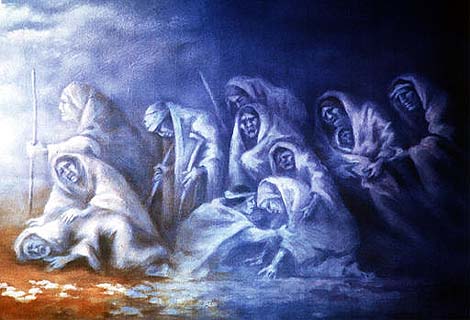
"Long time we travel on way to new land. People feel bad when they leave Old Nation. Womens cry and make sad wails. Children cry and many men cry ... but they say nothing and just put heads down and keep on go towards West. Many days pass and people die very much." [Recollections of a survivor]


She died of pneumonia at Little Rock. Some drank stagnant water and succumbed to disease. One survivor told how his father got sick and died; then, his mother; then, one by one, his five brothers and sisters. "One each day. Then all are gone."

The Wikipedia entry notes:
The number of people who died as a result of the Trail of Tears has been variously estimated. American doctor and missionary Elizur Butler, who made the journey with one party, estimated 2,000 deaths in the camps and 2,000 on the trail; his total of 4,000 deaths remains the most cited figure. A scholarly demographic study in 1973 estimated 2,000 total deaths; another, in 1984, concluded that a total of 8,000 people died.

During the journey, it is said that the people would sing "Amazing Grace", using its inspiration to improve morale. The traditional Christian hymn had previously been translated into Cherokee by the missionary Samuel Worcester with Cherokee assistance. The song has since become a sort of anthem for the Cherokee people.

The entire program of Indian relocation, including not just the relocatees but also such displaced tribes as the Osages, was fraught with bad faith throughout, as had been the history of most white dealings with native Americans. The Americans, however, elevated the deceptiveness to a form of murderous high art: They would encourage the Indians to believe they were dealing with them in good faith, and then would proceed to unilaterally abrogate the terms of whatever treaties they signed, and they did so with remarkable impunity. In many cases, the very authors of the treaties encouraged other whites to break them. In their view, the Indians had no rights worth respecting. And the government, at every turn, accommodated them -- turning a blind eye to their depredations, and facilitating their ability to grab land and resources at every turn.

The Osages' government agent in 1870, a man named Isaac T. Gibson, delivered a report to his superiors in Washington that laid out the problem:
It is almost without precedent, yet strictly true, one great cause of their decline has been fidelity to their pledges. More than sixty years [ago] they pledged themselves by treaty to perpetuate peace with the white man. That promise has been nobly kept -- kept in spite of great and continual provocation. Individual white men have committed upon them almost every form of outrage and wrong, unchecked by the Government, and unpunished. Every aggressive movement of the whites tending to the absorptioon of their territory has ultimately been legalized. Thus, a kind of premium has been offered by the Government to enterprising scoundrels to ply their vocation at the expense of the Osages. The Government itself has been careless of its obligations, indifferent, it would seem, alike to its own honor and the security of the Indians. It has failed or neglected to afford them protection, and yet has allowed the Osages' persistent fidelity to truth to tie their arms and render them powerless to protect themselves.

... The process of grinding them to powder might almost be inferred a meritorious work from the indifference and apathy of many, and the exultation of some, who thik themselves living in the light of Christian civilization.

Gibson in fact was describing the outline of both official and unofficial U.S. government policy regarding the Indians for the duration of the 19th century: Any act that benefited whites was found to be legal, and the rights of Indians were purely illusory and did not exist -- though the illusion of offering them to Indians was maintained as a way to manipulate them to the benefits of whites.

Luther Standing Bear, a Sioux chief, was later to remark: "They made us many promises, more than I can remember, but they never kept but one; they promised to take our land, and they took it."

Next: 'Nits Make Lice'

Sunday, December 24, 2006

Another Voice In The Mix

Sara Robinson

Along the same line we've been discussing, E.J. Dionne talks about the role of journalists, accountability, and the tension between old and new media:
In my view, the new media forms are answering a great need that traditional journlism was not answering. Though as a consumer of blogs from left to right, I often get important and accurate information from their work, they do not exist primarily to inform. They exist to engage citizens in the obligations and magic of politics. They draw people into the fight. They have made millions of people feel that their voices will be heard somewhere and, when aggreghated together, can have a real influence on the outcome of policy debates and elections.

In fact, the opinionated forms of journalism are not new to the media or our public life. They take us back in our history to a time when most journalism was partisan and raucously engaged on one side or another in our political battles....

If there is a problem with traditional, just-the-facts-m'am journalism and its twist-your-self-into-a-pretzel effort to appear non-partisan or bi-partisan, it is that such journalism was in many ways demobilizing. Because journalists could not declare that they were Republicans or Democrats, liberals or conservatives, they often went out of their way, sometimes unconsciously and unintentally, to sell a variety of ideas that actually drove people away from politics. You couldn't be partisan, so you said they were all crooks or liars. (Every once in a while, you even got the "they are all good men and women" stories.) You couldn't be partisan, so you said there was no difference between or among the politcians - or, alternatively, that they were all too extreme....

The real issue confronting modern journalism is thus a paradoxical one. There is a need to resurrect a concern for what's true---to draw clearer distinctions between fact and opinion, between information and mere assertion. At the same time, there is an urgent requirement that the media take seriously their obligation to draw people, as citizens, into the public debate, to demonstrate that the debate is accessible and that it matters. What is needed, in other words, is both a strengthening of the older professional ethic involving accuracy and balance and a new engagement with the obligations of journalists to democracy.

For all of its shortcomings, the success of opinionated journalism on the radio, cable television and the blogs reflects a public thirst for debate and argument that goes beyond the confines usually imposed by conventional definitions of news. The lesson is not that all should copy their style of argument, but that argument and engagement are very much in demand. For the established media, this will mean going back to the original debate between Walter Lippmann and John Dewey. The objective should be to salvage Lippmann's devotion to accuracy and fairness by putting these virtues to the service of the democratic debate that Dewey so valued.

In broad terms, the media need to help us recover what Lasch called "the lost art of argument."
Just go read the whole thing. His account of how journalism got professionalized, and the implications of that development, is also a fascinating addition to our conversation here.

Saturday, December 23, 2006

A noteworthy milestone

Just noticed that sometime today, Orcinus had its 4 millionth visit. Still kind of mind-boggling, really.

Thanks to all of you who keep reading, and to the many friends who keep linking to us. I'll go into this further when we have our 4th blogiversary in a couple of weeks.

Friday, December 22, 2006

Why I Blog: A Romance

Sara Robinson

Nieson Himmel


Dave's thoughts below on the Murray Waas smear job brought up a related conversation I've been having within my family the past couple months, as various members of the clan have reacted to the news that their family writer has turned blogger.

This has not been welcome news on all fronts, especially among the intellectual factions of the elder generation. Stalwart PBS supporters, retired suburbanites, canny consumers of mainstream media, all they know is what the MSM has told them: bloggers are unruly, untrained, unqualified, and probably unwashed as well (if the truth were told). In their minds, journalism is still a noble profession, practiced by a (preferably Ivy-) educated elite whose access to and consonance with the interests of the power structure ensure that their reportage will always be well-informed, reasonable, and balanced. Bloggers, on the other hand, are outsiders -- screeching know-nothings who lack either the class or the resources to play the game at the highest levels. Though no one has said so out loud, the unspoken thought hangs in the air: hanging out with these disreputable characters is a shameful waste of a perfectly expensive j-school diploma.

The funny thing is that these particular relatives are old enough to remember an earlier generation of reporters who, literally, were coming from a very different place. There was a time, a couple generations back, when newspaper work was one of the few accessible upward mobility routes for smart, literate, ambitious urban working-class or small-town kids who lacked money or connections. (The others included teaching, preaching, public safety careers, labor leadership, and the military officers' corps.) The majority of reporters came from modest backgrounds; and if they had a bias, it tended toward the interests of the hard-working classes they had come from. Few ever achieved stardom or made a lot of money -- and that was OK. Like teaching or preaching, the true rewards of the job were seldom reflected in the paycheck; and they knew going in that this would be the case.

This was also the era in which any city of reasonable size had two dailies -- usually a business-oriented conservative morning paper and a more liberal, labor-oriented afternoon one. All these papers had a strong and obvious political slant; while reporters were expected to deliver fair, accurate, and thorough coverage, objectivity and detachment weren't anywhere on the menu. (My first journalism teacher, a veteran of the LA Times, told us that every reporter of her era had a list of Dorothy Chandler's friends permanently taped to their desks, so that reporters would remember to say nothing but nice things about them.) People knew that the Star-Republican was going to see things differently than the Press-Democrat, and bought their papers accordingly.

This began to change in the years following World War II, as the media began to seriously corporatize. Journalism schools, which had traditionally been parked next to the teacher's colleges at the state college, were endowed by major news organizations, moved over to Big U, and staffed with faculties of retired lions from the Great Papers and Networks. The field was being elevated from a skilled trade to a Profession, on a par with doctors and lawyers. By the early 60s, the products of this system -- disproportionately white, upper-middle-class, and laced from birth into family webs connecting them to power and money -- began to show up in newsrooms. This professionalized coverage was in many ways more incisive and nuanced -- there would be no lists of the owner's wife's friends taped to their desks -- but then, by the late 70s, they didn't need a list to know whose butts to kiss. Personable, presentable, and elegant in a way the old street reporters had seldom been, this new generation of highly-educated journalists looked good at all the right parties, and attracted a growing crowd of would-be patrons offering them money, fame, and power for providing just the right kind of coverage. Their seduction didn't need to be overt, because the corruption was built right into the system they worked for.

(A lot of that game revolved around "access," the insider connections that allegedly imparted the superior insight that made these elite media personalities worth a million bucks a year. The old-timers almost never had "access;" and most of them were suspicious of it, believing that spending too much time with those people was likely to be corrupting. In any event, they seldom found that the lack of access got in their way when they wanted to cover a story. If you doubt this, reflect on the number of major news stories that have been broken by access-free bloggers in the past three years. And then reflect on the fact that Bob Woodward -- who has long enjoyed more access to the White House than any reporter in America -- was also the very last person in Washington to see George W. Bush for the disaster he is.)

RJ Eskow recently speculated over at HuffPo that, if there was a tipping point, it was probably when George Will coached Ronald Reagan in the 1980 debates; then provided "objective" network commentary on Reagan's performance in those same debates; and then, far from being sanctioned for this patently unethical performance, actually went on to win a Pulitzer Prize that year for it. That, says Eskow, was the moment the entire profession realized that the only remaining ethics code was: Anything goes. The accountability Dave wonders about may have died the day that Pulitzer was awarded.

Everybody knows it was all straight to hell in a copybasket from there, as journalism became more and more attentive to the desires of their corporate masters, and less and less connected with the concerns of average Americans. I'm not sure it's a coincidence that newspaper readership began to decline in about that same time frame. While there are half a dozen reasons for this, I have to wonder to what extent the readers wandered off because the "balanced" coverage -- which increasingly defined "objectivity" as "covering both sides" (as if there are always exactly two sides to an issue, no more and no less), rather than in terms of the story's relationship to objective truth -- was no longer compelling or useful enough to the average reader to be worth four bits a day.

Dave and I, here on the cusp of geezerhood ourselves, are probably as young as you can be and still have any memory at all of those old working-class reporters. My college newswriting teachers were among the last of this breed, mostly LA Times and NBC warhorses who'd been put out to pasture to teach us new cubs the basics. (I'm remembering the Times' Nieson Himmel, a vast and legendary gnome of a man who had provided the Times' coverage of the Black Dahlia back in the 40s-- a notorious curmudgeon who left ashes from his stogie alongside his red pen marks on my Newswriting 101 papers.) And it's possible that, as rural kids who came to the trade without much more to our credit than a way with words, we have more in common with the reporters of that lost generation than we do with the smooth and politic journalists of our own.

Unlike Dave, my newsroom years were limited and undistinguished. I decamped early on for the brothels of corporate communications, with occasional dips into magazine work. The kind of newspaper work I'd set out to do was rapidly vanishing anyway; and as the years passed, I realized that my old professors had lived through some golden years that were gone, and would not likely be coming back again.

But I was wrong about that. It turns out that the public never did lose its appetite for passionate, compassionate, opinionated, incendiary reporting. Rather, the mainstream media simply refused to feed it anything but corporatized journalistic junk food -- leaving the market wide open for millions of mom-and-pop blogs serving up big platters of home-cooked news with a generous side order of personal flair.

So I tell my family's clucking elders this: Why on earth would I want to go hang out with the Kewl Kidz of Beltway High, when I can come here and do the job the way it was done in its best days -- days you yourselves remember -- when there were many papers with many voices, daily re-engaging an opinionated and often contentious conversation about whose dreams, whose priorities, and whose interests would determine the future of their communities? Unruly? Of course we are, because democracy always is. Unkempt? Often, especially if I'm blogging from bed. Unpaid? You bet -- Mr. Himmel's first paycheck, in unconverted 1940s dollars, was still more than I've ever made from blogging. Unbiased? If a fierce commitment to the common good is a bias, count me guilty, and don't bother waiting around for an apology.

But unqualified? Don't you believe it. In a media monopoly, career success increasingly correlates more with political skill than it does with actual journalistic ability -- which is why guys like Wemple, Cherkis, and Keefer are more likely to be promoted for their audacity in taking down Waas than they are to be censured for any breach of long-forgotten ethics. But in the free marketplace of ideas -- and there's never been a freer one than this Web -- you're only as good as your facts, your analysis, and your ability to put it all together in a way that keeps the readers coming back…in other words, the same stuff that sold papers back in the days when people still read them.

What goes around has come around. We may have traded the Red Wings for Eccos, the black Remingtons for laptop computers, and the scotch and stogies for Guiness and cheetos -- but I'm starting to realize that we are those old guys and gals, coming back from The Front Page to the front of a new century. We really are mostly the same people, doing most of the same things for most of the same reasons. And that's what makes us different from the guys Dave is discussing below.

The accountability problem

Atrios names the Washington City Paper the "Wanker of the Day" for its treatment of Murray Waas, and for good cause. Waas' account of the paper's behavior is a journalistic horror story:
During the course of reporting his story about me, Jason Cherkis, a City Paper reporter working on the story about me with Wemple, badgered me to consent to an interview.

When I expressed concerns for my right to privacy, and said that nobody had written about me being a cancer survivor, he screamed at me over the telephone: "You told every single person you have had a conversation, `I had cancer!' Don't tell me it was a secret because you told every single person you have ever come in contact. Don't you lie to me! You told people if you really didn't want to keep it a secret, you shouldn't have told."

He then glibly added: "You wouldn't have like passed it out like part of your business card."

Cherkis called later with the discovery that the high costs of medical bills and health insurance had been one large reason that I went bankrupt--something hardly uncommon that for young people who have been cancer survivors.

He then badgered me over the telephone: "So are you a deadbeat of a cancer survivor? So which is it? Which is it?" Then attempting to bully me, he says "You're like begging me and Erik [his editor] not to write about it. Now you're like the poor cancer patient. Now you are falling back on your whole fucking tale of woe, dude. Feel sorry for me! I had the cancer thing."

Later, Cherkis told me that this was all a lie, and that I really went broke because I was living high off the hog. He screamed at me: "Don't tell me that in 2005 that the effect of your cancer survivorship made you bankrupt! Maybe it was living in fucking house where the rent was $2,800 a month!"

As if that weren't appalling enough, Waas goes on to explain the reasons for this bizarre behavior:
One thing that became certain over time was that they became determined to somehow get me on tape screaming or acting inappropriately as they have been to me. When yelling me at me himself did not work, Cherkis adopted a new tact: He began to ominously suggest in emails that all sorts of people have said horrible things about me -- then emailed or called those people to say that I might be calling soon, and asked them to tape the conversation -- in hopes that I would I blow my stack.

In the case of Keefer, Cherkis suggests to me over and over again that Keefer has handed over to him all sorts of confidential files to him.

Then Cherkis emailed Keefer hoping that I would call him: "if Waas does call, please try and tape it," Cherkis emailed Keefer, in one of the emails made public by Wonkette earlier this week.

I have to say, just as a longtime denizen of various newsrooms, this behavior -- which is unethical in the extreme, as Waas notes in his HuffPo piece -- shakes me up. It's just a grotesque abuse of the public trust, a gross abuse of their positions, and is the kind of thing that should forever brand these guys pariahs.

I mean, really: Passing along the identities of confidential sources held by your former employer. Harassing a cancer victim about his medical bills. Screaming at them in an attempt to get them to scream back. Those are just the most obvious.

There are others. I imagine a lot of us old city-editor types raised our eyebrows at a couple of other aspects of this story, including letting the subject of a story read it beforehand (this is very, very rarely ever done, and its ethics are dubious at best -- it indicates that WCP had no confidence in the factual accuracy of the story) and then bargaining with him to alter the information in the story if he'll drop damaging countercharges against them. That's the kind of deliberate manipulation of reporting for nontransparent purposes that is very much frowned upon -- by ethical journalists, anyway.

The trio of actors here -- Eric Wemple, Jason Cherkis, and especially Bryan Keefer -- should be summarily fired from whatever journalistic positions they hold for the behavior that Waas describes -- and I'm assuming that Murray is as accurate as he ever is here, which is to say very.

In an ideal world, their next jobs should be flipping burgers or cleaning toilets. The only publication they should be allowed to edit or write for in the future would be the newsletter for the sanitation department of Bone, Idaho. And even then its factual content would be dubious.

But I'm sure the Wise Men of Washington will little note nor be bothered by any of this. Indeed, one can assume that this behavior will continue to be rewarded, because the City Paper crew is part of a snug little Beltway crowd of Kewl Kidz who view any attempts to hold them accountable with growing disdain.

Look, we've known ever since the New York Times completely blew off Gene Lyons' findings in Fools for Scandal that we have a serious accountability problem within the journalism trade. The problem only intensified during the Clinton impeachment brouhaha and Bush's ascension to the presidency, and in the ensuing years Beltway journalism has become an ethical and reportorial cesspool, largely because there is simply no accountability for this kind of misbehavior. It's also a major factor in the utter failure of the press to report adequately on the Iraq war, either during the runup to the invasion or in its aftermath; the same lack of accountability on the part of the press has translated into a complete lack of accountability within the goverment -- the Bush administration and its cohort in the Republican Congress.

The journalists who have placed themselves atop the media food chain, including particularly those inside the Beltway, no longer see themselves as accountable to the "little people" further down the chain, especially not to their readership. In the new environment they've created, all that matters is making a "score," whether truthful or not. And any way you can get that score is OK. Ethics are for suckers.

That's the chief reason the Beltway types are so hostile to the blogosphere; all those noisy rabble-rousing critics keep interrupting their prefabricated narratives, which represent the collective wisdom of the ruling classes. Similarly, anyone like Murray Waas, whose serious and well-grounded work slices through the heart of their narratives and exposes them for the phony crap they are, is going to be subject to the most vicious kinds of attacks -- and the media's ruling class will wink, nudge, and nod.

Serious journalists need to start taking this problem seriously. We need to start working together to stand up for the ethics that really are the root of whatever credibility any of us might enjoy. We need to start finding new ways to create real accountability in the profession.

Organizations like Media Matters are a good start. But at some point the ethical and factual issues that are increasingly tainting whatever good work the rest of us might do need to be confronted by journalists themselves. There need to be consequences within the profession for this kind of malfeasance of the public trust.

I have some ideas myself for how to do this. But if anyone else (other journalists especially) has ideas on how we might achieve that, I'd sure like to hear from them. Post them in comments and I'll compile some of the better ideas in a later post.

Thursday, December 21, 2006

A killer whale Christmas


Christmas came a little early this year for the Puget Sound's orca population, in the gift of a ruling from federal Judge Thomas Zilly, who dismissed the Building Industry Association's lawsuit against the endangered-species listing for the region's killer whales -- and dismissed it with prejudice, which means that they can't refile the lawsuit but can only appeal the ruling, which isn't likely.

The BIAW and its cohort, the Farm Bureau, were predictably nonplussed about it all:
In his decision, Zilly said the builders and farmers don't have the legal right to challenge the federal government's decision to protect the orcas as endangered because lawyers failed to provide evidence that the listing harms the two groups. That didn't please Brooks or his clients.

"Why in the world do we have to wait until someone actually loses their livelihood?" asked Brooks, who works for the Pacific Legal Foundation, which specializes in property rights cases.

Foes of the listing have argued that building regulations and other land-use restrictions based on the listing would unnecessarily hinder farming and construction.

The P-I report has more regarding their objections:
In his ruling, Judge Thomas Zilly stated that the building and farming groups that brought the suit had not proved that they would be harmed by the protection of the orcas under the Endangered Species Act.

"Remarkably, plaintiffs have totally failed to provide any evidence of standing," Zilly stated.

The case was dismissed with prejudice, meaning the groups can't bring it back to court.

Russell Brooks, the Pacific Legal Foundation lawyer who represented the Building Industry Association of Washington and the Washington Farm Bureau, said Zilly "is punting. That's the nicest, most PC way to say it. The judge has an out, and he doesn't want to reach the hard issues."

Brooks said it's possible but not likely his clients will appeal.

Zilly "basically said don't come back until your water is shut off or your building permit is denied," Brooks said.

The suit he brought predicted that protecting the orcas would result in water and land-use restrictions near rivers inhabited by salmon, the orcas' prime food source, and that ultimately farmers could face fines and imprisonment.

I have some background on the BIAW lawsuit here, and I discussed it in my Seattle Weekly piece from earlier this year.

It's true that Zilly's ruling short-circuited any determination of the BIAW's main contention, namely, that the listing itself violated the ESA's basic structure. As Brooks told me for the Weekly piece:
"The fisheries service can only evaluate for listing purposes, and then list, . . . a species, a subspecies, or a distinct population segment of a species. That's very clear under the law in the [Endangered Species Act's] terms," Brooks says. He claims the southern resident orcas don't fit any of these categories, but are rather "a distinct population segment of a subspecies, which is pretty clearly not allowed under ESA case law."

Brooks says that the opponents haven't consulted any scientists on the matter. "We don't really need any scientists backing us up on it, because it's a legal argument. . . . It's not a factual dispute, it's not a scientific dispute, it's a pure legal dispute.

"It's not that we're against orcas or anything like that. . . . It could be any other species. You know, we love orcas as much as anyone else. But here we believe there's a much larger legal issue that is at stake, and it just happens to involve orcas."

It's hard to imagine Brooks' case in this area succeeding either. The problem is that he's assuming that killer whales are not generically constituted of subspecies, as though there is some kind of overall generic killer whale population that is distinct from these subspecies. But the biology of orcas doesn't work that way; there is in fact a global population of killer whales constituted of a range of subspecies.

There are resident killer whales in a variety of locales, including the Puget Sound, Alaska, Iceland, Antarctica, New Zealand, and Argentina (to name just a few; killer whales actually appear in every ocean on the planet). Then there are so-called "transient" killer whales that travel great distances over long-established territories, such as those we find here who travel from the Baja to Alaska in search of food. These populations are all distinct subspecies, and genetically the animals are identical, though behaviorally they are all quite distinct. The ESA is written in a way that allows us to protect those distinct populations.

In any event, Zilly's ruling is welcome news:
Steve Mashuda, a lawyer for Earthjustice, which sued to obtain the listing on behalf of Munro and others, said the fact that the case was dismissed with prejudice is significant. Under these circumstances, a successful appeal is unlikely. Also, the builders and farmers can't file another challenge.

"They don't get another bite at the apple," he said. "I think it's pretty cut and dried.

"This was the only cloud over the listing," Mashuda said. "I don't think it's unfair to say that the holidays came early for the orcas this year."

Now that this cloud has been banished, we can only hope the hard work of saving these populations will begin in earnest.

All Over But the Shouting

Sara Robinson

2006 may go down in history as the year the Religious Right finally jumped the shark, going over the top so high at last (as every Great Awakening in history ever has) that even some of their own followers noticed that their utopian fantasies were, finally, unworkable. Unmoored at last from the real-world concerns of their own moderates, and convinced (as authoritarians usually are) that the only answer can ever be more intrusion, more patriarchy, and more control, they've given us some singularly gobstopping moments this year, as a stunned nation finally stood in shock and awe, taking in the fully revealed and spectacularly bizarre details of their version of a Christianized America.

We saw the reductio ad absurdum of the idea that life begins at fertilization, which brought us false tragedy of frozen "snowflake babies," and the real tragedy of Michael J. Fox's frozen features -- and, ultimately, the thawing awareness that if America turns its back on stem cell research, it is doing nothing short of opting out of the biggest revolution in medicine since the discovery of germs.

We saw the pro-choice activists -- who have been telling us for years that the real target wasn't Roe but Griswold -- proven catastrophically right, as South Dakota tried to ban all abortions and the National Right to Life Foundation openly put itself on record as opposing most forms of birth control. Many of us were quite surprised. And quite a few of us weren't, because we knew they'd never stopped saying this kind of thing to each other in private since the days of Margaret Sanger.

We finally saw the media take a good hard look at longstanding experiments in radical patriarchy like Quiverfull families and fundamentalist Mormonism. And we realized that among patriarchy's greatest perversions is the way it fetishizes women as children, and children as women; and that men who gravitate to these extreme forms too often have some very weird psychosexual shit going on that makes them unsafe around minor girls.

And if there was any doubt about that, we saw videos ricocheting around the Internet of earnest young women at "purity balls" publicly pledging their chastity to their daddies -- and daddies, in turn, publicly swearing to "cover" (a choice word that means one thing to fundies, and quite another to anyone who grew up where livestock were bred) their daughters by holding them to it. And we watched, and shuddered, and the only word that seemed to fit was creepy.

We heard from the anti-environmental extremists who are learning in church that global warming isn't an issue, because God will fix it. (Would this be the same God who once deliberately drowned his entire creation in a flood? Just asking.) And we realized that the right-wing War on Science is not only real; but that it has already been more deadly than the war in Iraq -- and we have yet to see the full magnitude of the disaster.

We finally faced up to the size of the conservative movement's walk-in closet, which is big enough for Mark Foley and Ted Haggard and Ken Mehlman and a whole lot of Congressional aides, and we wondered once again just what Jeff Gannon was doing during those nights at the White House.

Alongside this, we saw the deeply venal corruption of the most "Christian" members of Congress, who betrayed the futures of the poor and middle class -- both in America, and elsewhere -- on behalf of their wealthy friends, even as they attempted to tear up the Constitution and institute Government by Divine Fiat. And we learned -- bitterly -- that the bigger and brighter a public figure's faith or patriotism appears to be, the more likely it is that they have never actually paid much attention to what's really in either the Bible or the Constitution.

And, to cap This Year in Hypocrisy, we've got the Department of Health and Human Services telling Americans under 30 to just stop fooling around. At which point pretty much everybody in the country knew that we'd ascended to a whole new shark-jumping level of whackadoodlery, and stopped being gobstopped, and just started rolling their eyes and laughing. Our self-appointed moral scolds finally overplayed their hand. No need to hold it back any more -- it's OK now to giggle and point. In fact, we have a moral duty of our own to do so, loudly and long, whenever we're confronted with this sort of reactionary absurdity.

The recurring theme in all these stories is this: The Religious Right, overweening in its self-righteousness and drunk on hubris and power, is no longer making even the slightest effort any more to keep its crazies in the closet. Free at last from any accountability to reason, they're increasingly taking positions that are guaranteed to alienate ever-wider swaths of the American electorate.

Over 90% of American women will use contraception at some point in their lives (most of them, ostensibly, with the support of their male partners). A National Family Planning and Reproductive Health Association study done last spring found that even 80% of anti-choice Americans support giving women access to contraception. Likewise, 70% of Americans consider themselves environmentalists; and 88% think global warming poses a serious future threat. Two-thirds of us think the government should support stem-cell research. The election showed that most of us had had about enough of the GOP's devotion to charity for the upper classes only. And now, this week, it's being reported that 95% of all Americans engage in premarital sex, and have been doing so rather robustly for several generations now.

When you set the opinions of the vast majority of Americans against the extremist views the religious right staked out this year, you have to wonder: What are they thinking? Surely, they can't believe that staking out such extreme positions is the way to recover their political clout, and win back hearts and minds?

Actually: Yes. It is quite possible that this is exactly what they believe.

Remember that while the soft core authoritarian right was drawn to the movement for reasons of security in a time of fear (and is equally susceptible to being drawn away if their own perception of threat changes, as it is now), the smaller and more enduring hardcore has a different agenda. These people are lifelong right-wing authoritarians (RWAs) because they believe that a world without strong authority enforcing black-and-white rules is a world in which chaos must reign. To them, the only authorities worth following are those that place the most stringent demands from their followers. Rigidity and extremism are a sign that their leaders care enough to set high standards; punishment is a sign that they are noticed and loved.

Because of these beliefs, the first authoritarian response to any failure -- a lost election, dropping ratings, or a stymied legislative agenda -- is to demand that ever-stronger authority step in to enforce even more draconian standards. At this late hour, when their three-decade-long party is finally showing signs of breaking up, the hardcore RWAs are increasingly the only ones left. Drunk on the hard stuff, this is how they think: The more they lose, the more obstreperously they will insist on doing more of whatever it was they were doing before, back in the days when they were succeeding.

Opposing abortion was a 30-year winner. If we're losing support now, it's because we got too soft; so let's regain the moral high ground by opposing contraception and stem cell research, too. If opposing environmentalism made us powerful friends in the past, then opposing global warming should attract quite a few more. If our emphasis on family purity and patriarchy attracted millions of members, then making a public spectacle out of our oversized families and our prepubescent daughters' virginity oughta really wow the crowd.

Stay tuned. It's only going to get weirder for a while. We're probably going to see even more Fundie Follies in 2008, as the realization dawns that their social and political clout are fading. The more acutely they feel the loss, the more outrageous their attempts to push old favorite themes to new extremes will become. Which will, of course, only speed the continued loss of clout and followers, and turn up the volume on the general derision level. Which will, in turn, lead to even stranger pronouncements and more aggressive attempts to ship us all back to the 19th century, the shuddering machinery throwing off bolts and sparks and passengers with every accelerating and doomed orbit.

The good news is this: The stranger it gets, the closer we are to done. This is how Great Awakenings end in America -- with the last handful of remaining True Believers yelling ever-crazier things on street corners, while the sane and sober citizens sidestep them on their way to doing the real work of the country.

Update: Old Hickory's Weblog puts the above post (which focuses on the Christian Right specifically) into a larger context with the secular authoritarians of the Bush administration, who are of course caught in pretty much exactly the same authoritarian logic trap. If you are following the God-ordained One Right True and Only Way, then deviating from that way is simply not an option. Faith demands that you stay the course, even if that course is leading you directly into Hell. And if what you're doing isn't working, the only acceptable option is to do it bigger, deeper, louder, and harder until the superiority of your position is made clear to all those recalcitrant unbelievers. To admit that your mission is in error is to deny the very truth of God -- or, in Bush's case, his Divine Right as king. Victory is inevitable. Failure is impossible. Turning back is unthinkable.

Hickory points out that things at the White House are likely to get weirder this coming year as well, for precisely the same reasons. That grinding, ripping sound you hear is the wings coming off as fantasy descends to ground level, approaching its final brutal encounter with the reality down here. The only good news (if we survive the impact) is that the longer their denial holds out, the crazier their corrective maneuvers become, and the more memorable the final explosion turns out to be, the longer and more thoroughly the whole conservative enterprise will stand discredited. With a big enough boom, the right will not be able to rise again until the last person old enough to remember this disaster has left the scene, heels first, sometime very late in the century -- longer if we don't forget to warn the grandkids.

It could go other ways, of course. The future is never knowable. But the pattern's a familiar one, so consider this the trendline -- the most expectable future out of many that could occur.

Uglier every day

Here's the real face of the anti-immigration movement:
A demonstration against illegal immigration turned into a public argument Saturday outside the Mexican Consulate in Phoenix.

A group called the Border Guardians burned and spat on a Mexican flag and made speeches claiming that illegal immigration overloads public services and increases crime.

Opponents called them racists and questioned their intelligence. The stance of both sides underscored how polarized and emotional the debate over illegal immigration can be.

"They are strictly racist," Sheri Jones of Phoenix said.

About 20 police officers kept an eye on the small crowd. Laine Lawless of Tucson, the Border Guardians' director, burned the flag with help from Donald Pauley of Las Vegas.

Lawless said illegal "invaders" hurt everything from the economy to the desert. Pauley said employers who hire illegal immigrants should be jailed.

Ali Souissi of Tempe said the protest was disgusting and staged to intimidate people who come to the consulate for services.

Sure enough, it turned out that mingled in with Lawless' crowd were some noteworthy neo-Nazis on the local scene. And later that very same day, Lawless and her "Border Guardians" group attended a neo-Nazi gathering with them:
Eight months ago Border Guardian leader Laine Lawless denied her ties to the neo Nazi organization National Socialist Movement. According to the Anti-Defamation League (ADL) Lawless not only attended the neo-Nazi National Vanguard Winterfest after her flag bar-b-que at the Mexican Consulate in Phoenix on Saturday, she was accompanied by neo-Nazi leader Donald Pauly (as a pagan she probably wasn't interested in Christmas caroling).

The local ADL officials had it about right:

"By attending a neo-Nazi event with Holocaust deniers and known racists, Lawless has demonstrated that she is not just an activist concerned with the problems of illegal immigration, but an anti-Hispanic bigot using the border issue to forward her own hateful agenda."

You all remember Laine Lawless, don't you?

For awhile, back in Tombstone, Lawless was one of Minutemanmeister Chris Simcox's right-hand, er, persons. That is, he claimed, until he discovered her "radical beliefs" (perhaps her purported lesbianism) and they ostensibly parted ways, although Simcox remains vague about just how long they actually were associated.

Mostly, you may recall Lawless as the subject of a Southern Poverty Law Center report (as noted here) that she was surreptitiously urging skinheads and neo-Nazis to start inflicting violence on illegal immigrants:
At the request of Lawless, who declined to respond to questions from the Intelligence Report, Martin posted her suggestions to a number of neo-Nazi bulletin boards. Those suggestions included:

"Steal the money from any illegal walking into a bank or check cashing place."

"Make every illegal alien feel the heat of being a person without status. ... I hear the rednecks in the South are beating up illegals as the textile mills have closed. Use your imagination."

"Discourage Spanish-speaking children from going to school. Be creative."

"Create an anonymous propaganda campaign warning that any further illegal immigrants will be shot, maimed or seriously messed-up upon crossing the border. This should be fairly easy to do, considering the hysteria of the Spanish language press, and how they view the Minutemen as 'racists & vigilantes.'"

More recently, Lawless has been involved with the same group of charming folks who were intimidating Latinos at the polls on Election Day.

Just makes ya feel red, white, and blue all over, doesn't it?

Wednesday, December 20, 2006

Ho ho ho

Quick hits:

Boehlert's column today is awe-inspiring.

If you're in the Christmas spirit, show Digby some love.

Speaking of people who are making Islam itself into our enemy, Oliver Willis discusses Rep. Virgil Goode, R-Outer Wingnuttia.

The General has some excellent design plans for the next Bush Presidential Library. I especially like the Hall of Closets.

Republicans for Osama

Why does Debbie Schlussel hate America?
In a December 18 column headlined "Barack Hussein Obama: Once a Muslim, Always A Muslim" and posted on her website, right-wing pundit Debbie Schlussel argued that because Sen. Barack Obama's (D-IL) middle name is Hussein, his late, estranged father was of Muslim descent, and he has shown interest in his father's Kenyan heritage, Obama's "loyalties" must be called into question as he emerges as a possible Democratic presidential candidate. In the column, Schlussel asked: "So, even if he identifies strongly as a Christian ... is a man who Muslims think is a Muslim, who feels some sort of psychological need to prove himself to his absent Muslim father, and who is now moving in the direction of his father's heritage, a man we want as President when we are fighting the war of our lives against Islam? Where will his loyalties be?" She ended her column by asking if Obama becoming vice president instead would be acceptable. Answering her own question, she wrote: "NO WAY, JOSE ... Or, is that, HUSSEIN?"

The Media Matters piece goes on to explore how, factually speaking, this entire smear, as it were, of Obama is utter tripe. It also discusses how this represents a growing trend of smearing both Obama and anyone of Muslim background or heritage who holds public office.

This last point is especially a problem, and really driven home by Schlussel's remark that
we are fighting the war of our lives against Islam

Schlussel, who in most regards is a second-tier right-wing pundit anyway, nonetheless represents a formulation we've seen increasingly (including during Roy Moore's tantrum over Keith Ellison) saying not that we are at war with terrorists or Al Qaeda, but that we are at war with Islam itself.

What these right-wingers fail to remember is they are playing directly into Osama bin Laden's hands.

Remember, as I remarked early on in this conflict:
Osama bin Laden wants you to make this into an Islam-vs.-the-West conflict. That was the explicit purpose behind 9/11.

The more that conservatives make the rest of Islam culpable for 9/11, the more they make enemies of our allies in the Islamic world. These include such major strategic partners as Turkey, Pakistan and Saudi Arabia. Their own Republican president has been working hard not to allow this to turn into an anti-Islamic crusade. Yet their own ignorance about the nature of Islam is nonetheless increasing the chances that the "war on terror" could explode into an uncontrollable global cultural conflict.

People like Debbie Schlussel and Roy Moore (not to mention Ann Coulter) provide recruitment fodder for radical Islamists who want nothing more than to portray Americans as engaged in a war against the whole of Islam. Because these Islamists know that by doing so, they can turn their tiny faction of radical terrorists into a massive army supported by a religion adhered to by many millions of people around the world.

Osama bin Laden doesn't need propagandists in America. He's got people like Schlussel doing his work for him.

Tuesday, December 19, 2006

That other terrorist

Back when I was contemplating the contrasts in how the mainstream media treat white and Muslim domestic terrorists, my main point of comparison involved the weird case of Chicagoan Derrick Shareef, a seeming nutcase with no actual ties to any known terrorist organization, and Demetrius "Van" Crocker of Tennessee, another seeming nutcase of like background.

But it occurred to me then that a more useful and significant comparison regarding Crocker would be that to Jose Padilla, whose treatment at the hands of authorities stands in stark contrast to Crocker's as well. It's one thing, after all, for the media to enforce a double standard; it's another thing entirely when it's our national law-enforcement apparatus.

Unfortunately, I knew such a post would take a lot of footwork, and I was engaged in other looming projects. So I put the idea on a back burner.

Fortunately, Alex Koppelman not only had the same idea, but he did all the heavy lifting, and the result is really a remarkable piece for Salon. Here's an excerpt, after an introduction describing the Justice Department's Kafkaesque tactics in its mistreatment of Padilla:
This shockingly cynical new tack is just the latest in the saga of moral and legal breakdown that is the Padilla case. On Dec. 4, the New York Times published graphic evidence to substantiate Padilla's claims of mistreatment. The paper ran old photos of Padilla while he was in Department of Defense custody wearing dark goggles, earmuffs and shackles, being led from his one-man cell to a dental appointment for a root canal. Padilla spent 1,307 days at the Naval Consolidated Brig in Charleston, S.C., where, his lawyers allege, he was kept in solitary, deprived of sleep, drugged with PCP or LSD, held in stress positions, and blindfolded, shackled and deafened on the few occasions he was allowed out of his 9-by-7-foot cell.

The Bush administration has defended its handling of Jose Padilla and other alleged terrorists in federal custody by arguing that the post-9/11 "war on terror" requires extraordinary methods. But while the Department of Justice has been tying itself in knots trying to justify the government's handling of Padilla, the nearly simultaneous -- and successful -- prosecution of another supposed "dirty bomber" in Tennessee stands as proof that the measures taken in the Padilla case are at best counterproductive. Without fanfare, and without any damage to the Constitution, 41-year-old Demetrius Crocker has been convicted of plotting to explode a bomb and release sarin gas outside a courthouse.

On Nov. 28 -- six days before the Times ran its photos of Padilla -- Demetrius "Van" Crocker was sentenced to 30 years in prison. David Kustoff, the United States Attorney for the Western District of Tennessee, where Crocker was prosecuted, tells Salon that "It was one of the preeminent anti-terrorism cases of 2006 nationwide." Whether or not that is true, few outside of the greater Memphis metropolitan area have ever heard of Crocker. Only one reporter, John Branston of the weekly Memphis Flyer, even covered his entire trial. What is certain is that in every particular his case is a study in contrasts with the prosecution of Jose Padilla.

You'll remember Koppelman from his Dragonfire days; it's nice to see him gaining the larger audience Salon afford.

Be sure to go read it all.

Monday, December 18, 2006

Mad Max vs. the Mayans


[Note: Contains spoilers.]


One word kept tumbling through my mind as I watched Apocalypto, Mel Gibson's profoundly racist depiction of Mayan civilization on the verge of collapse:

Bogus.

Or variations thereupon. As the movie proceeded, my notes read something like this:
Uber-bogus.

Bogalicious.

Bogosity.

I'm being bombarded with bogons!

Aiiee!!! Quantum bogosity!

Sure, the movie is imbued with a Sepulvedan racism. It's also stomach-churningly violent even as it lectures us about the perils of moral decay (note to Mel: I hear from morally upright folks all the time that a taste for excessively violent entertainment is a strong indicator of moral decay). And there are plenty of the details of Mayan culture that he gets wrong, too (more on that later).

But Apocalypto is bogus on so many levels, including the simple elements of its plotline, that it's difficult to recommend it even as a piece of fantastic cinema. It's not even a particularly good chase film, which is what Gibson says he set out to make here.

For one thing, there really isn't much of a plot: Young Mayan jungle hunter Jaguar Paw is kidnapped for human sacrifice by the evil Mayan city dwellers, though he first manages to secrete his pregnant wife and young son at the bottom of a dry cenote. Once in the city, said sacrifice is interrupted by the surprise appearance of a total eclipse. Jaguar Paw is then forced to flee a pack of vengeful Mayan warriors when he kills the leader's son while escaping. Long pursuit then follows through the jungle, where Jaguar Paw manages to outwit his pursuers, picking them off one by one until only three, including the Vengeful Father, are left. He kills VF with a tapir trap introduced in the opening scenes. Then, with the last two warriors in pursuit, he runs out onto the beach and discovers a small flotilla of Spanish ships, with soldiers and priests in the process of rowing ashore. The remaining two pursuers, agape, go out to meet the strangers, while Jaguar Paw sneaks back to rescue his wife and child, whose hiding place has since been filled with rainwater. We last see the young family heading off into the deeper parts of the jungle together.

The chase scenes are not particularly imaginative, though Gibson manages to mix in the expected obstacles: waterfalls, mudpits, jaguars. And the yawning predictability of the whole affair doesn't exactly enhance the suspense. I mean, didn't we see this basic plotline 40 years ago in The Naked Prey?

Still, on a pure popcorn-munching level, Apocalypto has at least a decent level of suspense to hold your attention throughout. That, and the crisp-yet-lush cinematography, are about all it has going for it. But if you're looking at all for an authentic representation of pre-colonial life in the Yucatan, this movie ain't it. It's just bogus, from start to finish. Especially the finish.

Now, no doubt my experience was negatively affected by knowing a little more about Mayan culture than the average American moviegoer who is Gibson's audience. But you don't have to know much about the Mayans to realize that what ensues in Apocalypto just doesn't make any sense, even within the context of its own self-created world.

The most obvious example comes in the movie's central set piece: the sacrifice scene atop the temple in the Mayans' stone city. Just as Jaguar Paw is about to have his heart cut out on the altar atop the temple stairs, a total eclipse of the sun occurs, driving the populace below into a confused frenzy. The priests declare the gods satisfied, and let Jaguar Paw and his fellow captives off the hook, so to speak.

Huh? OK, nevermind the fact that Mayans not only regularly predicted astronomical events, they actually designed their temples and cities and religious ceremonies around such events as solstices and eclipses. Nevermind that they would have been eagerly anticipating any such eclipse.

Let's just pretend, for the sake of argument, that nobody knows this (even though they teach it to sixth-graders nowadays) and that the story exists in its own vacuum. It still doesn't make any sense.

It's obvious, after all, that these priests need a pretty steady supply of warm bodies to keep trooping up the stairs and have their hearts cut out and heads cut off. After all, we not only see a steady flow of headless corpses to join a large pile at the bottom of the pyramid, we later see Jaguar Paw staggering through an entire Holocaust-sized dumping ground full of similar corpses.

So why, exactly, do they let these intended victims go? Even if the day's ceremonies were at an end, they obviously could be imprisoned for use on the next day. And if you're going to let them go, why only turn them back over to their murderous captors for death at their hands (which is what befalls everyone but our protagonist)?

Why? Because Mel wanted to make a chase movie, dammit. Logic be damned.

There are plenty of other such instances in which the basic premises of the movie simply don't add up. One of the key plot points -- the jungle dwellers' vulnerability to capture, a product of their utter ignorance of the existence of urban Mayans -- might have been plausible in the proto and early Classic Mayan period (150 B.C.-500 A.D.), but at the period in which it is supposed to take place, that is, at early Spanish contact in the 16th century, city-building Mayas had been a common and significant feature of the Yucatan, Guatemala, and Belize for over a thousand years. It simply is not credible that people living anywhere in their vicinity would be unaware of them.

This is where just a little knowledge of Mayan society makes Gibson's lapses look almost comical, were the upshot -- depicting Mayan life as relentlessly savage and brutish, even in its most "idyllic" state -- not so repulsive. Indeed, the chief narrative of the innocents' village life that Gibson depicts involves the public humiliation of a young married man over his sex life. The whole scene plays like Spanish colonists' depictions of native Mesoamericans as sexually wanton and primitively ribald.

Yet the reality was that there is no evidence that there ever were such jungle dwellers in Mayan society, at least of the kind depicted here. There were many thousands of Mayans who dwelt in the jungles, but they were primarily farmers who supplemented their diets with hunting and fishing. These farms were called milpas, and before there were even cities these formed the backbone of Mayan society.

These farmers usually lived in villages about the size of that shown in Apocalypto, but these villages were uniformly surrounded by the milpa fields, growing maize, beans, and squash, which usually constituted several acres of cleared-out jungle. Like most agrarian societies, they were highly ritualistic, building and arranging their lives according to long-established customs and ceremonies, including the very architecture of their homes.

We don't know a lot about their sex lives, except that the Mayans prohibited adultery and were not particularly promiscuous. More likely Mayan villagers would have been frowning at the kind of scene Gibson depicts than laughing.

Perhaps more to the point, the urban Maya had a powerful symbiotic relationship with the agrarian villagers, since the milpas also were their primary source of food. Trade with the farmers was a long-established facet of Mayan life. As David Freidel and Linda Schele put it in A Forest of Kings: The Untold Story of the Ancient Maya:
In times of general prosperity, which existed for most of the Classical Maya periof, the common folk enjoyed ready access to the basic necessities of life, both practical and spiritual. In times of hardship and privation, the commoners and nobles all suffered alike. The ancient Maya view of the world mandated serious and contractual obligations binding the king and his nobility to the common people. Incompetence or exploitation of villagers by the king invited catastrophic shifts in allegiance to neighboring kings, or simple migration into friendlier territory. Such severe exploitation was a ruler's last desperate resort, not a routine policy.

So not only is it beyond unlikely that a Mayan forest villager would be unaware of urban dwellers, but it's likely only in the remotest circumstances that these urban dwellers would be taking captives from the jungle.

Mayans did engage in plenty of wars, and they did decapitate plenty of sacrificial victims. But these victims were almost uniformly soldiers captured on the field of battle from opposing armies. Mayan warfare, like that of the Aztecs, was predicated on taking captives rather than slaying armies on the field of battle; for the Mayans, these captives were then used as slaves, as participants in their ritualized ballcourt games (which also featured decapitations), or as victims of bloodletting rituals.

The temples on which these sacrifices occurred, in Gibson's centerpiece sequence at the city, are clearly based on the temples at Tikal in Guatemala, which were a product of the Classic Maya culture. The best-known is Temple I, which was built around 695; but Tikal was abandoned by the end of the 10th century. It is particularly recognizable because of its steep angles and high crown, which were not features of most later Mayan temples, particularly not in the Yucatan. These later temples, such as the famed Castillo at Chichen Itza, or the extraordinary Pyramid of the Magician at Uxmal, were less steeply angled and broader-based.

So Gibson gives us a Tikal-style pyramid, even though none of the extant Mayan temples in use at the time of European contact would have looked like it. And then, in the scene atop the temple, we see up close that it is adorned with a fantastic panoply of Chaac rain-god masks and snake faces.

These too were common in certain Mayan cities, particularly the Puuc style of architecture found in post-Classic cities like Uxmal and Sayil. These are all in the eastern Yucatan, far removed from Tikal, and were created mostly after A.D. 900, by which time Tikal had been largely abandoned.

So what Gibson gives his audience is actually a bizarre mishmash of Mayan styles, grabbed from different eras and different regions and slapped together, suggesting if not a disrespect at least at a willful ignorance of Mayan culture. This would not be so bad in a transparently inauthentic film, but Gibson parades his "authenticity" throughout the affair, insisting the script be in Yucatec Mayan (even though none of the speaking cast is a native Mayan speaker) and making brief nudges at authenticity by at least pilfering authentic Mayan styles for his mishmash.

What's noteworthy also is what Gibson fails to show. There is no indication that the Mayans possessed a refined sense of art; that they had written a large body of literature; that they had a deep sense of religious faith as well as deeply refined notions of honor that made them extraordinarily vulnerable to white invaders. We get no sense of their scientific achievements, which ranged from astonishing astronomical precision to acoustic wonders built into their architecture. We don't even get a glimpse of the Mayan ballcourts, one of their more interesting creations, or the games played on them (which actually might have offered Gibson even more opportunities for gore).

But then, showing these aspects of Mayan culture would have countered the point that Gibson appears intent on making: that Mayan civilization was irredeemably corrupt, and that was why it fell. Even if the historic record tells us otherwise, Gibson's thesis, drawn straight from the worldview of the 16th-century Catholics who constantly touted the natives' barbarism as a reason for destroying them, comes before any deeper contemplation into the real causes of the decay of this civilization -- which, besides the costs of its frequent warring, almost certainly included environmental disasters and disease.

That brings us, finally, to Gibson's Big Point. He clearly intends to draw a parallel between the Mayan civilization and our own. If we read the analogy correctly, Gibson is essentially depicting American civilization as morally decadent and corrupt, innately violent and antagonistic to freedom. Apocalypto is intended as a warning about our imminent demise as a civilization corrupted from within.

No doubt there is some resonance to this thesis, especially in a time when we're sending off American soldiers to die in Iraq, a kind of public sacrifice on the bloody altar of our government's imperialist designs. But neither modern American culture, nor ancient Mayan culture, has ever been as relentlessly evil as the civilization he depicts in this film.

We can understand, given Gibson's well-established propensity for a medieval Catholic worldview, which goes hand-in-hand with his remarkable propensity for sadistic onscreen violence, why he might hate the Mayan civilization enough to depict it the way it does. But why, exactly, does Mel Gibson hate America?

And why, exactly, does he stoke our appetites for grotesque violence even as his film preaches to us about the dangers of such inhumanity?

Answer: Because Gibson, like his movie, is bogus. From start to finish.

UPDATE: Marcello Canuto, an actual Mayan scholar (and not a mere amateur like myself) weighs in on some of the same points, and much more, in Salon. (I only saw this piece after posting this review.)

The real Mayans


[Note: Following is a piece I wrote for MSNBC.com's Travel section in January 2001, which is no longer available on the Web. I'm republishing it here to supplement the above review of Mel Gibson's Apocalypto.]

By David Neiwert
Special to MSNBC

The Mayan rain god Chaac -- wide eyes and a scowling brow, long curling snout and a wide, toothy mouth stretched open in a grimace, suggesting either a war cry or hideous laughter -- snarls at the world everywhere you turn in Mexico's Yucatan Peninsula.

He most famously appears, of course, throughout the many ruins of the ancient Mayan world: on entire temple walls, cornices adorning palaces, and glaring from atop pyramids, where designers made Chaac's gaping mouth the doorway to inner sanctums.

However, Chaac is not a dead god. He quietly remains alive among the Mayan people who form the bulk of the Yucatan’s populace today. Many Mayans continue to practice their ancient religion, often in rituals conducted out of view of the general public. His visage, in a way, is a concrete symbol of the continuum between that ancient Mayan world and the modern.

Indeed, as archaeologists continue to unravel the "mystery" of the ancient Mayan civilizations, it becomes clear that the original riddle itself was based on a bad premise. The question -- What became of the great city-builders? -- presumed that the seemingly primitive Mayans who led simple farming lives were removed somehow from their forebears who constructed great cities and fought vast wars in the Central American jungle. Now, it's becoming clear that isn't the case.

"One has the impression from the modern representation of the tourist trade that the Maya are simple peasant farmers and always have been, and that there's no real connection between the modern Maya and the people who built the magnificent ruins -- it's kind of a mystery how the ruins got to be built," says David Freidel, an anthropologist at Southern Methodist University in Dallas, and the author of several books on the ancient Maya.

"Magical dwarves at Uxmal and lightning snakes and other such creatures, and ancient kings buried under the Ballcourt at Chichen Itza -- well, those stories are fun and they're part of the rich folklore of the Maya of the area. But they're not the truth. The truth is that the Maya that are around today -- not only are they the direct descendants, but in many cases they are still part of the urban culture, and always have been part of the urban culture, of Yucatan."

The continuum between the ancient Mayans and the modern is not an easy connection for modern travelers visiting the ruins to make, because there seems to be little resemblance between the builders of these awe-inspiring edifices and the generally impoverished Mayan villagers whose homes appear to be little more than thatched huts (though in fact they're ingeniously designed to fit the Yucatan climate). And most tourists' attention is focused, understandably, on the ruins themselves.

It is hard not to be in awe of the Mayan city-builders. The massive pyramids, like the famous Castillo at Chichen Itza, the Iglesia at Coba or the Temple of the Magician at Uxmal are visually stunning structures whose most impressive trait is their architectural perfection. The Castillo, for instance, is designed so precisely that on the day of the spring and autumn equinoxes, the shadow of the pyramid is designed to fall on its snake-headed staircase so that the pillars appear to be the slithering body of a serpent.

Thousands of visitors climb the steep steps up these pyramids every year -- not an easy feat, particularly on the vertigo-inducing descents. [Note: this is no longer the case; Mexican tourism officials closed off the pyramid stairways a couple of years ago after some tourists were badly injured on them, and they are no longer open to public climbing.] Like many of the surviving Mayan structures, the pyramids served mostly ceremonial purposes, and many of these ancient ceremonies featured bloodletting: beheadings, heart removals and dances involving pierced body parts. You can find evidence of these gory rituals everywhere in Mayan cities, from platforms decorated with skulls to Chaac-mool sculptures that served for beheadings to the ballcourts where the losers, evidence suggests, lost their lives.

These rituals, which appear barbaric to Western sensibilities, were part of a relatively consistent and logical Mayan religious world view carefully attuned to the four seasons, which dictated their agricultural practices and their social behavior too.

Other Mayan structures tell the tale of ritual as well. Mayan priests used the Caracol, or Observatory, at Chichen Itza, to gather astronomical data and keep track of the seasons, which they did with astonishing precision. The famed Mayan calendar, with a year comprised of 13 20-day months, was far more accurate and practical than our own Roman calendar.

Modern Mayans are still the dominant population in the Yucatan, farming the land as they always have, though many of them are turning to tourism to make a living. You’ll inevitably encounter them in shops, at T-shirt and trinket stands, and offering their services as guides at sites.

"They are remarkably open and friendly, to an amazing degree," says Dr. Bruce Love, a Riverside, Calif.-based anthropologist who has spent the better part of the past thirty years living among and writing about the Mayans in the Yucatan. "You know -- they invite you into their homes, invite you to share their food, their time. Happy to show you things, take you around. Hard-working. They just have a lot of real quality characteristics."

Though today's Mayans certainly do not cut out the hearts of sacrificial victims, ancient rituals survive. Integrating their indigenous beliefs with a layer of Catholicism, the Mayans continue to rely on native priests, especially when the need for rain arises.

Then, the village's shaman gathers everyone at a clearing in the forest for a day-long ritual called the Ch'a Chaac. A wooden altar with leaf arches is laden with sacred breads wrapped in leaves, sometimes shaped like animals. At one point during the ceremony, little boys squat under each corner of the altar and croak like frogs, which are always considered a sign of rain.

Bruce Love has witnessed these ceremonies, but they generally are not on view for the average tourist. "Most of these ceremonies are done far away from the main population centers, in small towns and villages, oftentimes out in the forest itself," he says. If a white person wants to watch one, it takes time. "It's something you have to build up to gradually, but there is the beginnings of cultural tourism, and so you see ceremonies performed for tourists. They are not really ceremonies -- they’re just done just for tourists. And that's beginning to happen more and more in Mayan areas."

In other regions with heavy Mayan populations -- notably Guatemala, Belize and Chiapas -- there have been increasing reports of a resurgence in Mayan religious ceremonies. And Love sees no sign that the ancient beliefs are on the wane. "I see no sign of it disappearing. It's a little bit hard to believe that when one is doing a tour and one is at the hotels on the highways and in the restaurants, because one tends just to see the outer surface. But once you get back off the main roads and into the villages, it's just such a strong and powerful culture, a coherent culture, that it's just not about to disappear."

In a way, this only deepens the mystery of the ancient cities. If the Mayans and their culture are still thriving, then why did they abandon such magnificent homes? If they simply blended back into the jungle and returned to the farmed milpas, or cleared jungle tracts that had sustained them for centuries, what was the reason?

Recently, modern researchers have uncovered possible answers. According to Freidel, a combination of socio-political disruptions and ecological disasters brought a close to the era of city-building for some Mayan cultures, while wars and military action destroyed others, including Chichen Itza.

But the Mayas were always city dwellers as well as farmers, even at the time of the Spanish conquistadors' arrival in the 16th century. However, both Love and Freidel cite the devastation wrought by disease from contact with Europeans which wiped out some two-thirds of the Mayan population as a major cause of the Mayans' real cultural decline. However, they say, the Maya have always nurtured a sophisticated, literate culture -- despite the efforts of their conquerors to force them into economic and cultural submission.

"It's not just a matter that the Maya are alive and well and living where their ancestors lived," Freidel says. "It is that the Maya of Yucatan -- along with the Maya of Highland Guatemala and other areas -- have been continuously urban and civilized people for more than 30 centuries. These people never stopped living in urban places.

"Cities like Tehu became Merida; Valladolid sits on an ancient ruin; Izamal sits on an ancient ruin. Most of the major towns of the Yucatan have ruins either inside their city limits or very close by, because that's where the Spanish settled into the countryside and gathered the people for purposes of conversion and also to harness their labor for the new colonial economy. But the Maya of those areas have always been urban."

Indeed, Freidel says, many of the ruins that attract visitors now were continuously inhabited from the time of their construction centuries ago.

"A city like Uxmal was never lost -- it was always part of the landscape, always part of the story of the Maya, and always inside an urban civilization that the Maya always were part of."

Sunday, December 17, 2006

Ooooops

Well, it looks like Michelle Malkin may not have to worry about trekking to Iraq to hunt down the missing Jamil Hussein anymore.

On the other hand, she is probably going to have figure out how to eat a full-fledged serving of crow, and simultaneously perform triage on the dead horse that is whatever credibility she might once have enjoyed.

That's because it's looking like, after a smear campaign against the Associated Press that revealed more about the Malkin's brand of journalism than it did any malfeasance on the part of the AP, that the intrepid investigators of the right are finding that, yes Virginia, there is a Jamil Hussein after all. And he is a police captain, precisely at the station the AP reported:
Has the mysterious and much-disputed Associated Press source in Iraq, a police captain named Jamil Hussein -- finally been found? His existence has been challenged in the past three weeks from the U.S. military, some Iraqi officials and conservative bloggers in the U.S.

A blogger named Marc Danziger who has followed the debate claimed late Saturday that he believes he has positively identified the captain at the Yarmouk police station, just as the AP had claimed, although (if this checks out) his first name may be spelled Jamail, not Jamil.

Though far from definitive proof, it was strong enough to cause at least one conservative blogger to wonder if those who had mocked the AP might have to eat "a huge shinola sandwich."

Ha. Even in their brief flashes of awareness, they can't tell shit from shinola.

Tolja so.

UPDATE: Lindsay has more.

Those other awards

Thanks to all of you who voted for Orcinus in the Weblog Awards' Best of the Top 250 category. We finished fourth, which I think is our best showing in these awards.

I especially took note of the fact that three of the top four blogs in this category -- in a contest that is heavily geared toward the right side of the blogosphere -- are from the left. Congrats to Jeralyn and the gang at TalkLeft for winning this.