Saturday, December 16, 2006

Eliminationism in America: III

[Continuing a ten-part series]

Part I: The Lurker Below

Part II: The Urge to Eliminate

Part III: Bringers of Light and Death
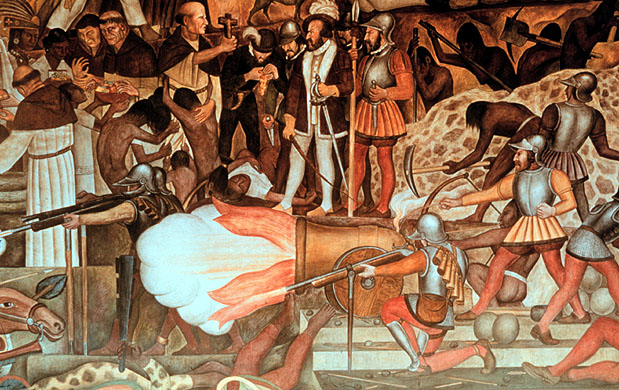


At the climax of Mel Gibson's new film Apocalypto -- currently the No. 1 film at the box office -- the main protagonist, a young Mayan named Jaguar Paw, is saved, at the end of a long chase through the jungle from a pack of Mayan warriors determined to kill him, by the arrival on the scene of a band of Spanish conquistadors, complete with Catholic priest in tow, whose presence gives him the distraction he needs to finally elude his pursuers.

It's a scene oddly reminiscent of the climax of Lord of the Flies, when the arrival of adult rescuers halts the bloodthirsty children's pursuit of their former leader. The clear implication is that the "civilized" adults from Europe have arrived to bring an end to the endless display of cruelty and savagery to which we've just been witness for most of the previous two hours.

This ending, in a film that is profoundly racist in its depiction of Mayan culture as relentlessly bloodthirsty and violent, is hardly lacking in irony. Because regardless of the brutality and viciousness of the Mayans at their worst -- and Gibson's depiction, for all of its faux authenticity (such as the strict use of Yucatec Mayan as the film's spoken language, even though none of actors cast in speaking parts was Mayan or knew the language), is almost crazily inaccurate as a cultural portrait -- they simply paled in comparison to what the Spanish, with the Catholic Church as their ideological wellspring, were about to inflict upon the Mesoamerican peoples as a whole. Nor could it hold a candle to what Europeans as a whole were to inflict upon Native American peoples over the next three centuries.

Traci Arden at Archaeology gives a rundown of just the immediate problems Apocalypto presents:
Yes, Gibson includes the arrival of clearly Christian missionaries (these guys are too clean to be conquistadors) in the last five minutes of the story (in the real world the Spanish arrived 300 years after the last Maya city was abandoned). It is one of the few calm moments in an otherwise aggressively paced film. The message? The end is near and the savior has come. Gibson's efforts at authenticity of location and language might, for some viewers, mask his blatantly colonial message that the Maya needed saving because they were rotten at the core. Using the decline of Classic urbanism as his backdrop, Gibson communicates that there was absolutely nothing redeemable about Maya culture, especially elite culture which is depicted as a disgusting feast of blood and excess.

... Gibson replays, in glorious big-budget technicolor, an offensive and racist notion that Maya people were brutal to one another long before the arrival of Europeans and thus they deserve, in fact they needed, rescue.

Nearly everyone with a serious acquaintance with Mayan culture has found Apocalypto repellent and simply wrong in nearly every respect. Among these is Julia Guernsey, an assistant professor in the Department of Art and Art History at the University of Texas who specializes in ancient Mayan art. She was interviewed by Austin360, and had this to say:
And the ending with the arrival of the Spanish (conquistadors) underscored the film's message that this culture is doomed because of its own brutality. The implied message is that it's Christianity that saves these brutal savages. I think that's part of Gibson's agenda, sort of, "We got the Jews last time (in 'The Passion of the Christ'), now we'll get the Maya." And to highlight that point there's a lot of really offensive racial stereotyping. They're shown as these extremely barbaric people, when in fact, the Maya were a very sophisticated culture.

Likewise, Juan Santos at Fourth World observes that the film is built upon "the premise that the Mayan city states collapsed because they deserved to collapse, and that they deserved to be replaced by a 'superior' culture in the genocide known as the Conquest":
"A great civilization is not conquered from without until it has destroyed itself from within," is how Gibson puts it. In other words the Conquest was not genocide but a moral comeuppance; the civilization didn't fall, in the final analysis, from climate change or inadvertent soil depletion or even war -- it was conquered in god's wrath against the forces of evil. And Gibson's made sure you see the ancient Maya as a force of profound evil.

Indeed, you would be hard-pressed, upon seeing Gibson's depiction of urban Mayan life, to understand how such a rabble of gibbering savages could possibly have placed two stones atop each other, let alone built massive cities with astonishing beauty and precision. (Oddly enough, the protagonist forest dwellers seem not even to be aware of the existence of these cities, even though Mayan cities had been a major feature of the Yucatan human landscape for over a thousand years at the point at which the story is supposed to occur.) They resemble nothing so little as the cartoonish natives who occupy a similar cityscape in the original 1933 version of King Kong.

Depicting Mayan culture this way leads modern-day audiences to leap to conclusions such as that noted by Santos, from one of the film's defenders, who says that it
[P]retty much precisely describes the whole point of the civilizations of such "noble savages" as the Mayans, if you ask us. There isn't one, there wasn't one, and there never will be one. Those bloodthirsty mongrels and many others before and after them were brutal, savage, cruel and entirely without redeeming qualities, and the best thing that ever happened to this planet was when they were wiped out, never to be heard of again.

In fact, we owe the Spanish Conquistadores an eternal debt of gratitude for having wiped that blood-curdlingly bestial, brutal blight upon humanity off the face of the planet because, had they not done it, we would have had to do so ourselves.

Bloodletting rituals, decapitations, and cenote sacrifices were inescapable factual features of Mayan civilization, as were the many wars that the various city-states engaged in, taking multiple slaves in the process. But focusing on these aspects gives us only a fractional view of Mayan culture. Depicting the gore and violence as constant, everyday occurrences creates a false and distorted portrait of Mayan society, which, as Julia Guernsey says, was actually extraordinarily sophisticated, a culture whose achievements at their height -- particularly in the Classic Maya period (A.D. 250-950) -- in some regards surpassed that of contemporaneous Europeans.

Mayan culture featured a complex and fascinating cosmology. Their art was both sublime and beautiful. And their language -- which was so complex and unusual in structure that it only has been deciphered generally in the past 20 years or so, and is still not completely so -- produced a massive literature that included poetic, religious and philosophical works.

However, we only are able to obtain a slight glimpse of this body of work today because those Spanish "saviors," in the two centuries following their arrival, successfully eradicated, through forced burning, nearly the entirety of it. As Michael D. Coe observed in his 1987 book The Maya:
"[O]ur knowledge of ancient Maya thought must represent only a tiny fraction of the whole picture, for of the thousands of books in which the full extent of their learning and ritual was recorded, only four have survived to modern times (as though all that posterity knew of ourselves were to be based upon three prayer books and 'Pilgrim's Progress')."

Their scientific and agricultural achievements were also substantial. Their astronomical observations in particular were extremely accurate; modern scientists note that their lunar and planetary charts are at least the equal of, if not superior to, those produced by any civilization working from the naked eye. And their astronomical achievements also played a role in their architecture; as David E. Stannard explains in American Holocaust: The Conquest of the New World [p. 38]:
... [I]t is important at least to point out how little we still know of these people. Their involved writing system, combining elements of both phonetic and ideographic script, for example, appears to have been fully expressive of the most intricate and abstract thinking and has been compared favorably to Japanese, Sumerian, and Egyptian -- but it continues to defy complete translation.

Similarly, for many years the absence of a gridwork layout to streets, plazas, and buildings in Maya cities puzzled scholars. Right angles weren't where they logically should have been, buildings skewed off oddly and failed to line up in the expected cardinal directions; everything seemed to twist away from an otherwise northward presentation. Apparently, said some archaeologists, Maya builders were incompetent and couldn't construct simple right angles. Given the exquisite and precise alignment of every other aspect of Maya architecture, however, others thought this to be at best a hasty criticism. And now it is beginning to become evident that these seeming eccentricities of engineering had nothing to do with incompetence.

On the contrary, a complicated and original architectural pattern had always been present -- the same pattern, some began to notice, in city after city after city -- but its conceptual framework was so foreign to conventional Western perception and thought that it remained effectively invisible. Recently the "code," as it were, of Maya engineering and construction has begun to be deciphered, and the story it reveals is mind-boggling. So precise were the Maya calendrical measurements and astronomical observations -- and so central were these cosmic environmental calculations to their ritual and everyday lives -- that the Maya constructed their cities in such a way that everything lined up exactly with specific celestial movements and patterns, particularly as they concerned the appearance and disappearance of the planet Venus in the evening sky.

Yet to the invading Spanish -- informed by centuries of Christian doctrine which portrayed people who dwelt on what they considered the "fringes" of the world as subhuman savages, in direct contrast to their view of Europe as the center of enlightenment and civilization -- the chief question was whether these people were even human.

That was the subject of the famed Debate of Valladolid of 1550-51, in which a council of 14 Church leaders discussed how to deal with the natives of the New World. The Spanish colonists' view was proffered by Juan Gines de Sepulveda, whose arguments are indistinguishable from Mel Gibson's portraiture of the Maya:
On the other hand, those who are dim-witted and mentally lazy, although they may be physically strong enough to fulfill all the necessary tasks, are by nature slaves. It is just and useful that it be this way. We even see it sanctioned in divine law itself, for it is written in the Book of Proverbs: "He who is stupid will serve the wise man." And so it is with the barbarous and inhumane peoples [the Indians] who have no civil life and peaceful customs. It will always be just and in conformity with natural law that such people submit to the rule of more cultured and humane princes' and nations. Thanks to their virtues and the practical wisdom of their laws, the latter can destroy barbarism and educate these [inferior] people to a more humane and virtuous life. And if the latter reject such rule, it can be imposed upon them by force of arms. Such a war will be just according to natural law. ...

Now compare these natural qualities of judgment, talent, magnanimity, temperance, humanity, and religion [of the Spanish] with those of these pitiful men [the Indians], in whom you will scarcely find any vestiges of humanness. These people possess neither science nor even an alphabet, nor do they preserve any monuments of their history except for some obscure and vague reminiscences depicted in certain paintings, nor do they have written laws, but barbarous institutions and customs. In regard to their virtues, how much restraint or gentleness are you to expect of men who are devoted to all kinds of intemperate acts and abominable lewdness, including the eating of human flesh? And you must realize that prior to the arrival of the Christians, they did not live in that peaceful kingdom of Saturn [the Golden Age] that the poets imagine, but on the contrary they made war against one another continually and fiercely, with such fury that victory was of no meaning if they did not satiate their monstrous hunger with the flesh of their enemies.

... What is more appropriate and beneficial for these barbarians than to become subject to the rule of those whose wisdom, virtue, and religion have converted them from barbarians into civilized men (insofar as they are capable of becoming so), from being torpid and licentious to becoming upright and moral, from being impious servants of the Devil to becoming believers in the true God?

The Council of Fourteen never officially rendered a verdict, though Stannard notes that "Sepulveda later claimed, and there is some reason to believe him, that in the end all but one of the Council supported his position that the Indians were indeed divinely created beasts of burden for their conquerors." This debate, as historians now acknowledge, was a critical moment in the development of European colonization, and the views that emerged from it proved critical not just for Spain but for Europe generally. Eventually, it grew into what we now call "Manifest Destiny" -- the belief that white Europeans were fated by the hand of God to bring enlightenment and civilization to the Americas.

The die for this worldview was cast with Christopher Columbus' first contact with the native peoples of Hispaniola in 1492, when the celebrated discoverer of the Americas took captive some twenty natives and kidnapped them for display upon his return to Spain; of these, only a half-dozen survived the trip, and only two were to live beyond six months. As Stannard notes [p. 204]:
Even the most educated and cultured and high-minded among the voyagers on this second expedition wasted no time in expressing their contempt for the native people. [Michele de] Cuneo, for example, the Italian nobleman and apparent boyhood friend of Columbus, repeatedly referred to the natives as "beasts" because he could not discern that they had any religion, because they slept on mats on the ground rather than in beds, because "they eat when they are hungry," and because they made love openly "whenever they feel like it." This judgment comes, it will be recalled, from a man who took a fancy to a beautiful young native woman during this trip and, when she rebuffed his advances, thrashed with a rope, raped her, and then boasted of what he had done.

Cuneo's opinion of the natives was echoed by Dr. Diego Alvarez Chance, a physician on the voyage who was later singled out by the Crown for a special award in recognition of his humanitarianism. For various reasons, including his disapproval of the Indians' method of laying out their towns and the fact that they ate cooked iguana (which the Spanish themselves later came to regard as a delicacy), Dr. Chanca declared that the natives were barbarous and unintelligent creatures whose "degradation is greater than that of any beast in the world."

... It is by no means surprising, then, that in only the second printed chronicle from the New World (the first being Columbus's report to the Crown on his initial voyage), the Spanish nobleman Guillermo Coma of Aragon dwelt at great length and in minute detail on the allegedly "very dark and grim-visaged" cannibals of the Indies. "They customarily castrate their infant captives and boy slaves and fatten them like capons," was but one of his numerous imaginings. And with equal vividness and equal falsity he described the great quantities of gold that awaited the adventurous, who could gather nuggets almost like fruit from a tree. ...

Yet it was with visions such as these that a flood of opportunistic adventurers called the Conquistadores began trammeling the shores of the Americas in search of gold. And whenever they encountered these "dark-visaged" natives, they read to them the Requerimiento, by which the natives could swear fealty to the Spanish Crown. It concluded:
If you do so, you will do well, and that which you are obliged to do to their Highnesses, and we in their name shall receive you in all love and charity, and shall leave you, your wives, and your children, and your lands, free without servitude, that you may do with them and with yourselves freely that which you like and think best, and they shall not compel you to turn Christians, unless you yourselves, when informed of the truth, should wish to be converted to our Holy Catholic Faith, as almost all the inhabitants of the rest of the islands have done. And, besides this, their Highnesses award you many privileges and exemptions and will grant you many benefits.

But, if you do not do this, and maliciously make delay in it, I certify to you that, with the help of God, we shall powerfully enter into your country, and shall make war against you in all ways and manners that we can, and shall subject you to the yoke and obedience of the Church and of their Highnesses; we shall take you and your wives and your children, and shall make slaves of them, and as such shall sell and dispose of them as their Highnesses may command; and we shall take away your goods, and shall do you all the mischief and damage that we can, as to vassals who do not obey, and refuse to receive their lord, and resist and contradict him; and we protest that the deaths and losses which shall accrue from this are your fault, and not that of their Highnesses, or ours, nor of these cavaliers who come with us. And that we have said this to you and made this Requisition, we request the notary here present to give us his testimony in writing, and we ask the rest who are present that they should be witnesses of this Requisition.

Stannard notes that in practice, "the Spanish usually did not wait for the Indians to reply to their demands. First the Indians were manacled; then, as it were, they were read their rights."

Perhaps more significantly, on his second voyage in 1494, Columbus arrived in the Americas carrying a disease -- now believed to be either bacillic dysentery or influenza carried by Canary Island pigs -- that proved to have lethal effect on the native population. As Stannard writes [pp. 68-69]:
Whatever it was, in any case, the imported pathogen moved among the native peoples with a relentlessness that nothing ever had in all their history. "So many Indians died that they could not be counted," wrote Gonzalo Fernandez de Oviedo, adding that "all through the land the Indians lay dead everywhere. The stench was very great and pestiferous." And in the wake of the plague they had introduced, the Spanish soldiers followed, seeking gold from the natives, or information as to where to find it. They were troubled by the illness, and numbers of them died from it. But unlike the island natives the European invaders and their forebears had lived with epidemic pestilence for ages. Their lungs were damaged from it, their faces scarred with pocks, but accumulations of disease exposure allowed them now to weather much. So they carried infections with them everywhere they went -- burdensome, but rarely fatal, except to the natives they met.

... Wherever the marauding, diseased, and heavily armed Spanish forces went out on patrol, accompanied by ferocious armored dogs that had been trained to kill and disembowel, they preyed on the local communities -- already plague-enfeebled -- forcing them to supply food and women and slaves, and whatever else the soldiers might desire. ...

As horrific as the pestilence brought by Columbus may have been, it only foreshadowed the coming of the most horrific killer in the history of the Americas: smallpox. Though it first arrived in Hispaniola in 1518, the most significant outbreak was carried by the soldiers under the command of Hernan Cortes, who invaded Mexico in 1519 and brought it to the Aztecs during the Siege of Tenochtitlan, and left it behind after he was forced into retreat by his defeat on La Noche Triste in 1520.

Smallpox had immediately had a horrific effect on the native populace. Stannard writes [p. 77]:
After being released among the Aztecs, wrote Cortes's secretary Francisco Lopez de Gomara, "it spread from one Indian to another, and they, being so numerous and eating and sleeping together, quickly infected the whole country. In most houses all the occupants died, for, since it was their custom to bathe as a cure for all diseases, they bathed for the smallpox and were struck down." Gomara continues:

Those who did survive, having scratched themselves, were left in such a condition that they frightened the others with the many pits on their faces, hands, and bodies. And then came famine, not because of a want of bread, but of meal, for the women do nothing but grind maize between two stones and bake it. The women, then, fell sick of the smallpox, bread failed, and many died of hunger. The corpses stank so horribly that no one would bury them; the streets were filled with them; and it is even said that the officials, in order to remedy this situation, pulled down the houses to cover the corpses.


The epidemic seems to have lasted for about two months, during which time, and for months later, Cortes was reorganizing his defeated forces and marching on and burning smaller towns in the region. Once the disease dissipated -- having devastated the city's residents and killed off most of the Aztec leaders -- Cortes prepared to attack again.

The ensuing battle lasted for months, but Cortes eventually emerged victorious, thanks to a combination of tactics (he shut off the city's water supply) and the spread of the disease. But this was only the beginning. Endless waves of conquistadors now spread out through in Mexico, carrying with them the same brutal campaign of death: Pedro de Alvarado, Nuno Beltran de Guzman, Hernando de Soto, Francisco Vasquez de Coronado, Francisco de Ibarra, Vasco Nunez de Balboa. These were only some of the leading names of the marauders who engaged in a relentless campaign of massacres throughout what is now Latin America. Stannard writes [pp. 82-83]:
The gratuitous killing and outright sadism that the Spanish soldiers carried out on Hispaniola and in central Mexico was repeated in the long march to the south. Numerous reports, from numerous reporters, tell of Indians being led to the mines in columns, chained together at the neck, and decapitated if they faltered. Of children trapped and burned alive in their houses, or stabbed to death because they walked too slowly. Of the routine of cutting off of women's breasts, and of the tying of heavy gourds to their feet before tossing them to drown in lakes and lagoons. Of babied taken from their mothers' breasts, killed, and left as roadside markers. Of "stray" Indians dismembered and sent back to their villages with their chopped-off hands and noses strung around their necks. Of "pregnant and confined women, children, old men, as many as they could capture," thrown into pits in which stakes had been imbedded and "left stuck on the stakes, until the pits were filled." And much, much, more.

One favorite sport of the conquistadors was "dogging." Traveling as they did with packs of armored wolfhounds and mastiffs that were raised on a diet of human flesh and were trained to disembowelel Indians, the Spanish used the dogs to terrorize slaves and to entertain the troops. An entire book, Dogs of the Conquest, has been published recently, detailing the exploits of these animals as they accompanied their masters throughout the course of the Spanish depredations. "A properly fleshed dog," these authors say, "could pursue a 'savage' as zealously and effectively as a deer or a boar. ... To many of the conquerors, the Indian was merely another savage animal, and the dogs were trained to pursue and rip apart their human quarry with the same zest as they felt when hunting wild beasts."

... Just as the Spanish soldiers seem to have particularly enjoyed testing the sharpness of their yard-long rapier blades on the bodies of Indian children, so their dogs seemed to find the soft bodies of infants especially tasty, and thus the accounts of the invading conquistadors and the padres who traveled with them are filled with detailed descriptions of young Indian children routinely taken from their parents and fed to the hungry animals. ...
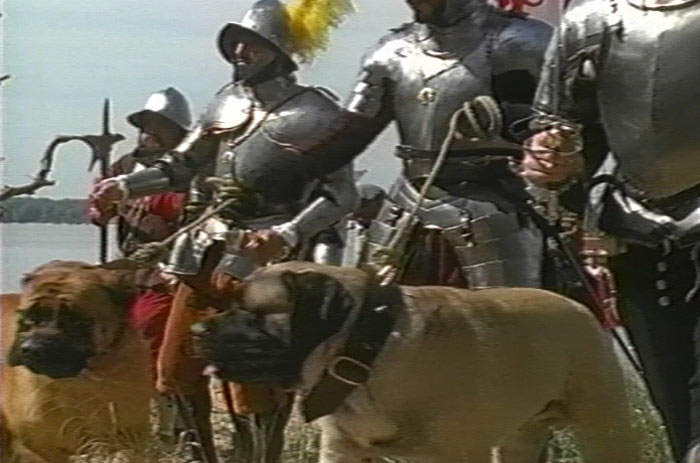
Of all the weapons the Spanish brought with them, these dogs epitomized the brazen cruelty with which they treated the native peoples, wrought by a worldview that held these human beings as being no more than beasts themselves.

This pattern -- weakening the populace with disease, then overpowering them with superior arms and an inhuman ruthlessness and brutality -- was repeated endlessly throughout Americas in the ensuing decades, first throughout Hispaniola and the Caribbean, then in Mexico itself, then in Central and South America. The Spanish conquest of the Yucatan and of Mexico were only the first steps in Spain's larger colonization program in the Americas. The result was the near-utter obliteration of the existing civilizations.

Stannard observes [pp. 94-95]:
From the very beginning -- from at least that day in 1493 when a "very beautiful Carib woman" fought off the violent advances of Michele de Cuneo, before being thrashed with a rope and then raped by him -- the people of the Americas resisted. None did so more successfully than the Maya, who combined retreats into the deep jungle cover of the Yucatan lowlands -- where, as one historian puts it, the pursuing conquistadors "soon found themselves adrift in a green expanse of forest without food to eat, souls to convert, or labor to exploit" -- with relentless military counterattacks that finally led to temporary expulsion of the Spanish in 1638. And neither did any people resist with more symbolism than they Maya, who made a practice of destroying not only Spanish soldiers but whatever foreign things the Spanish had brought with them -- horses, cattle, cats, dogs, trees, and plants. In the end, however, the Maya too lost 95 of 100 of their people -- a price for resistance that most outsiders, if they know of it, can hardly hope to comprehend.

By the time the sixteenth century had ended perhaps 200,000 Spaniards had moved their lives to the Indies, to Mexico, to Central America, and points further to the south. In contrast, by that time, somewhere between 60,000,000 and 80,000,000 natives from those lands were dead. Even then, the carnage was not over.

In reality, it had only begun. North America's native people had only begun to feel the effects of their contacts with European settlers. And the eliminationist worldview of the Spanish was fully intact throughout most of Europe; indeed, the English expanded upon and perfected it as they settled the northern reaches of the Americas.

The twin infections -- rampaging disease and a malignant eliminationism -- were proceeding on due course in the rest of the New World.

Next: 'People Die Very Much'


[Note: Edited for minor corrections.]
Thursday, December 14, 2006

Race and detention


There are a number of disturbing aspects of the recent Homeland Security raids intended to snare illegal immigrants at various workplaces suspected of hiring them, not the least of which, as TPM Muckracker's Justin Rood reports, is that a number of legal immigrants were caught up in the sweeps:
Cashen said that reports from all six states confirmed that legal immigrants were among those taken away, and have not been returned. "We're still trying to find out where the buses went," she said. "Children have been left at church day cares. Nobody knows where these people are."

But there is a second aspect of this that is equally disturbing: as Rood's followup report points out, racial profiling was in play during these raids:
DHS agents allegedly separated workers by their skin color -- light-skinned were considered citizens, dark-skinned got scrutiny. Predicatably, they swept up at least one dark-skinned U.S. citizen up with immigrant workers.

The Salt Lake Tribune report he cites contains a vivid illustration of what happened:
If only for a few minutes, Maria felt like an "illegal alien" in her homeland -- the United States of America.

She thought she was going on break from her job at the Swift & Co. meat processing plant here [in Hyrem, Utah] on Tuesday, but instead she and others were forced to stand in a line by U.S. immigration agents. Non-Latinos and people with lighter skin were plucked out of line and given blue bracelets.

The rest, mostly Latinos with brown skin, waited until they were "cleared" or arrested by "la migra," the popular name in Spanish for Immigration and Customs Enforcement (ICE), employees said.

"I was in the line because of the color of my skin," she said, her voice shaking. "They're discriminating against me. I'm from the United States, and I didn't even get a blue bracelet."

The arrest of legal immigrants and citizens is the most obvious flaw in racial profiling like this. The larger problem is that racial profiling is wrong in principle, particularly as a matter of law enforcement. It contradicts the notion of equal protection under the law, and when applied in these circumstances, it underscores the institutional racism latent within immigration law itself.

This isn't the first time we've seen this kind of racial profiling in ICE raids. Back in August, as Citizen Steve reported, the ICE performed a similar raid on a Bellingham linen firm:
The raid took place midmorning at Northwest Health Care Linen, located on Strider Loop Road just off of East Bakerview and Hannegan roads. Armed with a sealed civil search warrant, U.S. Immigration and Customs Enforcement agents entered the business to question employees, said ICE spokeswoman Virginia Kice. ...

... Jim Hall, owner of Northwest Health Care Linen, said all of his 90 employees pay taxes and had completed I-9 forms. The company, which supplies linens for hospitals throughout Puget Sound, was shut down for two hours as armed agents in bulletproof vests interviewed workers, he said.

However, Hall questioned the need for Wednesday's operation. He said the agent investigating his business promised to give him a list of employees with questionable documents within 60 days. Instead, agents raided the business, which Hall described as an "extremely emotional event" that could have been avoided.

"It was just too bad that it was handled this way," he said. "It sure leaves a lot of questions for Whatcom County with what Homeland Security is doing." ...

Rosette Royale at Real Change followed up and found even more disturbing aspects of this:
Why, when Immigration and Customs Enforcement (ICE) raided Northwest Health Care Linen in Bellingham on Aug. 30, did the agency separate the Latino workers from those who were Sikh, Russian, or Southeast Asian? Why were the Latinos questioned when other workers weren't? Why were the Latinos the only ones arrested and then threatened with imminent detention?

You see, in Bellingham, many of the illegal immigrants are going to be white: a substantial portion of the immigrant population already there are Russians. As Royale notes, there are also many illegal immigrants here in this corner of the world from South Asia and Southeast Asia.

The arrests were conducted with an icy police-state response as well:
All the workers with whom she met, she says, were Latino, and they described how more than 40 ICE officers, bearing guns and wearing bulletproof vests, separated employees according to race. ICE asked whether the Latino workers were undocumented, to which, according to the employees, none of the sequestered individuals answered. When the workers asked ICE officials why they were being detained, the workers say they got no replies, only shouts to be quiet. The workers described people crying, she says, of being traumatized by the experience. When recounting their experiences, she says, the workers were crying and visibly shaken. "I cannot say enough about the wrongness of this kind of behavior [by ICE]," says Guillen.

That brings up the third, and perhaps most disturbing (in the long-term sense, anyway) aspect of these raids: Where are these people being taken?

The Bellingham detainees were taken to the ICE's Detention Center in Tacoma. Here's how that situation is playing out:
The arrestees, whatever their true number, only represent a portion of those detained in ICE's Tacoma facility, which, estimates Rose-Avila, sees 100 new people a week, some flown in from as far away as Miami. While his organization tries to inform those being detained in Tacoma of their rights, he says most enter an immigration hearing pro se, where they defend themselves, as lawyers are not provided to those with financial hardships facing immigration charges. He says, with the Northwest Detention Center considering raising its bed count from 800 to 1,000, that there are simply too many people for his organization to represent. Asks Rose-Avila: "Who's going to defend these people?"

Justin Rood's report notes:
The paper confirms that the federal agents took an undisclosed number of people away in buses away to an undisclosed location.

It's a fairly simple matter, really: When you have mass arrests, you need mass detention centers. Because every person detained, whether citizen or not, has to be processed if for no other reason than to determine their actual status. The system in place simply cannot process thousands of people dumped upon it in large numbers. Bush himself noted the problem of capacity in his immigration address last June. The end result is that housing the growing numbers of detainees backed up in the system will require more facilities.

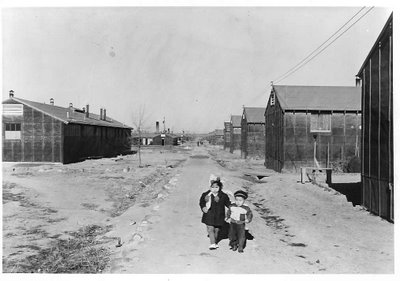
That was the reality that the government faced in 1942 when, after deciding to evacuate the Pacific Coast of its Japanese Americans, found that -- since the governors of interior states refused to accept the evacuees except under armed guard and behind barbed wire -- the only way the program would work would be to detain the evacuees. And so they set about building mass detention centers, 10 of them, which eventually held 120,000 people.

This is where those Halliburton detention-center contracts -- the substantive concerns about which were obscured by the paranoia they provoked -- will probably come into play. It will be worth finding out whether they have already.

These are only some of the immediate consequences of pursuing the right-wing agenda of using illegal immigrants as a scapegoat for the nation's economic ills, even as they wink and nudge at the businessmen who get rich off the backs of these same workers. The nativist crowd -- Michelle Malkin, VDare, and the like -- has been demanding the government immediately detain and deport all 8 million illegal immigrants. Well, this is just a taste of what you get.

There are also other unintended consequences that are beginning to raise their heads: emptying whole towns and wiping them out. Sundering families. And all this time, you thought that conservatives were pro-community, pro-family, didn't you?

But that's just the start when we head down this road. It's time to take a look at some other roadmaps.

Remorseless

The best lack all conviction, while the worst
Are filled with passionate intensity

-- Yeats

One of the more striking traits of haters, particularly those who act out their hate violently, is that they never see themselves as the rest of us do, as monsters who have lost their humanity. Rather, they see themselves as heroes, engaged nobly in a herculean task of redemption.

Hate-crime perpetrators are like this. They rarely express any remorse for their crimes, because they believe they are acting on a higher imperative than the law. They all believe they're expressing a higher will, either that of the community, or at the behest of God himself.

So we have the prospect of watching Olympics bomber Eric Rudolph, in this report from the Colorado Springs Gazette, smirk and mock his victims from the prison cell where he will rot:
FLORENCE -- Unrepentant, Olympics and abortion clinic bomber Eric Rudolph sits in his cell at Supermax complaining about being treated like a "terrorist" and composing "satires" mocking his victims.

Yeah, it's just a damn shame that the guy who set off a pipe bomb at the Olympics is being treated like a terrorist.
Rudolph's homemade bombs in Atlanta and Birmingham, Ala., killed two people and injured 120. He was captured in 2003 after hiding out for five years in the North Carolina mountains.

In correspondence with The Gazette during the past 15 months, Rudolph refers to himself as a political prisoner and accuses the federal Bureau of Prisons of inhumane treatment for keeping him and other terrorists in their cells for 23 hours a day.

...Nearly 16 months in isolation have not changed his attitude. Last month, Rudolph sent The Gazette a 16-page story he said was a "satire" based on his sentencing in Birmingham in July 2005.

The names were changed slightly, he wrote, because the Bureau of Prisons won't let him send mail that deals with crimes or acts of violence.

In it, he mocks the prosecutors, judge and victims of his 1998 bombing of the New Woman All Women clinic, which killed off-duty policeman Robert Sanderson and maimed nurse Emily Lyons.

Lyons was struck by flying nails and shrapnel, which tore out one of her eyes. She has had 22 surgeries since 1998.

In a narrative dripping with sarcasm, Rudolph wrote that he "never learned that there is no freedom more dear to women than the right to dispose of their own unwanted children."

Lyons, he wrote, "is a facilitator of this sacred right," adding that he "had pointed his finger in judgment of Emily. And there is nothing more repugnant to citizens of the Brave New World than being called to account for one's actions."

Rudolph described Derzis as "brassy, worldly, the kind of woman who had not only been around the block a few times but was probably dragged behind a truck the entire way."

"Releasing women caught in the shackles of maternity became her mission in life," he wrote.

Sanderson, he wrote, was "a hero who stood steadfast watch as thousands of women made it to freedom over the corpses of their unborn children. That's heroism folks!"

Of course, as Diane Derzis, who runs the clinic he bombed, points out, the victims will have the last smirk:
"At the end of the day, he hears bars clanging," she said. "He can mock the rest of us as much as he wants, but we still have lives."

Derzis said it's appropriate he'll spend his life in a cell.

"I thought, for him, he's someone who loves the outdoors, this was the most appropriate punishment," she said. "He'll never see that again. That to me is a fate worse than death."

Wednesday, December 13, 2006

Lies and memory


Lest anyone forget that eliminationist hatred is a global phenomenon, this week's Holocaust Denial conference in Iran is a vivid reminder of the ways this kind of vicious bigotry can spread to every corner of the globe.

Indeed, according to the New York Times report, many of the same players who spread this poison here in the United States are showing up in Tehran this week:
The Foreign Ministry had said that 67 foreign researchers from 30 countries were scheduled to take part. Among those speaking on Monday were David Duke, the American white-supremacist politician and former Ku Klux Klan leader, and Georges Thiel, a French writer who has been prosecuted in France over his denials of the Holocaust.

Duke's remarks were expected to assert that no gas chambers or extermination camps were built during the war, on the ground that killing Jews that way would have been much too bothersome and expensive when the Nazis could have used much simpler methods, according to an advance summary of his speech published by the institute.

"Depicting Jews as the overwhelming victims of the Holocaust gave the moral high ground to the Allies as victors of the war and allowed Jews to establish a state on the occupied land of Palestine," Duke's paper says, according to the summary.

Especially noteworthy was the fact that this wasn't merely a private convention, the kind where this material is commonly spewed. This was a government-sponsored affair entirely under the aegis of Iranian president Mahmoud Ahmadinejad:
The conference was being held at the behest of the Iranian president, Mahmoud Ahmadinejad, who likewise called the Holocaust a myth last year, and repeated a well-known slogan from the early days of the 1979 revolution in Iran: "Israel must be wiped off the map." He has spoken several times since then about a need to establish whether the Holocaust actually happened.

Most of the speakers at the conference on Monday praised Ahmadinejad's comments.

Anne Applebaum in Slate (whose strangely inane front-page head for the piece described Holocaust revisionism as "silly, but very scary") has a fairly accurate assessment of this:
Unfortunately, Iran is serious -- or at least Iran's president, Mahmoud Ahmadinejad, is deadly serious. Holocaust denial is his personal passion, not just a way of taunting Israel, and it's based in his personal interpretation of history. Earlier this year, in a distinctly eerie open letter to German Chancellor Angela Merkel, he lauded the great achievements of German culture and assaulted "the propaganda machinery after World War II that has been so colossal that [it] has caused some people to believe that they are the guilty party." Such views hearken back to the 1930s, when the then-Shah of Iran was an admirer of Hitler's notion of the "Aryan master race," to which Persians were meant to belong. Ahmadinejad himself counts as a mentor an early revolutionary who was heavily influenced by wartime Nazi propaganda. It shows.

... All of which is a roundabout way of saying that this particular brand of historical revisionism is no joke, and we shouldn't be tempted to treat it that way.

Applebaum is right, of course. However, it has to be remembered that "this particular brand of historical revisionism" -- embodied by people like Duke and David Irving -- isn't relegated strictly to Holocaust denial.

Recall, if you will, that the same white nationalist faction that spreads this anti-Semitic hatred is engaged in revising history on a number of fronts. There are, for instance, revisionists who claim that slavery was a benign institution.

The phenomenon is not simply relegated to the American far right, however; it has in fact crept well into mainstream conservatism. Take, for instance, right-wing author Thomas Woods, whose chief thrust is that civil-rights advances in the 20th century were actually harmful for minorities.

More notoriously, there was Ann Coulter's attempt to rehabilitate McCarthyism in her book Treason: Liberal Treachery from the Cold War to the War on Terrorism by engaging in precisely the kind of historical distortion in which the Holocaust deniers engage -- eliding contradictory evidence, distorting and falsifying facts.

Applebaum actually addressed Coulter's work as sham history -- it made her want to "throw the book across the room" -- but treated it mostly as, well, a bad joke. She neglected to observe that the enterprise constituted precisely the kind of historical revisionism that she now recognizes as innately destructive. Even worse, she equates Coulter with Michael Moore:
Still, it isn't hard to imagine using the same methods to write the same book from precisely the opposite point of view, and indeed someone has already done it: Michael Moore, in Stupid White Men.

Yet Moore's methods -- for all their flaws, which are considerable -- are decidedly not the same as Coulter's (nor, for that matter, are Tammy Bruce's, whose work she also equates with Coulter's). At no point in Stupid White Men does Moore attempt to revise history or present an "alternative" version of history; accusing "pretty much everyone on the right of corruption and venality" is simply his perspective -- and Lord knows that, in distinct contrast to Coulter, not only did Moore have a substantial mound of hard factual evidence, the succeeding years have provided a veritable mountain of it to support his thesis.

Another noteworthy example of this brand of historical revisionism appearing in the guise of mainstream conservatism was Michelle Malkin's attempt to justify the incarceration of Japanese Americans during World War II -- a matter that, as far as I can tell, Applebaum never addressed. As I observed at the time, while Malkin's enterprise was not as profoundly vile in nature as, say, David Irving's, her methodology was remarkably similar:
In Defense of Internment ... employs a methodology very similar, if not identical, to the deniers: It fudges numbers, claiming, for instance, that the numbers of Nisei serving in the Japanese Army ranged "from 1,648 ... to as high as 7,000", a range that renders it almost meaningless, while omitting the fact that many of those Nisei were unfortunate students forcibly conscripted into service. It elides whole ranges of evidence and manipulates other pieces of evidence in a way that is clearly deceptive. It rationalizes the internment by raising the canard that because many of the Nisei were technically "dual citizens," their loyalty was suspect, thereby minimizing the impact of the incarceration for thousands of loyal citizens. It tries to place the decisions that drove the internment in a false "context" of supposed military concerns about an imminent invasion (though Malkin has since conceded that the military's only real concern was about spot raids similar to those that wracked the East Coast -- where German American citizens were not incarcerated -- as well). And it raises "fresh evidence" in the form of MAGIC encrypts, the significance of which has consistently been discarded by serious historians as minimal at best, for sound factual reasons.

As the Irving example suggests, this kind of approach to history -- in which facts are mere indulgent playthings to be manipulated and distorted at will, all in the service of "proving" a thesis -- is more than a mere exercise in pedantic polemicism. It inflicts real-world harm on the lives of ordinary people by minimizing the tragedies of those who actually lived through the events whose memory they abuse so blithely.

Worst of all, in doing so, they pave the way for these tragedies to repeat themselves. And that, really, is what makes Malkin, Irving, Gibson and their like truly reprehensible.

Historical revisionism is not only never a joke, it is positively an evil. Because history, in the end, is about preserving intact the memory of real human experience. Lies about those memories are intended to destroy them and, in the end, to destroy our sense of history.

Those who forget history, as Santayana put it, are condemned to repeat it. And those who destroy it are condemning the rest of us to the endless cycle of hatred and violence.

That is as true in America as it is in Iran.

UPDATE: Eric Muller has a personal take on the Tehran conference.

UPDATE II: Natasha at Pacific Views offers a broader perspective.

Those other awards

I normally pay little attention to any of the various blogging awards except for the Koufaxes and the Northwest Progressive Institute's annual regional awards. But I'd be remiss not to mention that Orcinus is one of the 10 finalists in the Weblog Awards' Best of the Top 250 category.

I tend to find these kinds of popularity contests -- which seem to have little to do with the quality of writing -- a bit silly, but if you're a fan of this blog, I suppose this is a way of showing it a little love.

Monday, December 11, 2006

Eliminationism in America: II

Continuing a ten-part series

I: The Lurker Below

Part II: The Urge to Eliminate


Is the urge to eliminate, to purge from within the people we deem our internal enemies, simply a natural impulse buried deep in our psyches -- irresistible, ineluctable, inevitable? Certainly, CNN's Glenn Beck seems to think so.

This summer, Beck was arguing over the airwaves that if there were further terrorist attacks by Muslims on American soil, that concentration camps were all but a fait accompli, and that "Muslims will see the West through razor wire if things don't change":
All you Muslims who have sat on your frickin' hands the whole time and have not been marching in the streets and have not been saying, 'Hey, you know what? There are good Muslims and bad Muslims. We need to be the first ones in the recruitment office lining up to shoot the bad Muslims in the head.' I'm telling you, with God as my witness... human beings are not strong enough, unfortunately, to restrain themselves from putting up razor wire and putting you on one side of it. When things -- when people become hungry, when people see that their way of life is on the edge of being over, they will put razor wire up and just based on the way you look or just based on your religion, they will round you up. Is that wrong? Oh my gosh, it is Nazi, World War II wrong, but society has proved it time and time again: It will happen.

Beck is at least right about one aspect of this: the compulsion to purge society of a designated threat is deeply buried in our psyches, both individually and collectively. Its origins, in many regards, date to earliest humanity. Indeed, it can properly be said to arise from the same primitive impulse -- the desire to dominate others, by violence if necessary -- that underlies humankind's most destructive enterprises throughout history: war, slavery, torture, genocide.

Eliminationism is, however, no more inevitable than any of these other impulses, against which mankind has over the centuries, in fits and starts, struggled to overcome. Slavery is considered a dead letter in modern global society, though aspects of it can still be found in some of the world's darker corners. Genocide and torture have been outlawed by the international community and are considered the most grievous of war crimes. And although American presidents are still capable of blithely making war, it is still widely understood to be among mankind's greatest scourges, a blot that only the most amoral among us undertake as anything but a last grim resort.

In its final outcome, eliminationism is almost indistinguishable from genocide, except for one aspect: it is genocide directed against an enemy within instead of without. But in all other aspects, particularly the utter objectification of the Enemy to the point of demonization, they are closely related.

And genocides, of course, have been with us throughout much of human history. The Bible records a number of them, including the killing and enslavement of the Israelites by the Egyptians; the extermination of the Canaanites by the Israelites, commanded by God (Deuteronomy 20:16-17), as well as the incomplete genocide commanded by God of the Amalekites at the hands of King Saul (Deuteronomy 25:19); and the massacres of various Middle Eastern peoples carried out by the Assyrian and Babylonian empires. Other genocides buried in the mists of history include the Scythian slaughter of Cimmerians recorded by Herodotus, who described these massacres occurring in the vicinty of the Black Sea as the Scythians swept westward of the Black Sea in the 7th century B.C.

Genocide became an institutional feature of Empire under the Romans. Julius Caesar slaughtered more than half of the Helvetii in conquering present-day Switzerland); he also massacred over a million Gauls and destroyed 800 cities in present-day France. The Romans also completely destroyed the city of Carthage in the Third Punic War, as well as the city of Jerusalem in A.D. 70; the populations of both cities were either killed or enslaved, and both cities were later rebuilt and repopulated by the Romans.

Genocide is a constant in much of the rest of the history of the world's violence as well. Genghis Khan and his sons, in the pursuit of their massive Mongol empire, systematically massacred millions of civilians throughout Eurasia during the 13th century. This includes the sacking of Baghdad in 1258, in which some two-thirds of the city's 1.5 million inhabitants were slaughtered. Likewise, the Islamic conquest of South Asia saw the massacre of thousands of Hindus, Buddhists and Jains, mostly in periodic outbreaks that in many cases represented an effort to suppress dissident factions.

The vast majority of these genocides were directed at ostensibly external enemies -- either the occupants of neighboring territories whose activities were deemed threats to the perpetrators, or people whose lands were coveted for purposes of territorial expansion. All of them took place in the context of war and conquest.

Yet throughout history, war and conquest have not only shaped our societies but have been products of them. Warmaking has always been inextricably bound up with cultural conceptions of heroism and virtue, and these conceptions have in turn driven the shape of how we wage war -- including the urge eliminate.

The adulation of heroes arises out of a basic human need, as the late Ernest Becker put it, to feel good about ourselves, to know ourselves as heroes. In the West, the heroic task historically has entailed energetically taking up arms to redeem the world. It also entails creating an enemy and naming him; the heroic warrior, after all, needs an enemy against which to fight, something to give his life meaning. The drama that results is a holy war to drive out an alien darkness or disease, and it is a drama that has played out innumerable times throughout the long history of the West.

Yet, as James Aho observes in This Thing of Darkness: A Sociology of the Enemy, the heroic dynamic has played out differently in different cultures. In the East, he notes, the martial-arts hero is perfected by becoming "absorbed in a cycle that is larger than himself," subsumed by eternal spiritual principles with which he has become aligned. But this is not the case in the Occident:
In civilizations that have come under Judeo-Christian and Muslim influence -- which is to say, among others, modern Europe and America -- chaos is experienced as the product of disobedience regarding ethical duties, not mere ritual infractions, as these have been revealed through prophecy. Here, then, the heroic task becomes one not of passively yielding to the Way but of energetically taking up weapons to reform the world after the personal commandments of the Holy One. The Occidental holy war functions to stereilize the world of an alien darkness or disease, not to reconcile man to its inevitability, particularly its inevitability in himself.

... For adherents of sacred and secular Occidental faiths (such as Marxism, liberalism, or fascism) the world is "fallen" or "problematic," hence susceptible to reform. But no reform movement can make the world over all at once in its entirety. Therefore, each focuses its indignation and redemptive energy on a "fetish" of evil -- a despicable act, a heretical belief, a foreign place, an alien people, a criminal person -- that is to be fettered, expulsed, or exterminated.

This expiative impulse, in the West at least, became closely associated with Christianity during the early Middle Ages, especially in the later phases of the Holy Roman empire, when Church doctrine regarding the nature of sin developed into a deep psychological fixation regarding the impurity of the flesh.

Historian David E. Stannard's text American Holocaust: The Conquest of the New World explores these historical roots of genocide in European culture in some depth. As he observes (pp.154-155), the Augustinian doctrine of worldly sin equated all the natural world with evil and brutality, including such natural impulses as sex:
The idea is hardly a Christian invention, then, that immoderate enjoyment of the pleasures of the flesh belongs to the world of the brute, and that abstinence, modesty, strictness and sobriety are to be treasured above all else. Still, it is understandable why subsequent European thought would regard Greece and Rome as realms of carnal indulgence, since subsequent European thought was dominnated by Christian ideology. And as the world of the Christian fathers became the world of the Church Triumphant, while fluid and contested mythologies hardened into dogmatic theology, certain fundamental characteristics of Christianity, often derived from the teachings of Paul, came to express themselves in fanatical form. Not the least of these was the coming to dominance of an Augustinian notion of sex as sin (and sin as sexual) along with a larger sense, as Elaine Pagels puts it, that all of humanity was hopelessly "sick, suffering, and helpless." As late antiquity in Europe began falling under the moral control of Christians there occurred what historian Jacques le Goff has called la deroute du corporal -- "the rout of the body." Not only was human flesh thenceforward to be regarded as corrupt, but so was the very nature of humankind and, indeed, so was nature itself; so corrupt, in fact, that only a rigid authoritarianism could be trusted to govern men and women who, since the fall of Adam and Eve, had been permanently poisoned with an inability to govern themselves in a fashion acceptable to God.

... The Christian leader ... stood apart from all others by making a public statement that in fact focused enormous attention on sexuality. Indeed, "sexuality became a highly charged symbolic marker" exactly because its dramatic removal as a central activity of life allowed the self-proclaimed saintly individual to present himself as "the ideal of the single-hearted person" -- the person whose heart belonged only to God.

Of course, such fanatically aggressive opposition to sex can only occur among people who are fanatically obsessed with sex, and nowhere was this more ostentatiously evident than in the lives of the early Christian hermits ...

Stannard later offers, by way of illustration, the following explanation from the poet and Franciscan monk Giacomo di Verona, describing the origins of human nature:
In a very dirty and vile workroom
You were made out of slime
So foul and so wretched
That my lips cannot bring themselves to tell you about it.
But if you have a bit of sense, you will know
That the fragile body in which you lived,
Where you were tormented eight months and more,
Was made of rotting and corrupt excrement ....
You came through a foul passage
And you fell into the world, poor and naked ...
... Other creatures have some use:
Meat and bone, wool and leather;
But you, stinking man, you are worse than dung:
From you, man, comes only pus ...
From you comes no virtue,
You are a sly and evil traitor;
Look in front of you and look behind,
For your life is like your shadow
Which quickly comes and quickly goes ...

As Stannard explains, such "learned and saintly medieval urgings" were part of a medieval worldview that created a culture that "became something truly to behold," one in which the effort to purge oneself of base sinfulness gave birth to a panoply of bizarre and painful self-inflictions. He cites a passage from a "not untypical" devout friar, described by Norman Cohn, who
shut himself up in his cell and stripped himself naked ... and took up his scourge with the sharp spikes, and beat himself on the body and on the arms and legs, till blood poured off him as from a man who has been cupped. One of the spikes on the scourge was bent crooked, like a hook, and whatever flesh it caught it tore off. He beat himself so hard that the scourge broke into three bits and the points flew against the wall. ...

Eventually, this hatred of sex was expressed in an abiding misogyny that identified women with the putrefication of the natural world and the source of worldly evil. It also identified the outside world with untamed nature and thus with wanton sinfulness. As Stannard writes, "there also lurked in distant realms demi-brutes who lived carnal and savage lives in wilderness controlled by Satan."

This view of the "uncivilized" world as populated by creatures who were perhaps only passably human also preceded Christianity by several centuries. Greek poets like Homer and Hesiod often described an outside world populated by demigods and other half-human races. Pliny the Elder, in the first century A.D., described in his Natural History peoples of far-off lands with fantastic traits, including people whose faces are embedded in their chests, or have the heads of dogs, or hooves instead of feet, or ears so long or lips so large they use them as coverings. As this myth-making was incorporated into Christian culture, it was assumed that the strangeness of these "monstrous" races, linked to the outcast lineage of Cain, was product of their innate sinfulness and downcast nature. "So great was their alienation from the world of God's -- or the gods' -- most favored people, in fact," writes Stannard, "that well into late antiquity they commonly were denied the label of 'men.'"

Eventually, by the later Middle Ages, this fascination with "monstrous" races evolved into an interest in the "wild man" who it was believed inhabited the unexplored wildernesses of the world. Stannard writes:
Hidden or not, however, the loins of the wild man and his female were of abiding interest to Christian Europeans. For, in direct opposition to ascetic Christian ideals, wild people were seen as voraciously sexual creatures, some of them, in Hayden White's phrase, "little more than ambulatory genitalia." Adds historian Jeffrey Russell: "The wild man, both brutal and erotic, was a perfect projection of the repressed libidinous impulses of medieval man. His counterpart, the wild woman, who was a murderess, child-eater, bloodsucker and occasionally a sex nymph, was prototype of the witch."

... In sum, the wild man and his female companion, at their unconstrained and sensual worst, symbolized everything the Christian's ascetic contemptus mundi tradition was determined to eradicate -- even as that tradition acknowledged that the wild man's very same carnal and uncivilized sinfulness gnawed at the soul of the holiest saint, and (more painful still) that it was ultimately ineradicable, no matter how fervent the effort. ...

However, these threats, like the heathen enemies of Muslim lands, were purely external. But the European populace was never entirely homogenous, and many of the non-Christians who lived in their midst were readily seen in the same heretical light as the Muslims who had been designated the Enemy; these Others' failure to conform was also taken as a certain sign of their sinfulness. The leading component of these non-Christians were Europe's Jews, who eventually bore the brunt of the Christian impulse to eliminate such sin with the scourge.

The first significant instance of this occurred in 1096 in the German town of Speyer, where 11 Jews who refused to convert to Christianity were killed; a few weeks later, in the city of Worms, some 800 Jews who refused to convert were stripped naked and summarily murdered. The killing spread to Mainz, Trier, Metz, and Cologne, Regensburg, and Prague. By the time the month was out, some 8,000 Jews had been massacred.

Their killers were primarily would-be Crusaders supposedly en route to the Holy Land, though many of them were simply bands of thugs who had decided to search out and destroy heretics who were not so far from home. Robert Chazan's In the Year 1096: The First Crusade and the Jews details how the First Crusade permanently changed the relationship of Jews to Christians in Europe, particularly in the way it made them wholly distinct within the European community, which they were no longer part of but were now considered to be "outsiders," as other "heretics" had already been designated.

The result was a nearly ceaseless litany of expulsions and pogroms. The most vicious of these were associated with the spread of the plague, or "Black Death," in the 14th century, for which the Jews were scapegoated. Rumors that they had spread the plague by poisoning wells led to the massacres of thousands of Jews in Germany, France, and Iberia; in Strasbourg, a town where the disease had not even hit, some 900 Jews were burned alive in 1349.

Meanwhile, some nations expelled Jews altogether. The practice began in France during the 12th-14th centuries, mostly as a way of enriching the French crown, which confiscated Jewish property even as it expelled Jews, first from Paris in 1182, then from the entirety of France in 1254, an act that was repeated in 1306, 1322, and 1394. In England, meanwhile, Edward I first accused Jews of disloyalty, then began constricting their "privileges" and forcing them to wear yellow patches; eventually, some 300 Jewish heads of household were taken to the Tower of London and executed. Eventually, all Jews were banished from England in 1290, which led to the deaths of thousands as they fled. No Jews were to be found in England for the next three centuries.

The urge to eliminate Jews reached a fever pitch, however, with the Inquisition, particularly the Spanish Inquisition:
Nevertheless, in some parts of Spain towards the end of the fourteenth century, there was a wave of anti-Semitism, encouraged by the preaching of Ferrant Martinez, archdeacon of Ecija. The pogroms of June 1391 were especially bloody: in Seville, hundreds of Jews were killed, and the synagogue was completely destroyed. The number of victims was equally high in other cities, such as Cordoba, Valencia and Barcelona.

One of the consequences of these disturbances was the massive conversion of Jews. Before this date, conversions were rare, more motivated by social than religious reasons. But from the 15th century, a new social group appeared: conversos, also called new Christians, who were distrusted by Jews and Christians alike. By converting, Jews could not only escape eventual persecution, but also obtain entry into many offices and posts that were being prohibited to Jews through new, more severe regulations. Many conversos attained important positions in fifteenth century Spain.

The eliminationist impulse, as it always did, rose and fell with the cultural tides over the ensuing centuries in Europe. It particularly returned with a vengeance in the 20th century. The Armenian genocide of 1915-23 saw the massacre of hundreds of thousands of Armenians, and the expulsion of some 2 million of them, at the hands of the Ottoman government in Turkey. The genocide induced the Allied Powers of Britain, France and Russia to jointly issue a statement accusing the Turks of "a crime against humanity," the first time such a charge had ever been made.

But the eliminationist enterprise in Europe reached its apex only a few years later, when the German government embarked on the Holocaust, a project of extermination aimed primarily at Jews but including a broad range of people deemed unfit because of the contamination threat they were believed to pose to the purity of the Aryan race fetishized by the Nazis.

By that point, of course, Europeans had already been in America for some four and a half centuries. And not only had they exported the eliminationist impulse to the New World, but in doing so had given it fresh life, and a nearly limitless horizon.

Next: Bringers of Light and Death

Saturday, December 09, 2006

The media and terrorism

A couple of days ago Will Femia at MSNBC.com's Clicked observed:
While I understand the point Dave Neiwert is making about non-Muslim terrorists not getting the same media hysteria treatment, I'm glad that we didn't have to endure another round of fretting, hand wringing and empty political gestures about the threat of terrorism.

I responded:
I agree. The chief problem is all the hand-wringing and fear-mongering that erupts whenever a Muslim is involved in any act that might potentially be deemed "terrorist" but is most often simply a crime. Secondarily, of course, I also think that domestic terrorists like this deserve at least some attention, since the record demonstrates that they are more of a consistent threat than Al Qaeda. What cases like these demonstrate is the extraordinary blind spot -- induced by an absurd, and frankly racist, double standard -- that is in place in the media regarding domestic terrorism.

Yet there on the front page of MSNBC.com's site last night was a headline reporting, "Man accused of plotting 'jihad' in Ill. mall," linking to an NBC News report on the case:
CHICAGO - A Muslim convert who talked about his desire to wage jihad against civilians was charged Friday in a plot to set off hand grenades at a shopping mall during the Christmas rush, authorities said.

Investigators said Derrick Shareef, 22, was acting alone and never actually obtained any grenades.

"He fixed on a day of December 22nd on Friday ... because it was the Friday before Christmas and thought that would be the highest concentration of shoppers that he could kill and injure," said Robert Grant, the agent in charge of the Chicago FBI office.

Shareef, of Rockford, was arrested when he met with an undercover agent in a parking lot to trade a set of stereo speakers for four hand grenades and a handgun.

Shareef had no accomplices and was not part of a terrorist cell, sources told NBC News.

Officials said Shareef had been under investigation since September, when he told an acquaintance that "he wanted to commit acts of violent jihad against targets in the United States as well as commit other crimes."

The acquaintance immediately informed the FBI, officials said.

Federal officials said Shareef planned to set off four hand grenades in garbage cans at the CherryVale Mall in Rockford, about 90 miles northwest of Chicago.

The story was featured on the NBC Nightly News broadcast with Brian Williams, complete with a report from veteran correspondent Pete Williams, who noted ominously that even though he "likely couldn't have carried out the attack," nonetheless "there's no telling what he might have done if they hadn't found him."

It was clear, as Williams reported, that Shareef had no connections to any known terrorist groups, and that his plot constituted a conspiracy of one. Indeed, it was clear that he was also incompetent to the point of harmlessness: Williams reported that he attempted to buy the grenades by trading some stereo speakers for them.

What's most likely, in fact, is that Shareef belongs with the gallery of mentally unstable "lone wolves" who have been making headlines in recent months with terrorist acts against a variety of targets.

Meanwhile, the usual suspects -- including Michelle Malkin and Little Green Footballs -- were busy holding up their end of the bargain, twisting the hand-wringing into outright hatemongering.

Compare all this coverage to that afforded the case that was the subject of my earlier post: Demetrius "Van" Crocker, whose case was thoroughly detailed last April in a John Branston piece in the Memphis Flyer.

Branston correctly describes the case as one involving
... a white supremacist dealing with a crooked security employee at a weapons arsenal to buy stolen ingredients to make deadly Sarin nerve gas; a plot to use dirty bombs, nerve gas, and conventional weapons against federal and state courthouses and the U.S. Capitol, while the House and Senate were in session; a plot that was foiled by an informant; and a dramatic takedown by FBI agents with their guns drawn seconds after the Sarin canister and package of C-4 explosives changed hands.

Like Shareef, Crocker was hardly a model of competence; like Shareef, he envisioned himself a "lone wolf" striking back at the system:
Martyrdom isn't in the cards for Crocker, who began flirting with neo-Nazi groups as a teenager. His trial attracted little media coverage, even though reports of it made The New York Times and other national papers. He had no followers or courtroom supporters other than his 16-year-old son, who briefly took the stand as an inconsequential defense witness. Crocker himself -- bald, glasses, medium build, dressed in khakis and a pressed shirt -- did not testify. He behaved himself in the courtroom, and marshals hustled him in and out of the federal courthouse through a garage where he could not be photographed.

But Crocker said plenty on the tapes, some of which were recorded while his 4-year-old daughter sat in the back seat of agent Burroughs' truck. Burroughs pretended to be a fellow white supremacist and a security employee at the weapons arsenal in Pine Bluff, Arkansas. Their conversations, filled with profanity, racial slurs, and Crocker's fantastic schemes were apparently enough to convict. Jurors declined to be interviewed.

"There is no doubt he had everything he needed to cause all sorts of destruction in the United States," said assistant U.S. attorney Fred Godwin, noting that McVeigh used commonly available materials to blow up the Murrah Building.

The piece includes transcripts of the tapes the FBI made as it gathered evidence against him, which give you a pretty clear idea of the nature of Crocker's motivations:
Crocker: "I ain't wantin' it to be no ruthless murder, you know. ... Only just certain people even have an idea of anything, that I knowed, trust all my life, that's just like me. ... You see no other way out and you see an opportunity to strike a blow at 'em, then so be it. I'm not for goin' out here and just wastin' honest people."

Burroughs: "Just dumb, dumb, dumb ignorant people."

Crocker: "Yeah. Not for that. So, ah, somethin' big, if I had to, federal, federal courthouse."

When I briefly noted the Crocker case last year, I observed that it reflected "the hard reality that terrorism does not always come from abroad, from brown-skinned foreigners, but often from our own midst as well; and that at the root of all of them lies a broad disaffection with modernity; and that truly winning the fight against terrorism requires us to confront and defuse that disaffection."

If you look at the facts of the two cases, the similarities are remarkable, including the fact that both Shareef and Crocker were tripped up by informants, and that their plots were thoroughly documented by FBI agents prior to their arrests. Indeed, it's clear that, even though the FBI has decidedly skewed its domestic-terrorism priorities under the Bush administration to focus on eco-terrorists, the anti-terrorism professionals doing the daily work of law enforcement continue to work hard to defuse domestic terrorism from all stripes of would-be terrorist.

Dealing with the entire range of terrorist threats, after all, is at the heart of taking terrorism seriously, in no small part because they are deeply intertwined:
While eco-terrorists are a serious problem, and deserve certainly serious prosecution under the law, the level of threat they represent is proportionally so much less than that from the far-right "Patriot" movement and white supremacists as to raise serious questions about the priorities of both the FBI and the Justice Department. Certainly it is worth observing, as does It's a Crock, that "eco-terrorist" Jeff Luers -- who torched three SUVs and took care to do so when it was unlikely anyone would be harmed -- is serving a 22-year prison sentence, while William Krar -- who built a cyanide bomb designed to kill perhaps a hundred people or more -- is facing a mere 15 years. When left-wing terrorists begin actually killing and maiming people and blowing up federal buildings with day cares inside them, or even plotting to do so, perhaps then they will deserve the kind of focus being accorded them under the Bush and Ashcroft style of governance.

Moreover, lest anyone think that the American far right is incapable of serious damage and not really in al Qaeda's class, it's probably useful to recall that before Sept. 11, the most lethal terrorist attack on American soil was committed by American right-wing extremists, with a toll similar to Spain's recent losses.

And contrary to those who argue that an emphasis on law enforcement is inadequate, the reality is that a one-two punch of intelligence and law enforcement is extraordinarily effective in stopping terrorism, at least domestically. One of the points that emerged from my in-depth work for MSNBC on domestic terrorism was that of the 40-plus cases of serious domestic terrorism we identified as arising in the 1995-2000 period, the vast majority had in fact been nipped in the bud by law enforcement before the would-be terrorists could act, largely through effective intelligence-gathering and aggressive arrests and prosecution. There is no reason this same approach would not be effective on a global scale -- unless, of course, one was allergic to cooperating with the very concept of international law enforcement.

The key difference in the Crocker and Shareef cases lies in the media coverage. Shareef's arrest was covered by the major networks and in a variety of leading newspapers, and his trial will probably be well covered. Crocker's arrest, on the other hand, was only briefly noted at the time, and no one covered his trial. His eventual sentencing only made the interior pages of the local papers.

This reveals a fairly stark double standard at play in the media -- one that is innately racist, though probably not consciously so. Rather, this is an institutional problem. The shape of most current coverage of terrorism is focused almost solely on Al Qaeda and Middle Eastern terrorism, and has been since well before Sept. 11 -- recall, if you will, that the media initially pinned the blame for Oklahoma City on Arab terrorists -- but it became even more pronounedly so in the days, months, and years since.

One of the clearer expressions of that double standard was voiced by Howard Kurtz when discussing the abominable treatment of terrorism suspect Jose Padilla by the government in custody:
I don't know. It depends on whether you believe that someone accused of plotting a dirty-bomb attack should have to wear blacked-out goggles and have his legs shackled when he is taken outside solitary confinement for a dentist's appointment.

It seems likely that Kurtz would not be so blithe if it had been Crocker -- a white "good ol' boy" -- who had been treated this way, despite the fact that Crocker had been plotting to blow up Congress. But then, the example of Crocker would have made all too clear just how inhumanly abusive this kind of treatment really is.

The problem is that today's mainstream media have a series of prepackaged narratives regarding various issues and personalities, and anything that falls outside that narrative, or worse yet that might reveal the narrative's basic falsity, is quietly ignored. The narrative on terrorism is a comforting one that fits in with the Bush administration's "war on terror" -- essentially a political marketing campaign. It's one that assures us that terrorists are a foreign threat best confronted militarily, a line of narrative that makes invasions and fabricated wars like that in Iraq not only palatable but desirable.

It is essential, as always, to assess these threats realistically. And offhand, it's obvious that on the surface at least our homegrown fundamentalist terrorists are a lesser terrorism threat, as Jeffrey Bale explained in detail -- thought it's worth noting that cases like Shareef's suggest that would-be Islamist terrorists in the United States are developing a "lone wolf" syndrome similar that of white supremacists.

But as I later explained:
It's true that, generally speaking, domestic terrorists are neither as competent nor as likely to pose a major threat as most international terrorists, particularly Al Qaeda. And the belief systems that feed the domestic terrorists have not become pervasive in popular Western culture the way Al Qaeda and Wahhabism generally have insinuated themselves in the Islamic world (though there has been an increasing blurring of the lines between the mainstream and extremist right in recent years).

Nonetheless, given the right actors, the right weapons, and the right circumstances, they remain nearly as capable of inflicting serious harm on large numbers of citizens as their foreign counterparts. This is especially true because they are less likely to arouse suspicion and can more readily blend into the scenery.

Most of all, what they lack in smarts or skill, they make up for in numbers: Since the early 1990s, the vast majority of planned terrorist acts on American soil -- both those that were successfully perpetrated and those apprehended beforehand -- have involved white right-wing extremists. Between 1995 and 2000, over 42 such cases (some, like Eric Rudolph, involving multiple crimes) were identifiable from public records.

Some of these were potentially quite lethal, such as a planned attack on a propane facility near Sacramento that, had it been successful, would have killed several thousand people living in its vicinity. Krar's cyanide bomb could have killed hundreds. Fortunately, none of these plotters have proven to be very competent.

The rate has slowed since 2000, but the cases have continued to occur. And someday, our luck is going to run out. Certainly, if we are counting on their incompetence, the fact that the anthrax killer (whose attacks in fact were quite successful in their purpose) has not yet been caught should give us pause. Likewise, if Al Qaeda attacks again, that will likely signal a fresh round of piggybacking.

The very real and very lethal threat of domestic terrorism is underscored by the numbers that existed prior to 9/11:
Between 1980 and 2000, the FBI recorded 335 incidents or suspected incidents of terrorism in the United States, according to the Congressional testimony in February 2002 of Dale L. Watson, then the assistant director for counterterrorism and counterintelligence for the FBI.

"Of these, 247 were attributed to domestic terrorists, and 88 were determined to be international in nature," Watson said.

Watson's prepared remarks did not provide details, but he noted that right-wing extremism in the 1990s overtook left-wing terrorism "as the most dangerous domestic threat to the country."

It's always helpful to remember that whenever American fundamentalists are arrested for terrorism plots, they almost invariably are found with substantial armaments, while would-be terrorists like Shareef have to trade in their stereo speakers.

But you'll probably never hear that point raised in the mainstream media, either.

Thursday, December 07, 2006

Hmmmmmm

I don't know about you, but the symbology of the Bush White House marketing official presidential hand cleaner strikes me as a flagrant bit of unintentional self-revelation.

It's for getting out those nasty bloodstains, no doubt.

Welcome Home, for real (and, we hope, for good)

-- Sara

My youngest cousin dropped us all an e-mail this morning. Her husband is safely home from 13 months in Iraq -- just in time for Christmas.

This was his second tour; he was deployed to Afghanistan for nine months in 2003.

Welcome home, Cliff. May this be the first of 150,000 homecomings in the year to come.

Wednesday, December 06, 2006

The "centrist" fallacy


Atrios had a great post today (well worth reading on its own) that springboarded from this interview of ex-Washington Post political editor John Harris by journalist Jay Rosen. It included this snippet from Harris:
I am happy to report that we have some common ground. The "instinct for rationalist, difference-splitting politics" can indeed be a form of bias. A "fixed idea" as Joan Didion says. Extreme centrism (as I would call it) is about hogging rationality to itself. (See Atrios on it.) This is the default form politics takes in the way the mainstream press conducts its reporting and explains the world to us. It's software the system runs on. Maybe you plan to un-install it, or put it out of commission. That would be a development I would watch with great interest.

Atrios is right to observe that this is a more insightful glimmer than we might expect from Harris, given the shape of the Post's coverage during his tenure. It's the kind of insight into Beltway-style Conventional Wisdom that more members of the press need to possess.

But it needs to be pointed out that this kind of approach to journalism is not merely about "hogging rationality to itself." It is, at its core, bad logic and thus nearly certain to lead to misjudgments, miscalculations, and misconceptions.

This kind of thinking is predicated on the fallacy of the middle ground, as I've explained previously:
For the bulk of my journalistic career, I probably saw the world in terms similar to [Cathy] Young's: the left and right, both for their virtues and their flaws, tended to balance each other out. For every bit of ugliness on the right, you could often find a counterpart on the left. This leaves those of us in the middle to balance things out. I think this view dominated in most of the newsrooms where I worked as well.

But I also studied logic and ethics back in the day (philosophy was a second major) and after awhile came to see that what many of us were doing in "balancing" our stories was in fact the antithesis of seeking out the truth, which is what journalism is supposed to be about. Specifically, many of us -- not just journalists -- were indulging in a classic logical fallacy, namely, the "false middle," or the argumentum ad temperantiam: "If two groups are locked in argument, one maintaining that 2+2=4, and the other claiming that 2+2=6, sure enough, an Englishman will walk in and settle on 2+2=5, denouncing both groups as extremists."

I don't know if the balance that I used to see ever existed. But in the 1990s, when it became clear that a lot of people on the right were declaring that 2+2=6, and a lot of people in the media were reporting their claims without batting an eye, any balance I had seen before began to vanish -- and it has not returned.

As the Iraq war devolves into the mess that many of us predicted when it began, you'll continue to hear a lot of people insisting that this kind of "centrism" is the only viable course out of the mess. Rest assured, instead, that it will be a certain prescription for even further disaster.

It can't help itself; it's in its deeply illogical, shallow nature.

UPDATE: Jay Rosen writes in to note that this observation came from him, not from Harris. My many apologies for misreading the outtake. And kudos to Rosen for the keen insight -- though we've known that about him for some time anyway.

Arrrgh. Edited for earlier fuckup. Can you tell I had two teeth extracted and am on painkillers today? Sorry, Jay.

Welcome Home

--Sara

Well, we chose the wrong car to get behind at the border checkpoint, as usual.

The U.S. Immigration officer is taking his time with this one. He's stepped out of the box with a heaving swagger, his barrel chest huge and heavy under his body armor and dark navy cop's shirt. Slowly, he walks around, shading his face with his hands as he peers in the back windows, then wandering to the back of the car to pop open the trunk for a leisurely poke through its contents. He opens a zippered suitcase and gropes around the sides. On the passenger side, a younger officer stands by with a beagle in a bright green jacket, who is sniffing at the wheel wells for drugs.

Finally, after a long Q-and-A with the driver and a long second look at the passports and his computer screen, he waves them on reluctantly -- as though he's sure there's something going on there, but he can't quite make a case that would stick. As the car disappears around the corner, he waves us forward. My husband gooses our ancient SUV through the yellow barriers. A flash goes off as the camera takes a picture of our license plate, and now it’s our turn.

We know the drill so well now that we can almost do it in our sleep. (Though sleeping in front of a CIS officer is a no-no: it's best to wake napping passengers up when you get near the front of the line. Other big no-nos are reading, eating, talking to other people in the car, listening to an iPod, or -- don’t even think about this -- having the radio on.) Over the last three years, we reckon we've passed through this checkpoint well over 100 times, usually on day runs down to Bellingham to pick up mail and do our US banking.

"Where do you live?" It's almost always the first question, and his eyes stay on our faces while his hands effortlessly skim the edges of our passports through an automatic scanner.

"North Vancouver." It's just like talking to any cop: you don't offer any information you're not asked for.

He scans the screen for a moment. It's full of information, evidently accessed via that photo of our license plate and the numbers in the passports. Within a second or two, it's already told him how to handle us. There are only a couple questions after that.

"What brings you to the US this morning?"

"We're just down for the day to get our mail."

"Are you bringing anything down with you -- meat, eggs, plants, gifts, anything like that?"

We know the right answer to this one, and give it without a moment's thought. "No. No food on board. And we're not bringing anything else that's going to stay in the country." Sometimes, we'll make a joke about it: "Only this box of Timbits (Timbits are an iconic Canadian snack -- assorted donut holes, bought by the box at Tim Horton's donut shops, of which there is one right before the border) -- which we guarantee you will be eaten before we leave the US." If the officer is in a smiling mood, this always gets a grin.

"OK, then," the agent says, glancing at the cars down the line as he folds up our passports and hands them back to us. "Have a nice stay." (Once in a while, one will say, "Welcome home.")

You go through this wait and this interview a hundred or so times, watching the ebb and flow of officer interest in people as the lines move around you, and you can't help but wonder. Why did they wave that huge RV through in under 30 seconds -- but pull over that pickup truck for a thorough tossing? Why does my husband attract no attention at all when he's with me -- looking like the male half of a nice middle-aged suburban white couple in family car -- and considerably more when he's by himself in his own car, a vaguely Semitic single man traveling alone in a BMW convertible that's seen better days? What information are they gleaning from questions like, "Why did you move to Canada?" (And, no, we didn't say: Dude, look in the mirror.) And, most curious of all: What on earth is on that screen that pops up when the officer runs our passports?

Well, we know the answer to that now, don't we? Michael J. Sniffen of the AP explains it all to us:
The Associated Press reported Thursday that Americans and foreigners crossing U.S. borders since 2002 have been assessed by the Homeland Security Department's computerized Automated Targeting System, or ATS.

The travelers are not allowed to see or directly challenge these risk assessments, which the government intends to keep on file for 40 years. Some or all data in the system can be shared with state, local and foreign governments for use in hiring, contracting and licensing decisions. Courts and even some private contractors can obtain some of the data under certain circumstances.

Almost every person entering and leaving the United States by air, sea or land is assessed based on ATS' analysis of their travel records and other data, including items such as where they are from, how they paid for tickets, their motor vehicle records, past one-way travel, seating preference and what kind of meal they ordered.

Acting Assistant Homeland Security Secretary Paul Rosenzweig told reporters Friday they could call it scoring. "It can be reduced to a number," he said, but he clearly preferred the longer description about how the rules are used.

Great. I'm from San Francisco, which has got to mean my score is probably in the tank from the get-go. If they've got my air travel records, they can see I've done the occasional one-way trip (usually some sort of drive/fly vacation involving our RV) -- oops, points off for that, too. Being a lover of window seats probably calms their minds -- you can't make sudden moves when you're wedged in behind two other passengers -- but Mr. R is an aisle seat kinda guy, and a long-time martial artist to boot. He could do some damage in a hurry if he had a mind to. Big guy, big points off there.

And what about those meals? I usually order vegetarian or kosher meals on flights originating in the Midwest, where airline catering often doesn't have quite the flair one finds at coastal airports. It's one way to increase the odds of getting a decent meal. It's probably a good thing it's never occurred to me to order halal. But millions of other have made this choice, unaware that they were implicating themselves as potential terrorists.

The basic paranoia that prevails at US border crossings, both air and land, has already muted my behavior in many small ways that rub at my American sense of justice like gravel in sweaty shoes. The way I tuck away my reading material before approaching the checkpoint, for fear that seeing The Nation or Mother Jones in my lap will arouse unnecessary suspicions. The way I just never get around to putting those great bumper stickers on my car, for the same reason. Being liberal in America these days means that you're only safe as long as you don't try to wear it (literally) on your sleeve or anywhere else. Being a liberal who regularly crosses borders may be unsurprising as a metaphor; but as a literal act, it's best approached with caution, in full awareness that you are putting yourself in the direct path of all kinds of official mischief.

And now it turns out that, for the past four years, all this information, some factual, some inferred, has been compiled into a superfile that -- unlike my driving record, my medical file, or my credit rating -- is completely out of my ability to view, correct, or control. Every time I cross that border or get on an airplane, I'm adding another data point to its detailed and growing portrait of my life. If the border guard is feeling cranky, he can take the time to read the screen in greater detail, and harass me about the things he finds "of interest." And it does happen: the "Why did you move to Canada?" guy went on to ask a lot of other questions about our political beliefs, more than hinting that he found the idea of Americans choosing to live elsewhere deeply offensive and suspicious. He did not approve of our choice; and he was determined to make us answer to him for it. For about five seconds, we considered discussing his attitude with his supervisor -- and then realized that even that very reasonable step would likely get us written up in a file somewhere (and now we know exactly where) as activist malcontents, and subjected to much worse harassment in the future. But keeping silent is always a mistake, too: because we didn't do that, he's probably out there on the job today, adding who knows what to the files of those unlucky enough to end up at his booth.

The thought that would-be stormtroopers like this one, based on secret information and a whim, could detain me, restrict my access to the country of my birth, put my US assets and mail beyond reach, charge me in secret, and deport me for extrajudicial "treatment" is terrifying. And all this inferential "data" is, day by day, making its way into other databases, where it will be seen (according to the AP) by employers, lower-level governments, contracting agencies, and people who issue licenses. Lies and whispers, hints and allegations -- yet they may someday, without our even being aware of it, determine which of us gets a job, a loan, a university acceptance, a government contract, a business license.

Is it worth exposing myself to all this just to go get my damned mail? It's a question I've started asking myself every time I pull into the southbound customs line to wait for my welcome home.

Senator Pat Leahy of Vermont has promised to institute oversight on the ATS program in the new year.