-- by Sara
This week's piece is up over at The Big Con as of today. (If you've been wondering where I've been hiding out while Dave was so energetically and thoroughly working over Jonah Goldberg, now you know.) It's a sequel to last week's piece on how the conservative war on America's infrastructure is undermining our ability to function as a democracy.
Also, a piece I wrote for Group News Blog last week on how RU-486 is changing the politics of abortion will (according to their editors) be appearing on Alternet's front page in the next couple days.
As you can see: I've been a very busy blogger the past week or two -- just not a lot of it here. I hope to fix that tomorrow.
In the meantime, I'd also like to echo Dave's thanks to everyone who threw a coin in the tin cup to keep this place going for another year. You are, quite simply, the best.
Thursday, January 31, 2008
If conservatives really, really hate being called fascists ... #2
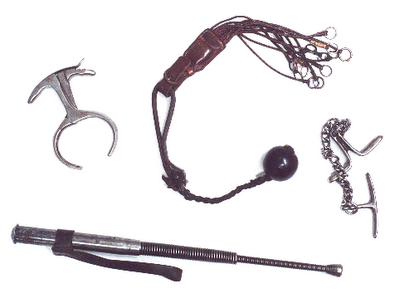
-- by Dave
... then maybe they shouldn't talk and act like them.
Maybe they shouldn't, in the name of the "war on terror," begin condoning torture as an acceptable tactic for American military or intelligence officials.
And maybe conservatives shouldn't show such enthusiasm for the idea, either.
- CALLER: It was like a college fraternity prank that stacked up naked men --
LIMBAUGH: Exactly. Exactly my point! This is no different than what happens at the Skull and Bones initiation and we're going to ruin people's lives over it and we're going to hamper our military effort, and then we are going to really hammer them because they had a good time. You know, these people are being fired at every day. I'm talking about people having a good time, these people, you ever heard of emotional release? You ever heard of need to blow some steam off?
...LIMBAUGH: You know, if you look at -- if you, really, if you look at these pictures, I mean, I don't know if it's just me, but it looks just like anything you'd see Madonna, or Britney Spears do on stage. Maybe I'm -- yeah. And get an NEA grant for something like this. I mean, this is something that you can see on stage at Lincoln Center from an NEA grant, maybe on Sex in the City -- the movie. I mean, I don't -- it's just me.
Rush Limbaugh, May 4, 2004
- Which brings me to this week's scandal about No Such Agency [NSA] spying on "Americans." I have difficulty ginning up much interest in this story inasmuch as I think the government should be spying on all Arabs, engaging in torture as a televised spectator sport, dropping daisy cutters wantonly throughout the Middle East and sending liberals to Guantanamo.
Ann Coulter, Dec. 21, 2005
- It turns out that the most unpleasant aspect of life at Guantanamo for the detainees came with the move out of the temporary "Camp X-Ray." Apparently, wanton homosexual sex among the inmates is more difficult in their newer, more commodious quarters. (Suspiciously, detainees retailing outlandish tales of abuse to the ACLU often include the claim that they were subjected to prolonged rectal exams.) Plus, I hear the views of the Caribbean aren't quite as good from their new suites.
Even the tales of "torture" being pawned off by the detainees on credulous American journalists are pretty lame.
The Washington Post reported that a detainee at Guantanamo says he was "threatened with sexual abuse." (Bonus "Not Torture" rule: If it is similar to the way interns were treated in the Clinton White House.)
Ann Coulter, June 23, 2005
- I don't mean to be too comedic in the political arena, but these so called abuse photos frankly are mild by comparisons to what goes on in South of Market clubs in San Francisco.
... And eventually you're gonna find that we need more of the humiliation tactics, not less. ...
I don't know what its gonna take for you to finally welcome what the troops are doing, what the interrogators were doing until you finally recognize the enemy, the true face of the enemy and what its gonna take to break this death grip that they seem to have on the minds of the Democrats. ...
These people don't fear death, they fear humiliation. The only way to humiliate them is take their deepest fear, the pig, the dog, the woman with the leash, and use it on them to break them!
... Instead of putting joysticks, I would have liked to have seen dynamite put in their orifices and they should be dropped from airplanes. How's that? You like that one? Go call somebody that you want to report me to, see if I care. They should put dynamite in their behinds and drop them from 35,000 feet, the whole pack of scum out of that jail.
Michael Savage, May 10-11, 2004
- GLENN BECK: Waterboarding, everybody was on board when this particular case happened. It was effective. I don't believe waterboarding is torture. Some do. That's okay. That's a debate. But now it's being played as if it was the evil United States torturing people when everyone was on board because we thought another attack was right around the corner.
REPRESENTATIVE POE: That's correct. The people are switching sides on this very issue and many people talk about waterboarding. They don't even know what it is but they --
BECK: Do you believe it's torture?
REPRESENTATIVE POE: I don't believe it's torture at all, I certainly don't. You know --
BECK: You know, I've wondered because it does [no] physical damage. It supposedly freaks the living daylight out of you but it does no damage to you physically.
Glenn Beck and Rep. Ted Poe, Dec. 12, 2007
[A brief editorial interruption: As Human Rights Watch points out, while waterboarding can be performed in ways that do not cause lasting physical damage, it often is not. and when it is not, not only causes extreme pain, damage to the lungs, brain damage caused by oxygen deprivation, and injuries (including broken bones) due to struggling against restraints, it can also cause death. Moreover, waterboarding victims -- like victims of all kinds of torture -- suffer psychological effects that endure for years, even decades.]
- "I believe every opponent of waterboarding would use the technique if it would save their children, their spouse, their mother and father from death. So why should other people die while politicians debate ethics? In my opinion, it is immoral to allow terrorists to kill people when you can stop them. ... Opponents of tough interrogations are lost in a fog of misguided indignation, crazy with hatred for Bush."
Bill O'Reilly, Dec. 11, 2007
- IFILL: I just would like to — but do you think that waterboarding, as I described it, constitutes torture?
SEN. KIT BOND: There are different ways of doing it. It’s like swimming: freestyle, backstroke. The waterboarding could be used almost to define some of the techniques that our trainees are put through, but that’s beside the point. It’s not being used.
Sen. Kit Bond, Dec. 11, 2007
- "Our rules for interrogation need to catch-up with this awful new form of war that is being fought against all of us and the free world. The post-World War II standards do not apply to this new war.
"We must redefine how our lawful society treats those who have nothing but contempt for the law and rely on terrorizing the innocent to accomplish their objectives. The lines must be redrawn and then we must pursue these criminals as quickly and as aggressively as the law permits."
The Rev. Lou Sheldon, Traditional Values Coalition
- Michael Mukasey: I don't think I'm saying it is simply a relative issue. There is a statute under which it is a relative issue. I think the Detainee Treatment Act engages the standard under the Constitution, which is a "shocks the conscience" standard, which is essentially a balancing test of the value of doing something as against the cost of doing it --
Sen. Joe Biden: When you say "against the cost of doing it," do you mean the cost that might occur in human life if you failed to do it, do you mean the cost in terms of our sensibilities in what we think is appropriate and inappropriate behavior as a civilized society --
Mukasey: I chose the wrong word. I meant the heinousness of doing it, the cruelty of doing it, balanced against the value.
Biden: Balanced against what value?
Mukasey: Of what information you might get.
[Via Digby; also, what she said. Meanwhile, Marty Lederman at Balkinization has more.]
- The point is that terrorism has consequences beyond life and property. It requires a tightening of liberty no one desires. The prevention of terrorism prevents the need, real or perceived, for further tightening. The Pelosi cop-out is that if you’re scared and angry, you get a free pass to do things you find morally objectionable. Well, terrorism makes people scared and angry; that’s sort of why they call it “terrorism.”
Jonah Goldberg, Dec. 14, 2007
- But there is no equivalent word for murder when it comes to torture. It’s always evil. Yet that’s not our universal reaction. In movies and on TV, good men force evil men to give up information via methods no nicer than what the CIA is allegedly employing. If torture is a categorical evil, shouldn’t we boo Jack Bauer on Fox’s 24? There’s a reason we keep hearing about the ticking time bomb scenario in the torture debate: Is abuse justified in getting a prisoner to reveal the location of a bomb that would kill many when detonated? We understand that in such a situation, Americans would expect to be protected. That’s why human-rights activists have tried to declare this scenario a red herring.
Sullivan complains that calling torture “aggressive interrogation techniques” doesn’t make torture any better. Fair enough. But calling aggressive interrogation techniques “torture” when they’re not doesn’t make such techniques any worse.
Jonah Goldberg, Sept. 27, 2006
- The issue here is context. Coercion of the sort we’re discussing is used by good guys and bad guys alike — in films and in real life. Just as with guns and fistfights, the morality of violence depends in large part on the motives behind it (that’s got to be one of the main reasons so many on the left oppose the war: They distrust Bush’s motives. Very few of Bush critics are true pacifists).
American audiences — another word for the American public — understand this. A recent poll by AP-Ipsos shows that some 61 percent of Americans believe torture can be justified in some cases. Interestingly, roughly half of the residents of that self-described “moral superpower” Canada agreed, as did a majority of French citizens and a huge majority of South Koreans.
Jonah Goldberg, Dec. 9, 2005
You see, if conservatives were serious about not wanting to be mistaken for fascists, they'd not only eschew such talk, they would denounce it.
There are many reasons to associate torture, and the public acceptance of its use, with fascism. When movement conservatives become defenders and advocates of the practice, people tend to just naturally think -- Fascist!
And for good reason:
- It's not that torture is unique to fascism. It has, after all, been around since the Dark Ages, and remained alive as a component of theocratic and feudal states for centuries. Certainly it has always been a commonplace feature of communist regimes as well, with the Soviets and Chinese providing abundant examples. What can be said generally is that torture is a feature of totalitarianism, regardless of its content.
But it occupies a unique position in the fascist ideological hierarchy, which is, after all, not so much a cohesive ideology but a multifaceted pathology. What makes fascism so potent on a personal level is its psychosexual component, expressed mostly as a desire to purge "unhealthy" elements through eliminationist violence, including the control of the body of the Other, and the ability to inflict purgative pain and suffering on that body. (For more on this, see Klaus Theweleit's study of this aspect of fascism, Male Fantasies, especially Vol. II.)
Fascists are particularly fond of torture because it represents such a complete expression of the fascist will to power. So when a nation adopts torture as an officially condoned policy -- as the United States has just done -- it immediately raises the specter that, indeed, it may be descending into the fascist abyss.
Of course, beyond its mere fascist qualities, there are many other good reasons for thinking, decent Americans to stand their ground on the use of torture.
For starters, there are serious practical reasons not to condone torture, the most obvious being that it encourages and induces similar treatment for American prisoners.
More significantly, torture is obviously immoral, and its open embrace by conservatives reflects more on the black hole that is their movement's soul than their actual desire to "keep the nation secure." The same can be said of the nation's media, who have stood silently by while these practices became imbedded in the system.
Movement conservatives have lost sight of what the norms of human decency are when they condone torture and the abrogation of both national and international law in the process. As the late Joan Fitzpatrick put it:
- The prohibition on torture is a peremptory norm of customary international law binding on all nations. The torturer is the enemy of all mankind.
The same, it could be said, is true of the fascist. Indeed, torture (like eliminationism) is one of the real harbingers of fascism. And it's the words and actions of conservatives themselves that make the connection between the two in people's minds.
[A note explaining this series.]
The KIRO clusterfuck
-- by Dave
Seattle's radio market is possibly the best example of why the demise of the Fairness Doctrine and the rise of mass corporate-owned media have combined to create real distortions in the information market.
Located within our market are not one but two stations devoted to nothing but right-wing talk -- KVI-AM and KTTH-AM, both with plenty of "local talent" (including KTTH's Michael Medved) in addition to the nationally syndicated bile from the likes of Limbaugh and Savage. Meanwhile, the only "liberal" talk station, KPTK-AM, is all canned stuff.
 One of the only local liberal talk shows of any note was David Goldstein's weekend gig at KIRO-AM, a station which otherwise mostly features the work of the very centrist Dave Ross and the unlistenable right-winger Dori Monson, notorious for being a WATB and a generally vindictive little prick.
The funny thing is, Seattle is a very liberal town. And hardly anyone I know who lives here actually listens to AM radio at all anymore, because the range of offerings has gotten so bad. So the right-wing talkers can justify their existence by pointing to the relatively good showing they make in the market, but no one acknowledges that in reality, talk radio in Seattle is a barren wasteland that most people avoid.
So what did KIRO do this week? Why, they fired Goldy, of course -- along with its only other liberal talkers, Carl Jeffers and Bryan Styble. Ostensibly, it's for "budgetary" reasons -- though everyone knows that's bullshit.
KIRO, you see, is owned by Bonneville International. BI also owns KTTH (which calls itself, incidentally, "the Truth" -- in Russian, that translates as "Pravda"). Its right-wing lineup went utterly untouched. How can they justify taking Seattle's only local liberal talkers off the air while leaving us with a lineup that includes the likes of David Boze (ugh!)?
Blatherwatch has all the details, including an internal report that makes clear this is can largely be laid at the feet of Monson, who's hated Goldy since nearly the day he was hired for having had the audacity to criticize him.
I'm hoping my readers outside of Seattle are outraged by this travesty too. If you are, please feel free to sign the online letter to KIRO telling management how you feel.
Seattle's radio market is possibly the best example of why the demise of the Fairness Doctrine and the rise of mass corporate-owned media have combined to create real distortions in the information market.
Located within our market are not one but two stations devoted to nothing but right-wing talk -- KVI-AM and KTTH-AM, both with plenty of "local talent" (including KTTH's Michael Medved) in addition to the nationally syndicated bile from the likes of Limbaugh and Savage. Meanwhile, the only "liberal" talk station, KPTK-AM, is all canned stuff.
 One of the only local liberal talk shows of any note was David Goldstein's weekend gig at KIRO-AM, a station which otherwise mostly features the work of the very centrist Dave Ross and the unlistenable right-winger Dori Monson, notorious for being a WATB and a generally vindictive little prick.
The funny thing is, Seattle is a very liberal town. And hardly anyone I know who lives here actually listens to AM radio at all anymore, because the range of offerings has gotten so bad. So the right-wing talkers can justify their existence by pointing to the relatively good showing they make in the market, but no one acknowledges that in reality, talk radio in Seattle is a barren wasteland that most people avoid.
So what did KIRO do this week? Why, they fired Goldy, of course -- along with its only other liberal talkers, Carl Jeffers and Bryan Styble. Ostensibly, it's for "budgetary" reasons -- though everyone knows that's bullshit.
KIRO, you see, is owned by Bonneville International. BI also owns KTTH (which calls itself, incidentally, "the Truth" -- in Russian, that translates as "Pravda"). Its right-wing lineup went utterly untouched. How can they justify taking Seattle's only local liberal talkers off the air while leaving us with a lineup that includes the likes of David Boze (ugh!)?
Blatherwatch has all the details, including an internal report that makes clear this is can largely be laid at the feet of Monson, who's hated Goldy since nearly the day he was hired for having had the audacity to criticize him.
I'm hoping my readers outside of Seattle are outraged by this travesty too. If you are, please feel free to sign the online letter to KIRO telling management how you feel.
The big fund-raiser boost
-- by Dave
Wow! We had a big jump of nearly $2000 overnight in the fund-raising drive, nearly doubling the total already.
I have a lot of folks to thank, including the many donors (who will be hearing from me personally). But I also have to say thanks!!!!! to the many fellow bloggers who gave the drive a shout-out at their sites.
The fabulous honor roll:
Matt Stoller at Open Left
d at Lawyers, Guns and Money
Digby
Susie Madrak
The General
Goldy
Wampum
Lean Left
Upper Left
The American Street
Doug's Dynamic Drivel
Many thanks to all. I'll continue updating as we go along. And if I missed your shout-out, drop me a line.
Wow! We had a big jump of nearly $2000 overnight in the fund-raising drive, nearly doubling the total already.
I have a lot of folks to thank, including the many donors (who will be hearing from me personally). But I also have to say thanks!!!!! to the many fellow bloggers who gave the drive a shout-out at their sites.
The fabulous honor roll:
Matt Stoller at Open Left
d at Lawyers, Guns and Money
Digby
Susie Madrak
The General
Goldy
Wampum
Lean Left
Upper Left
The American Street
Doug's Dynamic Drivel
Many thanks to all. I'll continue updating as we go along. And if I missed your shout-out, drop me a line.
Wednesday, January 30, 2008
Decemberists in January
We're off to see the Decemberists at the Moore Theatre tonight. I've been looking forward to this show since last fall, having purchased tickets for their originally scheduled December show at the Moore.
A bit of trivia: Mrs. Orcinus used to babysit Colin Meloy when he was a toddler living in Helena, Mont.
If conservatives really, really hate being called fascists ... #1
-- by Dave
... then maybe they should stop talking and behaving like them.
Maybe they should refrain from adorning their book covers with logos ...

... that have enjoyed circulation among various neo-Nazi "pop" figures for several years now.

[A note about this series.]
... then maybe they should stop talking and behaving like them.
Maybe they should refrain from adorning their book covers with logos ...

... that have enjoyed circulation among various neo-Nazi "pop" figures for several years now.

[A note about this series.]
Conservatives and fascism

-- by Dave
"Now for the evidence," said the King, "and then the sentence."
"No!" said the Queen, "first the sentence, and then the evidence!"
"Nonsense!" cried Alice, so loudly that everybody jumped, "the idea of having the sentence first!"
"Hold your tongue!" said the Queen.
"I won't!" said Alice, "you're nothing but a pack of cards! Who cares for you?"
Dealing with Jonah Goldberg over his book Liberal Fascism has been like talking with the Queen of Hearts from Alice: Sentence first, evidence later. The sentence being: "Nyah nyah nyah, you liberals are the real fascists!"
It's been abundantly clear, as I've noted, that what has animated this entire enterprise has been his desire to refute the old easy left-wing name-calling canard identifying conservatives with fascism. It's been a constant refrain in nearly every interview, and he also spells it out in text (p. 329):
Ever since I joined the public conversation as a conservative writer, I've been called a fascist and a Nazi by smug, liberal know-nothings, sublimely confident of the truth of their ill-informed prejudices. Responding to this slander is, as a point of personal privilege alone, a worthwhile endeavor.
I think Timothy Noah at Slate has it about right:
Liberal Fascism is a howl of rage disguised as intellectual history. Some mean liberals called Goldberg hurtful names, so he's responding with 400 pages that boil down to: I know you are, but what am I?
Indeed, it's clear that Goldberg, having settled upon not merely his thesis -- "nyah, nyah, nyah, etc." -- but simultaneously his title, then did his merry best to go about finding anything and everything that would support them. This includes, of course, eliding nearly every bit of the mountain of real-world evidence that, in truth, "fascism is a phenomenon of the right."
As things have gone along, its also included making the claim that he got his title from a speech by H.G. Wells that announced the phrase and concept of "liberal fascism" (which, as John Holbo explains in detail, was derided even then as an oxymoron, and gained no traction whatever). In his Bloggingheads interview with Will Wilkinson, Goldberg even received absolution of sorts for his obviously provocative title by virtue of the notion that "I didn't make it up, it came from Wells!"
He's made the same defense at NRO, where he wrote:
- I tried to explain, for those whose feelings were so hurt they didn’t even crack the spine, that the title Liberal Fascism comes from a speech delivered by H. G. Wells...
But strangely, this seems to directly contradict what he wrote in the book -- specifically, on p. 429, in note 19:
- I did not get the title of this book from Wells's speech, but I was delighted to discover the phrase has such a rich intellectual history.
Of course, Goldberg is being entirely disingenuous by saying that he didn’t invent the phrase. Because he’s perfectly aware that he’s trying to introduce a new, “controversial” concept. Right there on p. 21, near the end of the Introduction, he writes:
The introduction of a novel term like “liberal fascism” obviously requires an explanation.
So, is he “introducing a novel term” or is he just quoting H.G. Wells? Goldberg, like another Queen of Hearts, wants to have his cake and eat it too (a consistent MO throughout both his book and his subsequent defense of it).
Ah well. I'm sure that for pointing this out, we can just be summarily dismissed again as Marxist dupes. "Off with their heads!"
And of course, it's become manifestly clear that Goldberg's whining about how "no one on the left wants to take my book seriously" was just a fraud like his book. I'm not the only serious critic he's dismissed out of hand (Holbo and Spencer Ackerman have both earned a response that has never come, and his response to Yglesias was a joke). Meanwhile, the extent of Goldberg's linking to my posts has been just to make a generic link to my blog instead of to the individual posts. It's all been either neurotically petty or delusionally dismissive. (Meanwhile, he's been all too eager to embrace those fawning fan letters. Pwned!!)
However, there really is a serious undertext here, and at a certain level, I think Jonah's complaint raises an important point that deserves to be explored in greater length. To wit, as I tried to explain previously:
[L]et's also be clear: mainstream conservatives are not fascists. While both are clearly creatures of the right, they are quite distinct, and it's essential to our understanding of fascism that we make that distinction. Moreover, it's my belief that right-wing extremists pose at least as great an existential threat to mainstream conservatives as they do to liberals, even though the latter are in fact their natural enemies. Maintaining the line between the far right and the mainstream is an essential project for all of us -- especially conservatives.
That's an important project, whether conservatives wish to join us or not. Certainly, their longtime propensity for self-serving bullshit is not indicative of any such willingness, and Goldberg's book in fact indicates quite the opposite. Yet it remains not merely worth pursuing, but I think imperative, as explained later:
- I have in fact written at length about the crosscurrents between American proto-fascists and mainstream movement conservatives, and have done so by insisting rigorously on people making the distinction between them. But at the same time, it's important to understand that the rise in ideological traffic between the far right and the mainstream actually means that the constellation of traits that constitute the fascist pathology gain traction, and the demon itself starts to take shape.
This is why so many people outside the conservative movement look at its True Believers and see budding little fascists. If Jonah Goldberg is concerned about people mistaking conservatives for fascists, he'd do far more good calling on conservatives to stand back and take a look at where they're heading ideologically.
If conservatives like Jonah don't want to be mistaken for fascists, they won't embrace the racial politics of people like Buchanan or Brimelow or Malkin. They won't let a far-right extremist like Ron Paul, whose campaign is riddled with white supremacists, even into the Republican Party, let alone play a significant role in the GOP presidential campaign, and they won't embrace vigilante organizations like the Minutemen. Maybe they won't write books that manage to trivialize an utterly monstrous and destructive right-wing ideology, pretending that entities like the Klan really aren't right-wing in the process. But conservatives like Jonah have done all these things.
Most of all, perhaps, they could eschew the eliminationist rhetoric that has not only deeply infected the conservative discourse but has poisoned the larger public discourse as well. After all, as Robert Paxton observes:- The legitimation of violence against a demonized internal enemy brings us close to the heart of fascism.
So in the spirit of trying encourage conservatives to think about why other people -- and not merely liberals -- are increasingly mistaking them for fascists, we're going to run a helpful series this week and perhaps longer.
We'll call it "If conservatives really, really hate being called fascists ...". Each post will explore reasons why folks in the general public -- whose understanding of fascism, while loose and corrupted, is closer to the reality than Goldberg's Bizarro book -- are increasingly mistaking movement conservatives for fascists these days.
They'll be presented, of course, in the hope that these things will change. But -- given conservatives' now-intense state of denial about their political aislemates the fascists and other right-wing nutcases -- not exactly hopeful that they will.
No. 1 will be up shortly. Hope you enjoy.
Ron Paul and that money
-- by Dave
We've all noticed Ron Paul's fundraising prowess, but has anyone noticed that in spite of this, there haven't been any indications that he's actually spending it?
DrSteveB at DailyKos has, and so he has some questions:
Actually, my guess is that Paul has conceded the GOP nomination and is laying the groundwork for a third-party run. That's where this warchest will be directed.
You can say you read it here first.
We've all noticed Ron Paul's fundraising prowess, but has anyone noticed that in spite of this, there haven't been any indications that he's actually spending it?
DrSteveB at DailyKos has, and so he has some questions:
- There has been no serious public campaign expenditures such as major TV ad buys to match the level of his fund raising. He is not actually getting serious levels of votes beyond what he would be getting anyway. I would suggest the appropriate comparison would be to the low-funded, free publicity, paleoconservative movement outside of the officially approved of Republican mainstream, would be to Pat Buchanan (like Buchanan, Lew Rockwell himself is from a post-Father Coughlin hard right wing Catholic politicial culture background).
Paul has minimal paid staff, and regardless of his enthusiasts, no real statwide comprehensive, yet down to the precinct level, campaign organization. In other words, no real campaign.
Now, one answer has been that he is going to run as an indepdent. Maybe. But still: Where is the money really actually going? What remains after election day November 4, 2008?
Actually, my guess is that Paul has conceded the GOP nomination and is laying the groundwork for a third-party run. That's where this warchest will be directed.
You can say you read it here first.
The Orcinus fundraiser
-- by Dave
Fund-raisers can be something of a mixed bag -- simultaneously inspiring and deflating, especially when you're like me and really don't care for certain things required of people who use them as the revenue sources for their blogs. Things like rattling your tin cup and bugging your friends and acquaintances.
But the donations themselves are always an inspiration. It's pretty amazing, really, that people send money to total strangers whose work they read and, evidently, like, and can get for free if they like. And no matter how many times I do this, I can't quite get over being amazed by people's generosity.
Thing is, I've never quite taken it as seriously as I need to. The first few times it happened, there were actual events around it (notably publishing my essays in PDF form) that were the inspiration, and I just kind of hung my cup out and was pleasantly surprised by how much people were willing to toss back in.
So this year I hung the cup out there again, but the best angle to hang it on was the fact that I've been at this for five years now -- not exactly a barn-burner. And I also decided not to bug my friends and colleagues in the blogosphere to send their readers my way.
I suppose it was predictable, then, that the results so far have been fairly tepid -- especially since I got caught up enough in my responses to Jonah Goldberg that I let the fund-raiser reminder just slide for awhile. To date, we've pulled in $2,638.39 -- a healthy amount, really, but definitely off previous years.
The donations themselves, at the same time, have been a real source of inspiration. Some people really stepped up to the plate, including one of my favorite congressional candidates.
And the one shout-out we got -- from Jesse Wendel at Group News Blog -- was so flattering and kind that we were blown away.
Unfortunately, however, the raw numbers of total donors is sharply down this year, along with the total so far. All of which is part of my ongoing assessment of whether to continue with the fund-raiser model for revenue generation at Orcinus.
But then, just as I was thinking the whole thing was going bust, I was inspired by an unlikely source: our counterparts at the World's Most Asinine Blog, Red State, who decided that the best way to get their readers to dip into their wallets is to scare them with liberal bogeymen, including those eeeeeevil software devs. Oh, and anyone donating tiny amounts through PayPal? Ve haf your numbers now, commie scum! (Dr. Biobrain has more.)
And the drive -- which started at about the same time as mine -- was such a stunning success that, when I last saw a graphic displaying the total (this was on Jan. 15), it sat somewhere south of $700. Meanwhile, over here -- with our puny little staff of two people, contrasted with the WMAB's cast o'thousands -- we were at that point already near the $2,000 mark.
This in fact told me something: That we're doing a lot of things right here at Orcinus, and people appreciate it. But fund-raising isn't one of them. We were able to easily outpace RedState without seriously trying -- which raises the question, why aren't you seriously trying?
Now, the last we heard from RedState (on Jan. 11) on this, Erick indicated that they were just a little shy of hitting $10,000 -- though in fact, on the 14th, their graphic showed quite a bit less than that amount. And since then? Nary a word for those RedState donors on just how well that drive went.
Mind you, I would have no reason whatsoever for getting some satisfaction out of this. Indeed -- there will be no petty references to revenge, cold dishes, whatever, in these parts. Nosiree. Uh-uh.
Though for awhile, I toyed with the idea of making a head-to-head competition out of our respective fund-raisers. ("Go killer whales! Eat Red State!") Woulda been kind of fun, dontcha think?
In the end, I decided not to, because it's really just another gimmick that isn't much about what this blog is all about. Much as I might like to sit all day and make fun of idiotic right-wing sites -- a truly target-rich environment -- it's not the best use of my resources.
As I've explained, I have my reasons for sticking with the fund-raising model for a revenue stream from Orcinus, including an antipathy to advertising, both professional and aesthetic, and an insistence on maintaining the journalistic integrity of the site. It does, however, require that I do things I really don't have much stomach for, including hitting my colleagues up for links and donations. And it also requires I keep readers updated, and send thanks to my many donors.
So if I'm going to give this revenue model a decent chance, I need to engage it properly. Thus, I've decided to extend the fund-raiser for one more week -- and this time, my friends and colleagues will be getting asked to help out.
However, there are still some things I won't do:
In the meantime, if you've already donated, many thanks -- you'll be hearing from me personally -- and consider spreading the word.
If you haven't, please think about the value that Orcinus provides the blogosphere and the public discourse generally, and then decide if that's something you want to see continue, and are willing to help out to that end.
No gimmicks, just a straight appeal for support for what we do here.
I hope you all find that enough.
[As before, either click on the PayPal button above left, or send donations by snail mail to:
David Neiwert
P.O. Box 17872
Seattle, WA 98127-7872 ]
Fund-raisers can be something of a mixed bag -- simultaneously inspiring and deflating, especially when you're like me and really don't care for certain things required of people who use them as the revenue sources for their blogs. Things like rattling your tin cup and bugging your friends and acquaintances.
But the donations themselves are always an inspiration. It's pretty amazing, really, that people send money to total strangers whose work they read and, evidently, like, and can get for free if they like. And no matter how many times I do this, I can't quite get over being amazed by people's generosity.
Thing is, I've never quite taken it as seriously as I need to. The first few times it happened, there were actual events around it (notably publishing my essays in PDF form) that were the inspiration, and I just kind of hung my cup out and was pleasantly surprised by how much people were willing to toss back in.
So this year I hung the cup out there again, but the best angle to hang it on was the fact that I've been at this for five years now -- not exactly a barn-burner. And I also decided not to bug my friends and colleagues in the blogosphere to send their readers my way.
I suppose it was predictable, then, that the results so far have been fairly tepid -- especially since I got caught up enough in my responses to Jonah Goldberg that I let the fund-raiser reminder just slide for awhile. To date, we've pulled in $2,638.39 -- a healthy amount, really, but definitely off previous years.
The donations themselves, at the same time, have been a real source of inspiration. Some people really stepped up to the plate, including one of my favorite congressional candidates.
And the one shout-out we got -- from Jesse Wendel at Group News Blog -- was so flattering and kind that we were blown away.
Unfortunately, however, the raw numbers of total donors is sharply down this year, along with the total so far. All of which is part of my ongoing assessment of whether to continue with the fund-raiser model for revenue generation at Orcinus.
But then, just as I was thinking the whole thing was going bust, I was inspired by an unlikely source: our counterparts at the World's Most Asinine Blog, Red State, who decided that the best way to get their readers to dip into their wallets is to scare them with liberal bogeymen, including those eeeeeevil software devs. Oh, and anyone donating tiny amounts through PayPal? Ve haf your numbers now, commie scum! (Dr. Biobrain has more.)
And the drive -- which started at about the same time as mine -- was such a stunning success that, when I last saw a graphic displaying the total (this was on Jan. 15), it sat somewhere south of $700. Meanwhile, over here -- with our puny little staff of two people, contrasted with the WMAB's cast o'thousands -- we were at that point already near the $2,000 mark.
This in fact told me something: That we're doing a lot of things right here at Orcinus, and people appreciate it. But fund-raising isn't one of them. We were able to easily outpace RedState without seriously trying -- which raises the question, why aren't you seriously trying?
Now, the last we heard from RedState (on Jan. 11) on this, Erick indicated that they were just a little shy of hitting $10,000 -- though in fact, on the 14th, their graphic showed quite a bit less than that amount. And since then? Nary a word for those RedState donors on just how well that drive went.

Mind you, I would have no reason whatsoever for getting some satisfaction out of this. Indeed -- there will be no petty references to revenge, cold dishes, whatever, in these parts. Nosiree. Uh-uh.
Though for awhile, I toyed with the idea of making a head-to-head competition out of our respective fund-raisers. ("Go killer whales! Eat Red State!") Woulda been kind of fun, dontcha think?
In the end, I decided not to, because it's really just another gimmick that isn't much about what this blog is all about. Much as I might like to sit all day and make fun of idiotic right-wing sites -- a truly target-rich environment -- it's not the best use of my resources.
As I've explained, I have my reasons for sticking with the fund-raising model for a revenue stream from Orcinus, including an antipathy to advertising, both professional and aesthetic, and an insistence on maintaining the journalistic integrity of the site. It does, however, require that I do things I really don't have much stomach for, including hitting my colleagues up for links and donations. And it also requires I keep readers updated, and send thanks to my many donors.
So if I'm going to give this revenue model a decent chance, I need to engage it properly. Thus, I've decided to extend the fund-raiser for one more week -- and this time, my friends and colleagues will be getting asked to help out.
However, there are still some things I won't do:
- -- I won't threaten anyone who donates.
-- I won't tell my readers that only I, the great Killer Whale, stand between them and certain right-wing doooooom!
-- And I won't blame the devs at Blogger if it doesn't work out so hot.
In the meantime, if you've already donated, many thanks -- you'll be hearing from me personally -- and consider spreading the word.
If you haven't, please think about the value that Orcinus provides the blogosphere and the public discourse generally, and then decide if that's something you want to see continue, and are willing to help out to that end.
No gimmicks, just a straight appeal for support for what we do here.
I hope you all find that enough.
[As before, either click on the PayPal button above left, or send donations by snail mail to:
David Neiwert
P.O. Box 17872
Seattle, WA 98127-7872 ]
Tuesday, January 29, 2008
Orcas and salmon

-- by Dave
It's becoming more than apparent in recent years that the Puget Sound orca population has been barely scraping by on their winter food resources, which as I reported awhile back used to consist mostly of Columbia River chinook congregating along the continental shelf. Now that those fish runs are a mere wisp of their former selves (less than 2 percent of their historic levels), the killer whales that always fed on them are having to look elsewhere.
This winter, they've once again (as they did last winter) traveled to northern California in search of chinook, as Robert McClure at the P-I reports:
- In what a leading orca researcher calls an ominous sign, a group of the killer whales that frequent Puget Sound and nearby waters has turned up feeding off the coast of California for the sixth winter in a row.
L pod, one of three orca families that frequent Washington waters, was spotted Sunday off Monterey Bay.
The fact that the orcas are apparently ranging farther than they once did suggests that Washington's winter stocks of chinook, the orcas' main food, have dropped too low to support them, said Ken Balcomb, a San Juan Island scientist who has studied the orcas since mid-1970s.
Now, if the orcas want to eat, "they've got to go somewhere else," said Balcomb, founder of the Center for Whale Research.
Solving the problem might require a moratorium on salmon fishing for several years, Balcomb wrote in a statement released Monday by the research center.
"The path society is on, according to fisheries experts, is that chinook stocks will be driven to extinction before the end of this century," Balcomb wrote. "We consider that ... worse news for fishermen than a few years of closure to allow stocks the best opportunity to recover."
Problem is, those northern California stocks are in nearly as bad of shape:
- The number of chinook salmon returning to California's Central Valley has reached a near-record low, pointing to an "unprecedented collapse" that could lead to severe restrictions on West Coast salmon fishing this year, according to federal fishery regulators.
The sharp drop in chinook, or "king," salmon returning from the Pacific Ocean to spawn in the Sacramento River and its tributaries last fall is part of broader decline in wild salmon runs in rivers across the West.
The population dropped more than 88 percent from its all-time high five years ago, according to an internal memo sent to members of the Pacific Fishery Management Council and obtained by The Associated Press.
Regulators are still trying to understand the reasons for the shrinking number of spawners; some scientists believe it could be related to changes in the ocean linked to global warming.
Some fishermen and environmentalists believe the sharp decline is related to increased water exports from the San Joaquin-Sacramento River Delta, which supplies drinking water to millions of people in dry Southern California, as well as irrigation for America's most fertile farming region.
"It's time to reduce pumping of delta waters before we destroy the fish and wildlife species we appreciate so much in California," said Mike Sherwood, an attorney for Earthjustice.
Remember that these waters were also the scene of the West's largest fish kill ever when Klamath Valley irrigators, pumped up by Patriot types, managed to turn off the water downstream during critical periods. That was brought to us courtesy of Dick Cheney himself.
I agree with Balcomb that a moratorium is necessary for restoring Puget Sound stocks. But as I noted in my report for Seattle Weekly, they're going to have to do something about the Columbia chinook stocks too. And that means looking, once again, at tearing down those dams on the Snake, much beloved of Dick Cheney and inland Republicans.
Monday, January 28, 2008
Jonah's mutual-admiration society
-- by Dave
It seems that Jonah Goldberg -- who, as we have seen, already has a predilection for dubious sources in his book Liberal Fascism -- has quite a fan in the form of an Australian professor named John J. Ray, who fancies himself something of an Orcinus-killer. Today, Jonah put up a post extolling Ray's work:
I'll let readers judge for themselves the value of Ray's critique; I'll have nothing more to say about it other than to point out that, once again, Ray (just like Goldberg) resolutely refuses to tackle the review's central thesis.
Ray, as I've mentioned previously, is not exactly the sharpest tool in the shed to begin with. But read on into his "dissection" of yours truly and you'll find this:
That sure is one insightful thinker you're citing there, Jonah!
Actually, a little background on Mr. Ray might be helpful at this point. Ray for awhile was among the writers empaneled at the white-nationalist website MajorityRights (no link, but if you Google it you can check it out), where "Miscegenation" is one of the main topics of discussion. He reportedly resigned in 2006 because the site became overtly anti-Semitic.
Ray is considered part of the Australian wing of what is politely called "academic racism." In addition to his own work, his website also hosts the work of "scientific racist" Chris Brand.
Here's what the Institute for the Study of Academic Racism has to say about Dr. Ray:
Note that Goldberg also spends several pages frantically attacking "the Frankfurt School" and its "Marxist" professors, and similarly castigates The Authoritarian Personality. He's obviously been feeding from the same trough.
More to the point, Ray and Goldberg are busy indulging the same sort of enterprise: furiously finding "fascists" on the left as a way of diverting people's attention from the fact of the longtime existence of very real fascists operating within the realm of the political right. I'd guess their motives are different, but both the ploy and the outcome are the same.
UPDATE: Colugo in the comments notes that Ray claims he joined those Nazi organizations for the purpose of "investigating" them.
It seems that Jonah Goldberg -- who, as we have seen, already has a predilection for dubious sources in his book Liberal Fascism -- has quite a fan in the form of an Australian professor named John J. Ray, who fancies himself something of an Orcinus-killer. Today, Jonah put up a post extolling Ray's work:
- Anyway, on the web one of the sites that's been finding fascism on the left for a very long time is Australia's John Ray. I was sent his garroting of Neiwert at his blog Dissecting the Left this morning and it reminded me that I should have alerted readers interested in this stuff about his work a while ago. You'll find much of this argument familiar, for example. Anyway, I'm delighted to form the Northern Hemisphere's side of the antipodean anti-fascism tag-team. (I'm sure someone will tell me if I'm using antipodean wrong.)
I'll let readers judge for themselves the value of Ray's critique; I'll have nothing more to say about it other than to point out that, once again, Ray (just like Goldberg) resolutely refuses to tackle the review's central thesis.
Ray, as I've mentioned previously, is not exactly the sharpest tool in the shed to begin with. But read on into his "dissection" of yours truly and you'll find this:
- In fact, with his constant inspirational calls for national unity, Obama is eerily reminiscent of the Fascists. If he spoke German he might well be inclined to adopt as his slogan Ein Volk, ein Reich, ein Fuehrer -- as Hitler did ("One nation, one government, one leader"). After all, right to the end most Germans saw Hitler as a warm and kindly father-figure. And if the ruthless power-seeker that is Hillary reminds you of Joe Stalin, don't blame me!
That sure is one insightful thinker you're citing there, Jonah!
Actually, a little background on Mr. Ray might be helpful at this point. Ray for awhile was among the writers empaneled at the white-nationalist website MajorityRights (no link, but if you Google it you can check it out), where "Miscegenation" is one of the main topics of discussion. He reportedly resigned in 2006 because the site became overtly anti-Semitic.
Ray is considered part of the Australian wing of what is politely called "academic racism." In addition to his own work, his website also hosts the work of "scientific racist" Chris Brand.
Here's what the Institute for the Study of Academic Racism has to say about Dr. Ray:
- Ray himself holds some forthright views on racism. His book Conservatism as heresy includes chapters with such appetising titles as 'Rhodesia: in defence of Mr Smith' and 'In defence of the White Australia policy'. Ray also argues that it is "moralistic nonsense" to denounce racism.
Well might Ray defend racism. He does not mince his words when he writes about Australian Aborigines. Ray says that "aborigines are characterised by behaviour that in a white we would find despicable . . . White backlash is then reasonable. Unless we expect whites to forget overnight the cultural values that they have learned and practised all their lives, they will find the proximity of aboriginals unpleasant" (p.58).
Ray has conducted a number of academic surveys in order to bolster his prejudices. For instance Ray assumes that it is natural that whites should develop an antipathy towards Aborigines:- "If, for instance, people suddenly find themselves living in close contact with Aborigines and Aborigines happen to be in fact rather unhygienic in their habits, some people previously without prejudice will start to say that they don't like Aborigines." (p.261.)
Therefore Ray designed a survey to measure white Australians' attitudes towards Aborigines, comparing those who lived near Aborigines with those who lived further away.
The results of his survey failed to confirm his prediction; Ray did not find that whites living near Aborigines were in fact more prejudiced. Ray described his results as "disappointing" (p.267). Instead of discarding his hypothesis, Ray still strove to maintain his own prejudices; he searched around for reasons why his questionnaire might not have obtained the correct results. Thus, even in the face of negative results, Ray clings to what he calls his 'rational prejudice model'.
Ray's prejudices do not just relate to Aborigines. Dr. Ray enjoins us to "face the fact that large numbers of even educated Australians do not like Jews or 'Wogs'." (p.70.) Ray writes approvingly of people who will- "among friends, exchange mocking misnomers for suburbs in which Jews have settled: Bellevue Hill becomes 'Bellejew Hill' and Rose Bay becomes 'Nose Bay'; Dover Heights becomes 'Jehova Heights'." (p.71.)
Ray obviously has sympathy with the racists and anti-Semites. Many of the people who make the comments Ray cites, are according to our Australian psychologist "superbly functioning and well-adjusted Australians". In Ray's opinion such people will "justly deny being racists" (p.70): n.b. the give-away word 'justly'.
The main reason why Ray does not find such attitudes racist is that he considers them perfectly logical. Thus he asserts that people "who don't like sloth . . . may object to Aborigines. People who do not like grasping materialism, will certainly find no fault with Aborigines but they may find fault with Jews" (p.265).
It seems that Dr Ray, in an academic paper about psychology, is repeating the racist and anti-Semitic assumptions that Aborigines are lazy and Jews are 'grasping materialists'. It is hard to find any other explanation for Ray's continual defence of prejudice.
In his academic papers Ray has a tendency to use some curious turns of phrase. Thus when he criticises, as he often does, the classic work in the psychology of fascism, The Authoritarian Personality by Adorno, Frenkel-Brunswick, Levinson and Sanford, he refers to "the work of these Jewish authors" (see, for instance, the start of Ray's article in the distinguished social science journal Human Relations).(82) This is not the standard way of describing opponents' research, at least not since the days of Nazi Germany.
But there again Ray is not exactly ignorant of the ways of Nazism. During the 1960s Ray was a member of various Australian Nazi parties. In fact Ray has openly described his seven-year association with Nazism (see, for instance, his article 'What are Australian Nazis really like?' in The Bridge, August 1972).
Note that Goldberg also spends several pages frantically attacking "the Frankfurt School" and its "Marxist" professors, and similarly castigates The Authoritarian Personality. He's obviously been feeding from the same trough.
More to the point, Ray and Goldberg are busy indulging the same sort of enterprise: furiously finding "fascists" on the left as a way of diverting people's attention from the fact of the longtime existence of very real fascists operating within the realm of the political right. I'd guess their motives are different, but both the ploy and the outcome are the same.
UPDATE: Colugo in the comments notes that Ray claims he joined those Nazi organizations for the purpose of "investigating" them.
Sunday, January 27, 2008
'Liberal Fascism': The response
-- by Dave
I've appreciated everyone's patience while I've dealt with Jonah Goldberg's fraudulent bestseller, Liberal Fascism. The last few posts have been awfully long and have entailed some heavy wading, but I wanted to make the record as complete as possible so that people who have to deal with this archetypal piece of bogosity in real life can have some of the resources necessary.
Tomorrow I'll begin a new series that will deal with Goldberg's pap hackery (and that of the rest of the "liberals are the real fascists" contingent of the right) in a different and, I hope, amusing way. It's way of taking the conversation to a more useful level.
So, to wrap up the primary, factual-response phase of this discussion, here are links to all the posts I've done on Liberal Fascism to date. The idea here is to put them all in one place for resource purposes (and I'll put a link to this post in my left sidebar).
Pre-publication:
The ultimate Newspeak
Conservative fascism
'Liberal Fascism': A preview
The Pantload weighs in
Post-publication
*Jonah Goldberg's Bizarro History [TAP Online review]
Liberal Fascism leftovers #1
Shallow and cliche-ridden
That definition of fascism
Jonah's response
A serious person
The buck stops here
*The methodology of Liberal Fascism
An appendix on fascism
The Jonah note of the day
Jonah and the Klan
*Calling out Jonah Goldberg [Firedoglake post]
Liberal Fascism leftovers #2
Liberal Fascism: A correction, please
Jonah responds
*Responding to Jonah
About Jonah's sources
Wilson and fascism
*Asterisks indicate the major posts in the sequence.
I've appreciated everyone's patience while I've dealt with Jonah Goldberg's fraudulent bestseller, Liberal Fascism. The last few posts have been awfully long and have entailed some heavy wading, but I wanted to make the record as complete as possible so that people who have to deal with this archetypal piece of bogosity in real life can have some of the resources necessary.
Tomorrow I'll begin a new series that will deal with Goldberg's pap hackery (and that of the rest of the "liberals are the real fascists" contingent of the right) in a different and, I hope, amusing way. It's way of taking the conversation to a more useful level.
So, to wrap up the primary, factual-response phase of this discussion, here are links to all the posts I've done on Liberal Fascism to date. The idea here is to put them all in one place for resource purposes (and I'll put a link to this post in my left sidebar).
Pre-publication:
The ultimate Newspeak
Conservative fascism
'Liberal Fascism': A preview
The Pantload weighs in
Post-publication
*Jonah Goldberg's Bizarro History [TAP Online review]
Liberal Fascism leftovers #1
Shallow and cliche-ridden
That definition of fascism
Jonah's response
A serious person
The buck stops here
*The methodology of Liberal Fascism
An appendix on fascism
The Jonah note of the day
Jonah and the Klan
*Calling out Jonah Goldberg [Firedoglake post]
Liberal Fascism leftovers #2
Liberal Fascism: A correction, please
Jonah responds
*Responding to Jonah
About Jonah's sources
Wilson and fascism
*Asterisks indicate the major posts in the sequence.
Saturday, January 26, 2008
Wilson and fascism

-- by Dave
One of the more interesting chapters in Jonah Goldberg's Liberal Fascism is the one devoted to consigning Woodrow Wilson to the pigpen of fascism. I've never been much of an admirer of Wilson, mainly due to his suppression of wartime dissent and general civil liberties afterward, embodied by the Palmer Raids.
Indeed, Wilson's rhetoric -- warning of "hyphenated Americans who have poured the poison of disloyalty into the very arteries of our national life" -- sounds very much like a modern day right-wing complaint. Indeed, Goldberg complains about multiculturalism along similar lines.
His main claims against Wilson involve the civil-liberties issues and various aspects of his authoritarian personality and its manifestation in policy. However, there is nothing particularly fascist about these aspects of Wilson's presidency. In calling it "fascist," Goldberg clearly is relying on his manifestly inadequate definition of fascism, which in fact only describes authoritarianism generally.
So I asked one of our regular readers and commenters, a history professor who specializes in Wilson and thus goes by the moniker "Woodrowfan," to offer his two cents' worth. Rather than assess whether Wilson was fascist by following Goldberg's plainly self-serving definition, he's examined the matter by using the criteria for fascism offered by more serious (ahem) and broadly respected scholars, both acknowledged experts in the field.
Here he is:
- Hello. Well, Dave and Sara suggested that I chime in on this issue of Jonah's revisionist version of fascism. Frankly I find "Liberal Fascism" (sic) to be so silly that I suspect that the major historical journals will ignore it, but for the sake of accuracy I'll add a few words.
First off, who the heck am I to be chiming in? I'm a professional historian with a doctorate from a good Midwestern university. I teach college and work with museums. My specialty is late 19th- and early 20th-century American politics and foreign policy and my book on Wilson is being published by a good university press later this year. While it won’t have a snappy cover like "Liberal Fascism" (sic) it will have the advantage of being edited and fact-checked by actual experts in the field. I've also given papers at professional conferences and written articles on Wilson and his period so I have some expertise as to the 28th American President. I prefer to keep my anonymity simply because I like to keep my political opinions separate from my job. I don't discuss politics at work and I don't let my students know which party I support. And Dave and Sara know my real identity as we've talked on and off for awhile.
Oh, and before I go further, why the nick, "Woodrowfan?" I needed a name to use on the liberal blogs I read and I saw others using variations on JFK, Clinton, FDR, Jefferson, Truman, etc. Since I study Wilson's era and Wilson himself, I used his name. OK, on with "Liberal Fascism." (sic)
First, let's address the elephant in the living room with Wilson. Was he a racist? Of course he was. Born in Virginia before the Civil War, he grew up in Georgia and South Carolina during and after the war. His father was a Confederate sympathizer and Wilson grew up in the South of the mid-19th century. As far as we can tell his parents never owned slaves but they had black servants either free blacks or slaves provided by Wilson's father's congregation. Wilson had the racial attitudes you'd expect from someone in his time and place. African-Americans were considered socially, politically and intellectually inferior. They were denied the right to vote, lynchings were common, discrimination wide-spread and institutionalized. Wilson saw this as normal. He told "darkie" and "coon" jokes which would curl the hair on a modern listener and as President he allowed his cabinet members to segregate most of the federal worker and institute Jim Crow in the federal workplace. A handful of agencies, such as the new Department of Labor, did not segregate but they made up only a tiny proportion of the federal government in 1913. Wilson condemned lynching, but in a way that could, at best, be described as lukewarm.
Does this make him a fascist? If it does, then a large majority of Americans in 1912 were fascist. Only a small group of Americans objected to Jim Crow in anything more than a pro-forma way. When a conservative Republican administration came into office in 1921 they didn't reverse Wilson-era segregation, they maintained it. Read the letters and press of the time and if you're not used to it the casual use of "n****r" and other such terms it can be jolting. Jim Crow was an awful system but it had at least the tacit backing of most Americans on every part of the political spectrum.
I've heard Wilson referred to on blogs as the most racist American President ever. I suspect the slave-owning Presidents have him beat on that score, and even as modern a President as Nixon seemed bigoted against more peoples than Wilson, judging from the Nixon tapes. Wilson at least though that blacks would eventually reach a level of "civilization" equal to whites in the future (i.e., a century or two). That's more than can be said about Teddy Roosevelt. Yeah, Teddy had Booker T. Washington for dinner. Once. Wilson invited Washington to his inauguration as President of Princeton. Both men were willing to meet with a few select African-Americans, if they were educated and polite. Neither man was a poster-child for the NAACP and by today's standards both were not only racist but very racist. That doesn’t make them fascist. To put it crudely, all fascists are racist, not all racists are fascist.
Jonah claims that Wilson was a liberal fascist (sic). Let's look at the traits common to fascist movements from Stanley Payne, in Fascism: Comparison and Definition (1980): and see how Wilson fits.- A. The Fascist Negations:
-- Antiliberalism
-- Anticommunism
-- Anticonservatism (though with the understanding that fascist groups were willing to undertake temporary alliances with groups from any other sector, most commonly with the right)
Anti-liberalism? As Thomas Knock argues in "Against All Wars" Wilson took much of his inspiration from liberals and socialists in American politics. They were perhaps his most important allies politically. Wilson is regarded by most historians as the prototypical liberal Democrat of the Progressive Era. His administration passed child labor laws, currency reforms, an eight-hour day law, laws governing working conditions for sailors, etc. Yeah, he was slow to endorse women's suffrage, but he came around in 1918 and pressed Congress to pass the 19th amendment. He vetoed anti-immigration laws an being discriminatory. He was, to put it bluntly, the most liberal and the biggest reformer in the White House between Lincoln and FDR.
Anti-Communism: Yes, of course he was. Most American liberals and conservatives were. However, he opposed intervening in the Russian Revolution and regretted letting Britain and France pressure him into it. He felt that Russia should work out their destiny on their own.
Anti-Conservatism: “A conservative is a man who just sits and thinks, mostly sits.” Woodrow Wilson.
Every fascist movement I've ever studied hated liberals and hated communists. Wilson was a liberal and disliked communism but didn't see it as that much of a threat. (Although he allowed Attorney General Palmer to overreact in 1919-1920.) Fascists seem to hate conservatives because they don't go far enough, they're not reactionary enough. That does not fit Wilson. He thought conservatives were already too reactionary.
Score 1/2 of 3.- B. Ideology and Goals:
-- Creation of a new nationalist authoritarian state based not merely on traditional principles or models
-- Organization of some new kind of regulated, multiclass, integrated national economic structure, whether called national corporatist, national socialist, or national syndicalist
-- The goal of empire or a radical change in the nation’s relationship with other powers
-- Specific espousal of an idealist, voluntarist creed, normally involving the attempt to realize a new form of modern, self-determined, secular culture
These are rather broad but I'll take a shot at it.
1. Creating a nationalist authoritarian state? No. Read through Wilson's writings and his speeches as a historian/political scientist and as a politician. He wanted to encourage debate to reach consensus. During World War One Wilson allowed, and even encouraged, suppression of dissent. It's easily the largest blot on his record after race. It was also a huge political mistake as well as being morally wrong as it silenced some of the very allies he needed during the League ratification debate. Americans today don't realize, however, how little understanding their was at the time for freedom of dissent during wartime. Republicans like Roosevelt wanted to hang dissidents, a position even Wilson never took. Wilson feared entering the war because he knew how the public would react, and he was right. It wasn't just a blot on Wilson's record, it was a blot on the history of the entire country because stifling dissent was so popular. Was it fascist? At its worst, yes. Was it meant to be a permanent policy? No.
2. A national corporatist structure? (I am using this term as a shorthand for all the variations.) Hell no. Wilson's "New Freedom" policy was intended to restore competition between businesses, not to integrate monopolies into the economy. Jonah seems to think all regulation of business is fascism without regard to its purpose or effects. Every fascist system I've studied as been very pro-big business and very anti-union. Big business hated Wilson and supported the Republican Charles Evans Hughes in 1916 in hopes of getting him out of office. Read through Wilson's mail and through the press of the time if you think big business liked Wilson.
Wilson was also pro-Union and remained allied with the AFL throughout his career. Yeah, the Wobblies hated Wilson, and he them. But the hatred of a radical union didn't reflect the opinion of all unions, especially after Wilson sided with the railroad union to win the 8-hour workday.
3. An empire? Three words: League of Nations. The first major international organization to include the small states and to give them a voice is about as unfascist as you can get. Some historians on the left disagree but he also acted to protect the right of small countries to run their own affairs, including Mexico. Yes, he invaded Veracruz, Some on the left cry "oil", never explaining why if Wilson invaded for oil he invaded Veracruz (which had none) and pulled the U.S. fleet away from Tampico, which was the heart of the Mexican oil industry. Again, read through the original documents (something that seems to have escaped Jonah). Wilson wanted the Constitutionalists to drive out the Mexican dictator Victoriano Huerta and he ordered Veracruz taken to stop a shipment of arms from reaching him. Yes, Smedley Butler says it was for big business. Butler isn’t actually the best source late in his life. None of the FDR specialists I know believe in the 1933 coup plot either (some FDR specialists may, but the ones I know do not). Butler is fun to read but on Wilson he's wrong. His judgments don't match the records. Hell, Wilson passed on John Reed's writings from Mexico to his ambassador in Britain because, he said, Reed "had it right."
What about Mexico in 1916? Haiti and the Dominican Republic? Wilson would have been a poor President if he had not reacted to Pancho Villa's raid on Columbus, New Mexico. He did try to keep the U.S. military from trying to widen the war, something he also did at Veracruz in 1914. When the U.S. military pressed Wilson to move on to Mexico City he refused. As for Haiti and the Dominican Republic: Guilty. He intervened during times of chaos. In those cases the U.S. acted like the hemisphere's big brother.
Also note that Wilson accepted international mediation when the U.S. intervened in Mexico, accepting offers from the so-called ABC and ABC-BUG nations respectively (ABC-Argentina, Brazil, Chile, BUG-Bolivia, Uruguay, Guatemala). Try to imagine a fascist state accepting an offer by smaller, weaker states to mediate.
4. Specific espousal of an idealist, voluntarist creed, normally involving the attempt to realize a new form of modern, self-determined, secular culture.
Pretty damn broad, but I see what the author is getting at. Well, Wilson did try to unify the country during the World War but it's not quite what the original author of these traits had in mind. And besides, the word "secular' is as unlike the stern Wilson, the "Presbyterian Priest," as is the word "goofy."
Score: I'll give a full point for World War One's suppression of dissent and ½ point for Haiti and the DR. 1.5 of 4.- C. Style and Organization:
There is a lot here, let's do them one at a time.- 1. Emphasis on esthetic structure of meetings, symbols, and political choreography, stressing romantic and mystical aspects.
Sorry, that was me snickering. Romantic? Mystical? Esthetic? Sorry but NO.- 2 . Attempted mass mobilization with militarization of political relationships and style and with the goal of a mass party militia.
During World War One with groups like the Four Minute Men, a little bit. But militarization? Again, no way except for the preparedness campaign, something started by the right. We'll give a half point here.- 3. Positive evaluation and use of, or willingness to use, violence
Wilson thought war was sinful, cruel and wasteful if occasionally necessary as a last resort. He resisted efforts to get the U.S. into the World War in 1915-1916, refused the cries of the right and of business to take over Mexico, and founded the League to prevent war from happening again. Yeah, the League failed, but the crucial point here is that Wilson not only tried, he drove himself to the point where he almost died to get the U.S. into the League. Again, check the documents. Did the U.S. military, or Teddy, think Wilson loved force, loved war? If you believe that, I can convince you William Howard Taft looked good in a speedo.- 4. Extreme stress on the masculine principle and male dominance, while espousing the organic view of society.
Well, Wilson was sexist, as were 95% of American males at the time. He was very much the scholar in politics though, especially compared to Teddy. Roosevelt fits this criteria far more than Wilson.
An organic view of society? Yes. Wilson earned his Ph.D. at Johns Hopkins studying under German-trained scholars such as Herbert Baxter Adams. They believed nations developed like organisms, evolving over time. Wilson was explicit on this point.
½ point for organic.- 5. Exaltation of youth above other phases of life, emphasizing the conflict of generations, at least in effecting the initial political transformation
Whoa. Bad, bad fit. Wilson saw youth as important, he was a college teacher for cripes sake. But exalting youth? Emphasizing the conflict of generations? Again, a very bad fit, so that's a no.- 6. Specific tendency toward an authoritarian, charismatic, personal style of command, whether or not the command is to some degree initially elective
Eh. Wilson believed in a strong executive, that the President, the only office elected by all the people, was the only representative of all the people. Authoritarian? He'd deny it, but yeah, he hated when people argued with him once he made up his mind. I'll give this one a full point although I think it's not the best fit for Wilson's leadership style.
Score: 2 of 6:
Final score: 4 out of 13. Not very high, is it?
Now let's look, briefly, at Paxton's criteria.- - a sense of overwhelming crisis beyond the reach of any traditional solutions; NO.
-- the primacy of the group, toward which one has duties superior to every right, whether universal or individual, and the subordination of the individual to it; NO, not even during World War One was it this extreme.
-- the belief that one's group is a victim, a sentiment which justifies any action, without legal or moral limits, against the group's enemies, both internal and external; NO .
-- dread of the group's decline under the corrosive effect of individualistic liberalism, class conflict, and alien influences; NO. (hell, he believed in individualistic liberalism!)
-- the need for closer integration of a purer community, by consent if possible, or by exclusionary violence if necessary; NO. (vetoed immigration laws, remember)
-- the need for authority by natural leaders (always male), culminating in a national chief who alone is capable of incarnating the group's destiny; YES, but could be changed by the people at any time through elections with mass suffrage.
-- the superiority of the leader's instincts over abstract and universal reason; LOL, NO. Wilson was all about trusting reason over emotion. See his reaction to the Lusitania.
-- the beauty of violence and the efficacy of will, when they are devoted to the group's success; Good God, NO.
-- the right of the chosen people to dominate others without restraint from any kind of human or divine law, right being decided by the sole criterion of the group's prowess in a Darwinian struggle. WOW, a big NO here. Not obey God's law? Wilson understood Darwin to be evolution and gradual change, NOT a Social Darwinism. Wilson, BTW, had no problem with evolution like William Jennings Bryan. His favorite uncle, James Woodrow, had an advanced degree in science and was kicked out of teaching seminary in South Carolina for teaching evolution.
So far Wilson isn't scoring too highly on the fascism scale. Basically he fits Jonah's version of fascism because he supported reform and was a racist. Not exactly a convincing argument. Where's the love of war? It's not there. Where's the scapegoating of a minority? Again, it's not there, expect for a short period during the war. Where is the religious hatred? Wilson appointed the first Jewish and Catholic professors at Princeton and the first Jewish member of the Supreme Court. Where is the love of the military? Wilson respected the military but believed it had to be subservient to civilian leadership.
OK, what about the KKK? It's always back to race when discussing Wilson. It's unavoidable. Let's start with the question I get sometimes, was Wilson a KKK member? NO. He thought they were thugs. In 1923 he wrote to a friend in Texas and remarked that the KKK was one of the worst things to happen in the U.S. He praised the Reconstruction Klan in his history books, but also noted that they disturbed order more than they restored it (a quote Griffith and Dixon omitted from "Birth.") As I already noted, he did not share the 1910-20s Klansman’s hatred of Jews, Catholics and immigrants.
Birth of a Nation! I hear you cry. Yes, he saw it in the White House. (It was, for what it's worth, the second movie shown in the White House, not the first.) He was friends with Thomas Dixon in grad school, briefly. They stayed in touch, but were not close. Dixon asked Wilson to view a new movie that was a wonderful new teaching tool. Wilson loved movies and agreed. It was shown in the White House because Wilson was in mourning and so could not go to the theater (his wife died in August 1914; Birth was shown in February 1915). Did he say "It's like writing history with lightning. My only regret is that it is all so terribly true."? Probably not. The only eyewitness account, taken down decades later, claimed he sat silently through the movie and left without saying a word. I've held his program from the movie. It's been wadded up into a ball. His friend Dr. Cary Grayson picked it up and saved it. Did Wilson wad it up as he sat? We don't know, but it is an interesting possibility. He treated most of his theater programs gently.
Wilson MAY have told D.W. Griffith that "it's like teaching history with lightning", especially since the movie was promoted to Wilson as a new teaching tool. But the rest of the quote is likely Dixon's invention. I've spent a couple years tracking down the origins of this quote and I am fairly certain now that he did not praise Birth as in the quote, and in fact he refused to endorse or condemn it.
Did Wilson share the view of Reconstruction portrayed in the movie? He didn't see the Klan as total heroes, but most Southerners including Wilson saw Reconstruction the way it was told in Birth. Wilson wrote "Division and Reunion" in the 1890s, the first supposed "non-partisan" history of the Civil War. But, yes, he did agree that the Reconstruction governments were bad. But, once again, this is how most white Americans, even Republicans, saw it.
So, where does this leave us. Well, I don't take the history in "Liberal Fascism" (sic) seriously, and I doubt any other historian will either except for a small handful of right-wing professors on the fringe on the discipline. The book will sell a lot of copies to conservatives who like to read nasty stuff about the left. But is it serious history? Is it good history? Is it accurate history? No. That's it, a plain and simple, no. It may, however, do some good by prompting real historians, and real writers to examine fascism and in doing so they'll find that fascism hides and grows which is always has, on the right wing. Jonah may well have inadvertently turned a flashlight onto his own political allies. I hope so. - A. The Fascist Negations:
Many thanks, Woodrowfan, for contributing to the record on this.
Friday, January 25, 2008
Friday orca blogging

-- by Dave
Well, today the folks at the National Marine Fisheries Service announced their plan for orca recovery in the Puget Sound, and it's decidedly a tepid mixed bag. Rober Mcclure at the P-I has the details:
- Expressing "considerable uncertainty" about how to rescue Puget Sound's imperiled orcas, federal fisheries officials said Thursday that the job will take more than 20 years and cost about $50 million.
Even that price tag considers only the extra costs of the National Marine Fisheries Service. The agency's recovery plan for orcas assumes that billions more will be spent to restore Puget Sound and bring back battered salmon runs -- orcas' main food.
Environmentalists attacked the recovery plan, released Thursday, as too vague, while the fisheries service said it lacked enough information about what's depressing the orca population to outline many fixes.
The plan specifically recommends stationing a fulltime rescue tugboat near Washington's outer coast to prevent an oil spill -- the biggest short-term threat to the orcas. It says "more aggressive initial responses" are needed.
It also calls for "greater efforts ... to minimize pollution," including the stormwater that washes filth into the Sound after every good-sized rain.
But mostly the plan, required under the Endangered Species Act, calls for more research and relies on existing efforts -- of uncertain adequacy -- to rescue Puget Sound and its salmon.
I'm sure that the feds can do better, and given a few more years and a different administration, one can hope they will. As it is, considering the current regime's propensities, I suppose we should be grateful that there hasn't been an executive order to start shooting at them. Yet.
About Jonah's sources
-- by Dave
One of the yet-unaddressed issues regarding Jonah Goldberg's Liberal Fascism is his sourcing and what it indicates about the quality of his "scholarship" (such as it is) as well as the role of his enterprise in the public discourse.
Specifically, you'll see, it suggests that not only is he (as I suggested in my review of the book) indulging in the methodology of dubious historical revisionists, he's endorsing the same sort of pseudo-historical logic we can see currently polluting the public discourse over global warming.
One point that has already raised eyebrows is his depiction, on pp. 378-379, of the Nazi attitudes toward homosexuals:
As Brad at AlterNet observed, this characterization of the situation is "downright sickening."
More to the point here, note who Goldberg cites here: The Pink Swastika and its authors, Scott Lively and Kevin Abrams. Bob Moser at the SPLC has the rundown on this text, which is nothing less than a work of Holocaust revisionism:
The piece also sets the record straight regarding the Nazi policy toward homosexuals after 1933, which Goldberg carefully elides:
Odd that none of these facts managed to find their way into Goldberg's description. I gather he was just found the weight of historical evidence, which clearly shows a vicious anti-homosexuality as an expression of Nazi ideology in action, too "confusing" because it tended to obliterate the non-sequitur he wanted to publish.
Just as significant, though, is his willingness to cite Lively and Abrams as a credible source, vague demurrals notwithstanding. Yes, you could call their claims an "overstatement," but most people would call them a baldfaced pack of lies -- lies intended to obscure the realities of the Holocaust.
But Lively and Abrams are hardly the only dubious source Goldberg indulges. Indeed, another -- historian A. James Gregor, known for his contention that fascism was an ideology of the left -- is almost certainly the chief philosophical mentor of the book's central thesis, which makes the same claim. Goldberg cites him twice in the text and several other times in his endnotes. At his blog, he posted this:
Actually, Gregor is generally treated by most of the scholars of fascism whose works I've studied as a dubious source at best. Paxton, for instance, does not mention him once in his 28 pages of bibliographical essay; while Roger Griffin, in The Nature of Fascism, does mention Gregor, but mostly as an example of the dangers of indulging precisely the methodology upon which Goldberg relies throughout his text -- an over-reliance on the words fascists used in their appeals as opposed to properly recording their actions. As he explains it (p. 14):
We can further assess Gregor's reliability by noting that he has played a role in the past in similarly muddying the waters of public discourse -- particularly, as it happens, on the subject of race and racial segregation in the South.
The Wikipedia entry makes note of this:
This episode in his academic background is explored in much greater detail by John P. Jackson Jr. in his book Science for Segregation: Race, Law, and the Case Against Brown v. Board of Education (New York University Press, 2005). The first chapter, available here, provides a rough overview of the book's contents:
[Note: I discuss Grant here and Boas here.]
That's right: Just as we're seeing today in such controversies as global warming and the debate over evolution, the debate over segregation attracted a handful of academics who were glad to lend their "expertise" -- which mainly involved distorting data and misleading the public in the process -- to the cause of defending the otherwise indefensible "conservative" position. And one of the academics involved in doing this was none other than one of Goldberg's major influences.
It's clear why Goldberg would have such an affinity for sources like these: Not just their ideas, but their dubious methodologies are the same as those found in Liberal Fascism.
UPDATE: Professor Jackson, with whom I've been corresponding, sends along this note discussing the further details in the book:
One of the yet-unaddressed issues regarding Jonah Goldberg's Liberal Fascism is his sourcing and what it indicates about the quality of his "scholarship" (such as it is) as well as the role of his enterprise in the public discourse.
Specifically, you'll see, it suggests that not only is he (as I suggested in my review of the book) indulging in the methodology of dubious historical revisionists, he's endorsing the same sort of pseudo-historical logic we can see currently polluting the public discourse over global warming.
One point that has already raised eyebrows is his depiction, on pp. 378-379, of the Nazi attitudes toward homosexuals:
- Nazi attitudes toward homosexuality are also a source of confusion. While it is true that some homosexuals were sent to concentration camps, it is also the case that the early Nazi Party and the constellation of Pan-German organizations in its orbit were rife with homosexuals. It's well-known, for example, that Ernst Rohm, the head of the SA, and his coterie were homosexuals. When jealous members of the SA tried to use this fact against him in 1931, Hitler had to remonstrate that Rohm's homosexuality was "purely in the private sphere." Some try to suggest that Rohm was murdered on the Night of the Long Knives because he was gay. But the Rohm faction posed the greatest threat to Hitler's consolidation of power because they were, in important respects, the most ardent and "revolutionary" Nazis. Scott Lively and Kevin Abrams write in The Pink Swastika that "the National Socialist revolution and the Nazi Party were animated and dominated by militaristic homosexuals, pederasts, pornographers, and sadomasochists." This is surely an overstatement. But it is nonetheless true that the artistic and literary movements that provided the oxygen for Nazism before 1933 were chockblock with homosexual liberationist tracts, clubs, and journals. [Emphases mine.]
As Brad at AlterNet observed, this characterization of the situation is "downright sickening."
- Oh sure, he writes, "some homosexuals were sent to concentration camps," but it's also true that the early Nazi party was "rife with homosexuals." I'm sure the 100,000 men who were arrested for being homosexuals in Nazi Germany, as well as the thousands more who died in concentration camps, were proud to see their brethren so well-represented in the SS.
More to the point here, note who Goldberg cites here: The Pink Swastika and its authors, Scott Lively and Kevin Abrams. Bob Moser at the SPLC has the rundown on this text, which is nothing less than a work of Holocaust revisionism:
- For decades now, "Holocaust revisionists" in the U.S. and Europe have published pseudo-scholarly papers and books claiming to prove that the Nazis never carried out a systematic extermination of Jews. In 1995, a book called The Pink Swastika made similar claims about the Nazis' treatment of homosexuals during the Holocaust.
Written by fundamentalist activists Scott Lively and Kevin Abrams, The Pink Swastika says that rather than being victimized by the Nazis, gay men in Hitler's inner circle actually helped mastermind the Holocaust.
"While we cannot say that homosexuals caused the Holocaust, we must not ignore their central role in Nazism," write Lively and Abrams. "To the myth of the 'pink triangle' — the notion that all homosexuals in Nazi Germany were persecuted — we must respond with the reality of the 'pink swastika.'"
Historians agree that this "reality" is utterly false. But many anti-gay crusaders have used the "gay Nazi" myth as proof that gay people are immoral and destructive.
The piece also sets the record straight regarding the Nazi policy toward homosexuals after 1933, which Goldberg carefully elides:
- In fact, while the number of homosexuals who died in the Holocaust does not approach the number of Jewish or Gypsy victims, the historical record shows that between 50,000 and 100,000 men were arrested for homosexuality (or suspicion of it) under the Nazi regime. They were routinely sent to concentration camps and marked with a pink triangle on their prison garb.
... The myth that Nazis condoned or promoted homosexuality sprang up as a slander against Nazi leaders by their socialist opponents in the 1930s. Only one of the half-dozen leaders in Hitler's inner circle, Ernest Rohm, is believed by credible historians to have been gay.
The "gay Nazi" slander stuck, though, partly because German laws against homosexuals remained in place for a quarter of a century after World War II ended. That effectively silenced many homosexual victims of the Holocaust from telling their stories. A landmark survivor's memoir, The Men With the Pink Triangle, began to break that silence in 1972.
There is no question that the Nazis saw homosexuality as one aspect of the "degeneracy" they were determined to extinguish. When it came to power in 1933, the Nazi Party moved quickly to strengthen Germany's existing penalties against homosexuality. On Oct. 11, 1936, Hitler's security chief, Heinrich Himmler, went further, announcing that homosexuality was to be "eliminated" in Germany, along with miscegenation between the races.
In 1942, the death penalty was instituted for homosexuality. Offenders in the German military were routinely shot. "That wasn't a punishment," Himmler explained, "but simply the extinguishing of abnormal life. It had to be got rid of, just as we pull out weeds, throw them on a heap, and burn them."
Odd that none of these facts managed to find their way into Goldberg's description. I gather he was just found the weight of historical evidence, which clearly shows a vicious anti-homosexuality as an expression of Nazi ideology in action, too "confusing" because it tended to obliterate the non-sequitur he wanted to publish.
Just as significant, though, is his willingness to cite Lively and Abrams as a credible source, vague demurrals notwithstanding. Yes, you could call their claims an "overstatement," but most people would call them a baldfaced pack of lies -- lies intended to obscure the realities of the Holocaust.
But Lively and Abrams are hardly the only dubious source Goldberg indulges. Indeed, another -- historian A. James Gregor, known for his contention that fascism was an ideology of the left -- is almost certainly the chief philosophical mentor of the book's central thesis, which makes the same claim. Goldberg cites him twice in the text and several other times in his endnotes. At his blog, he posted this:
- For those who don't know, A. James Gregor is probably the single most respected mainstream academic making the case for the fascist nature of Communist regimes. From Mao's "Chinese way" to the inherent national-socialism of Stalinism, Gregor argues that once you sever radical Marxism from international Communism the result is much closer to classical fascism than some never achieved "communism." I'm simplifying, but that's the gist. It's heady, serious, theoretical stuff. He was a big influence on my thinking and a valuable resource. That he doesn't appear much (he is in there) in my pages stems from the editorial decision to show not tell in the book.
Actually, Gregor is generally treated by most of the scholars of fascism whose works I've studied as a dubious source at best. Paxton, for instance, does not mention him once in his 28 pages of bibliographical essay; while Roger Griffin, in The Nature of Fascism, does mention Gregor, but mostly as an example of the dangers of indulging precisely the methodology upon which Goldberg relies throughout his text -- an over-reliance on the words fascists used in their appeals as opposed to properly recording their actions. As he explains it (p. 14):
- [A]pproaching fascism primarily in terms of political theory and the history of ideas is misleading because it detracts attention from concrete events which constitute the real 'nature of fascism' and moreover euphemizes the immense human suffering caused when nebulous fascist ideals and policies became translated into gruesome political realities.
We can further assess Gregor's reliability by noting that he has played a role in the past in similarly muddying the waters of public discourse -- particularly, as it happens, on the subject of race and racial segregation in the South.
The Wikipedia entry makes note of this:
- Gregor was also an opponent of the United States Supreme Court's Brown v. Board of Education decision ending the practice of racial segregation in American schools. In recent years, Gregor has claimed that he supports desegregation in every respect, and that he merely opposed the use of the judicial branch's powers to engineer change. Instead, Gregor has argued that desegregation should have occurred through legislative action, witnessed in the Civil Rights laws that Congress passed in the years thereafter. According to Gregor, his primary concern with Brown lies in the threat of a judicial branch overstepping its constitutional powers. However, Gregor's own writings from that time do not seem to support such an argument.
Idus A. Newby's book Challenge to the Court: Social Scientists and the Defense of Segregation, 1954-1966 published in 1967 contains an extensive discussion of Gregor's works on race, which, Newby asserts, were among the main institutional centers of scientific racism in the 1960s. Nearly half of the book is a response by Gregor, in which he vehemently denies Newby's allegations that he is a racist or adopts a particular perspective on race. Gregor has regularly asserted that the intellectual climate that prevails prevents serious discussions about race, ethnicity and their relationship to genetics.
This episode in his academic background is explored in much greater detail by John P. Jackson Jr. in his book Science for Segregation: Race, Law, and the Case Against Brown v. Board of Education (New York University Press, 2005). The first chapter, available here, provides a rough overview of the book's contents:
- The second chapter traces the origins of the conspiracy rhetoric in the professionalization of Boasian anthropology and its opposition by racial anthropologists, most notably New Yorker Madison Grant. Grant despised Boas as a Jewish leftist who was polluting the science of anthropology. A key figure here was Virginian Earnest Sevier Cox, who was a close associate of Grant. Unlike Grant, Cox was concerned with “the Negro Question” and, far more than Grant, saw the racial problems of the United States through the lens of the black/white binary. Cox also lived three decades longer than Grant, becoming a central figure in the racist underground in the postwar United States.
[Note: I discuss Grant here and Boas here.]
- Chapter 3 explores the origins and ideology of that racist underground, which came up into the sunlight in the late 1950s. I trace the origins of different groups of activists who eventually joined together by 1959. First were the heirs to the anti-Semitic worldview of Madison Grant and associated with the “Northern League” a Nordicist group organized by British writer Roger Pearson and American political activist Willis Carto. The Northern League members published a series of interlocking publications such as Truth Seeker, Northern World, and Western Destiny. In these publications, Northern Leaguers held forth against the Jewish domination of the Western world and championed the Nordic as the true representative of the white race.
Chapter 4 examines a second group concerned about the Boasian conspiracy. This group was composed of an older generation of southern scientists who had grown up under segregation. These men were born in the late nineteenth century or the first two decades of the twentieth century. A good example of this group was psychologist Henry E. Garrett, one of three scientists who testified in favor of segregation during the Brown litigation. Garrett was on the faculty of Columbia University for decades before retiring in 1956 and assuming a position in his home state at the University of Virginia. Also in this group was anatomist Wesley C. George, who had been on the faculty of the University of North Carolina Medical School since 1919. For this group, having grown up in the South during the height of Jim Crow, the dismantling of segregation represented the dismantling of their culture. They were fully prepared to use their scientific expertise to defend the old order.
In chapter 5, I look at how these two groups came together in a formal organization. They were joined by a number of what I have chosen to call the “idiosyncratic conservatives.” Ernst van den Haag, psychoanalyst and social philosopher, was one of the earliest critics of the use of social science in Brown. A. James Gregor, who was closely associated with members of the Northern League, published widely within the social science literature criticizing Brown, published psychological studies with psychologists R. Travis Osborne and Stanley Porteus, and wrote highly theoretical articles on racial thought. These writers rejected the notion that African Americans were biologically inferior to white Americans and instead based their arguments for segregation on notions of group identity. These disparate groups came together in their own professional organization, the International Society for the Advancement of Ethnology and Eugenics (IAAEE), founded in Washington, DC, in 1959. The expressed function of the IAAEE was objectively to investigate racial differences and to publicize their findings.
The IAAEE provided an organizational basis for the scientific attack on Brown, which is explored in chapter 6. The district court in the first of these cases, Stell, found segregation constitutional, justified on the basis of the inferiority of African Americans. The Stell decision was overruled by the court of appeals. The subsequent cases were forced to follow the rule laid down by the appeals court and the cases were denied a hearing by the U.S. Supreme Court. The court cases died with a whimper after the passage of the 1964 Civil Rights Act, which permanently ended de jure segregation in the American South.
In chapter 7, I look at how the mainstream scientific community struggled with the segregationist scientist attack. The mainstream scientific community needed respond to the segregationist appropriation of science when asked to do so by educational groups who were being bombarded with segregationist propaganda. Additionally, the scientific community struggled with notions of what it meant to be an objective scientist and the relationship between the production of scientific knowledge and the role of the scientist in the larger society.
That's right: Just as we're seeing today in such controversies as global warming and the debate over evolution, the debate over segregation attracted a handful of academics who were glad to lend their "expertise" -- which mainly involved distorting data and misleading the public in the process -- to the cause of defending the otherwise indefensible "conservative" position. And one of the academics involved in doing this was none other than one of Goldberg's major influences.
It's clear why Goldberg would have such an affinity for sources like these: Not just their ideas, but their dubious methodologies are the same as those found in Liberal Fascism.
UPDATE: Professor Jackson, with whom I've been corresponding, sends along this note discussing the further details in the book:
- Gregor was associated with the third group, although was not ideologically identical with them. The Truth Seeker crowd was closely associated with Willis Carto and the National Renaissance Party as well as British anthropologist Roger Pearson, who is still the editor of the quasi-scholarly Mankind Quarterly which continues to publish a lot of scientifically racist material.
Gregor was closely associated with the Truth Seeker folks. He spoke at their lecture series entitled "Racist Forum." He worked with them to form the "Association for the Preservation of Freedom of Choice" to oppose open-housing laws in NYC in the late 1950s and the "International Association for the Advancement of Ethnology and Eugenics" a quasi-scientific organization to provide a forum for their writings. He also toured the south with Donald Swan, a self-proclaimed "American Fascist" in order to discover how the South was responding to the Supreme Court desegregation order.
Gregor also helped prepare legal briefs for subsequent cases meant to overturn Brown. I quote letters in the book where he writes of how proud he was to be associated with these people and how hard he has worked to preserve segregation. By the time these activities became public in the late 1960s Gregor was at Berkeley and had abandoned all this work.
A historian, I.A. Newby, wrote a book entitled Challenge to the Court, which described some of Gregor's work on behalf of segregation, and Gregor wrote a vicious response which downplayed his activities. Gregor pointed out that he had actually published a lot of criticisms of the Nordicism of the Truth Seeker variety, which is very true. His own arguments on behalf of segregation turned on the "natural" inclination of people to self-segregate by race. Gregor argued that forced integration would therefore be psychologically damaging to black children. My argument in the book was that Gregor was therefore a MORE effective advocate for segregation by abandoning the crude white supremacy of his fellow-travelers. His work was not biological racism but a social/cultural form of racism.
Subscribe to:
Posts (Atom)