Saturday, November 19, 2005

Unhinged: Unhonest

1: The Unbearable Lightness of Malkin

2: Eye of the Unhinged

3: The Unhinged Right

Part 4: Hunting Liberals
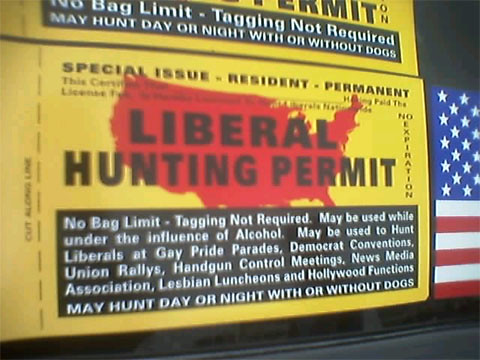


[Via Left in SF]


To hear Michelle Malkin tell it in Unhinged, the levels of extremism and ugliness that can be found on the right are apparently relegated to a few minor instances that apparently don't really count [p. 9]:
And while the Left's knee-jerk response to these stories will doubtlessly be to trot out well-worn examples of unseemly behavior on the right -- Dick Cheney swearing, or mean-spirited conservatives' Internet jibes about Democrats -- the truth is that it's conservatives themselves who blow the whistle on their bad boys and go after the real extremism on their side of the aisle.

As Malkin depicts things, the vast majority of ugliness is emanating from the left, from those same Internet jibes about Republicans to Howard Dean yeaaaarghing. In other words, covering the same range of participation that Malkin describes coming from the right.

Ah, but the way Malkin explains things, you see, it's the sheer volume of the left's unhingedness that is worth examining. So her text is mostly dedicated to cataloging this ugliness -- while studiously ignoring the question of whether a similar volume might exist on the right. Indeed, other than these two "minor" instances, you won't find a single instance of Malkin describing (let alone denouncing) "unhinged" behavior on the right.

It's not as though the information isn't available. After all, we tracked thuggery from both sides during the 2004 election here, and came up with a 33-to-8 ratio of right-wing vs. left-wing ugliness -- though the data collection for left-wing incidents was obviously flawed. Malkin's book cites most of the incidents we gathered, and a number we missed, including a large number of vandalism attacks on Republican campaign offices.

But Malkin, while cataloging these attacks, leaves unmentioned the nine separate attacks on Democratic campaign offices that were reported in 2004, incuding a number of deeply disturbing cases.

Malkin also describes a number of incidents of assaults, threats, and intimidation by left-wingers during the campaign, but similarly ignores the many incidents of identical behavior that were recorded on the right (we counted 15 of them). These included the the Bush supporter who pointed a gun at the head of a Kerry backer, and the boyfriend who put a screwdriver to the throat of his girlfriend who balked at voting for Bush. Or the Freepers who invaded an antiwar protest with the clear intention of disrupting the event and attempting to provoke fights.

Here's how Malkin sums it up:
It's not Republicans taking chainsaws to Democrat campaign signs and running down political opponents with their cars. It's not conservatives burning Democrats in effigy, defacing war memorials, and supporting the fragging of American troops. And it's not conservatives producing a bullet-riddled bumper crop of assassination-themed musicals, books and collectible stamps.

It's not a Republican who invoked Pol Pot and Nazis and Soviet gulag operators when discussing American troops at Guantanamo Bay. That was Democrat Senator Dick Durbin of Illinois, who kept his Senate Minority Whip position and who continues to blame an "orchestrated right-wing attack" for what came out of his mouth.

It's not Republicans who suggested that President Bush had advance knowledge of the September 11th attacks or that Osama bin Laden has already been captured. Those notions were advanced by former Secretary of State Madeline Albright and current Democratic National Committee chairman Howard Dean.

And it wasn't a Republican who asserted that the war Iraq was "just as bad as six million Jews being killed." That was Democrat Rep. Charlie Rangel, who has refused to apologize and whom no Democrat leader has denounced.

And while conservatives zealously police their own ranks to exclude extremists and conspiracy theories, extremism and conspiracy theories have become the driving force of the Democrat Party.

Well, if Malkin were as concerned as she claims regarding wackos who disrespect veterans and commit violence against their opponents' signs, what did she have to say about the lunatic who ran over the flags at Cindy Sheehan's Texas protest that were intended to be a tribute to the soldiers killed in Iraq? She called him a "nutball." Pretty tough talk there, lady.

As I already noted in response:
It isn't Democrats who sprayed racist, pro-Bush graffiti on Democratic campaign HQ in Sacramento, or stole computers from Democrats in Ohio, or set campaign signs afire in Louisiana, or spread blood and innards around the front doors of Bush critics. It isn't Democrats firing workers for their presidential choices.

It isn't Democrats, Michelle, who have denigrated the service of war heroes; it's people like you. And it isn't Democrats who are delivering a steady stream of "bestselling" books attacking liberals as subhuman scum: calling them innately treasonous, identifying them with terrorists, the "enemy within" with a "mental illness." Going on talk shows and saying that the best way to talk to a Republican is "with a baseball bat, preferably."

As for the "assassination" themes, Michelle, it wasn't a left-wing blogger who posted the following remark at the height of the 2004 campaign:

Rope. Tree. Justice. The only three things that Qerry deserves for his "service".


No, as a matter of fact, that was a blogger who resides on your blogroll.

It was that same blog, in fact, that earlier urged the use of violence against another blogger and even provided directions to that person's home on his blog. I'm not aware of any left-wing bloggers having done that.

Indeed, for all the left-wing wackery out there -- and there's no doubt plenty of it -- what you don't see is this kind of eliminationist rhetoric.

After all, Michelle, it wasn't a prominent Democrat who publicly hypothesized about what would happen to the crime rate if all black babies were aborted. It wasn't a prominent Democratic radio talk-show host in Seattle who said of a U.S. Senator -- yes, the same Dick Durbin whose remarks you find completely out of line: "This man is simply a piece of excrement, a piece of waste that needs to be scraped off the sidewalk and eliminated."

It isn't the most prominent liberal talk-show host in the country who jokes that we shouldn't "kill all the liberals" -- instead, we should "leave enough so we can have two on every campus -- living fossils -- so we will never forget what these people stood for."

It wasn't a prominent member of the "liberal" media who opined that we ought to incarcerate everyone who works for Air America.

It wasn't a Democratic congressman who opined that we ought to ship liberal dissenters to Iraq to serve as "human shields."

It wasn't left-wing letter writers who attacked former USA Today editor Al Neuharth and recommended he face execution for treason. Al Neuharth, mind you -- not exactly Mr. Liberal.

And kooky theories? Well, Michelle, what about the forthcoming tome from a well-known conservative postulating -- against all known historical fact -- that fascism is a liberal phenomenon. Of course, you know all about ignoring the weight of historical evidence, don't you?

It isn't liberal bloggers, Michelle, who have waxed wroth at the General Ripperesque notion that the Flight 94 memorial is actually a tribute to the terrorists, or who have whipped up groundless fears about Islamist terrorists in Oklahoma and elsewhere; no left-wing moonbats groundlessly attacked the Pulitzer winner in photography or attacked USA Today with conspiratorial accusations for a badly retouched photo.

No, Michelle, that would be you and yours. Moonbats, wingnuts, take your pick: The shoe fits -- you.

Malkin also makes a great deal (pp. 163-164) out of a Bush-hating entrepreneur who offered a line of "Kill Bush" T-shirts and cups (the logo being a takeoff of the Tarantino film "Kill Bill"), and observes that no one on the right likewise promoted "Kill Kerry" shirts.

Perhaps not, but there is someone offering, at the same location, "Liberal Hunting Permits" like the one at the top of this post. Ah, but for Malkin, no doubt, there's nothing extremist about such gear.

Malkin also includes photos and anecdotes of left-wing Kerry supporters getting ugly with right-wing Bush backers throughout the campaign, and includes a photo gallery of some of the "unhinged" folk who would do such things.

Strangely missing, though, are shots like these:


[More info here.]


[More here.]

There's quite a gallery of this behavior on both sides of the aisle, really. But an honest and thorough survey of the ugliness will reveal something Malkin doesn't want her readers to know, because it contradicts completely her claim that the right reins in its extremists:

Not only are conservatives guilty of nearly identical behavior that Malkin describes as "unhinged," but the volume of it is at least equal to, if not greater than, that from the left. Right-wing unhingedness is equally pervasive, if not more so, at nearly all levels: it can be found throughout ordinary movement conservatives; conservative media and punditry spokespeople; and among the officials and movement leaders (like Cheney) who set the tone for the rest. And it has been poisoning the public discourse for a much longer period of time.

Anyone who is seriously concerned about the ugliness and division that has become imbued in today's politics should be concerned about the kind of discourse that Malkin documents -- at least, those instances that actually document beyond-the-realm behavior and not simple partisanship. There are enough of these, I think, to give any liberal pause.

But any honest assessment will not only consider all the ugliness across the political spectrum, it will consider it in its respective context. How should we assess left-wing nastiness, for instance, when it appears not only to be a relatively recent phenomenon, but in many regards highly reactive to right-wing provocation?

As I observed in the previous post, the deeply eliminationist nature of so much right-wing rhetoric -- "hunting liberals" being a classic example -- is the antithesis of constructive discourse. Its purpose is to intimidate and antagonize, as well as to encourage similar ugliness.

Conservatives' complaints about left-wing ugliness are akin to those of the lunatic who walks about the town square poking his fellow citizens in the eye with a sharp stick -- and then complaining about their lack of civility afterward.

The most significant context in this regard is another reality: the "unhinged" discourse from the right -- what Malkin calls "a lot of the violence, a lot of the paranoia, a lot of the conspiracy theories, a lot of this hatred" -- has been going on for a long time.

Perhaps it's just a convenient memory lapse by Malkin that omits the fact that conservatives have engaged in ten years and more of liberal-bashing -- consumed by a pathological hatred of Bill Clinton, especially, that came floating to the surface in the form of violence, paranoia, and conspiracy theories.

After all, who could forget all those stories promoted -- not just by fringe players, but by supposedly mainstream conservatives like the Wall Street Journal's editorialists -- about Bill Clinton:
-- Clinton was responsible for the fiasco surrounding the 1992 FBI shootings on Ruby Ridge.

-- Clinton and his attorney general, Janet Reno, were responsible for the massacre of the Branch Davidians who died at the culmination of the standoff in Waco.

-- Clinton was the nominal leader of the "New World Order," a government conspiracy to subsume American sovereignty under the United Nations and destroy our freedoms.

-- Clinton was responsible for a long string of deaths of people who had the misfortune to cross his path, cataloged in the "Clinton Body Count."

-- Clinton was a rapist.

-- Clinton had a love child by a black woman and then denied paternity.

-- Clinton was responsible for a vicious cocaine-dealing ring that operated out of Mena, Arkansas.

-- Bill and Hillary secretly conspired to have Vince Foster murdered and made to look like a suicide.

-- The Clinton staff vandalized the White House on their way out.

All of them either laughable on their face or completely disproven and discredited. We do know that an intern was giving him blow jobs, and he was evasive in his testimony about that (gwarsh, wonder why). But other than that, there was a tremendous amount of shit flung onto Bill Clinton's wall during the 1990s, and none of it stuck. Malkin, of course, makes no mention of this context.

She also makes much of protesters who burn Bush in effigy, but conveniently forgets that not only was Clinton burned in effigy during the 1990s, so was the first lady. And when she runs for President, expect a lot more of that. Indeed, no one seems to inspire unhinged behavior on the right like Hillary.

Considering how Michelle Malkin treats extremism like this on the right, I think it's a fair likelihood that she'll be one of the leading torchbearers in the Hillary-burning mob.

Next: Extremists? What Extremists?

Friday, November 18, 2005

Unhinged: Unhonest

1: The Unbearable Lightness of Malkin

2: Eye of the Unhinged

Part 3: The Unhinged Right

You might think that, having just appeared on Bill O'Reilly's Fox News show to plump her new book about left-wing looniness, Unhinged: Exposing Liberals Gone Wild, Michelle Malkin might have squirmed a little when, just a couple of days later, O'Reilly himself uttered some of the most unhinged, unAmerican remarks I think any host on any major network has made in recent years, perhaps ever:
Hey, you know, if you want to ban military recruiting, fine, but I'm not going to give you another nickel of federal money. You know, if I'm the president of the United States, I walk right into Union Square, I set up my little presidential podium, and I say, "Listen, citizens of San Francisco, if you vote against military recruiting, you're not going to get another nickel in federal funds. Fine. You want to be your own country? Go right ahead."

And if Al Qaeda comes in here and blows you up, we're not going to do anything about it. We're going to say, look, every other place in America is off limits to you, except San Francisco. You want to blow up the Coit Tower? Go ahead.

Has any major "liberal" media figure ever written off an entire city's population? Given terrorists permission to attack them? Damned thousands of Americans -- men, women, children -- to horrible deaths? Can you imagine the reaction if they had?

When the city's mayor demanded an apology, O'Reilly refused to back down, saying the city needed "a wake-up call." He also tried to claim he was making a "satirical" point and promised to publicize the "smear" sites that suggested he had said what he actually had said.

Regardless of whether he actually was inviting a terrorist attack -- and what kind of "humor" is it, exactly, that's predicated on mass death? -- what he was clearly saying was people who choose not to participate in the Bush "war on terror" do not deserve the protections afforded the rest of Americans, and by extension deserve to be killed by terrorists.

It doesn't matter to O'Reilly that these people may have legitimate reasons for being concerned about having military recruiters in their schools, especially since those recruiters are known to lie to and threaten young people. They may also have legitimate concerns about their children being recruited to fight in a war in Iraq that is nothing but a diversion from the real war on terrorism.

No, conforming with his notion of what is "patriotic" is all that O'Reilly cares about. Those who don't -- well, they can die.

Did any conservatives stand up and argue that O'Reilly's remarks were out of line and extremist? Um. No.

Did Michelle Malkin? Um. Well. [Crickets chirping.]

Y'see, Malkin is adamant in Unhinged that the right does its best to decry extremism and kookery, to purge it from their ranks:
"[T]he truth is that it's conservatives themselves who blow the whistle on their bad boys and go after the real extremism on their side of the aisle."[p. 9]

And while conservatives zealously police their own ranks to exclude extremists and conspiracy theories, extremism and conspiracy theories have become the driving force of the Democrat Party. [p. 169]

On O'Reilly's show, Malkin expounded similarly:
It is in fact conservatives who are very outspoken in condemning fringe people, and people who are extremists on the right side of the aisle.

So, either Malkin has no intention of actually participating in said "zealous policing," or she doesn't consider O'Reilly's remarks to be the same kind of plainly grotesque, extremist rhetoric she denounces in Unhinged. I'd guess both. Especially when the remarks in question are coming from one of her friends.

So, no -- Michelle didn't squirm. It's one of the cool things about the conservative cult mentality: it relieves you of those untidy little guilt pangs that usually accompany ostentatious hypocrisy.

But of course, we've already seen that when it comes to obvious cases of extremism, such as Michael Savage, Malkin is remarkably silent.

Did anyone from the conservative side of the aisle ever speak up when Savage announced that the tsunami disaster in Southeast Asia "wasn't a tragedy"? Uh, no. How about when he said this?
Right now, even people sitting on the fence would like George Bush to drop a nuclear weapon on an Arab country. They don't even care which one it would be. I can guarantee you -- I don't need to go to Mr. Schmuck [pollster John] Zogby and ask him his opinion. I don't need anyone's opinion. I'll give you my opinion, because I got a better stethoscope than those fools. It's one man's opinion based upon my own analysis. The most -- I tell you right now -- the largest percentage of Americans would like to see a nuclear weapon dropped on a major Arab capital. They don't even care which one. They'd like an indiscriminate use of a nuclear weapon.

Nope. It's positively an orchestra of crickets chirping away over there on the right when it comes to Savage, who claims an audience in the millions.

Though Malkin claimed on O'Reilly's show that conservatives denounce Savage "all the time" she has so far been unable to come up with a single instance of it. Indeed, a Google of Malkin's site reveals no denunciations of Savage -- just warm approval.

What about other extremists from the right? Perhaps the most prominent of these is Ann Coulter, who says things like:
"My only regret with Timothy McVeigh is he did not go to the New York Times Building."

"We need to execute people like John Walker in order to physically intimidate liberals, by making them realize that they can be killed too."

"They are either traitors or idiots, and on the matter of America’s self-preservation, the difference is irrelevant. Fifty years of treason hasn’t slowed them down."

"We should invade their countries, kill their leaders and convert them to Christianity."

"God said ... rape the planet -- it's yours. That's our job: drilling, mining and striping. Sweaters are the anti-Biblical view. Big gas-guzzling cars with phones and CD players and wet bars -- that's the Biblical view."

"I have to say I'm all for public flogging."

"I think [women] should be armed but should not [be allowed to] vote."

"Liberals hate America, they hate flag-wavers, they hate abortion opponents, they hate all religions except Islam, post 9/11. Even Islamic terrorists don't hate America like liberals do. They don't have the energy. If they had that much energy, they'd have indoor plumbing by now."

"My libertarian friends are probably getting a little upset now but I think that's because they never appreciate the benefits of local fascism."

And, since assassination fantasies apparently send Malkin all aflutter, recall also that Coulter thought assassinating Clinton should be a subject of public discourse:
In this recurring nightmare of a presidency, we have a national debate about whether he "did it," even though all sentient people know he did. Otherwise there would be debates only about whether to impeach or assassinate.

Has Malkin ever spoken up about this kind of extremism? It doesn't appear so. A quick Google of her site reveals plenty of references to Coulter -- but they're all adulatory and approving; many are about painting Coulter as a right-wing martryr.

And what about Rush Limbaugh? Any raised eyebrows (let alone voices) when he suggested that Hillary Clinton would have John Kerry assassinated if he won the presidency? Nope.

How about when he suggested that it would be best to just kick out of the country anyone who speaks out against it -- thereby ridding us of Michael Moore and "half of the Democratic Party"? (The "unhinged" half, no doubt.) Any condemnation from the right?

Or then there are the numerous times Limbaugh has joked along these lines: "I tell people don’t kill all the liberals. Leave enough so we can have two on every campus -- living fossils -- so we will never forget what these people stood for." See anything wrong with wishing to kill all but a few liberals? Hmmmm? Anything extreme about that?

Then, of course, there is Malkin's friend O'Reilly, who has made numerous ugly outbursts over the course of his career. There was this recent gem too:
Everybody got it? Dissent, fine; undermining, you're a traitor. Got it? So, all those clowns over at the liberal radio network, we could incarcerate them immediately. Will you have that done, please? Send over the FBI and just put them in chains, because they, you know, they're undermining everything and they don't care, couldn't care less.

Wait. I think I know what Malkin is going to say about all these examples: "They're just jokes. Don't you liberals have any sense of humor?"

The funny thing about that is, when it's this kind of extreme "humor" coming from the mouths of those on the left, Malkin dismisses this defense. See, for instance, p. 161:
Of course, if a conservative journalist had written this tripe, no one would let him get away with the "ironic joke" alibi. He'd be figuratively hanged instead for a hate crime.

Right. So why is it so easy to find "ironic jokes" from the right, but not so many figurative nooses for them?

Now, what's really noteworthy about the kinds of "jokes" and ugly rhetoric coming from the right side of the aisle is its nakedly eliminationist nature: it is predicated on the idea of eliminating liberals, either through violence or through mass roundups and incarceration.

This is really only found on the left in the form of the "jokes" about assassinating Bush, which are indeed grotesque and worthy of real condemnation. But the left doesn't appear to harbor fantasies about wiping out all conservatives -- as the right does for liberals, commonly, frequently, and loudly.

More to the point, this eliminationism has increasingly become an imbedded feature of right-wing rhetoric over the past decade. It's commonplace in Internet discussions, as well as generic talk on the street.

It's important to understand the effect of eliminationist rhetoric: It can't be debated. It can't be discussed. It's simply a declaration of emnity and the intent to cause harm. It is, rhetorically speaking, the equivalent of poking your opponent in the eye with a sharp stick.

Now, one of the apparent predicates of Malkin's text is something that goes unstated: the surge of left-wing hatefulness she documents is a relatively recent phenomonen. And I think anyone surveying the political scene in the 1990s would say that, as a matter of sheer volume, the left in that decade, at least, was much quieter in terms of ugliness than the right.

So if Michelle Malkin -- or anyone genuinely concerned about the state of the nation's discourse -- were seeking answers about why we're seeing this kind of response from the left, she would have to seriously examine the effects of the conservative movement's rhetoric of the past decade.

What they would find is that people on the right have been repeatedly, and aggressively, poking their opponents in the eye with a sharp stick.

And now they're acting all innocent and wounded when folks on the Left respond with howls of somtimes inchoate anger.

As we'll see, there have been a lot of these sharp eliminationist sticks being wielded by the right in recent years, and well before. And no one -- no one -- has been reining them in on the right. Indeed, not only are Malkin's claims to the contrary thin and completely unsupported, she has herself been leading the stick-poking brigade.

Next: Hunting Liberals

Wednesday, November 16, 2005

Book notes

A couple of notes for my Seattle-area readers ...

I'll be interviewed Thursday afternoon on Seattle's KUOW-FM, during Dave Beck's afternoon program, The Beat, which begins at 2 p.m. PST. We'll be discussing my book, Strawberry Days: How Internment Destroyed a Japanese American Community. Click on the KUOW link for a live feed.

That'll be kind of a warmup for my big event of the day, which involves a presentation at the Winters House in Bellevue for the Eastside Heritage Center. Winters House is an appropriate location, since it's adjacent to a blueberry farm that was at various times under the management of Japanese immigrants. And I'm hoping to have a number of the folks who participated in the project turn out, since a number of them are still alive and kicking. I'll have a slideshow, and I'll be discussing and honoring the families of those who turn out.

If you have time, drop by. Festivities begin at 7 p.m.

Orcas: Officially Endangered


[A passing J pod orca photographed July 28 at Lime Kiln State Park.]

Perhaps the best political news of the week is the government's decision to endow "endangered" status on the Puget Sound's orcas. As the P-I story explains::
The Endangered Species Act requires the government to devise a recovery plan for the orcas and to identify and safeguard "critical habitat" necessary for their survival. This could trigger a renewed push for the cleanup of contaminated hot spots in the Sound, environmentalists said. They also speculated that restrictions could be tightened on whale-watching boats.

Under the act, federal agencies also must review their actions to make sure they won't hurt the orcas. Concerns have been raised by the potential harm caused by Navy sonar tests.

This was a critical decision, recognizing the growing scientific consensus that this population of these animals is on the brink:
Their numbers dropped precipitously from the mid-'90s until 2001, when they reached a recent low of 79. They currently stand at 90, according to the Center for Whale Research, a Friday Harbor-based scientific group.

The federal agency recently set 84 to 120 orcas as the target population.

"Because the population has such a small number of sexually active males in it, a catastrophic event -- an oil spill, a chemical spill -- could really make a huge difference in the population," said Brian Gorman, spokesman for the fisheries service.

"The fact that the population is small always worries a biologist," he said.

Scientists have identified many other factors that put the local orcas at risk of disappearance. There has been a decline in the amount of salmon -- their favorite food source -- from historic levels. The killer whales are contaminated with industrial pollutants that can reduce fertility and make them more vulnerable to disease. Research has indicated that boat traffic and other manmade noise can disturb the highly social animals.

Coming to terms with those factors is almost certain to bring the scientists into conflict with both local industry and the military. Efforts to restore salmon runs are certain to place limits on the building and development industries. Cleaning up the pollution that's killing the orcas is going to raise antipathies in military circles, since the majority of PCBs (the most lethal of the pollutants killing the whales) are on the Puget Sound's military bases adjacent to the marine waterways, and cleeanup will be costly. The Navy also is likely to be butting heads over their use of sonar in the Sound.

The Seattle Times coverage points out that the initial reaction is that the listing is being greeted on all sides:
Unlike many other ESA listings, groups whose activities could impact whales -- including salmon fishermen and whale-watching tour operators -- applauded this listing.

"It's not like the spotted owl, where it's loggers versus owls," said David Bain, a University of Washington orca expert. "We're all on the same side on this one."

I'm not so certain about that. The orca listing will at least have the effect of putting more bite to the efforts to restore salmon, because the lack of their dietary staple remains the most fundamental problem the orcas face. And that puts the orcas up directly against the same development and agricultural interests that have been fighting salmon restoration.

Those same people, as it happens, are responsible for the one thing that could render the listing moot: the effort in Congress to gut the Endangered Species Act. As the Times piece observes:
Then again, the listing could have no impact at all if Congress changes the ESA, Bain said. In October, the U.S. House of Representatives voted to significantly scale back the federal government's role in preventing species extinction. It's not clear how the Senate will side on the issue.

"It may be that we spent six years trying to get this listing only to have it not mean all that much," he said.

That isn't the only effort on the part of right-wing politicians that could seriously endanger the orcas. As one of the scientists noted, a single oil spill could kill enough whales to drop the population below the critical levels necessary for full recovery.

And, as it happens, Republicans in Congress are working to raise the likelihood of an oil spill by killing the so-called "Magnuson Amendment" that keeps the major supertankers out of the Sound and limits the traffic that does come here.

The first of these efforts was killed in the House, but it was recently resurrected in the Senate by Republican Sen. Ted Stevens of Alaska, the rape-and-run pro-development right's favorite senator. The plan is not being very warmly greeted:
Norm Dicks, D-Bremerton, and delegation staffers took them to task for trying to upend 1977 legislation by quietly enlisting Sen. Ted Stevens, R-Alaska, and Republicans from other states to champion their cause.

BP would like more oil tankers to be allowed to dock at its Cherry Point refinery in Bellingham.

But the so-called Magnuson amendment, named after the law's author, the state's late U.S. Sen. Warren Magnuson, restricts any increase in oil-tanker capacity in Puget Sound unless it serves Washington state's energy needs.

Internal e-mails from BP executives and one of its lawyers, given to The Seattle Times, indicate that BP has been working closely with Stevens to undo the tanker rule.

You can bet that when these big-money interests come up against the new orca listing, it will be just a matter of time before we start hearing from "scientists" funded by these selfsame interests.

They'll inform us sternly that there are plenty of orcas in the world, so this population doesn't really need protecting. And besides, the new restrictions are costing us jobs, and Americans more oil for their SUVs. And a few hundred other phony talking points designed to let the orcas go extinct here.

Count on it.

Unhinged: Unhonest

[1: The Unbearable Lightness of Malkin]

Part 2: Eye of the Unhinged

There's a lot of left-wing ugliness documented in Unhinged, and Michelle Malkin's reportage of it, on a surface level at least, appears to be largely accurate -- so far as what she actually reports. As noted, however, most of the time this reportage is incomplete: Exculpatory evidence, of course, is never even mentioned, and Malkin does little to ascertain that the ugliness is from bona fide liberal sources.

In fact, it turns out, Malkin's examples are often not what Malkin presents them as being.

There are certain stretches in the book -- particularly some of the Internet-spawned ugliness directed Malkin -- that should give all liberals pause. There's little doubt that some of the people angered by Malkin's arguments responded with vicious, racist, and misogynist hate mail.

However, Malkin never attempts to provide the reader with any perspective on all this. What percentage of the discourse, for instance, falls into this genuinely ugly category? That should, after all, tell us a great deal about the nature of the beast.

Those experienced in Internet-based discourse are well aware that nastiness abounds on all sides, particularly in the political realm. But the quantity of this nastiness can also be telling. What's striking about sites like Free Republic and Little Green Footballs, for instance, is not just the ugliness of the rhetoric, but the sheer overbearing mass of it. Is the ugliness at sites like Kevin Drum's and Atrios's -- both of whom provide much of the grist for Malkin's mill -- comparable? We never find out, because Malkin never bothers to examine the question.

Now, while Malkin correctly identifies some real examples of viciousness, she fluffs out her thesis regarding left-wing ugliness and kookery with plenty of examples that aren't really all that kooky.

For instance, she devotes most of pp. 7-8 mocking the Web site sorryeverybody.com for posting liberals' apologies to the rest of the world for having failed to prevent George W. Bush's re-election. This is simply old-fashioned partisanship -- something that Malkin appears to only consider kooky when it comes from the left.

Moreover, an examination of the genuinely vile comments that Malkin provides shows that Malkin was anything but careful about those citations. For instance, on her back cover, Malkin quotes an anonymous poster at Eric Muller's blog, Is That Legal?, who wrote:
This is what happens when you send a yellow woman to do a white man's job.

As Thersites has pointed out, the entire post was actually a clearly satirical one:
Why can't we find competent race-traitors anymore? Issuing a retraction based on legal threats? Disgusting. This was her moment to shine - a real public forum to level a set of smears against Japanese-"Americans" that would have assured they NEVER tried to drive across the heartland of America again. Instead she knuckles under like Tojo in Tokyo Bay.

This is what happens when you send a yellow woman to do a white man's job.

Posted by: Tommy Pain at May 18, 2005 11:45 AM

That is, the poster was writing in the voice of an actual racist to make a satirical point about Malkin's argument. This, of course, seems to have either been missed or glossed over by Malkin. Her use of it as an example of ugliness is either a dense misreading of the original post or just dishonest. Or, rather, "unhonest."

Another example of missing context is her inclusion of the following remark:
Look at how even aggressive educated wogs like this Michelle Malkin serve their white masters at little or no prodding simply because they desire to be white and not what they were born.

Malkin's a whore regardless what race she was born. She'd serve any Dark Lord as long as they paid her.

This remark came from a thread at Eschaton, which Malkin culled for the blog post that provided the basis for the section of Chapter Six of Unhinged that examines online lunacy.

And what's clear is that the post -- written by "Big Daddy Mars" -- was actually written in response to another satirical post, this time written by a troll who appeared on Atrios' threads and posted in the voice of the historical King Leopold. His post:
Why exactly does this large toothed educated female wog believe that she will be treated as white when God chose to make her yellow?

Even her political allies see her as nothing more than a trained monkey coached into saying a few simple racial truths that would be politically damaging if put into the mouths of a white man?

Her hatred for her fellow wogs comes from an inability to accept that God did not make her a European and that God chose to make her a woman.

Please, beat her severely and set her to work in a brothel somewhere in Malaysia that services Islamic terrorists.

King Leopold | Email | Homepage | 02.04.05 - 12:39 am | #

So Malkin, once again, omits context that makes the later "wog" reference clearer -- as well as the semi-satirical nature of Big Daddy Mars' response. As Thersites points out, Malkin's deletion of the King Leopold remark -- which she carried on the blog post, but left out of the book -- is telling in several important regards.

This all raises a critical context missing from Malkin's use of Internet posts to demonstrate liberal moral bankruptcy: To what extent, really, can Malkin ascertain that these posts actually represent liberals?

The Internet is indeed a wild and woolly place. And tricksters and hoaxters abound alongside the ugliness. Some liberals will wander over to conservative sites and post nasty material, posing as a fellow conservative, just to make the right look bad. And some conservatives do the same thing at left-wing sites.

In other words, these posts simply are not any kind of reliable source of information about the pervasiveness of the political ugliness Malkin wishes to document. Malkin never bothers to explain this to her readers -- no doubt because it would raise serious questions about her use of them in the first place.

Finally, Malkin attacks the sites' hosts for allowing this kind of nonsense on their boards. She attacks Duncan Black, aka Atrios, calling these citations his "idea of ideal political discourse" (p. 11), and Kevin Drum, saying that these "supposedly 'respectable' liberal bloggers allowed their foaming readers to post similarly depraved comments (p. 118). She particularly attacks Drum, who tried to ameliorate her anger with a reasonable e-mail exchange, and was rewarded for it by having her mock his response as "bleating" and "wimpy."

Malkin seems strangely obtuse about the nature of comment threads at blogs. Now, at small blogs like this one, monitoring and managing the comments is a relatively simple task. But as Malkin herself discovered, comments get completely out of hand when you reach the upper stratosphere of blogging -- when literally hundreds of comments are posted at your blog each day.

Malkin clearly believes that it's better to have no comments at all than to be unable to control what's posted at your blog. Which is fine; that's a legitimate choice for her blog.

But other bloggers will have different philosophies -- that it's better to encourage the public discourse by making comments available for your readers. It's an important way of building an online community at your blog, and it's a healthy exercise in free speech, the negative aspects notwithstanding. That, too, is a legitimate point of view.

Malkin, however, seems to be demanding that other major-level bloggers to follow her footsteps and shut down their comments. I don't think that's going to happen.

Frogs and Ravens had an excellent commentary the other day about the realities of blog-comment management:
On the one extreme of the spectrum are those who believe simultaneously that (a) blogs should not post anything that might offend them, even if they are only visiting a given blog on a first-time fly-by and (b) that anything should be allowed in the comment threads, up to and including insulting the blog owner and his or her other commenters. I call this the "The World Exists to Serve Me" contingent.

On the other extreme are those who believe that (a) blog owners can say whatever the hell they want, however they want, and if the people visiting the blog don't like it, they can go away (common rallying cry, "No one's making you read this blog") and (b) blog owners can do whatever they want with regards to their comments threads -- ban randomly, edit comments according to their own whims, refuse to have any comments, ban people who disagree with them, etc. I call this "It's My Blog and I Can Do What I Want" crowd.

... This is one thing that I think proves challenging to a lot of people new to the blogosphere (as well as a few tone-deaf old hands). The blogosphere is not a uniform, homogenous place, operating according to universal rules and expectations. (My god, how boring it would be if that were so.) Instead, the blogosphere varies with the whims and inclinations of each blog host and each commenting community. Some places are fine with profanity, others aren't. Some specialize in trading witty one-offs; others prefer thoughtful, meandering conversations. Some are snarky and sarcastic; some are warm and touchy-feely. Some develop small, close-knit communities into which a newcomer must ease slowly and cautiously; others are big raucous public parties that anyone can jump into without prior experience. The blogosphere is anything but homogenous.

And that's the point. Atrios' policy, he tells me, is that he will delete obnoxious trolls, but he has no intention of trying to play the role of full-time hall monitor in his threads. For the culture of his blog, that is a perfectly appropriate approach -- just as Malkin's is appropriate for hers.

Most significantly, perhaps, Malkin wants these bloggers to "clean up the trash" at their Websites, but seems to have no such concerns regarding the similar trash that can be found in the comments at such sites as Little Green Footballs and Anti-Idiotarian Rottweiler, both of whom reside on her own blogroll.

At LGF, for instance, you can regularly find comments that call both Muslims and liberals "vermin" and "subhumans" and say that "targeted genocide ... will become necessary." At the Rottweiler, you can read threats of violence against other bloggers, as well as assassination threats against John Kerry. Misha, the site's proprietor, has posted himself in support of the notion that antiwar dissenters were asking to be lynched.

What's evident is that Malkin doesn't consider the comments at these sites -- not to mention the posts by their proprietors -- to constitute "trash". Otherwise, she wouldn't express indignation at liberal bloggers for their similar failures.

No, as already noted, Malkin contends that conservatives are in fact much better at weeding out such extremism. On p. 9, she claims that "the truth is that it's conservatives themselves who blow the whistle on their bad boys and go after the real extremism on their side of the aisle." (Ironically, she holds up only two examples of possible right-wing ugliness: Dick Cheney's "Go fuck yourself" to Pat Leahy, and "mean-spirited conservatives' Internet jibes about Democrats" -- but mentions them only dismissively, as though barely worth discussing. Yet Malkin, ironically, devotes entire chapters of her book to the same behavior on the left.)

She goes into this in further detail on pp. 168-169:
It's not Republicans taking chainsaws to Democrat campaign signs and running down political opponents with their cars. It's not conservatives burning Democrats in effigy, defacing war memorials, and supporting the fragging of American troops. And it's not conservatives producing a bullet-riddled bumper crop of assassination-themed musicals, books and collectible stamps.

It's not a Republican who invoked Pol Pot and Nazis and Soviet gulag operators when discussing American troops at Guantanamo Bay. That was Democrat Senator Dick Durbin of Illinois, who kept his Senate Minority Whip position and who continues to blame an Â?orchestrated right-wing attackÂ? for what came out of his mouth.

It's not Republicans who suggested that President Bush had advance knowledge of the September 11th attacks or that Osama bin Laden has already been captured. Those notions were advanced by former Secretary of State Madeline Albright and current Democratic National Committee chairman Howard Dean.

And it wasn't a Republican who asserted that the war Iraq was "just as bad as six million Jews being killed." That was Democrat Rep. Charlie Rangel, who has refused to apologize and whom no Democrat leader has denounced.

... And while conservatives zealously police their own ranks to exclude extremists and conspiracy theories, extremism and conspiracy theories have become the driving force of the Democrat Party.

If only conservatives would zealously police their own ranks to exclude extremists -- particularly if they had done so over the preceding decade.

But, as we will see, they haven't. They aren't. And Michelle Malkin is one of the leading figures in this failure.

Next: The Unhinged Right

[Note: I've slightly rearranged the series since the first post, so the "Next" links have been edited.]

Sunday, November 13, 2005

Unhinged: Unhonest

Part 1: The Unbearable Lightness of Malkin

The first thing you notice about Michelle Malkin's new Regnery book, Unhinged: Exposing Liberals Gone Wild, is how lightweight it is. It practically floats off the shelf and up into the ether, whence it appears to have originated.

That's not just because of its physical thinness. At 172 fluffed-up pages of actual text, it actually clocks in ahead of the 165 pages of text she devoted to In Defense of Internment -- though the latter was then fattened out to over 300 pages with Malkin's appendices containing a number of government archival papers. Unhinged just feels thin in the hand, and it's even thinner in substance when you open it and start reading.

And it's not just the hurried feel to the book. There are typos and typesetting screwups aplenty, which always attests to a rush job in the publishing biz. (What exactly is the last half-sentence of Chapter Two? Perhaps we'll find out in the paperback edition. Speaking of which, where's the paperback of In Defense of Internment?)

No, the reason reading Unhinged feels like breathing helium really comes down to content: There's only half the story there. It's like a piece of Swiss cheese -- anyone can see it's full of holes.

Everywhere you turn in Malkin's book, you'll find lurid descriptions of liberal ugliness, looniness, and viciousness. Most of what she reports is accurate, though in many cases what she defines as looniness is, shall we say, a matter of perspective.

The problem is what she doesn't report.

This is true of the book on a larger, thematic scale: Nowhere in Malkin's fluffy little screed is there ever any recognition that ugliness, looniness, and viciousness are every bit as preeminent on the right as they are on the left, if not more so. Nor is there any recognition that the right might have played a significant role in dragging the national discourse down into this gutter.

To the contrary, Malkin specifically denies that this might be the case, right from the outset. On p. 9 there's this:
And while the Left's knee-jerk response to these stories will doubtlessly be to trot out well-worn examples of unseemly behavior on the right -- Dick Cheney swearing, or mean-spirited conservatives' Internet jibes about Democrats -- the truth is that it's conservatives themselves who blow the whistle on their bad boys and go after the real extremism on their side of the aisle. Though no one in the mainstream media depicts the GOP as the party of peace, tranquility and civility -- preferring to cast those of us on the right as angry, destructive, bigoted, and off the rails -- it is, in fact, the Left that now embodies that unhinged creature.

Note that she immediately dismisses, without any rationale, two fundamental pieces of evidence against her characterization of reality:
-- Dick Cheney's crude eruption on the Senate floor, telling Sen. Patrick Leahy, "Go fuck yourself," is a classic example of unhinged behavior -- and it was an example of its manifestation at the highest levels of the conservative movement. More to the point, Cheney and his fellow conservatives rather pointedly refused to apologize or back down for the outburst, and in fact seemed to recommend such behavior to the kids watching at home. What was that about reining in their bad boys?

-- Mean-spirited conservatives' Internet jibes about Democrats are probably, as Malkin suggests, not worth taking too seriously. But then Malkin goes on to devote over half of her subsequent text to mean-spirited liberals' Internet jibes about Republicans. So why can Malkin bring this kind of behavior up as evidence, but the left can't?

The holes in Malkin's reportage also exist on a fundamental level. Take, for instance, how she handles one of the centerpieces of her argument that this lunacy has taken root at the highest levels of the Democratic Party: Howard Dean's remarks about theories that the Saudis might have tipped off George W. Bush about 9/11.

As I've already noted, Malkin's discussions of Dean's record in television interviews indicate a serious skewing of the reality of what he said. And sure enough, Unhinged skews Dean's remarks on pp. 33-35 with some, shall we say, selective editing.

Here's how she quotes Dean:
Diane Rehm: "Why do you think he [Bush] is suppressing that [Sept. 11] report?"

Howard Dean: "I don't know. There are many theories about it. The most interesting theory that I've heard so far -- which is nothing more than a theory, it can't be proved -- is that he was warned ahead of time by the Saudis.

Here's what she omitted from Dean's remarks:
"Now, who knows what the real situation is? But the trouble is, by suppressing that kind of information, you lead to those kind of theories, whether or not they have any truth to them or not, and eventually, they get repeated as fact. So I think the president is taking a great risk by suppressing the key information that needs to go to the Kean Commission."

Likewise, she then goes on to quote Dean from a subsquent interview:
WALLACE: The most interesting theory is that the president was warned ahead of time by the Saudis. Why would you say that, Governor?

DEAN: Because there are people who believe that. We don't know what happened in 9/11. Tom Kean is trying to get some information from the president...

WALLACE: Do you believe that?

DEAN: ... which doesn't -- no, I don't believe that. I can't imagine the president of the United States doing that. But we don't know, and it'd be a nice thing to know.

But again she omits the contextual remarks that explain why Dean was talking about this:
WALLACE: I'm just curious why you would call that the most interesting theory.

DEAN: Because it's a pretty odd theory. What we do believe is that there was a lot of chatter that somehow was missed by the CIA and the FBI about this, and that for some reason we were unable to decide and get clear indications of what the attacks what were going to be. Because the president won't give the information to the Kean commission we really don't know what the explanation is.

Malkin consistently omits the important context of what Dean was trying to say: That keeping the public in the dark feeds these kinds of conspiracy theories. Indeed, she quickly glosses over the important subtext behind Dean's remarks, when she asks:
What leading Democrat in his right mind would lend even a shred of credence to the baseless theory that Bush was "warned ahead of time by the Saudis" about September 11?

While there may have been no evidence that this was the case, the speculation itelf did not happen in a vacuum, considering that nearly all of the 9/11 hijackers were Saudis by nationality, and the Bush family's ties to the Saudis have been voluminously documented. It's natural that there would be such speculation. (It's worth noting, of course, that Dean botched the opportunity to bring up these points by mishandling both the original remarks and his follow-ups to them.)

Moreover, as we later learned during the 9/11 Commission hearing, Bush indeed was warned ahead of time about the possibility of terrorist attacks -- not by the Saudis, but by his own presidential intelligence briefing. And he chose not to act on those warnings. That raises concerns not about any conspiracy, but about Bush's competence.

Conservatives definitely did not want to talk about these twin realities during the campaign -- so when Dean brought them up, it became imperative to paint him as an unhinged kook and conspiracy theorist. And they succeeded so well that Malkin could seize their altered reality and use it to plump up her thesis.

Malkin is especially hypocritical in discussing the Dean remarks, which she calls "the old I'm-not-saying-it-I'm-just-posing-the-question card". As TBogg points out, Malkin finds this card perfectly suitable to play when it comes to her own purposes, including smearing John Kerry by suggesting -- groundlessly -- that he wounded himself intentionally in Vietnam in order to obtain a Purple Star. What leading Republican would lend even a shred of credence to such a baseless theory?

Rewriting history by omission, of course, is a Malkin specialty: It's what she did, as I've explained in depth, with her pro-internment book. Any facts or details that might count as evidence against her thesis have no chance of being any more than briefly and dismissively mentioned.

In discussing this propensity of hers earlier, I described this missing element, in journalistic terms, as "fairness," but I don't think that fully describes what's lacking in Malkin's work; it goes beyond mere fairness. This is a matter of simple integrity -- intellectual and otherwise.

Malkin isn't being openly dishonest with these omissions. There's very little in Unhinged that you can say is actually false. It's more a matter of being unhonest: not letting her readers get the whole picture so they can judge for themselves. It's one of those things conservatives love to whine about with the "MSM" so much.

Unhinged lacks the fundamental honesty -- the integrity to consider countervailing facts and then factually counter them, if possible, to defend your thesis, rather than simply pretending they don't exist -- to be worth anyone's reading time.

The only people who will find this book useful are blinkered ideologues who just want more grist for their liberal-hating mills, the facts be damned. Certainly, it will be of little to use for any serious-minded person who is concerned about the state of the national dialogue -- except, perhaps, as Exhibit A regarding the source of the problem. Because Malkin's little contribution to the growing mound of liberal-bashing books is only going to make that dialogue incrementally worse.

Fortunately, it's so lightweight, that may be a rather small increment indeed.

Next: Eye of the Unhinged

Thursday, November 10, 2005

The Malkin thing

OK, so one of my regular readers has already wondered out loud if I'm obsessing over Michelle Malkin -- a fair enough question, since I've been posting a lot about her lately. And I'm going to be doing a lot more over the next week or so.

Let's just say that it's not about the person. And it's not an obsession, exactly. More of a focus.

Most of you will have noticed by now that this blog is primarily dedicated to tracking the extremist right and its interactions with mainstream America -- and especially in the ways extremism expresses itself violently, both as eliminationist rhetoric and thuggish behavior. And of course, as the author of a book on the Japanese American internment, I've written a lot on that subject as well.

So it shouldn't be surprising that Malkin comes up on this blog a lot, for a lot of reasons:
-- She's written a book of fraudulent history about the internment.

-- Her latest book is about the supposedly "unhinged" nature of modern liberalism, painting liberals as the political bloc most under the influence of extremists.

-- She is herself a classic example of what I call a "transmitter": someone who treads in both the extremist and mainstream right with relative ease, picking up ideas that have circulated in the echo chambers of the far right and repackaging them for mainstream conservative consumption.

So I'm going to be exploring the latter two aspects of her week over the next week or so in a serial review, of sorts, of Unhinged.

And then, I hope, I can let the subject rest for a bit. Certainly, I don't expect to engage in any kind of actual give-and-take with Malkin.

That's because, to date, she's responded to my criticism of her work exactly zero times. Indeed, her response to me so far has been to pretend, as best she can, that I simply don't exist. And I'm sure if you ask her, it has nothing to do with the points I make or the strengths of my arguments. Nope.

Nor does it have anything to do with her backing out of that agreed-to phone interview. No no no.

I expect that it's because I'm "unhinged." Makes for a nice catch-all excuse for cowardice, doesn't it? Especially when you're fond of boasting before audiences of adulating conservatives that you've unflinchingly confronted all your critics openly. Um, all of them but one, that is.

Now, it's true that Malkin has made oblique references to my work, mostly by linking to right-wing hacks who post blather attacking me (for the most, ad hominem). The latest was Michelle's post linking to this nonsense from Brian Maloney, her partner in reporting on the Air America non-story and a Seattle radio personality who seems not to have a show these days. She also links to a Glenn Reynolds post that just approvingly links to Maloney. Here's what Maloney wrote in response to this post:
Does this sound like anything more than journalistic sour grapes? Malkin's been at this a long time, it's hard to argue she hasn't paid her dues.

Worse, Neiwert is the author of a competing book on Japanese-American internment camps and that's a likely element of his obvious animosity.

Yet this site was linked to a number of liberal blogs this weekend, resulting in much higher than average traffic. Anything to slam your enemies, one supposes.

By the same standard, how many liberal writers would hold up as "journalists"? Why can't a commentator be a journalist? Yes, the times have changed, but Malkin's role is clear to her readership.

In working with Michelle, it's clear her investigative abilities are well-honed, so is small town newspaper "crime blotter" experience really necessary to develop this skill?

Especially interesting: in order to bash Malkin, circa-1999 Seattle Times columns are cited (and their backlash), forcing the reader to trust Neiwert's interpretation of ancient history. Proving only that there were differences of opinion over a talk show guest booking dispute, his argument falls flat.

A couple of factual points:

-- The post in question was not inspired by, nor was it a response of any kind, to her book. It was strictly in response to her blog posts. Maloney's characterization of it as being so was just factually false.

-- The links he cites later to "circa 1999 Seattle Times" columns, and from a "hit piece," didn't come from this post. They came from an earlier one I linked to in this post.

As for the rest, welllll ... in order for there to be "sour grapes," one has to envy the position of the person being criticized. And believe me, there is nothing about Malkin's career to envy.

I mean, really. Sure, she gets a lot of face time and makes lots of bucks. But who would envy a sellout political hack whose career is completely dependent on creating fresh propaganda for a well-moneyed movement? Please.

But that's the entire substance of Maloney's response to the many facts I cite, as well as the many examples of Malkin's shoddy work I provide: I'm envious of her.

Guys like Maloney populate the media business, especially in broadcast media, and they represent everything wrong with it, because they have no idea what constitutes serious journalism. They're only capable of ad hominem "he's a bad person with bad motives" arguments, because that's how they think. Their own positions are never the product of logic, reason, or fact, but instead of narrow personal interests and vendettas. So they assume it's true of everyone else.

No wonder he and Malkin get along so well. As you'll see in the coming week, that's pretty much the whole substance -- such as it is -- of Unhinged.

But for what it's worth: I don't really have any thoughts about Malkin the person (if, indeed, her work really is the product of one person). I'm not that interested, because her work reveals her to be such a shallow ideologue. I don't hate her -- and the idiots who post hateful, misogynistic and racist shit about her on liberal boards are, as I've said before, not on my side. (I also have a policy of deleting those kinds of posts here.)

Malkin is worth tackling for two good reasons: A) she is very influential, particularly in the blogosphere; and B) her work is harmful disinformation that needs to be examined and eviscerated. And as it happens, I have the kind of information needed to counter her pollution. So please, bear with me.

Wednesday, November 09, 2005

A privacy amendment

Conservatives like to pretend that there is no general "right to privacy" because those words don't appear in the Constitution.

So maybe it's time for the American public -- which does believe it has such a right -- to end the discussion once and for all and put them in.

Dan Savage (via Sasha) suggested the other day that progressives put together their own campaign for a constitutional amendment establishing, once and for all, a general right to privacy.

This actually was an idea I proposed to folks in Salon's Table Talk some years back, but no one else seemed to want to latch onto it. So I've had to satisfy myself with arguing, ardently, for Democrats and progressives to drop all this talk about a "right to choose" and start talking about a "right to privacy," because that is what is really at stake with the ascendancy of so-called "strict constructionists" to the federal bench under the Bush regime. I've made that argument here again and again and again and again.

Fortunately, during the recent Senate hearings on John Roberts' appointment to the Supreme Court, the right to privacy indeed came rushing to the fore as a significant point. Rather predicatbly, right-wing propagandists like Rich Lowry weighed in pre-emptively on Roberts' behalf, arguing that because the Constitution doesn't explicitly list a general right to privacy, it doesn't exist:
There are privacy rights in the Constitution. The Fourth Amendment, for example, prohibits unreasonable searches and seizures. The entire constitutional scheme is meant to limit government power and leave people alone most of the time. But there is not a generalized, abstract right to privacy unhinged from any constitutional text.

The mischief began 40 years ago in the case Griswold v. Connecticut, when the Court struck down a prohibition on contraceptives on the basis of a "right to marital privacy." The bit about "marital" was quickly dropped, and the new discovery became a general right to privacy.

In Griswold, the Court suggested the right might be found in the First, Third, Fourth, Fifth and/or Ninth Amendments. In other words, it must be there somewhere, anywhere. But since the right to privacy is nowhere mentioned, the Court had to contend that it resides in "penumbras formed by emanations." In layman's terms, that means in partial shadows formed by emissions, which it doesn't take a constitutional scholar to conclude sounds pretty vaporous.

"'Privacy' [has] functioned as a euphemism for immunity from those public-morals laws deemed by the justices to reflect benighted moral views," write scholars Robert P. George and David L. Tubbs. From a right for married couples to obtain contraceptives, it has evolved into a constitutional right of homosexuals to engage in sodomy (in the case of Lawrence v. Texas in 2003) and then the right of gays to marry, in a 2003 Massachusetts-supreme-court decision.

But Roberts didn't make this argument -- after all, it was precisely this position that had destroyed the nomination of Robert Bork back in 1987. Roberts had to expound quite bit on "the so-called right to privacy" (as he once put it), but gave answers that, on the surface, seemed to suggest he agreed with the existence of such a general right.

However, as William Saletan at Slate pointed out, his answers actually were slick evasions that paved the way for him to overturn Roe v. Wade on the basis of the limitations to such privacy rights:
Roberts was asked to locate the right to privacy in the Constitution. He quoted parts of the Bill of Rights pertaining to military occupations and invasions of citizens' homes. Does the right to privacy extend beyond those contexts? Roberts offered one addition: "I agree with the Griswold court's conclusion that marital privacy extends to contraception." Sen. Dianne Feinstein, D-Calif., pressed him about the extension of contraceptive rights to unmarried people. "I don't have any quarrel with that conclusion," he allowed. What about Lawrence v. Texas, the 2003 case that interpreted Griswold to bar prosecution of private sex between consenting adults? Roberts ducked the question, citing "the difference between the issue that was presented in Griswold and its ramifications." In other words, any claim of privacy beyond the specific "issue" in Griswold—the right to marital contraception—is a "ramification" Roberts might reconsider.

Sen. Arlen Specter, R-Pa., asked Roberts whether the right to abortion "is so embedded that it's become a part of our national culture." Roberts demurred, explaining, "That gets to the application of the principles in a particular case." Feinstein asked Roberts whether the "right of privacy applies to the beginning of life and the end of life." Roberts begged off again, arguing, "The exact scope of it, with respect to the beginning of life and the end of life—those are issues that are coming before the court." Feinstein asked Roberts about his pro-privacy remarks to Sen. Ron Wyden, D-Ore. Roberts affirmed the "right to be left alone" as "a general statement of the principle." But he cautioned, "With regard to particular restrictions [Wyden] was talking about ... I don't think it's appropriate to comment on."

You get the picture. Privacy is a principle so general that its assertion against any "particular restriction" unspecified in the Constitution, aside from a ban on married people using birth control, is a mere "ramification" or "application" open to review. By refusing to define privacy's "scope," Roberts eviscerates it.

Save the Court has more:
By saying that he believes in a constitutional right to privacy the way every member of the Court does, Roberts is essentially saying that he would provide virtually no real protection for the right to privacy. Every member of the Court, of course, includes Justices Antonin Scalia and Clarence Thomas. According to their view, any right to privacy does not encompass a woman's right to reproductive choice, and both have argued that Roe v. Wade should be overruled. According to their view, any right to privacy apparently does not include the right of consenting adults to be free from criminal prosecution for what they do in the privacy of their own bedrooms, as reflected in their dissents in Lawrence v. Texas. And according to Scalia's view, the right of privacy does not give even a fully competent adult the right to refuse unwanted medical treatment, as reflected in Scalia's opinion in Cruzan v. Missouri Dept. of Health.

Now, the subject continues to linger with the nomination of Samuel Alito to the court, likewise virtually assured to be a vote to overturn Roe:
Alito wants government to be able to interfere in personal decisions on reproductive rights. In Casey, Alito stated that he would have upheld a provision of Pennsylvania's restrictive anti-abortion law requiring a woman in certain circumstances to notify her husband before obtaining an abortion. His colleagues on the Third Circuit and the Supreme Court majority disagreed and overturned the provision.

But like Roberts, Alito is adopting the phony "I do believe in privacy rights" stance adopted by Roberts. And it appears to be working:
Senator Richard Durbin, an Illinois Democrat, said Alito told him in their meeting that he recognized a right to privacy, the principle that underlies the Supreme Court's abortion rights rulings. "I think he believes in that fundamental right," Durbin told reporters in Washington.

Volokh Conspiracy explores quite a bit more of Alito's real positions WRT privacy rights. As one commenter notes:
What exactly does he mean by "right to privacy"? The problem with that right (apart from the question of whether it's in the constitution) is that it's definitionally nebulous--it could mean a great deal or could mean next to nothing, depending on how one construes "privacy." If the right to privacy does not preclude spousal notification for abortions, then it's essentially a defense against state intervention, not a defense of personal sovereignty, which is a very important philosophical distinction.

Another commenter immediately observes:
Yep, pretty nebulous, sorta like "due process" or "privileges and immunities", "unreasonable search", "free exercise" or any of those unenumerated rights lurking in the 9th Amendment (maybe privacy is even one of those rights). One can certainly argue that there is no general right of privacy from government intrusion in the Constitution because the Constitution does not explictly provide for such a right but if "definitionally nebulous" made recognizing the right problematic (or the extent of the right), then that same objection could be applied to any number of rights in the Constitution.

Indeed, the right to privacy is generally recognized as one of those unenumerated rights inherent in the Ninth Amendment:
The enumeration in the Constitution, of certain rights, shall not be construed to deny or disparage others retained by the people.

And as Jeralyn at TalkLeft noted back in 2002, the Ninth Amendment rights widely recognized by jurists over the years have included not just the right to privacy but also the right to self-defense, which in my mind provides a more powerful bulwark in defense of private gun ownership than does the Second Amendment.

Yet, strangely enough, we don't see conservatives arguing that there is no "right to self-defense" ... even though those words appear nowhere in the Constitution.

As those wild-eyed leftists at USA Today point out:
In fact, the right to privacy is older than the republic, protected in the Constitution and affirmed repeatedly in a century of court rulings before the abortion controversy. Though the word privacy isn't in the Constitution, the "right to be let alone," as Justice Louis Brandeis put it, permeates the document.

What are freedom of religion, freedom of speech and freedom from unlawful searches and the like other than respect for privacy? Leading Founders urged adoption of the Constitution as necessary to protect "private rights." And the Ninth Amendment was added to assure that other rights already taken for granted were "retained by the people."

Starting in the 19th century, the Supreme Court ruled that the Constitution protects the privacy of the mail and that individuals have a right to refuse medical treatment.

Thus it was no stretch when, in 1965, the court overturned a Connecticut law banning birth control. Surely, the court ruled, the right of privacy prohibited police searches of "the sacred precincts of marital bedrooms." That decision, Griswold v. Connecticut, was the foundation for Roe.

To the anguish of those who want government in the bedroom and other personal places, privacy rights now protect unmarried and same-sex couples and individuals.

I think it's pretty clear that the coming Supreme Court lineup -- and particularly the Robert court -- is going to bring an end to Americans' general right to privacy.

Progressives would be smart to begin preparing against that eventuality now. As Sasha notes, it will be fun watching conservatives tie themselves up in knots explaining to Americans why they don't have a general right to privacy. But even more important, it is the kind of campaign around which a positive, forward-thinking progressive agenda can gain traction.

Tuesday, November 08, 2005

Malkin and journalism

Speaking of Michelle Malkin, check out Alex Koppelman at Dragonfire as he weighs in on Malkin's standards when it comes to journalism.

Koppelman points out (as I did earlier) that Malkin has never worked as a reporter or in the belly of the daily production of reportage, and quotes me regarding her career here in Seattle as a columnist. Then he continues:
None of this has stopped Malkin from interpreting even the minutest details as evidence of a liberal media conspiracy. Last week, it was a photo of Secretary of State Condoleeza Rice, altered by USA Today in what Malkin called the "malicious photoshopping of a black Republican official." Undoubtedly, the photo had been altered -- Rice's dark, bloodshot eyes had been whitened, and her pupils had changed in shape, becoming unflattering, even creepy -- but such alteration is hardly evidence of malice. In fact, alterations like those happen all the time as photo editors try to make their work more visually interesting.

... This week Malkin's back at it. Her new target is James Dao, a reporter for the New York Times, and a piece he wrote after the number of American casualties in Iraq hit 2,000. In the article, Dao quoted part of a letter Corporal Jeffrey B. Starr wrote to his girlfriend in case he died in Iraq, which he did in April of this year. Dao chose a quote from the letter that expressed Starr's premonition of his own death. Malkin, though, was angered by what Dao left out -- a part of Starr’s letter in which he confirmed his willingness to die for what he considered a noble cause. This, to Malkin, was proof of "selective editing" and "agenda-driven" reporting by Dao. But the truth is never as black-and-white as Malkin sees it.

Dao declined to comment for this article, but he did forward along an Email from Bill Borders, a senior editor at the Times. "The most prominent part of the presentation of Starr was the picture and caption at the top of Page A15," Borders wrote. "The caption represented him this way: 'His father, Brian Starr, said his son believed in the war but was tired of the harsh life.' The article also reported that even after his son's death Brian Starr 'remained convinced that invading Iraq was the right thing to do.' " And, in fact, Dao explicitly referred to Starr's pro-war views, using the same language given in the caption.

There can be some debate as to whether Dao should have included the rest of Starr's letter, and I myself would say he should have, not because the additional material would substantively change the portrayal of Starr, but because Starr's letter was a moving look into the thoughts of a soldier whose life was tragically cut short. But that's ultimately an editorial decision -- including the omitted portions of the letter would have meant fitting 100 additional words into the story. In a piece totaling more than 3,500 words, as Dao's did, that may not seem like much, but the article included the words of more than a dozen soldiers and their families, as well as background on the war, statistics on the death rates of soldiers, charts and photos. If Malkin had experience as a reporter she would know that in a newspaper, where articles must fit spaces defined more by advertising and layout concerns than editorial concerns, every word matters. Cutting 100 words of Starr’s letter, after summarizing the pro-war views those words reflected, allowed Dao to explore the lives of other soldiers, other families hurt by tragedy. That's not bias; indeed, it's the essence of a reporter's job.

Koppelman's piece was fresh in my mind when I happened upon Michelle's self-written profile at Pajamas Media:
A lot of the work that I do, it isn't just about opining, but about investigative journalism as well. That's one of the coolest things about the blog, being able to do that kind of hybrid thing. I got a lot of criticism in the past for doing opinion pieces with a lot of reporting in them. A lot of mainstream media editors aren't comfortable with that because they don't expect it. So I love that about blogging.

Ahem.

A few words about investigative journalism:

Investigative journalism is actually an extremely arcane, and hallowed, field within the trade. The people who are investigative journalists will spend months, sometimes years, working on a single story. Their specialty is a knowledge of genuine investigative techniques, including those employed by private investigators, and include some practices that some people (like certain mayors of Spokane) might consider devious. But for the most part, it's arduous work that requires, above all, an ability to comb through stacks of records and pull out important information.

Real investigative journalists are capable of employing their skills in a variety of areas: crime, corporate mismangement and malfeasance, government corruption and incompetence, and political scandals -- though the latter, while the best known, are probably the least often applied.

If you want to get a sense for the work of real investigative journalists, spend some time strolling about the site of Investigative Reporters and Editors, the premier organization for such journalists in this country. And note: If you do a search on their site for "Malkin," you come up empty.

There are very few genuine investigative journalists working today at most mainstream newspapers, mostly because they are expensive and not terribly productive in terms of the quantity of copy that newspapers rely upon, and because they also have a nasty habit of embarrassing the friends of their publishers. For some reason, when budget cuts come down in today's newsrooms, the investigative spots are usually the first to go.

Sometimes I am mistakenly referred to as an "investigative journalist," and I always try to take pains to correct that misinformation. What I do is more in the way of "research journalism" -- that is, I tend to rely on standard research techniques (interviews and archival research) rather than investigative techniques.

I've known and worked with a number of real investigative journalists over the course of my career, including Jay Shelledy (who worked on the Don Bowles investigation) and James Steele, of the famed Barlett and Steele duo.

In fact, Jim Steele is a friend of mine.

And Michelle, trust me -- you're no Jim Steele.

'Unhinged': Early notes

Finally got my copy of Michelle Malkin's new book, Unhinged: Exposing Liberals Gone Wild, and have begun digging already. Suffice to say that every aspect of my earlier critique has been confirmed in spades, and then some.

Of course, you can't judge a book by its cover. But I had an immediate question about its cover -- specifically, the back cover.

Y'see, the early reports on the book indicated that not only would Malkin feature nasty, ugly quotes from nasty, ugly liberals on the back cover, but it would include their e-mail addresses.

And that's what they showed when Malkin appeared on O'Reilly's show the other day. O'Reilly even specifically mentioned it.

But when my copy arrived, the nasty quotes were there ... but not the e-mail addresses.

Now, I have to admit, I was hoping to be one of the unhinged liberals Malkin quoted on the back cover.

But I also have to admit that I wasn't nasty enough. In fact, the bigots and mysoginists she does quote are definitely not on my side (regardless of what Malkin likes to imply, as she does for the entirety of this book).

I was hoping to be there anyway, just because I wanted to see what kind of mail it would generate to be on Malkin's list.

And when the inevitable death threats arrived, I really wanted to be able to sue the bejeesus out of Malkin and Regnery.

I wonder if that's why there weren't any e-mail addresses, as promised.

Monday, November 07, 2005

Suppressing democracy

Ask yourself which is the more important principle:
-- the right of American citizens to vote, or

-- preventing those who are ineligible to vote from doing so.

Now, think of this as a kind of Rohrschach test: The answer you give is neither right nor wrong. But it does tell us a great deal -- about your politics, about your priorities, and about what kind of American you are.

I think a strong case can be made that without the latter principle, the former is rendered meaningless. There are legitimate reasons to exclude some from voting -- particularly non-citizens, felons, and those who have already voted once -- and that failing to protect adequately from fraud dilutes and pollutes the meaning of every legitimate voter's ballot.

But there's little doubt, in my mind at least, that the former principle is far more significant; without it, the latter is not just meaningless, it's inoperative.

The right of Americans to vote, and the need to encourage citizens to participate in the voting process, is one of the real bedrock principles of our Republic and its democratic institutions. So while the need to protect against fraud is obviously fundamental, the pursuit of it must never come at the expense of the right of citizens to legitimately participate.

Better, in my mind, to let a hundred felons vote than to prevent a single citizen from legitimately casting their ballot.

Today's Republicans, obviously, disagree with me.

In the wake of the hotly contested Washington governor's race that saw the GOP's well-noted anti-democratic tendencies come rushing to the fore, we now face the prospect of an outrageous attempt by Republicans at intimidating voters by threatening to disqualify them -- often without any real evidence for doing so:
GOP challenges rights of hundreds of voters
Republican claims in King County draw angry denial

By GREGORY ROBERTS
SEATTLE POST-INTELLIGENCER REPORTER

Hundreds of worried and angry voters deluged the King County elections department Friday with calls questioning a Republican-backed effort challenging their right to vote in Tuesday's election, elections officials said.

Several voters said that King County GOP Vice Chairman Lori Sotelo was dead wrong in her claim that their voter registration addresses are not those of legitimate residences. And Democratic politicians denounced the Republican initiative as a blatant attempt to intimidate voters.

State GOP Chairman Chris Vance acknowledged some challenges were brought in error and would be withdrawn. But he vigorously defended the undertaking overall and promised more of the same.

The spark for the political firestorm was the delivery of certified letters Thursday from the county elections department to voters on the GOP hit list, which totaled 1,774 names after duplicates were eliminated. The letters informed the voters of the challenge and cited the state law requiring voters to register at a valid residence address.

"I'm extremely disappointed and angry at the audacity of this woman and the party she represents," said Demene Hall, who got one of the letters. Hall has lived for 16 years at the Watermarke apartment building at 320 Cedar St. in Seattle, her registration address.

Hall, who said she is "too African American" not to be a regular voter, said Friday she came of age in the civil rights era and watched her parents hand out political fliers outside polling places they were not allowed to enter.

"We just buried Rosa Parks on Wednesday, I got the letter on Thursday and today is my 57th birthday," she said. "And they're challenging my validity?"

Vance acknowledged that the inclusion of the Watermarke on the list was a mistake. Elections officials late Friday said Sotelo had rescinded 140 of the challenges.

But, Vance said, "The overwhelming majority of our challenges are valid."

Right. Actually, there's no proof of that, and plenty of evidence that the majority are in fact mistaken.

The Daily Kos diary entry by Andrew Villeneuve of the Northwest Progressive Institute lays out what has been happening:
And here's what's really clever: the filing of the registrations was timed to be right on the eve of the November 8th election, so that hearings have to be scheduled after the election. The GOP is hoping that voters whose registrations are being challenged will get discouraged and just not even bother to vote at all.

After the letters began arriving, the news media and progressive NW bloggers quickly jumped on the story.

The story first appeared on The Stranger's website, where one of the voters whose address was challenged posted to the site's forum:

So I get this certified letter from King County today informing me that my voter registration has been challenged.

Attached is a form signed by some woman named Lori D. Sotelo saying that "under penalty of perjury" she has "personal knowledge and believe that this person ... does nto reside at the address given on his or her voter registration..."

Under the section where she is asked to provide factual basis for the challenge, she writes "Voter is registered to vote at an address that is not a physical residence."

WTF? I live in a vintage apartment building in Belltown [the Watermarke] with about 60 other people. Then I talked to my neighbors - EVERYONE I talked to also received the letter.


Yep -- that's right. The Republicans challenged the voter registrations of EVERY SINGLE PERSON in THIS apartment building:

[Shot of Watermarke building]

Others being harassed are people who have lived in the same house for decades, and still others whose residence is also where they operate their business.

Vance and the GOP later admitted that the Watermarke residents were included by mistake and rescinded their challenges. However, the Seattle Times reported on others who were not so fortunate, though their challenges were every bit as bogus:
Jeff Weber, another voter whose registration was challenged, said he lives and is registered at his home in West Seattle, and is mystified about how he ended up on the Republicans' list.

"I think it's outrageous," he said. "It's a bungalow in West Seattle. ... It's a single-family house on a 5,000-square-foot lot. If they had done any investigating at all, they would have known."

Annette Fallin of Belltown said she was notified her registration had been challenged the same day she mailed in her absentee ballot.

"I'm very irate over it," she said. "I get this piece of mail telling me they're not even counting it like a normal ballot."

The challenge to Fallin's registration was one of the 140 the GOP dropped Friday. More than 50 of the 140 were registered at her apartment building, the Watermarke on Cedar Street.

The challenges to Thoma's, Taylor's, Blodgett's and Weber's registrations were not rescinded.

What is the GOP doing here? Can you imagine being one of these voters -- a legitimate, long-time voter who expects to cast their ballot as they always have, and suddenly you get a letter from a Republican official who says she's going to challenge your right to vote? That's not just Orwellian: it's Kafkaesque.

But then, it's what we've come to expect from today's Republican Party. It well knows that its grip on power is either maintained, in many places, or obtained, in places like Seattle where it struggles, by the slimmest margins -- and that its interests are more often served by suppressing voter turnout.

After all, it was a similar vote-suppression effort in Florida in 2000 that likely delivered that state to George W. Bush and with it the presidency. Many will recall Greg Palast's reporting on the effort, which has always struck me as a little shaky, particularly his assertions -- which he admits are simply estimations -- that 90 percent of the ChoicePoint voter-roll eliminations were incorrect. But there's little doubt that there was an extremely high rate of error in the purges, certainly in excess of 50 percent.

That's simply unacceptable. If you accept the primacy of the right of citizens to vote, then these attempts at preventing ineligible votes have to be as close to perfect as possible; an error rate of even more than 1 percent is too great. Because anything more than that means you're violating the inviolable.

[There's also a notable hypocrisy in all this for those of us who were observers in the Gregoire-Rossi tussle, because Republicans have made it a constant subsequent talking point -- no, a screaming point, really -- that King County elections officials proved themselves hopelessly corrupt and incompetent in this election, notably by their inability to reify a relatively small number of ballots with the numbers of votes (it was around .3 percent).]

But then, these kinds of vote-suppression effort have become commonplace in the GOP, particularly in areas where there are strong Democratic voting blocs, which are always what Republicans target. Recall, for instance, that there have been broader voter-suppression efforts, including those in Ohio in 2004.

To Republicans, elections no longer are sacred exercises in democracy. They are just another game that they can rig. All in the name of power.

And that's what the Rohrschach test reveals: If you prioritize the rights of voters, you will oppose vote-suppression efforts, particularly those that would intimidate legitimate voters. If you prioritize fraud prevention, then in the end you're placing process before participation -- the cart before the horse, as it were -- and, if you approve of the techniques currently in vogue with the GOP, you ultimately are willing to discard the rights of legitimate voters. The latter reveals a profound anti-democratic impulse, while the former indicates a healthy respect for democracy.

The latter also reveals, I think, the disposable ethics of the conservative movement: In the end, all that matters is winning. If democratic principles are trampled upon a bit, well, we can just pick them up and dust them off afterward, can't we?

Or, as long as they're laying there in the dirt, maybe we can just trample on them a little more.

UPDATE: David Goldstein at HorsesAss.org runs down the preliminary numbers, and it looks grim for Chris Vance and Washington State GOP. It appears their error rate may be in the 30 percent range or higher. That's literally hundreds of bogus challenges.